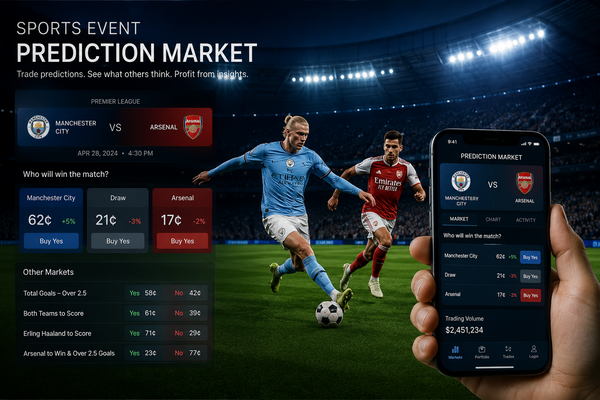
With the U.S. Commodity Futures Trading Commission (CFTC) releasing a draft regulatory framework that, in principle, allows sports event-based prediction markets, the institutionalization of the prediction market industry is expected to begin in earnest.
According to the cryptocurrency news outlet Cointelegraph, the CFTC determined that sports prediction contracts based on objectively quantifiable results, such as match wins and losses, season performance, and record achievements, can perform a price discovery function. Consequently, it is highly likely that these products will be classified as a market that does not run counter to the public interest.
On the other hand, contracts based on factors that could be manipulated or influence game operations, such as player injuries, referee decisions, or specific match situations, are expected to be excluded from eligibility. The CFTC has stated that strict restrictions are necessary for factors that could undermine market integrity and fairness.
In particular, this draft is considered to be a significant turning point for the rapidly growing prediction market industry. The sports prediction market has been the subject of ongoing regulatory controversy due to the ambiguous boundary with traditional sports betting. However, the CFTC has placed weight on the fact that prediction contracts based on game results can function as information-intensive financial products rather than simple gambling.
The CFTC has once again clarified that election prediction contracts do not constitute gambling under federal law. This interpretation is seen as lending weight to the regulatory controversy surrounding Kalshi, a leading U.S. prediction market platform, as it operates products related to presidential and congressional elections.
The market anticipates that this regulatory direction will promote the expansion of prediction markets in various fields, including not only sports but also politics, economics, interest rates, and macroeconomic indicators. In particular, with the advancement of artificial intelligence (AI) and data analysis technologies, prediction markets are being assessed as evolving beyond simple betting into information markets that leverage collective intelligence.
The industry is paying attention to the fact that U.S. regulators have begun to recognize prediction markets as a key pillar of financial market infrastructure. There is also speculation that a new digital financial ecosystem could emerge if sports prediction markets are combined with cryptocurrency and stablecoin payment infrastructure in the future.