Author: Zero Time Technology
AI-powered truth-revealing mirror, exposing the truth on the blockchain.
The decentralized and anonymous nature of cryptocurrencies, which should be a sign of technological progress, has instead become a "cloak of invisibility" for gray and black market activities—money laundering, pyramid schemes, and gambling platforms construct multi-layered, disguised financial networks on the blockchain. Traditional manual traceability is already inadequate in the face of massive transactions and multiple layers of redirection.
The rise of AI is changing this situation: it can automatically identify suspicious addresses, penetrate multiple layers of money laundering chains, and even fight against AI tools used by the black market.
In early June 2026, TesseraDao on the BNB Chain was hacked, resulting in the minting of 99 million tokens, which were then sold off and used for cross-chain money laundering. A vulnerability in the Syscoin cross-chain bridge verification system led to the minting of 5 billion unauthorized tokens. The methods used by cybercriminals are rapidly evolving, and AI governance has transformed from an "optional" issue into a "mandatory" one.
Part 01 - Four Typical Tactics in the Gray and Black Market of Cryptocurrency
The core logic of on-chain gray and black market activities remains the same despite variations. The following four categories are the key targets of AI's crackdown:
1. Online gambling fund inflow and outflow patterns
Online gambling platforms use virtual currencies (mainly USDT) for deposits, and gamblers deposit their winnings through channels such as USDT-TRC20. The platforms aggregate gambling funds through a large number of dispersed addresses, and then transfer them to money laundering address groups. The funds move in and out quickly, resulting in large sums being accumulated, thus circumventing bank risk control.
2. Money laundering and scalping model
"Money laundering" gangs use personal wallets or money laundering platforms to recruit henchmen under the guise of "part-time money collection." They split the illicit funds and transfer them into the henchmen's wallets, then transfer them layer by layer through coin mixers and cross-chain bridges, finally converting them into fiat currency to launder the money. The money chain exhibits the typical characteristics of "dispersed transfers in → concentrated transfers out → coin mixing → cashing out."
3. Staking Mining Model
Project teams, using the lure of "mining with computing power and earning passive income," require users to stake mainstream cryptocurrencies. They claim that "the more downlines you recruit, the higher your computing power, and the greater your returns." After accumulating funds in the pool, the project teams simply abscond with the staked coins. This is common during the DeFi boom, exploiting users' blind enthusiasm for "mining."
4. Wealth Management Wallet Model
Using "cross-exchange arbitrage" and "AI-powered smart wealth management" as bait, these platforms issue worthless cryptocurrencies. Users are required to register and pay a fee through a referral from an upline, with returns tied to the amount deposited and the number of referrals. The platform manipulates the price to create a false impression of profit, collapsing as soon as the funding chain breaks. These schemes are often packaged as "high-yield wealth management apps" and spread virally within social media communities.
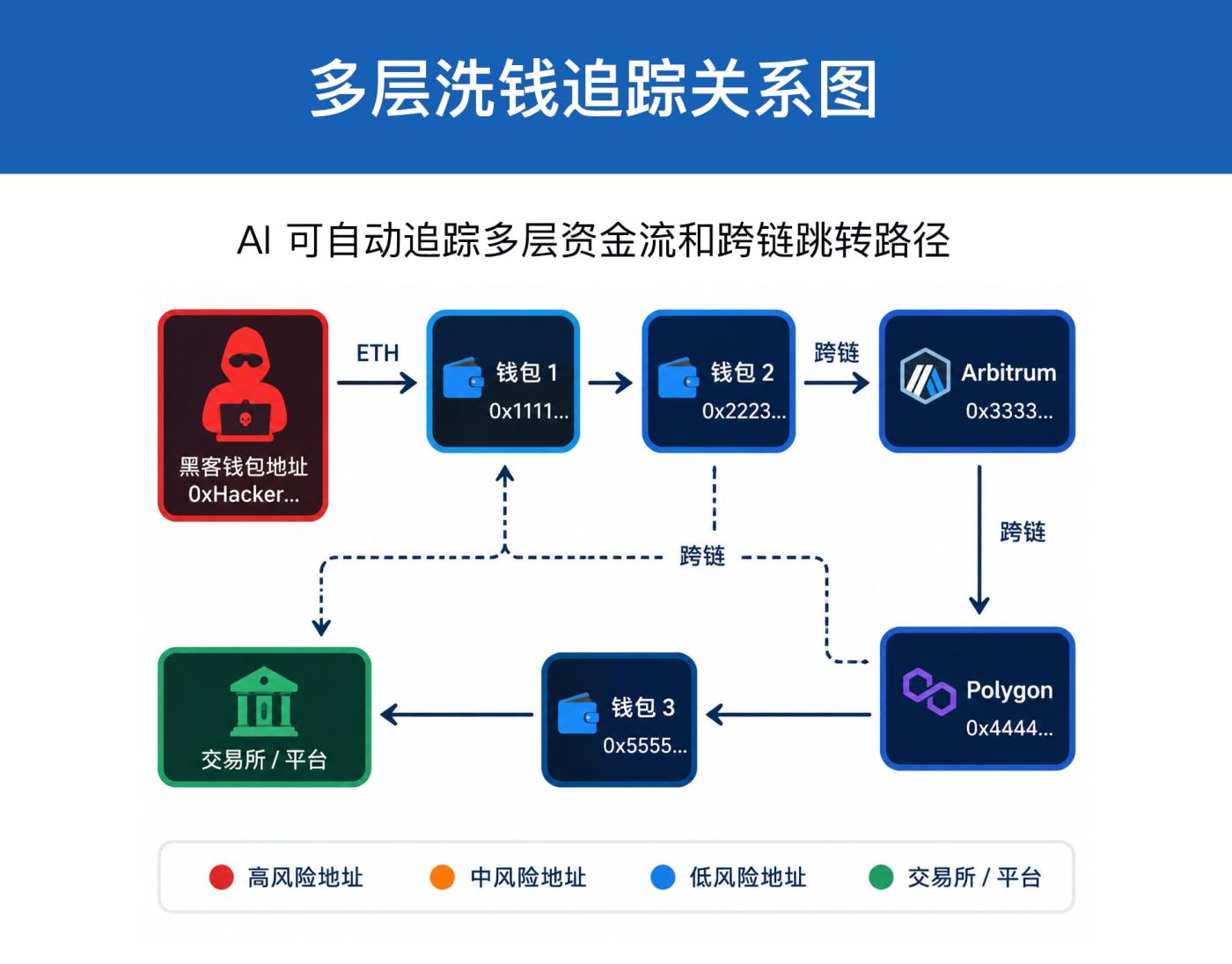
The diagram below illustrates a typical money laundering path for illicit funds, from the initial wallet to the final cash-out: multiple addresses, coin mixer obfuscation, cross-chain transfers, and exchange cash-outs, each step increasing the difficulty of tracking.
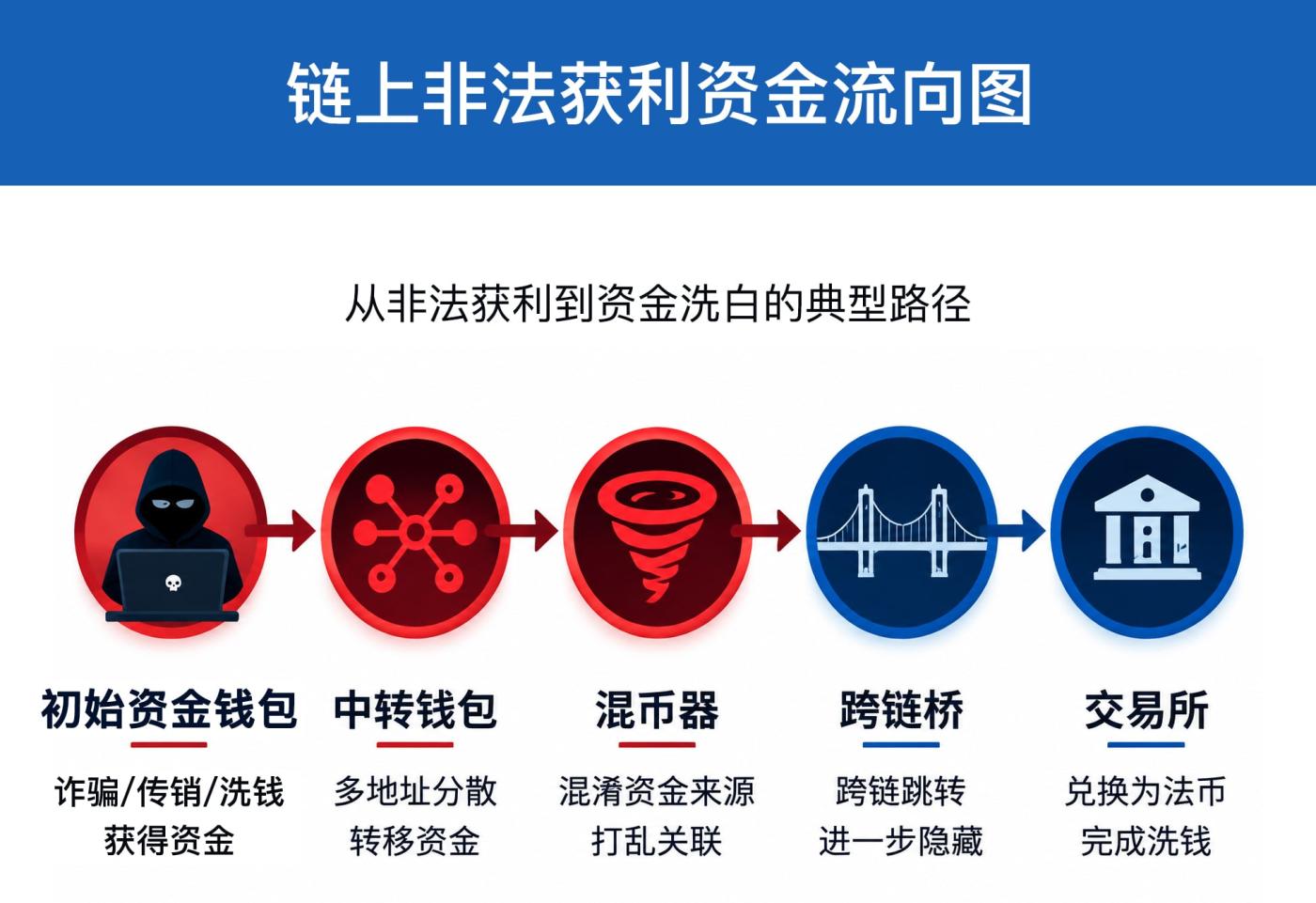
⚠️ Features: Multi-layered redirection, cross-chain decentralization, use of a coin mixer, increasing the difficulty of tracking.
Part 02 - How AI "tags" on-chain addresses, leaving no place for gray and black market activities to hide.
AI is like creating a "criminal file" for each address—it shows at a glance how much money was embezzled, where the money went, and who it was associated with.
1. AI Automatic Labeling: One-click categorization of addresses for cryptocurrency mixing, gambling, and illicit activities.
AI uses machine learning to automatically extract behavioral patterns of illicit funds (frequent interactions with mixers, access to gambling platforms, and rapid aggregation of funds after multiple layers of transfers), generating risk scores and tags for addresses. For example, an address highly associated with Dark Web addresses or frequently accessing mixers will be labeled "high-risk" by the system. When you receive a transfer from this address, your wallet will display a pop-up alert to help you avoid potential pitfalls.
2. Clustering algorithm: Enumerate all addresses of the group at once.
Cybercrime groups typically don't use just one address; instead, they use hundreds or even thousands of wallets to form "address clusters." AI clustering algorithms can automatically group these scattered addresses into the same group based on characteristics such as regular transfers, shared mixer behavior, and synchronized operation times. In a $27 million hack in early 2026, the attackers used 50 different wallets, but each wallet made a request to the mixer within the same second—this "synchronized" behavior was easily identified by AI.
3. End-to-end penetration: Even cross-chain redirects cannot hide it.
The biggest breakthrough of AI lies in "end-to-end penetration." No matter how many chains the funds cross—from Ethereum mixing to BNB Chain, and then from BNB Chain to Solana—AI can connect these isolated transactions into a complete fund flow graph. Even if the funds enter mixers such as Tornado Cash, AI can still combine features such as time sequence, amount, and gas fee patterns after the funds leave the pool to piece the "funds leaving the pool" scattered to different addresses back to the same starting point.
Part 03 - AI can track multiple layers of money laundering: How many layers can it trace to?
While manual tracking might fail at the second level, AI can track up to the sixth level or even further, provided the funds don't enter the mixer's black hole.
The diagram below illustrates how AI automatically tracks the flow of funds across chains—from Ethereum wallets to cross-chain bridges, then to Arbitrum and Polygon, ultimately identifying high-risk, medium-risk, and low-risk addresses and exchange exits.
🔍 Tracing back: Finding the source
It traces the origin of funds, determining whether they come from known scams, gambling sites, or Dark Web addresses. Starting from the target address, AI can traverse all upstream transactions in reverse, drawing a complete tree of fund origins.
🔁 Follow down: Find the destination
The system tracks where funds ultimately flow, identifying exit points (such as exchange deposit addresses) and addresses controlled by suspects. AI automatically flags all downstream forks until funds are aggregated or enter a mixer.
⚠️Technical Boundary Reminder
When funds enter mixers like Tornado Cash, the AI temporarily loses its path (resulting in a "data precipitate"). An effective approach is not to ignore the mixer, but to re-associate the funds after they leave the pool—combining time-series correlations, amount models, gas fee patterns, and other multi-dimensional data to piece together the "funds leaving the pool" scattered across different addresses back to the same starting point. Currently, the AI can achieve partial cross-mixer tracking, but complete decryption still requires off-chain intelligence support.
📊 Practical Results
In scenarios such as cross-chain analysis, coin mixing tracking, and score identification, AI has shortened the judgment cycle from weeks to hours or even minutes. However, the "last mile"—matching dozens of suspicious addresses to real people—still requires the combination of off-chain intelligence (such as exchange KYC and social media account association).
Part 04 - Cybercriminals are also using AI: forging addresses, faking transactions, how do we counter this?
Cybercriminals are also upgrading their arsenal: using AI to generate fake addresses, forge transaction records, simulate normal user behavior to evade detection, and even mass-produce phishing websites and fraudulent scripts. Faced with this "AI against AI" offensive and defensive strategy, the defense adopts a three-tiered countermeasure:
First layer: Combating counterfeit transactions
Simply looking at transaction frequency and amount is no longer enough. AI risk control systems simultaneously analyze dozens of dimensions, including transaction time distribution, gas fee payment patterns, address association depth, and the diversity of interaction protocols. Real user habits are chaotic and inefficient, making the "perfect" transactions fabricated by black market operators a more reliable identifying feature.
Second layer: Anti-cloning wallets
At the user level: Develop the habit of "not blindly trusting search ads and only obtaining links from official channels." At the platform level: Security agencies have established a multi-link phishing website blacklist database, and mainstream wallets and browser plugins can block malicious domains in real time. In the fake TronLink attack in May 2026, the AI system detected anomalies through code similarity analysis on the day of its release.
Third layer: Anti-cloning wallets
Many security teams are starting to use AI to generate simulated attacks, proactively probing blind spots in their own systems, and then optimizing their models accordingly. The speed of vulnerability discovery is increasing exponentially, and the "window of opportunity" for cybercriminals to bypass vulnerabilities is shrinking dramatically.
Part 05 - How can a regular user check if an address has a "black history"?
You don't need to be a blockchain detective; you can quickly determine this in the following steps:
✅ Use a blockchain explorer to search for tags
If you enter an address in Etherscan or Tronscan and see red markers such as "Phissing" or "High Risk," or if it shows frequent interaction with coin mixers or gambling platforms, refuse the transfer immediately.
✅ Address Health Check Tool
Use Revoke.cash to view the address's authorization history—if it has authorized numerous unknown contracts, it may be a phishing address. DeBank's "Address Analysis" feature can generate a risk report, indicating the source and destination of funds.
✅ Self-check of behavioral characteristics
A newly created address that frequently makes large inflows and outflows, uses the same gas fee payment method (always using a fixed rate), concentrates its transactions in the early morning, and frequently interacts with large-scale coin mixers—even without clear labels, should be viewed with caution.
The key principle: Before receiving unsolicited transfers or participating in unfamiliar projects, take 10 seconds to check the recipient's address. The more you verify, the less likely you are to fall into a trap.
Conclusion
The essence of the cryptocurrency gray and black market is "using anonymity as a pretext for money laundering." AI is breaking down the information asymmetry upon which this black market thrives—it uses AI to forge documents, and we use AI to see through the disguise. In this "AI vs. AI" battle, the ultimate goal is to protect the assets of every ordinary investor.
Ordinary users only need to remember: do not blindly believe in high returns, do not authorize others indiscriminately, and check the address risk before transferring money.