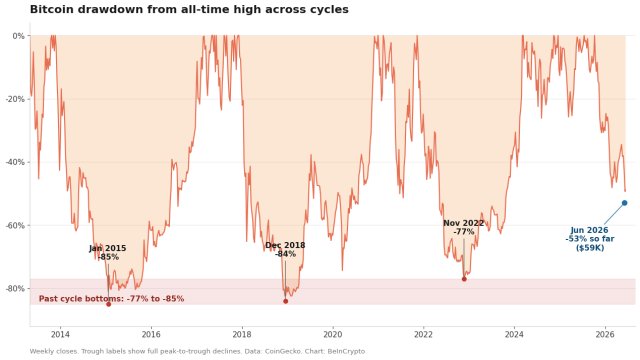
According to Mars Finance, on June 13th, Galaxy Research's latest research indicates that due to the lack of clear speculative signs at the top of this Bitcoin cycle, the BTC cycle low may not fall as low as in previous bear markets. The potential bottom range could be between $62,000 and the network realization price of $53,600. Alex Thorn, Head of Research at Galaxy, analyzed previous BTC cycle tops and bottoms and stated that the four-year Bitcoin cycle is still relatively close to historical patterns. He pointed out that the decline from peak to trough in each BTC cycle is continuously narrowing; earlier cycles saw declines of 85% and 84% respectively, 77% in 2022, and 51% in 2026. Thorn believes that the BTC top in October 2025 will differ from previous cycle tops. Of the 11 traditional top indicators, only 2 were triggered; the widely followed Pi Cycle Top indicator failed to trigger for the first time. BTC's MVRV ratio peaked at 2.29, while previous cycle peaks ranged from 2.93 to 5.91. However, the report also points out that several key bottoming signals have yet to appear. Currently, only 4 out of 13 bottoming indicators have been triggered, with most stronger signals yet to emerge. From a time perspective, previous cyclical bottoms typically occurred approximately 12 to 13 months after market tops, while the current pullback has lasted about 8 months. Thorn states that based on the current cost benchmark of $53,600, Galaxy estimates a base scenario bottom range of $40,000 to $46,000; a deeper "shakeout scenario" points to $30,000 to $37,000; and if the decline is shallower, it may hold around $51,000 to $54,000. CryptoQuant data shows that BTC is currently in a valuation zone historically correlated with major bear market lows. BTC recently traded near $59,000, approximately 9% higher than the $53,600 realized price. On the demand side, CryptoQuant reported that speculative futures demand and apparent spot demand combined fell by 652,000 BTC weekly, the largest drop since January 2022. The firm's one-year demand indicator has also turned negative, indicating that the number of BTC buyers is lower than a year ago.
Analysis: The lack of clear speculative signs at the current Bitcoin top may cause the cycle bottom to be higher than previous bear markets.
This article is machine translated
Show original
Sector:

Source
Disclaimer: The content above is only the author's opinion which does not represent any position of Followin, and is not intended as, and shall not be understood or construed as, investment advice from Followin.
Like
Add to Favorites
Comments
Share
Relevant content