Humanoid robots have finally come closest to the home environment, but they are not doing the housework that people most want to do.
Within 10 days of its launch, the U1 humanoid robot, which focuses on emotional companionship, garnered over 3,800 pre-orders for UBTECH, with total deposits exceeding 10 million yuan. For UBTECH, which only sold 1,079 humanoid robots last year, this attempt can be considered a "small breakthrough."
Dressed in a tailored suit, capable of makeup application, equipped with a "nurturing" emotional model, supporting multi-dimensional appearance customization, launching IP collaborations, and limited to adult purchases and use—these features have quickly propelled this male-and-female humanoid robot into the public eye, also hinting at another customer group: young consumers in the fan economy and "anime/manga" culture who are willing to pay for a "nurturing" character design. One "anime/manga" enthusiast told a reporter from the *Daily Economic News* (hereinafter referred to as "Daily Economic News reporter"), "If the price is controlled at around 100,000 yuan and it can collaborate with IPs such as otaku games, it will definitely be a 'sold-out' product."
On the other hand, the unique style has also raised many concerns, such as the possibility that supporting customization may lead to a copyright gray area of "highly similar to real people"; the design of robots as emotional companions may lead to unhealthy emotional dependence among users, further weakening real interpersonal interactions, etc.
Industry insiders believe the U1 series marks a leap for humanoid robots from technology demos to consumer products, but it still faces the triple challenge of balancing supply chain management, the naturalness of emotional algorithms, and ethical controversies. Production ramp-up, yield control, and delivery consistency also present challenges. In the short term, the U1 series is more suitable as a high-end emotional consumer product than a universal solution.
Within 10 days of its launch, deposits exceeded 10 million yuan.
The actual conversion rate remains questionable.
In late May, Zhou Jian, founder of UBTECH, launched his own video account, and his first post was an official announcement of the consumer-grade humanoid robot brand, U-World. Over the next 20 days, Zhou Jian and UBTECH released more information about their first full-size super-bionic humanoid robot, the U1 series (hereinafter referred to as "U1"), in a piecemeal fashion, and started online pre-sales.
A reporter from National Business Daily saw at the "You World JD.com Self-Operated Flagship Store" that two types of super-bionic humanoid robots (separate male and female models) are now available for pre-order, with a deposit of 3,000 yuan per unit (refundable). They are expected to be launched on June 30. The price has not yet been announced, and the balance payment for the order will begin at midnight on July 16.
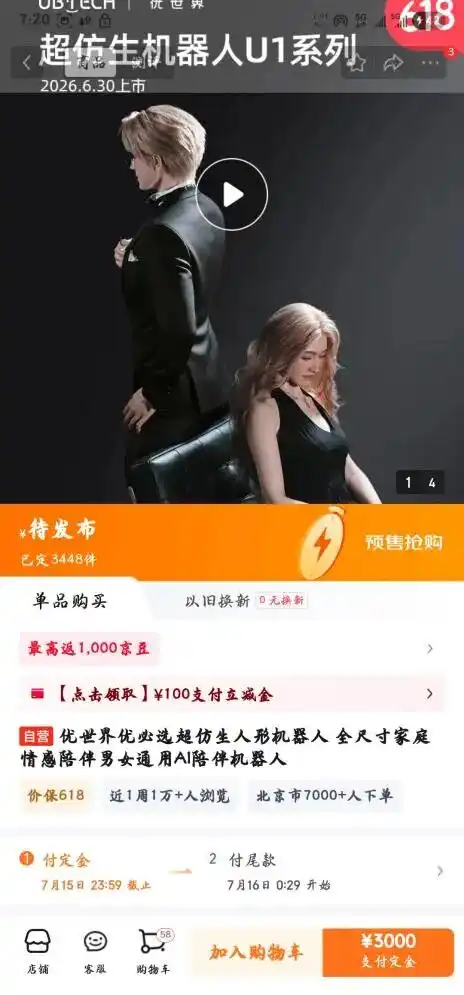
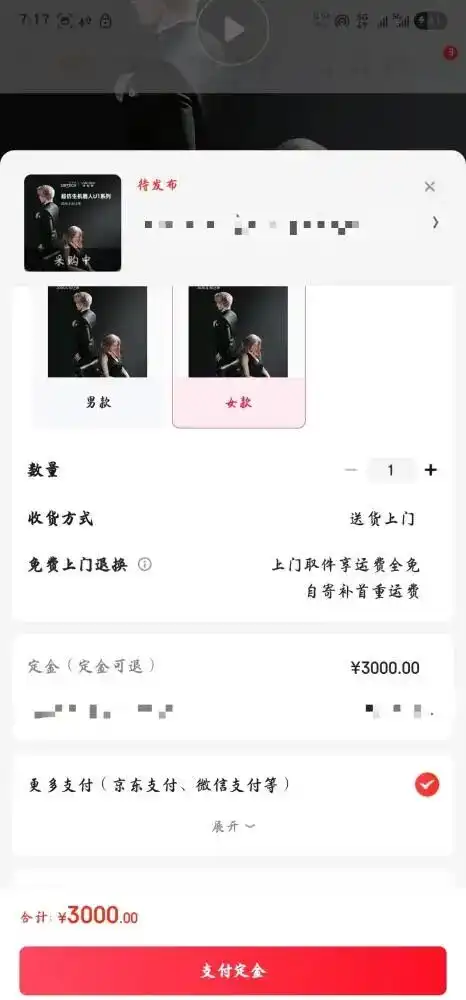
Image source: Screenshot from JD.com
Even before the price has been announced, according to statistics from e-commerce platforms, as of press time (8 pm on June 12), the U1 had received nearly 4,000 pre-orders. At this time, the U1 series had only been open for pre-sales for 10 days (pre-sales started on June 2). Based on this calculation, UBTECH has already received more than 10 million yuan in deposits alone.
According to the product descriptions on e-commerce platforms, the U1 series has two models, one for men and one for women. The men's model is 183 cm tall and weighs 42 kg, while the women's model is 168 cm tall and weighs 35.2 kg. Both models support Wi-Fi connectivity, have a battery life of 2 to 4 hours on a single charge, and do not have "3C" certification. They feature 88 highly free-motion joints, a large "nurturing" emotional model, local encrypted storage memory, support for multi-dimensional appearance customization, and have already started IP collaborations.
Compared to their specifications, the two robots have a more eye-catching visual appeal. Among the many videos posted by Zhou Jian, the one with the most shares, comments, and likes is a live-action video.
In the video, the male robot is dressed in a fitted suit and wearing gold-rimmed glasses; the female robot is having her makeup applied, including eyeshadow, blush, and highlighter. Both robots can blink and turn their heads, creating a highly immersive atmosphere. Terms like "robot male model" and "cyber girlfriend" have begun to appear on social media.
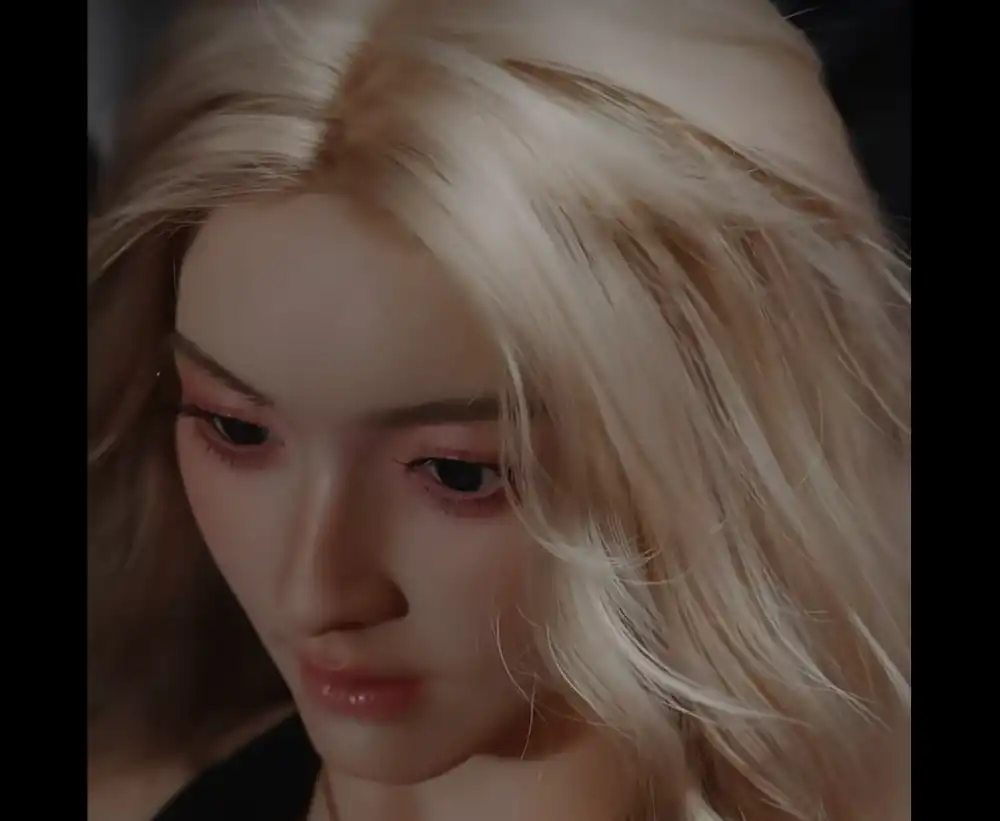
Image source: Screenshot from WeChat video account
However, many netizens also raised concerns, such as the robot's slightly slow and stiff reactions; limited intelligence; and unnatural makeup that made it look too much like a cartoon character.
It is worth noting that most bionic robots on the market at present either only have a head or cannot move. Whether the U1 series can walk on two legs and grasp objects are key questions that many consumers are asking.
As of press time, UBTECH has not yet demonstrated the U1's walking and hand abilities in its publicly available information. When contacted by a reporter from National Business Daily, a representative from UBTECH stated that the project is highly confidential and more details will be released later.
Besides netizens, the capital market also reacted. The day after the order volume exceeded 2,000 units (June 8), UBTECH's stock price rose by more than 6%. The stock trading platform Tonghuashun explained this abnormal stock price movement as "the booming orders for androids + the implementation of industrial cooperation".
According to Chen Songqing, an industry observer and founder of Guangzhou Zhiwen Technology Co., Ltd., the U1's popularity stems not from its leading technical specifications, but from its pioneering role in transforming a "humanoid robot" into a complete emotional consumer product, turning the robot from a "technology exhibit" into a "lifestyle proposal." Consumers are not buying a product with certainty, but rather an "option" for their future lifestyle. Furthermore, the Cai Ming bionic robot featured on the Spring Festival Gala has already educated the market; "UBTECH's timing was perfect," Chen Songqing stated.
However, Chen Songqing believes that the nearly 4,000 pre-orders represent a structural production capacity challenge for UBTECH. After all, deposits are refundable, and the actual conversion rate remains questionable. The U1 involves 88 degrees of freedom, and its skin material, makeup customization, and supply chain complexity are more challenging than those of the Walker series used in industrial settings. Production ramp-up, yield control, and delivery consistency are all challenges. More importantly, if the initial delivery experience is poor, negative word-of-mouth on social media will amplify exponentially. "Therefore, UBTECH's most pressing issue right now is not whether it can manufacture the units, but whether it can get the first batch of users to share their experiences," Chen Songqing stated.
Wang Wentao, a member of the Financial and Economic Committee of the China National Democratic Construction Association and director of the Higher Education Research Office of the Development Planning Department of Chongqing University of Technology, stated frankly that U1 represents a leap from a technology demo to a consumer product for humanoid robots, facing triple challenges in supply chain management, the naturalness of emotional algorithms, and balancing ethical controversies. In the short term, it is more suitable as a high-end emotional consumer product than a universal solution.
Is the target audience high-net-worth individuals who engage in emotional consumption?
With nearly 4,000 pre-orders, what kind of users are they coming from?
Zhan Junhao, founder of Fujian Huace Brand Positioning Consulting and a strategic positioning expert, believes that U1 focuses on emotional companionship, and its core customer base should be the large number of single young people living alone and urban lonely people, while also covering a small number of people who are curious about novelty and technology enthusiasts.
Chen Songqing's target customer group is more focused. He believes that U1's primary customer base is not tech geeks, but high-net-worth individuals who engage in emotional consumption. Judging from its positioning as "adults only" and "emotional companionship," the target users are likely to be middle-class individuals aged 35 to 50 with certain economic strength, living alone or in empty nests, as well as some consumers with special companionship needs.
In addition, IP collaborations and customized appearances suggest another customer group: young consumers in the fan economy and "anime" culture who are willing to pay for a "developmental" character. "This product is not essentially selling a tool, but rather 'emotional compensation,' filling the gaps in interpersonal relationships in modern society," Chen Songqing said.
However, creating a successful "idol trainee" series is not so easy.
According to Chen Songqing, most ordinary large-scale models are in a "stateless" mode, where each dialogue is a completely new interaction. The core difference of the "developmental" emotional large-scale model lies in its ability to retain long-term memory and evolve personality. It relies on local encrypted storage to continuously record and learn user preferences and emotional patterns, forming a unique "personality profile." Essentially, it is similar to a continuously running RAG (Retrieval Augmentation, one of the current cutting-edge technologies in large-scale models) system, with added emotional feedback loops.
“Currently, Lobo Intelligent’s ‘Fuzai’ also focuses on the ‘raising’ concept in the market. But that’s a desktop toy. UBTECH has brought this concept to a full-size humanoid robot, which is completely different in terms of technical difficulty and scenario depth. However, the ‘raising’ concept requires a lot of real interactive data, and it remains to be seen whether UBTECH has enough data closed-loop capabilities,” Chen Songqing said.
As predicted by industry insiders, Xiao Shi (pseudonym), a veteran "anime and manga" enthusiast, was very interested in this product.
"If we could create a physical AI android for otome games (games specifically developed for female players, focusing on a female perspective and emphasizing virtual emotional experiences), it would be a huge hit. It's difficult to bring 2D game characters to life, but 'Love and Deep Space' is a 3D modeling game. If we could directly create an android, it would definitely be a bestseller," Xiao Shi told the reporter from National Business Daily.
However, Xiao Shi also mentioned that price is a crucial limiting factor. If it's relatively "affordable," many players will be willing to pay. But if it reaches the level of tens or hundreds of thousands of yuan, it will be difficult to expand its influence among such users. "Actually, I think if it could be priced around 100,000 yuan per unit, but not above 150,000 yuan, it might sell better," Xiao Shi said.

Adults only
Industry insiders warn of potential copyright and ethical risks.
It's important to note that Xiaoshi's enthusiasm for U1 is predicated on her having a desired face, or rather, a defined IP image. However, whether such a popular IP can be collaborated on remains to be seen. Xiaoshi has learned that some game companies have already begun developing their own androids.
If we can't collaborate with well-known IPs, will some players request to customize similar appearances?
"I feel that multi-dimensional appearance customization involves integrating various otome game IPs, but it requires negotiating copyright issues with the game companies," Xiao Shi told the reporter from National Business Daily. She added that similar products existed in the industry before, such as custom-made BJD dolls (a general term for various exquisitely crafted, movable humanoid dolls with ball joints). Players customize details such as makeup and limbs to create a specific image they desire, including many anime characters or celebrities, but copyright issues are rare.
"The main issue with dolls isn't profit-making. For example, when ordering wigs, you order materials and then find a 'hair stylist' to make them look the dolls' as desired, or a 'makeup artist' to paint them to the dolls' liking. Since it doesn't involve large-scale profit, there won't be such serious copyright infringement issues," Xiao Shi said.
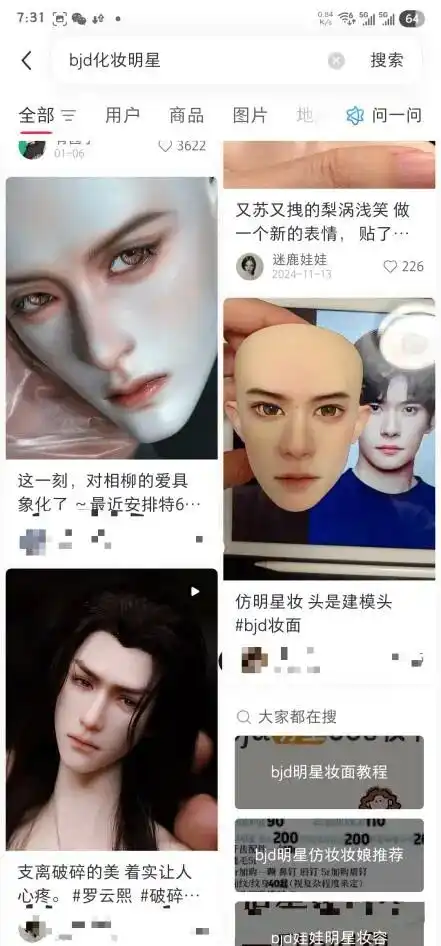
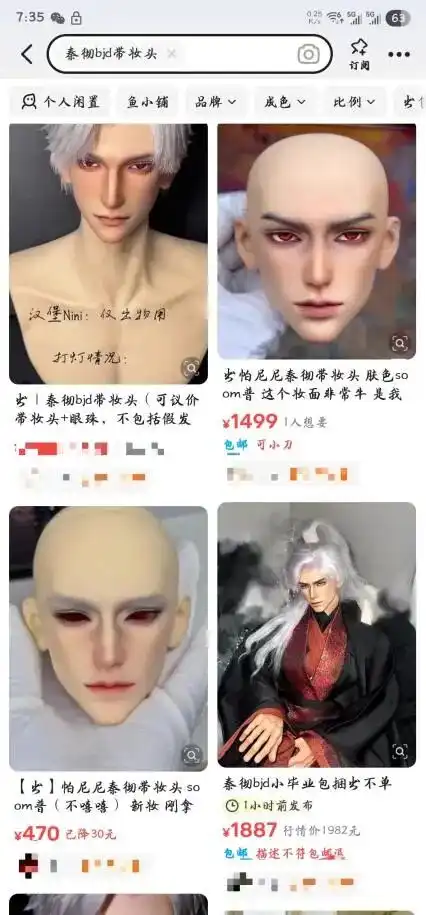
In response, Chen Songqing stated frankly that currently, supporting custom designs does indeed carry copyright risks, and these risks are two-way. If a user requests a custom design based on the image of a celebrity, the manufacturer must bear the obligation to review the user's portrait rights. Furthermore, highly realistic human-like designs can create a "gray area" where designs are not complete replicas but only similar in expression and appearance. He suggested that companies establish a pre-screening mechanism to limit custom designs to original IPs or user-created images, thus avoiding involvement in copyright disputes.
Since it has not yet been officially launched, the only known purchase rule for UBTECH is that it is only for adults to purchase and use.
Besides copyright, the issues hotly debated in the industry also focus on the ethical level.
Zhan Junhao stated that an extremely realistic appearance can easily cause discomfort and fear among the public, and may also lead to problems such as weakened interpersonal relationships, excessive emotional dependence, and privacy data leaks. The industry currently lacks corresponding ethical norms and regulatory standards, and the controversy may persist for a long time. Chen Songqing also mentioned that U1 is currently in a "bottom" range of being highly human-like but not yet perfect; if facial movements or expressions are not natural enough, it may trigger users' instinctive rejection.
"The deeper problem is that when robots are positioned as emotional companions, they are actually replacing the most private social relationships of humans, which may cause two major problems: first, users develop unhealthy emotional dependence on machines; second, it further weakens interpersonal interactions in reality." In response to these problems, Chen Songqing believes that robot manufacturers need to build "ethical safeguards," such as clearly informing users that the product is an AI device, providing reasonable usage time suggestions, and avoiding overly anthropomorphic late-night interaction scenarios.
"Technology can advance at breakneck speed, but social and psychological preparation takes time," Chen Songqing said.
This article is from the WeChat official account: Daily Economic News , authored by a reporter from Daily Economic News, originally titled: "Robot Companions Are Here! 3,800 Units Pre-sold in 10 Days, Men's Model Wears a Slim-Fit Suit, Women's Model Can Apply Makeup, Equipped with a 'Developmental' Emotional Model, Adults Only! Industry Insiders: Ethical Risks Need to Be Noted."