


Table of Contents
ToggleShouting at a row of server racks, and the monitoring curve on the screen suddenly spikes upwards in the same second? According to a report by HKEPC today, a video of a real data center experiment from December 2008, titled "Shouting in the Datacenter," has recently gone viral again on social media, accumulating over 5.3 million views.
The video's protagonist is Brendan Gregg, formerly of Sun Microsystems and now an engineer at OpenAI . The video was uploaded by his colleague, Bryan Cantrill; even Gregg himself admitted in an interview that he had almost forgotten about it, only remembering it after the old video resurfaced. This less than two-minute clip has become almost mythical teaching material in the hardware engineering community.
What happened during that roar in 2008?
The experimental site was a JBOD (simply put, a storage device consisting of a bunch of hard drives connected together) rack.
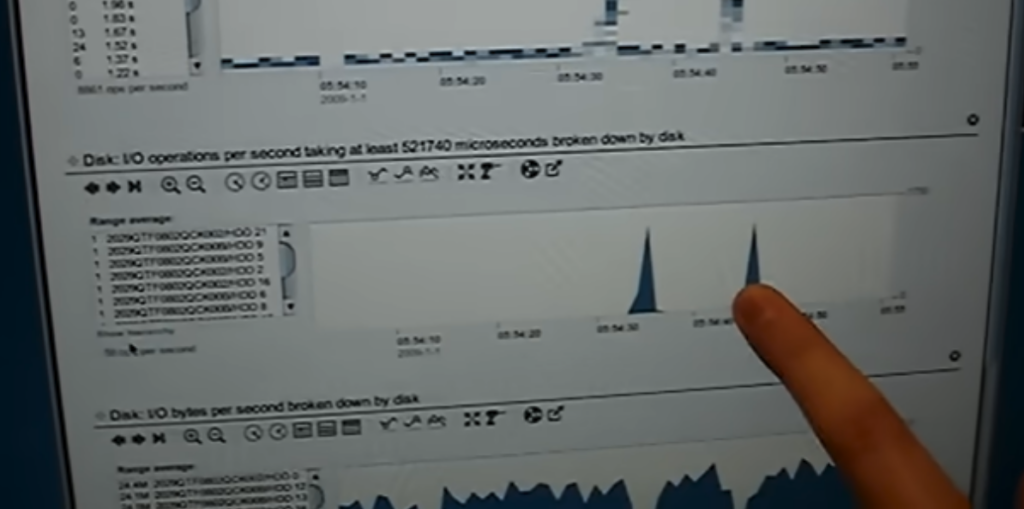
In the video, Gregg approaches the rack and yells at the dense array of hard disk drives (HDDs). At the same time, the analysis tool developed by the SunFishworks team monitors the internal latency of each hard drive in real time (simply put, the waiting time between the hard drive receiving the instruction and actually starting to read or write data).
The results were crystal clear: when Gregg roared, the latency figures for the HDDs affected by the sound waves immediately spiked, and their read/write speeds plummeted; when he stopped, the curves slowly returned to normal. The monitoring screen precisely indicated which hard drives were affected and to what extent.
How do sound waves cause a magnetic head to "get lost"?
Why is this? The inside of an HDD is a miniature world of unbelievable precision: platters made of aluminum, copper, or even ceramic rotate at thousands of revolutions per minute, while the read/write heads hover and move at a height of only a few nanometers above the platter surface. The fault tolerance of the entire system is practically zero when measured on a human scale.
When a person shouts loudly near the rack, the sound waves travel through the air to the hard drive casing, then through the casing structure into the interior, causing a tiny relative displacement between the disk and the read/write head. The read/write head must be precisely aligned with the data tracks on the disk during reading and writing; any unexpected, minute misalignment will trigger a repositioning process, resulting in increased read/write latency and decreased throughput.
While data center-grade HDDs are equipped with shock-resistant designs and offer some resistance to ambient background noise (air conditioning, fans), sudden high-intensity sound pressure levels can still exceed the protection threshold. This is not a design flaw, but rather a structural limitation of mechanically rotating discs in the face of physical laws: discs are susceptible to vibration, and sound is vibration.
Another, more widely known and even more absurd case brought this phenomenon to the forefront of a formal cybersecurity vulnerability database for the first time. According to Microsoft engineers, a section of Janet Jackson's 1989 single "Rhythm Nation" had a natural resonant frequency that coincided with the mechanical resonant frequency of the then-mainstream 5400 RPM notebook computer HDD.
Playing this song near some laptops could even cause hard drive crashes and system shutdowns. Not only on the same computer, but also on another laptop placed nearby could be affected. This case was eventually officially recorded as security vulnerability CVE-2022-38392 , becoming a rare record in software and hardware security history of a vulnerability caused by a popular song.
17 Years Later: AI Data Centers and Unfinished Issues of Physical Laws
The current AI wave is driving the expansion of data centers at an unprecedented pace, with demands for computing density, storage density, and stability increasing across the board.
SSDs (hard drives with no rotating parts that store data in flash memory) have seen a significant increase in penetration in modern data centers and consumer markets. They offer transfer speeds an order of magnitude faster than mechanical HDDs and are almost completely immune to sound waves, vibrations, and physical shocks: with no platters and no heads, there is naturally no problem of heads getting lost.
However, mechanical HDDs remain widely deployed in cold storage scenarios due to their cost and unit capacity advantages. The raw datasets required for AI training often reach tens or hundreds of terabytes in size, and a significant proportion of these datasets still reside in mechanical disk arrays. This means that the idea that "sound waves slow down HDDs" is not merely a historical anecdote, but a potential risk to existing infrastructure.
This 17-year-old video has recently gone viral again, and the reason may be this: no matter how modern the data center is, it still operates on the physical laws that can be disrupted by a shout.
 Related reports

