


Bitcoin (BTC) has just recorded its second major mining difficulty drop of 2026, falling 10.09% at Block 953,568.
According to Galaxy Research, this is the 11th downward correction in the history of the Bitcoin network.
Why is Bitcoin mining difficulty decreasing?
The mining difficulty has decreased from 138.9 trillion to 124.9 trillion. This is primarily due to the sharp drop in Bitcoin prices in June, which squeezed Miners ' profits and forced many Mining Rig to shut down, reducing the hashrate.
Follow us on X to get the latest news as it happens.
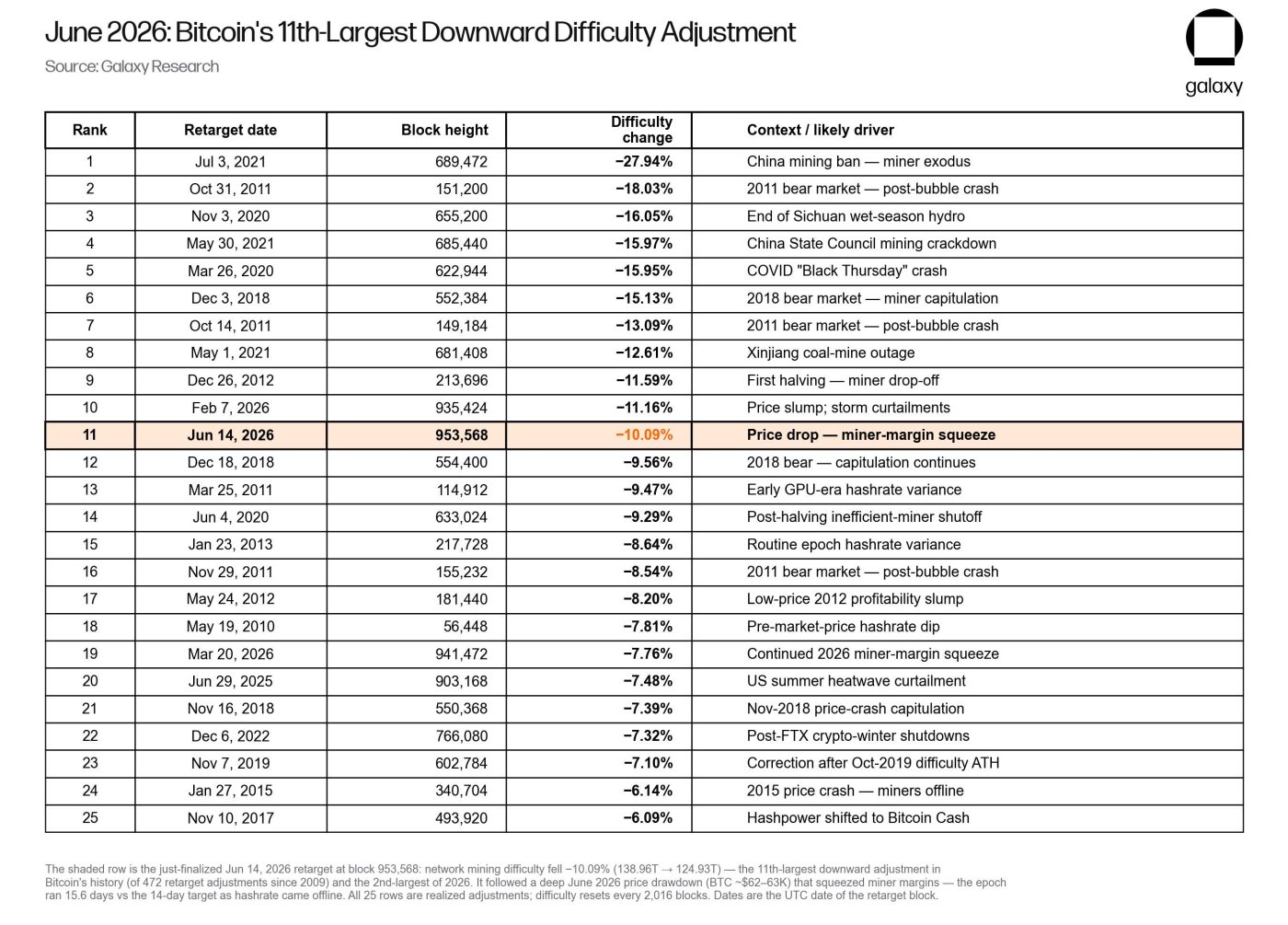 Adjusting Bitcoin mining difficulty. Source: X/Galaxy Research
Bitcoin automatically adjusts its difficulty every 2,016 Block to ensure that the Block mining time remains close to 10 minutes. When Miners stop working, the difficulty decreases to rebalance the network.
This marks the third significant downward correction in 2026, following two sharp drops of 11.16% in February and 7.76% in March. The latest decline comes amidst a continuing downward trend in Bitcoin prices.
“The approximately 15% drop in Bitcoin price during June has resulted in increasingly thin profit margins for Miners . This cycle lasted 15.6 days, longer than the target of 14 days due to the drop in hashrate,” Galaxy stated.
This month, Bitcoin experienced a sharp price drop, at one point falling below $60,000 last week before recovering above $64,000 on expectations of a deal between the US and Iran .
The sell-off caused hashprice – a measure of daily bitcoin mining revenue – to fall below $30 per petahash per second.
“This threshold is crucial for Miners because it pushes many mining pools close to or below the overall break- Capital point before deducting management costs, debt repayment, or expansion investments. While newer rigs can still be profitable when hash prices are low, older rigs or those with high electricity costs often have to shut down when revenue declines,” TheEnergyMag commented .
Bitcoin Miners are scaling back operations and shifting towards AI.
Part of the reason for the decline is economic, and another part is that many Miners have shifted their power output to tasks related to artificial intelligence (AI) and high-performance computing (HPC).
"Many large mining pools have temporarily shut down some of their rigs or slowed down expansion to upgrade infrastructure for AI/HPC contracts. This has caused Bitcoin hashrate to decrease even though electricity is still being used," the blog added.
Meanwhile, in Texas, the situation is also more volatile as the four-coincident-peak (4CP) season begins in June. Large ERCOT customers avoid using electricity during the four peak summer hours, as these times determine the transmission costs for the following year.
“For Bitcoin Miners , the 4CP mechanism provides a strong incentive to temporarily halt operations during peak hours each month… This can cause a temporary and significant drop in mining load, especially since Texas remains one of the largest Bitcoin mining regions in North America. The recent rebound in hashrate suggests that the load reduction in early June was only temporary due to 4CP, not a permanent shutdown,” commented TheEnergyMag.
The decrease in mining difficulty is positive news for Miners who remain active . Over the next two weeks, mining each Block will consume less computing power, meaning those who remain will receive more Bitcoin per unit of their hashrate.
Subscribe to our YouTube channel to XEM experts and journalists Chia in-depth analysis.


