


Michael Saylor has just introduced a new index of MicroStrategy's (MSTR) Bitcoin Treasury (BTC) holdings, amid widespread criticism and concerns about whether the company can continue to increase its borrowing without impacting common shareholders.
This index was released just as MSTR stock was plummeting. Currently, the stock price is lower than the value of the Bitcoin the company holds after deducting debt and concessional obligations. Saylor considers this an innovation, while critics argue it's just repetition of old practices.
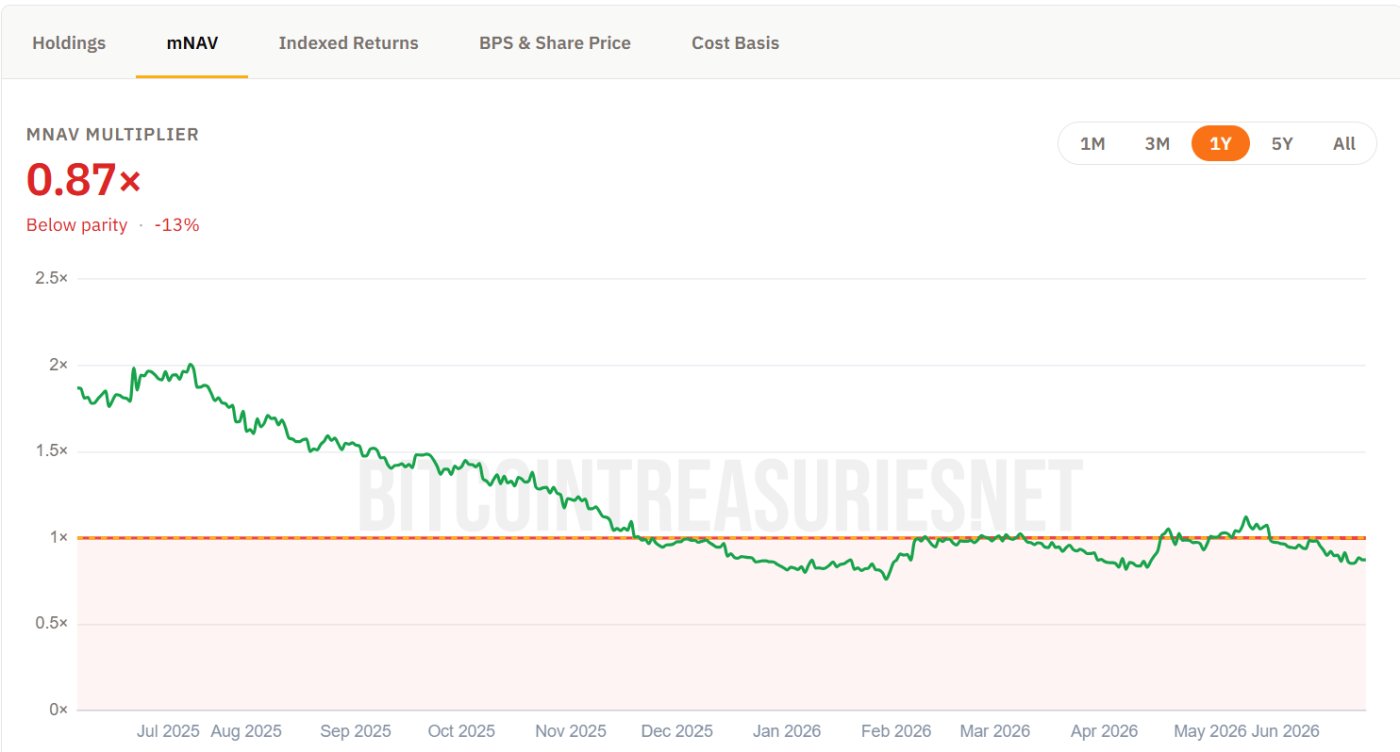 MSTR shares are trading below the company's Bitcoin value when deducting its principal and outstanding debt (mNAV). Source: Bitcoin Treasuries
What do Saylor's new metrics measure?
MicroStrategy now reports four KPIs to regulators, including:
- Bitcoin per share
- BTC yield
- BTC profit, and
- Profit from BTC is calculated in USD.
Starting in January 2026, the company will also change the way these metrics are calculated for interim reporting periods.
Michael Saylor's latest post goes even further. He adds the CEBE BPS index, which measures the number of Bitcoins per share after accounting for priority obligations, and a new concept called Amplification, which is the difference between two measurements created by financial leverage.
“Not all debt is created equal. Short-term debt with high costs can turn ‘amplification’ into risk and poor performance. Conversely, long-term debt with low costs can benefit common shareholders. If BTC ARR exceeds the cost of Capital, a well- Capital Bitcoin treasury company could outperform BTC itself,” the MicroStrategy president explained .
These terms have not yet appeared in the company's official reports.
MicroStrategy has acquired 845,256 BTC through a purchase program that began in August 2020, setting a record for Bitcoin holdings currently worth approximately $54 billion.
The company's report indicates an Medium purchase price of nearly $75,700 and a total Capital basis of over $61 billion, resulting in the portfolio currently showing losses as the spot price of Bitcoin hovers around $64,000.
In the first quarter, unrealized losses of $14.5 billion resulted in a net loss of $12.5 billion for MSTR, but Michael Saylor remained enthusiastic about continuing to buy.
Still adding dots. pic.twitter.com/MXVOYPUnYb
— Michael Saylor (@saylor) June 14, 2026
Critics argue that MSTR is changing the standard, while supporters see it as innovative.
Analyst Nic Pucrin warns that MSTR stock is currently trading at around 84% of the value of the Bitcoin the company holds, and any current move would only worsen the situation.
Issuing additional shares would reduce the amount of Bitcoin per share, while issuing preferred stock would increase obligations to over $13.5 billion, and selling Bitcoin could lead to market panic. He believes there is no easy way out for the company.
"I am genuinely concerned about MicroStrategy's current position," the head of Coin Bureau stated .
Quinn Thompson also agreed with that view. He pointed out that MSTR common stock is currently trading at only 0.8 times its net worth, after deducting $8.2 billion in debt and preferred stock with interest rates as high as 11.5%.
He argued that the company was selling shares at 80 cents to buy "1-dollar bills." Meanwhile, former banker Pius Sprenger questioned the true meaning of these new indices.
I find it increasingly worried that Saylor keeps inventing made-up metrics.It reminds me of my days in banking. Whenever the firm gets into trouble, management suddenly comes up with a whole new set of KPIs. https://t.co/ZqxKVegzY3
— Pius the Banker (@PiusSprenger) June 14, 2026
Investor Adrian argues that these KPIs primarily track Capital efficiency rather than reflecting actual value. MSTR itself acknowledges in its reports that these metrics are not used to assess value, and that ordinary shareholders will not have direct ownership of any of the company's Bitcoin.
This admission highlights the risks for MSTR shareholders , especially after MicroStrategy sold Bitcoin for the first time since 2022.
The final outcome will likely depend on Bitcoin's price movements. If the price rises sharply, Saylor's leveraged Bitcoin strategy will prove effective.
Conversely, if the market moves sideways, the priority obligations will remain in place. Which scenario will occur first remains an open question.


