Editor's Note: This article uses SpaceX as a starting point to unfold a grand narrative about the industrialization of space. Its core question is how a company can, through organizational capabilities, technological roadmaps, and capital narratives, break down a long-term mission with extremely high uncertainty into an executable industrial system.
What makes SpaceX special is that it integrates rocket reuse, satellite internet, AI computing power, robotics, semiconductor manufacturing, and lunar industrialization into a single roadmap, forming a cross-industry, cross-cycle infrastructure layout.
The author's key assessment is that SpaceX's long-term value depends on its ability to continuously reduce the marginal cost of accessing space and to push space out of scientific research and defense scenarios into new industrial spaces such as energy, computing power, and manufacturing.
The article begins by mentioning Musk's extreme compensation plan at SpaceX: he would only receive a real paycheck if the company's valuation reached $7.5 trillion, a permanent city of one million people was established on Mars, or a data center consuming 100 terawatts of power was operated in space. This design itself reveals SpaceX's end-game narrative: launching satellites more cheaply is just the beginning; the real goal is to push energy, computing power, manufacturing, and human habitation beyond Earth.
Currently, AI infrastructure is facing bottlenecks in electricity, land, approvals, and supply chains, and the marginal cost of traditional ground-based expansion models is rising. If computing power expansion begins to seek energy and deployment space beyond Earth, the boundaries between aerospace companies, cloud providers, energy companies, and semiconductor manufacturers will be redefined.
Within this framework, the key question for SpaceX may have shifted from how many rockets it has launched today to whether it can upgrade "access to space" into an industrial platform that carries energy, computing power, manufacturing, and the expansion of civilization.
Of course, this narrative relies heavily on Musk's judgment of technological progress, cost curves, and organizational execution, and also carries a clear investor's perspective. Readers are better off viewing it as a projection of the future industrial structure: its value lies in understanding three originally separate issues—space, AI, and energy—within the same cost curve, and also suggests where the next generation of industrial platforms might emerge.
The following is the original text:
Elon Musk's compensation package at SpaceX is designed around two goals. The first bonus will be unlocked when the company's valuation reaches $7.5 trillion and a permanent human colony of at least one million people is established on Mars. The second bonus will be unlocked when SpaceX operates data centers in space that consume at least 100 terawatts of electricity—more than 1,000 times the total power consumption of all data centers on Earth. If neither goal is achieved, Musk will receive nothing beyond the $54,080 annual salary he has received since 2019.
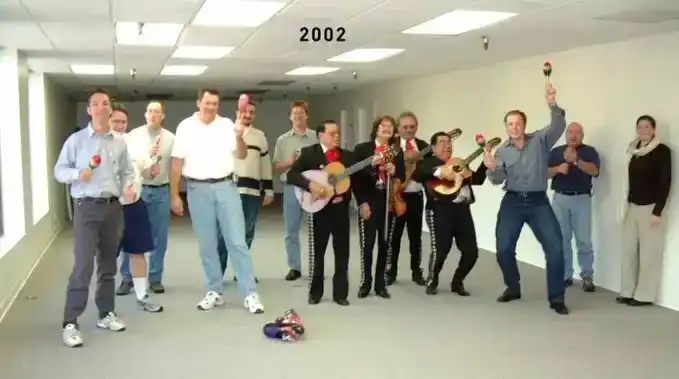
The board members who signed this compensation package have witnessed Musk make one seemingly impossible prediction after another for SpaceX over the past two decades, only to have them come true one by one. He once said that SpaceX would send humans into orbit, something no private company had ever done before; today, SpaceX routinely transports NASA astronauts. He once said that SpaceX would make orbital-class rockets land and be reused, when the entire industry viewed boosters as disposable; since then, SpaceX has accomplished hundreds of such recoveries. He once said that when satellite internet was a graveyard for bankrupt companies, the business could be worth tens of billions of dollars; today, Starlink's revenue has grown from zero to $11.4 billion in just a few years. These predictions were often radical in their timelines, but almost never wrong in their direction. And that initial direction was written into the company's mission as early as 2002: to make humanity a multiplanetary species. Therefore, the board tied his compensation to this mission itself.
If this mission sounds like science fiction, it's probably because it is.
Iain M. Banks spent twenty-five years writing a system of civilizations called "The Culture." By most reasonable standards, it may be the best utopian society ever imagined by humankind. There, humans live alongside super-intelligent AIs called "Minds," who operate vast orbital habitats, each a miniature world. The relationship between humans and AI is neither one of enslavement nor competition, but partnership. No one has to work. No one goes hungry. Minds handle the immense computational load required to run the space city. Humans simply do what it means to be human, and that, in itself, is a full-time job.
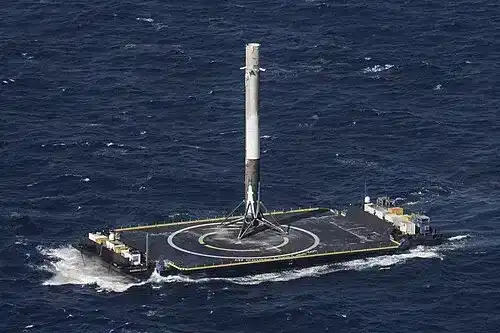
SpaceX's three autonomous unmanned landing craft, the floating platforms on which the Falcon 9 boosters land at sea, are named after sentient starships from Banks' novels: "Of Course I Still Love You," "Just Read the Instructions," and "A Shortfall of Gravitas." In an interview at the 2023 UK AI Security Summit, Musk was asked what a good AI future would look like. He replied, "Banks' Civilization series is by far the best vision of the AI future. No other work comes close, giving you a sense of a truly utopian, or rather, an incrementally utopian, AI future." He has been subtly revealing his vision for the future through the names on the landing platforms.
"Civilization" is not a frictionless paradise. Banks' novels are full of war, intrigue, and moral complexities. It is a utopia because this civilization has solved the prerequisites for survival to a sufficient extent, allowing trillions of people to freely engage in what Banks calls "the things that really matter in life, such as sports, games, love, studying dead languages, savage societies and impossible problems, and climbing mountains without a safety net."
Such a future rests on four prerequisites. First, the ability to extract a substantial portion of a star's energy output, several orders of magnitude greater than the energy produced by human civilization today. Second, large-scale physical intelligence: machines capable of building, mining, smelting, and repairing anything anywhere, without human intervention. Third, inexpensive digital intelligence surpassing that of biological intelligence. Fourth, a way to reliably transport mass from Earth at low cost and high frequency, because none of the aforementioned things can be expanded solely on Earth.
Working backward from the future
Most analyses of SpaceX work backward from the present: rockets, satellites, contracts, revenue. But to see what's really going on, a more useful approach is to start from the destination and work backward.
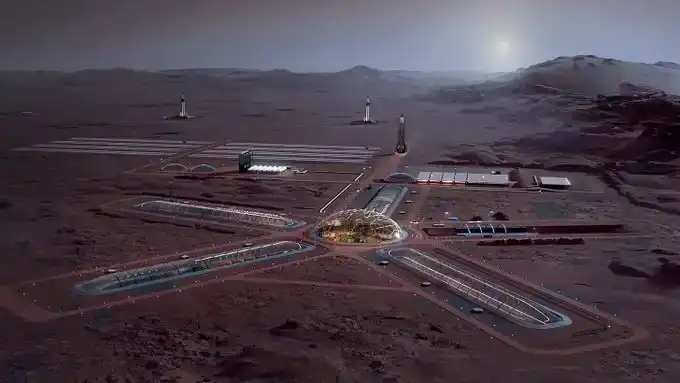
A Martian city. The operational goal is to establish a self-sufficient city of one million people on Mars within the lifetimes of those still alive today. The challenge lies in "self-sufficiency." This means that if Earth stops sending spacecraft to Mars, the city must be able to survive; it needs to produce everything itself: food, water, air, energy, medicine, machinery, and ultimately, the ability to reproduce. According to SpaceX's own calculations, sending one million people and millions of tons of cargo there over several decades will require thousands of Starship flights, launching more than ten times a day during each transfer window. Due to the orbital mechanics of Earth and Mars, these windows are only a few weeks long and open only once every 26 months.
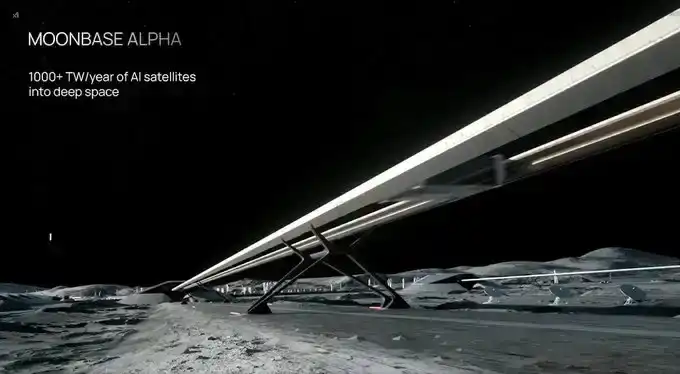
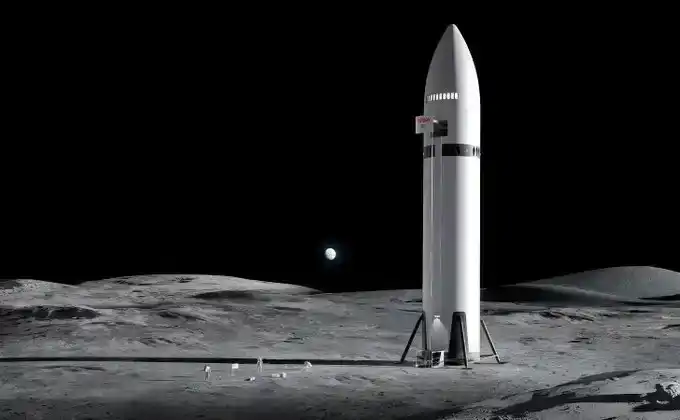
Lunar cities. This is a closer and more achievable rehearsal space. The permanently shadowed craters at the lunar south pole contain ice, while certain ridges receive continuous sunlight, making it a natural location for a base. But Musk isn't just talking about a research outpost; he's talking about something much grander. He envisions building factories on the moon to produce AI satellites and launching them one by one into space using mass actuators. Mass actuators, also a concept Musk borrowed from science fiction, are essentially electromagnetic launch systems that utilize the moon's gravity (only one-sixth that of Earth) and lack of an atmosphere to launch solar-powered satellites into deep space on an industrial scale. Building these satellites locally on the moon also has the material basis: lunar regolith contains approximately 20% silicon and 10% aluminum by weight, the two main raw materials for solar cells and satellite structures. "If you want to go beyond one terawatt per year," Musk explains, "you have to go to the moon."
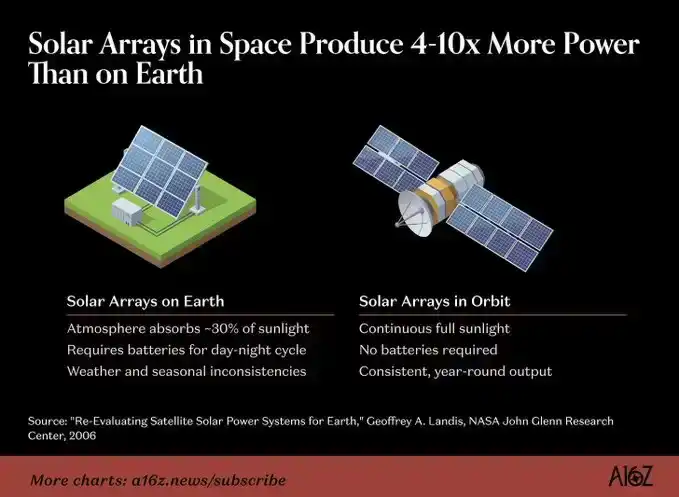
Orbital data centers. Musk is betting that in a few years, space will become the most economically attractive location for deploying AI data centers. The bottleneck for AI is energy. Except for China, energy supply is barely growing, while the demand for AI computing power is growing exponentially. Solar panels in orbit provide four to ten times the electricity of equivalent solar panels on Earth, depending on the sunlight conditions at the ground location, because there is no atmosphere, no day-night cycle, no clouds, and no seasonal changes in space. NASA calculated this decades ago, and now rockets are finally cheap enough to make it a reality. Musk predicts that in five years, SpaceX will launch more AI computing power into orbit annually than the total installed AI computing power on Earth. This is why SpaceX merged with xAI in February. Rockets and intelligence are becoming the same problem.
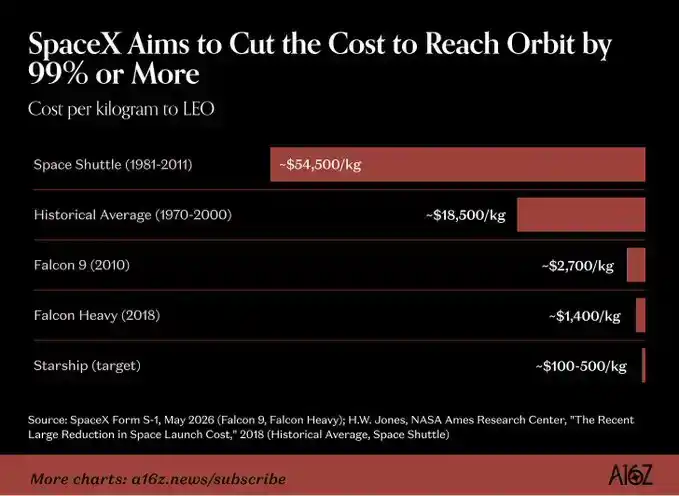
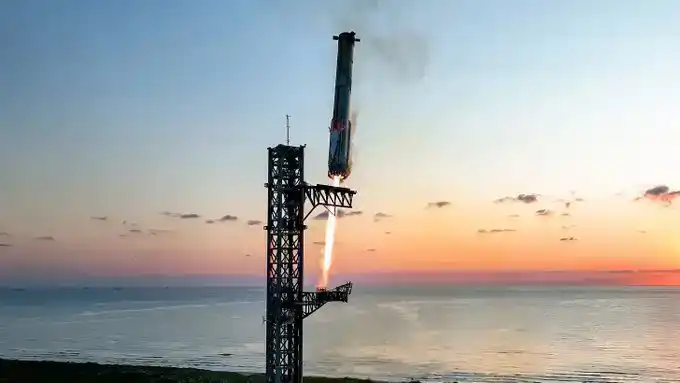
Starship is the launch vehicle that makes everything upstream possible. Starship V3, which completed its maiden flight this year, is the largest and most powerful rocket ever built—taller than a 40-story building and with more than twice the thrust of the Saturn V, which sent astronauts to the moon. According to NASA, the cost of reaching orbit was approximately $18,500 per kilogram in the past. In 2010, the first Falcon 9 reduced this cost by about 85%, to about $2,700 per kilogram. In 2018, the Falcon Heavy further reduced it to about $1,400 per kilogram. Starship is designed to be the world's first fully and rapidly reusable spacecraft, further reducing costs to $100 to $500 per kilogram. Spaceflight, which once cost billions of dollars per launch, now costs tens of millions of dollars.
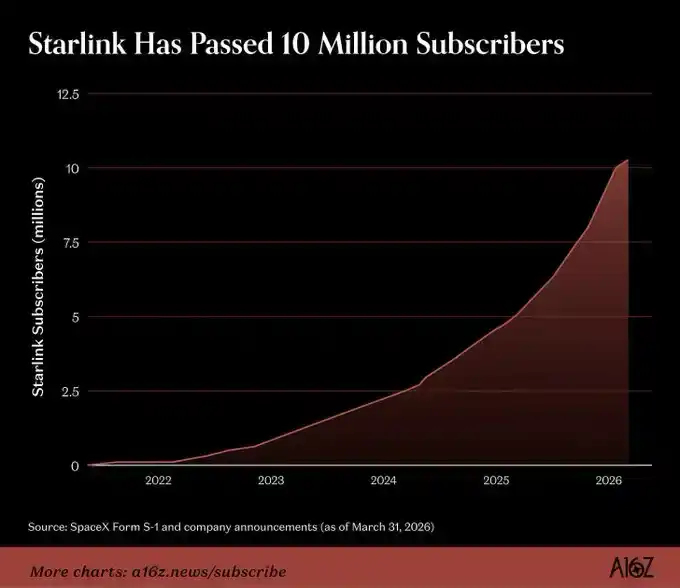
Starlink is the cash flywheel that helps pay for everything else. According to SpaceX's IPO filing, the connectivity business unit, which is almost entirely composed of Starlink, achieved revenue of $11.4 billion in 2025, a year-on-year increase of approximately 50%, with an adjusted EBITDA margin exceeding 60%. As of March 2026, Starlink has 10.3 million subscribers in 164 countries and operates on more than 9,600 satellites. What began as a side project to fill the company's own launch capacity is now becoming one of the greatest consumer businesses in history. When a16z conducted due diligence on SpaceX in 2019, many people told us that the business's economic model would never work. The technology required for user terminal antennas had previously only been used in F-22 fighter jets and naval destroyers, and had never been mass-produced for consumer use. SpaceX's earliest terminal devices cost approximately $3,000 to manufacture, but were sold for $499. But they found ways to reduce manufacturing costs and proved the skeptics wrong.
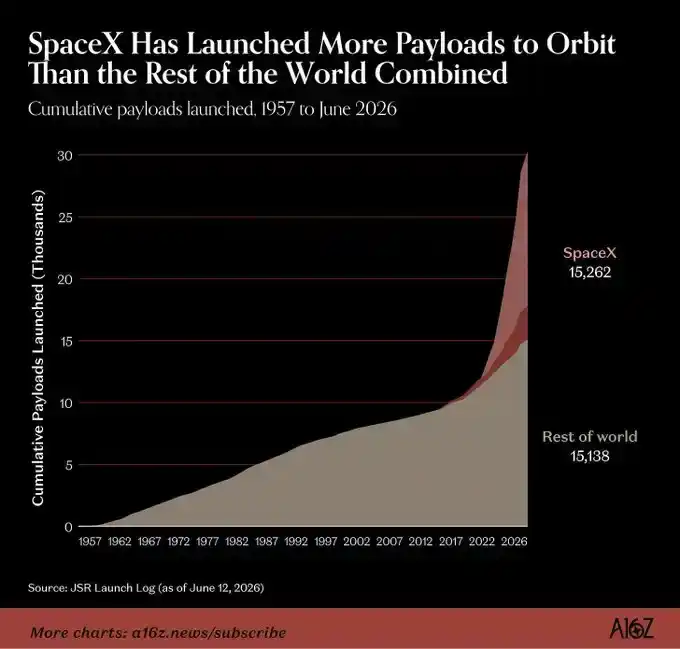
Falcon 9 is the driving force that buys time for everything else. It is the only orbital-class booster on Earth to achieve large-scale reusability, with a single booster typically capable of more than twenty missions before retirement. In 2025, SpaceX launched 83% of the world's total mass into orbit. Despite other players having a half-century of first-mover advantage, SpaceX now sends more payloads into orbit than all other countries and companies combined.
This is the entire stack, from top to bottom. Generations later, "civilization" sits at the very top. Falcon 9 and Starlink are at the very bottom, paying the bills for everything we have today. Each layer makes the next layer possible.
SpaceX CFO Bret Johnsen described what it looks like from the company's internal perspective:
"Musk created a culture where you set goals that initially seem almost insane, and then step by step, you realize you're moving toward something entirely achievable...like going to Mars. When I first joined the company in 2011, people would roll their eyes at the mention of Mars and making humanity a multiplanetary species. Now, when we say that, the reaction is really, 'What year?'... I think one of the things Elon did exceptionally well was setting these goals and building a fantastic business model around every key technological asset needed to achieve that ultimate goal."
Foolishness Index and "Algorithm"
Musk didn't initially intend to start a rocket company. In 2001, the 30-year-old Musk was contemplating what he wanted to do after PayPal. He had always been interested in space, and when he looked into NASA's plans to land humans on Mars, he was surprised to find that there wasn't one. So, he conceived a plan: to send a small greenhouse to Mars and transmit the images back to Earth. His idea was that a green sprout appearing on the desolate red planet might reignite public interest in space and rekindle political willingness to fund a real Mars mission. All he needed was a rocket to send the greenhouse there.
Later that year, he traveled to Moscow to try and purchase a refurbished intercontinental ballistic missile. This was the first of two trips to Russia. The talks were reportedly filled with vodka and a lot of bluster. "We would all go into a small room, and everyone would have a whole bottle of liquor in front of them," recalled Adeo Ressi, Musk's best friend from his time at the University of Pennsylvania, who also participated in the trip, in a 2012 interview with Esquire. The Russians didn't take Musk seriously. On one occasion, a chief designer even spat at Musk and his team in disdain. The second trip was in February, when Musk asked how much a missile would cost. They said $8 million each. When Musk countered by offering $8 million for two, Musk's aerospace consultant, Jim Cantrell, recalled them saying something like, "Young man, no way," implying he didn't have the money. Musk concluded they weren't serious about doing business and turned away.
Cantrell thought the trip was over. On the return flight, he and Mike Griffin ordered drinks and clinked glasses to celebrate finally leaving Moscow. Griffin, who later became NASA administrator, had participated in the second trip to Russia as an advisor. Musk sat in the row in front of them, hunched over, staring at his laptop. Then he turned around. "Hey guys," he said, "I think we can build this rocket ourselves." He showed them a spreadsheet listing the raw materials needed for the rocket—aluminum, titanium, copper, carbon fiber—and the cost of each. The raw material costs were only 2% of their quote. As Musk later said, "Obviously, you just need to figure out a clever way to put these materials into the shape of a rocket."
Within months, Musk decided to risk $100 million to start a rocket company. This was more than half of the approximately $180 million he received after selling PayPal. He then founded SpaceX in a warehouse in El Segundo, California. He extended an invitation to five people to join as a founding team. Three declined, including Cantrell and Griffin. The two who accepted were Tom Mueller and Chris Thompson. Mueller later became Vice President of Propulsion Systems and the company's first employee; Thompson was the second employee, responsible for operations and production.
Years later, Musk called the principle behind his spreadsheet diagnostic tool the "idiot index." If the ratio between the price of a component and its raw material cost is high, then either you're an idiot, or you're working with idiots. It sounds like a joke, but it's the foundation of SpaceX's strategy.
Every component SpaceX procures is accompanied by a foolproof calculation. There's a legendary story from the company's early days involving Steve Davis. After graduating from Stanford, he joined SpaceX directly as employee number 14, tasked with procuring a steering actuator for the Falcon 1 rocket's upper stage. When he reported that a traditional aerospace supplier had quoted $120,000 for the part, Musk laughed, saying its complexity was comparable to a garage door opener. Musk gave Davis a $5,000 budget to build it from scratch. As biographer Ashlee Vance recounts, Davis spent nine months refining the design, ultimately creating a functional actuator costing only $3,900. When Davis sent Musk a breakdown of this successful technology, Musk replied with a typical short email: "OK."
To push the "foolproof" index to its theoretical lower limit, you must vertically integrate and control the entire process end-to-end. However, vertical integration incurs fixed costs and is only worthwhile at high volumes; in the rocket industry, high volumes mean breaking the industry's established operating methods.
Traditional launch service providers like ULA and Arianespace treat each mission as a custom project. Clients specify the orbit, payload, and integration requirements, and the launch service provider designs a customized mission around that satellite. This model typically results in only a few launches per year, making each mission extremely expensive and hindering large-scale manufacturing.
SpaceX did the opposite. They released a Falcon user guide, clearly specifying the rocket's precise specifications and telling customers: design your satellites according to these specifications. At the time, this was seen as a very radical approach, and it cost SpaceX some business early on. But it unlocked the possibility of manufacturing flywheels.
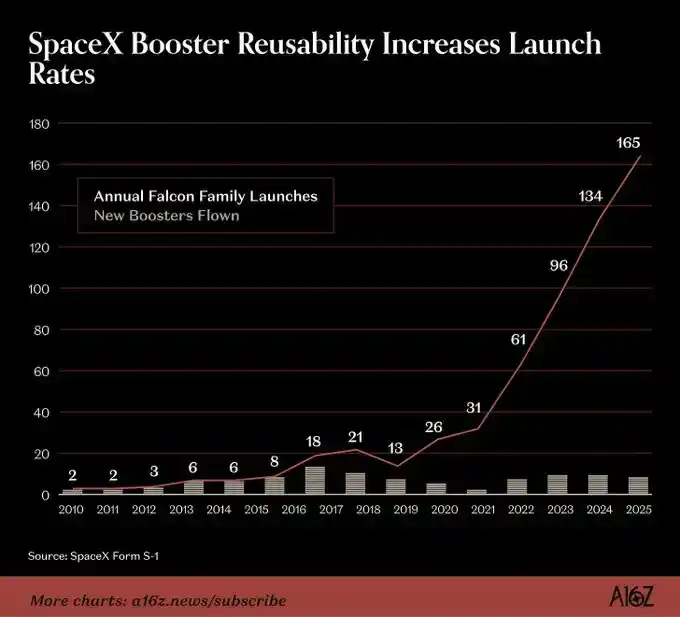
Standardization and reusability reinforce each other. Because every Falcon 9 is identical, a recovered booster can become a certified, flight-ready product again. The first Falcon 9 booster to fly twice was achieved in 2017. By 2020, a single booster could fly five times. By 2021, ten times. Today, the record holder has completed 35 missions. This reusability has transformed space economics and is difficult for competitors to catch up with. In 2021, Musk estimated the marginal launch cost of a Falcon 9 delivering a 15-ton payload to orbit under optimal conditions, excluding administrative costs, at approximately $15 million. He said this was "about half to a third of the cost of other options." Today, SpaceX launches a rocket every two to three days thanks to reusable boosters, while competitors can only launch a few custom-built rockets a year.
But SpaceX's advantage isn't just economies of scale, vertical integration, and a better strategy. It also comes from speed and culture.
Traditional aerospace companies mitigate uncertainty through analysis. To use NASA's polite language, Boeing's commercial crew program "uses mature systems engineering methods, investing in engineering research and analysis upfront before building and testing to mature system design." Measure twice, cut once. SpaceX, however, does the opposite. The company builds numerous inexpensive prototypes, pushes them to failure, learns from the failures, and iterates. Starship's testing program produced one of the most spectacular explosions in space history, but each failure was a data point, telling the team where reality deviated from the model.
Anyone who has worked in both worlds simultaneously can see the contrast. Garrett Reisman, a former NASA astronaut who flew two Space Shuttle missions, left NASA in 2011 to join SpaceX as a senior engineer. He described the prevailing view of SpaceX within NASA at the time: "They're a bunch of cowboys; they're dangerous; they'll kill people." What changed his perspective was witnessing firsthand how SpaceX worked. "What they could do in a month might take NASA a year. We were all stunned."
The clearest example is the Falcon 1 project. Between 2006 and 2008, SpaceX launched four Falcon 1 rockets from a small atoll in the Pacific Ocean called Kwajalein. The first three failed, but each failure was different and educational. The first was a fuel leak. The second was an abnormal propellant sloshing. The third was a stage separation collision caused by residual engine thrust. By September 2008, the company only had enough money for one more launch. And SpaceX wasn't the only one on the verge of collapse. Tesla, the electric car company Musk also ran, was only weeks away from bankruptcy. He had to decide whether to concentrate his remaining PayPal cash in one company or distribute it between the two.
“That was a really tough decision. In the end, I decided to split what I had left and try to keep both companies alive, but that could have been a terrible decision, and the result was that both companies died together,” Musk recalled. “I never thought I would have a nervous breakdown, but I was really close.” He couldn’t choose between the two because, in his worldview, both missions were crucial: Tesla was to accelerate the world’s transition to sustainable energy, and SpaceX was to make humanity a multi-planetary species. “All available resources had to be poured into these companies,” Musk’s then-fiancée, Talulah Riley, said in the BBC documentary series “The Elon Musk Show.” “He gave me the opportunity to back out. He said, ‘The hardest part is coming, and you don’t have to stay and go through it with me.’”
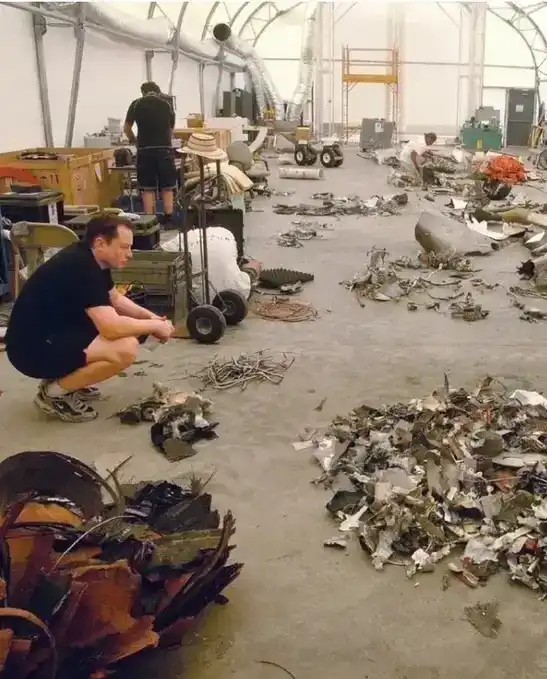
The fourth launch was a success. That December, just weeks before SpaceX was running out of money, NASA awarded it a $1.6 billion cargo contract. When NASA called Musk to inform him, he was overwhelmed with relief and blurted out, "I love you guys."
This model, forged through rapid failures and rapid error correction, later became the culture of every project within the company. It is precisely this same model that allows SpaceX to iterate on Starship between two flights, whereas traditional space projects often take years to go from a single flight anomaly to redesigning the spacecraft.
This approach is superior to alternatives because, when faced with problems you don't fully understand, you can't arrive at a perfect solution through mere thought. Reality is the only sufficiently effective validator; the key is to minimize the cost of consulting reality so that you can do so frequently.
The above is a narrative of SpaceX's iterative cycle, but there's also a written version. Over the past two decades, Musk has coded SpaceX's approach into a five-step operational process, which the company calls "the Algorithm." Tim Berry, who worked at SpaceX for ten years, leading the upper-level production teams for the Falcon 9 and Falcon Heavy, says the methodology has been "in our heads." Walter Isaacson published a standard version of this methodology in his Musk biography:
First, question every request. Every request should include the name of the person making it. You absolutely cannot accept a request coming from a department, such as the legal department or the security department. You need to know who the specific individual making the request is, and no matter how intelligent that person is, you should question the request. Requests from intelligent people are the most dangerous because people are less likely to question them. Then, make these requests less foolish.
Second, delete all removable parts or processes. You may have to add them back later. In fact, if you don't eventually add back at least 10% of what you deleted, you haven't deleted enough.
Third, simplify and optimize. This step should occur after the second step. A common mistake is to simplify or optimize a part or process that shouldn't exist in the first place.
Fourth, speed up cycle times. Every process can be accelerated. But this should only be done after the first three steps are completed. Musk once said that he made a mistake at the Tesla factory: he spent a lot of time accelerating processes that he later realized should have been eliminated.
Fifth, automation. Automation should be left until last. The mistake Tesla made at its Nevada and Fremont factories was trying to automate everything from the start, instead of first questioning requirements, removing parts and processes, and plugging the loopholes.
Most engineering organizations would skip directly to step five. They'd be automating a process that shouldn't even exist. SpaceX, on the other hand, executes these steps sequentially, every time, in every part of the company. After this "algorithm" runs on a piece of hardware many times enough, it starts to resemble nothing else in the industry.
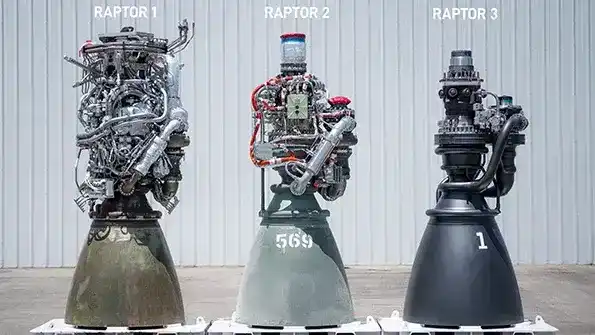
The Raptor 3 is the product of a team's decade-long iteration on the same engine. It boasts 22% more thrust and is 40% lighter than the Raptor 2, and it eliminates the need for a heat shield because the piping and wiring, originally suspended outside the engine, have been 3D-printed and integrated into the engine's metal structure. Musk once said, "Simplifying the Raptor engine, integrating secondary flow paths, and adding regenerative cooling to exposed components required an astonishing amount of work. It was close to the limits of known physics."
No known engine project in space history has iterated at such a rapid pace. For the last thirty years, the Space Shuttle's main engines were essentially the same design. The RD-180, powering the Atlas V, was a derivative of an engine designed in the 1970s. SpaceX, however, has redesigned the Raptor three times in less than a decade, with each generation representing a significant improvement over the last.
The same philosophy applied to people. By mid-2018, with Falcon 9's reusability on a reliable track, Musk turned his attention to the satellite internet constellation—the project that would later fund everything upstream. The Starlink team, based in Redmond, Washington, included many senior engineers from Microsoft, where development was proceeding at a slower pace than Musk desired. In June, he flew to Redmond and laid off the senior leadership team. He then brought in young, star engineers from the rocket business and gave them a year to launch the first operational satellites. This was a brutal management style. Judging from media reports of the layoffs at the time, the department seemed to be imploding. But 11 months later, in May 2019, the first satellites launched. Musk had cleared the bottleneck and moved on to the next problem.
This was his way of managing everything. In 2018, when Tesla was in "production hell," trying to expand Model 3 production and burning through cash at a life-or-death pace, Musk actually moved into the factory. Years later, in an interview, he recalled, "I lived in the Fremont and Nevada factories for three years straight. I slept on the floor under my desk so the whole team could see me when shifts changed. This was important because if the team felt their leader was having a great time somewhere else, drinking Maitai cocktails on a tropical island, it would demoralize them. Because when shifts changed, the team could see me sleeping on the floor, they knew I was there. It had a huge impact, and they gave it their all." Later, he turned this into a company-wide rule: the higher your position, the more visible your presence must be.
To find someone who can be compared to Musk's approach as CEO, we must go back to the industrial era of the late 19th and early 20th centuries: Henry Ford, Andrew Carnegie, Thomas Watson, Andrew Mellon, and Cornelius Vanderbilt. Musk's unique operating style lies in his connection to specific tasks. It's said that he would visit each of his companies weekly, identify the biggest problems, and solve them. He did this for 52 consecutive weeks, and each company essentially solved the 52 most important problems of that year.
An engineer who joined SpaceX from another aerospace company described his experience this way: "It was like being parachuted into an area of incredible competence. Everyone around you was absolutely capable of doing their job."
Star Cluster
SpaceX looks like a single company, but a more useful way to understand it is as the central node of a constellation of companies. These companies are all run by the same person, built towards the same long-term mission, and virtually inseparable from one another. For the past two decades, Musk has been assembling a group of companies, each solving a bottleneck that would otherwise have limited the others. And now, they are compounding each other.
The merger with xAI this February is a microcosm of what SpaceX is becoming. If computing power eventually gets into orbit—Musk's bet—then SpaceX has the most credible path to deploying it at the scale required for AI. Sending mass into orbit and mass-producing intelligence may become the two most decisive capabilities of the coming decades, and now they are reinforcing each other under the same roof.
xAI brings Grok, a cutting-edge model that has a unique position in real-time information due to its access to X's real-time data deluge. xAI also brings the engineers who built the Colossus 1 and Colossus 2 supercomputers at a speed many thought impossible.
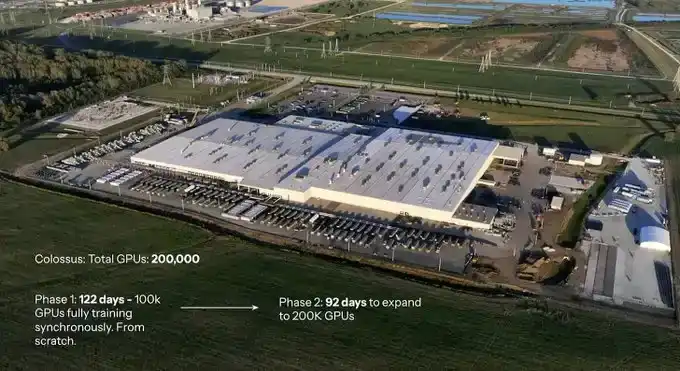
The construction of Colossus is worth a closer look. xAI took over an old factory in Memphis and put 100,000 GPUs into training within 122 days. Once the racks started arriving, they got the cluster up and running in just 19 days. Nvidia CEO Jensen Huang, commenting on Musk, said: "From a concept to building a large factory, liquid cooling, powering it up, getting licenses, and completing it in that timeframe, it's superhuman. As far as I know, only one person in the world could do that. What they accomplished is unique. No one had ever done it before. 100,000 GPUs as a cluster easily made it the fastest supercomputer on Earth at the time. Typically, such a supercomputer requires three years of planning, then delivery of the equipment, and another year to get everything running."
A project that would take at least four years for other companies in the industry, Musk and the xAI team completed in four months.
In May, Anthropic agreed to pay SpaceX $1.25 billion per month for all the computing power of Colossus 1. A few weeks later, in a revised IPO filing, SpaceX disclosed that Google would pay $920 million per month for access to 110,000 GPUs, roughly half the computing power Anthropic received. These two deals, totaling approximately $26 billion in annual revenue, come from only two customers, and this business didn't even exist until SpaceX acquired xAI earlier this year. With chips, electricity, and land all scarce, SpaceX is becoming one of the few companies with sufficient AI infrastructure to both lease computing power and pursue its ambition to build cutting-edge models.
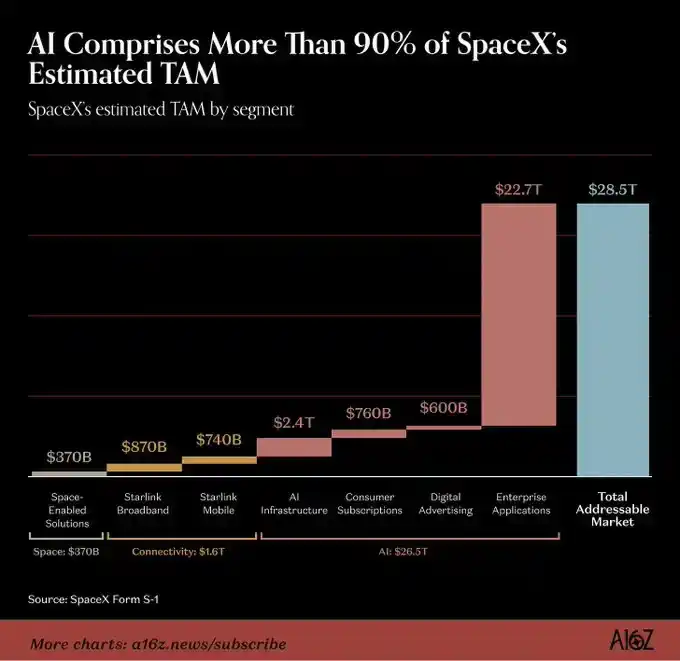
What xAI gets from SpaceX is a more sustainable solution to the power constraint. Musk believes that electricity will be the bottleneck for AI in the coming years. Producing enough electricity to meet his anticipated intelligent demands requires grid construction, new power plants, and years of approvals that the industry simply cannot afford to wait for. In his view, orbital solar power is the way out because it is virtually limitless. And SpaceX is the only company with a vehicle capable of sending computing power into space at scale. Whether he is right is one of the most important open questions in the tech world. But SpaceX's IPO filings show that the company is extremely serious about this bet: it expects AI to become its largest market to date. Compared to these ambitions, the space business that once built the company seems almost like a rounded-up fraction.
Tesla is another important piece of the puzzle in this constellation, and the integration of the two is unfolding in a different and deeper way. Tesla and SpaceX share the same founder, the same talent pool, the same operating culture, and an increasingly overlapping set of technology roadmaps.
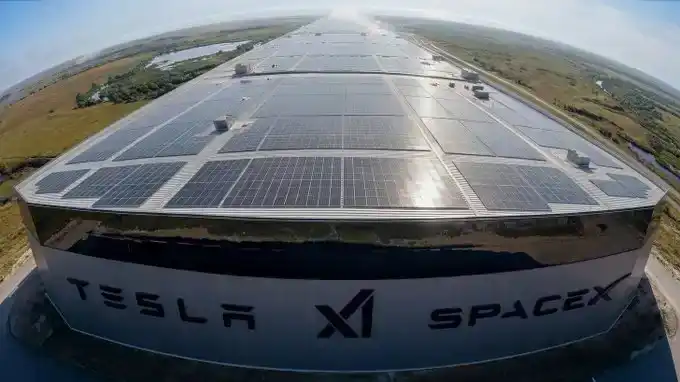
Tesla is providing three things to the SpaceX-xAI constellation. First, chips: AI5, AI6, and Dojo3, all designed in-house by Tesla. Musk has made it clear that these chips aren't just for cars, but are components of a larger constellation computing stack. AI5 handles autonomous driving inference, AI6 is geared towards Optimus and AI data centers, and Dojo3, paired with the planned AI7, is designed for orbital computing power. Second, robots. Tesla is betting that Optimus will become the physical AI layer for factories, warehouses, and homes, enabling these scenarios to operate without human labor, and ultimately serving Musk's envisioned lunar and Martian cities. Third, solar energy. Musk has stated that Tesla and SpaceX are each building 100 gigawatts of solar cell capacity annually to support AI development on Earth and in orbit.
Then there's TeraFab. In April, Tesla disclosed that it had begun ordering equipment for a research-oriented semiconductor fab at its Giga Texas campus. Musk told investors during Tesla's Q1 2026 earnings call, "We expect this to be a project worth around $3 billion, potentially producing a few thousand wafers per month." SpaceX, on the other hand, is funding a much larger facility because no existing fab can scale at the rate Musk envisions. Once fully operational, this facility is designed to produce approximately 1 million wafers per month. Musk's envisioned scale is in gigawatts. "This isn't something we promised to do," Musk said last week. "This is what we'll try to do, and we believe is highly likely to succeed: by the end of next year, to reach an annualized rate of about 1 gigawatt per year for space AI computing power. Then, ideally, to scale up by an order of magnitude each year. That is, to reach an annualized rate of 10 gigawatts per year in two and a half years. In three and a half years, perhaps 100 gigawatts. Then, depending on the progress of chip manufacturing in other parts of the world and TeraFab, to further expand to 1 terawatt per year, or 1,000 gigawatts. That's twice the electricity consumption of the United States."
Comparing Musk to the Gilded Age certainly touches on some truths, but it also points to differences. Carnegie built a steel empire; Vanderbilt built a railroad empire. They each dominated a sector of the industrial base of their time. Musk, on the other hand, is attempting to advance multiple fields simultaneously—space, energy, artificial intelligence, robotics, tunnels, brain-computer interfaces, self-driving cars—and bend them all toward a single goal that most consider far-fetched. Whether it will all ultimately succeed is anyone's guess; many parts may also fail. But this attempt itself has no historical precedent and could become a preparatory ground for a different century.
The world opened up by SpaceX
Before the Space Shuttle was retired in 2011, the cost of sending one kilogram of cargo into orbit was approximately $54,500. Musk predicts that once Starship matures, this figure will drop to $100 per kilogram. When the cost of accessing space decreases by more than 500 times, all industries that could theoretically exist in space will become economically viable. There are many such industries.
Perhaps the closest historical analogy is the transcontinental railroad. Before 1869, the journey from New York to San Francisco by horse-drawn carriage took six months, costing roughly the equivalent of a year's wages, and carried a considerable risk of death. After 1869, the journey took only a week. The railroad itself was a remarkable engineering achievement, but the real story is what it launched: meat processing giants like Sears Roebuck, Swift, and Armour, Standard Oil, and ultimately, US Steel, which consolidated the industrial empire born during the railroad boom.
If Falcon 9 was like the transcontinental railroad of the space age, then Starship might be an upgrade comparable to airplanes. Railroads opened up an entire continent. The jet age opened up an entire planet. Starship will open up the solar system.
Industrialized Moon
Ever since humans first looked up at the moon, it has held scientific significance. Now, it is beginning to take on economic significance, as it is an entire world made up of industrial raw materials.
Let's start with how to get things off the moon. As mentioned earlier, the moon has only one-sixth the gravity of Earth and no atmosphere, making mass-driven propulsion, rather than rockets, the natural way to lift cargo off the lunar surface. This will revolutionize transportation economics. Once orbits are established, the marginal cost of transporting manufactured goods will be primarily determined by electricity, not fuel; on the moon, electricity comes from sunlight. A package is ejected from the lunar surface, re-enters Earth's atmosphere with a heat shield, deploys a parachute, and lands at a recovery site. When throughput is large enough, the marginal cost begins to resemble freight transport more than spaceflight.
Then there's what can be manufactured there. The same lunar soil that provides the silicon and aluminum needed for solar cells and satellites is also the raw material for an entire industrial base. The space revolution of the 2030s and 2040s might look like this: automated mining trucks processing lunar soil day and night, smelters producing aluminum and silicon, and factories assembling satellites, solar panels, and the chips that power them. Most industries on Earth have a lunar version waiting to be built, and SpaceX can't build all of these things alone. Those who build "lunar versions of Alcoa," "lunar versions of Caterpillar," and "lunar versions of Union Pacific" will become giants of the 21st century.
Computing power in the sky
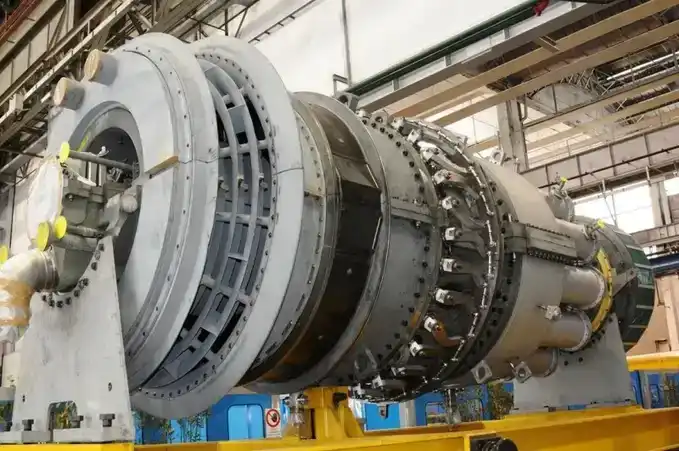
By 2030, the bottleneck for artificial intelligence will likely not be chips, but electricity. The obvious response is to build more solar power in Texas or Nevada, but this will hit a wall faster than people imagine. One terawatt of continuous solar power would require about 1% of the U.S. land area, and new utility interconnection approvals take a year or more. xAI's Colossus project in Memphis required deploying an entire fleet of temporary gas turbines, battling state permit approvals, and establishing a separate power hub in Mississippi on the other side of the state border to bring one gigawatt of power online. Scaling this up to the hundreds of gigawatts needed for AI deployment is simply not feasible. Even the guide vanes and blades inside the gas turbines that provide backup power for solar power are already booked until after 2030.
The solution is to move computing power where sunlight already exists. This will become easier once Starship achieves daily flights and orbital deployments become routine. And as the cost curves for rocket launches, solar panels, and chips continue to decline, economics will improve further. SpaceX CFO Bret Johnsen explained, "We're ramping up factory capacity and benefiting from declining silicon costs, so our costs will decrease over the next few years. If you look at ground-based solutions, the curve is going in the opposite direction. Everything is getting more expensive: cooling methods, electricity costs aren't decreasing, and land and regulations are becoming more difficult."
A common objection comes from those who, upon hearing "space data center," imagine launching a Colossus-sized building into orbit, but that's not the case. "It's roughly the size of a Blackwell rack, with solar panels that are probably 500 feet long on each side. You put it in a sun-synchronous orbit so the solar panels are always in sunlight," says Gavin Baker, an early investor in SpaceX. "I've spent a lot of time at Starbase over the years and talked to a lot of SpaceX engineers. I genuinely believe they are one of the most talented groups of engineers on Earth, and they are very confident they have solved this problem."
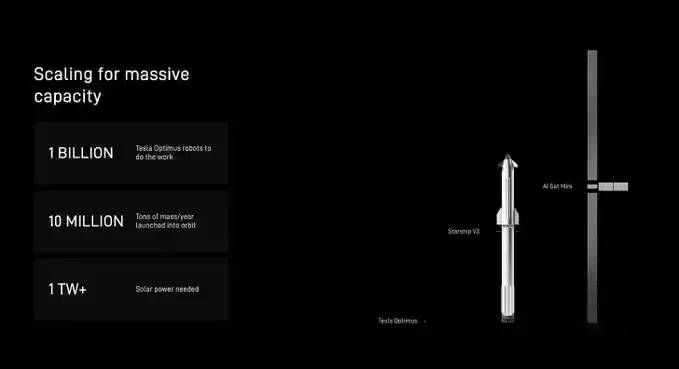
In fact, Musk believes the AI Sat Mini will be easier to build than Starlink satellites. "You still need some laser links, but you don't need those extremely complex antennas on Starlink satellites," Musk explained. "AI satellites are easier to design... AI satellites don't require any magic. We've already done a lot of the technology for Starlink V3 satellites. Compared to what we're already doing, we don't think it's a particularly difficult problem."
He predicts that within five years, SpaceX will launch more AI computing power into orbit annually than the total installed computing power on Earth. A rough calculation puts this at 10,000 Starship launches per year, or more than once per hour, around the clock. By the late 2030s, with the lunar-mass drive coming online, the petawatt-class threshold will come into view: equivalent to 1,000 times the computing power deployed in 2030, launching satellites into deep space at a rate of one every few minutes.
Mars
The Mars trajectory was originally scheduled to begin this year. Musk announced in September 2024 that SpaceX would launch five unmanned Starships to Mars during the November 2026 transfer window, carrying the Optimus robot to test landing systems, search for ice, and begin building infrastructure for future crewed missions. In May 2025, he said the probability of achieving this timeline was 50/50, but earlier this year, the situation changed.
In a February 8th post on SpaceX, Musk announced that SpaceX would be delaying its Mars launch schedule and shifting its short-term focus to building a self-sufficient city on the Moon. The reason given was that Mars launch windows only open every 26 months and require six months of flight time; in contrast, lunar launch windows are available every ten days with only two days of flight time. "This means we can iterate and build a lunar city much faster than we can build a Martian city," he wrote. "That said, SpaceX will also work towards building a Martian city, starting in about five to seven years, but the highest priority is securing the future of civilization, and the Moon is much faster."
On the surface, it looks like a turn, but it is actually the moment when the path to a Martian city of millions of people becomes clear.
The orbital data center concept gradually became clearer in late 2025 and early 2026, giving the Moon a new role. Achieving petawatt-level orbital computing power requires mining, smelting, and manufacturing solar panels, radiators, and satellite structures on the Moon, and launching them into orbit via lunar-powered mass actuators. An industrial base of this scale requires a permanent population, which in turn requires a city. This city could be entirely funded by the orbital computing industry, while simultaneously serving as a rehearsal for Mars. Every problem SpaceX must solve to build a self-sufficient Martian city—radiation shielding, life support, in-situ resource utilization, governance of an extraterrestrial permanent population, and supply chains across gravity wells—is also a problem that must be solved before building a lunar city. Building a lunar city will allow SpaceX to learn how to build Martian cities at a much faster iterative pace.
According to Musk's proposed timeline, the first unmanned lunar landing demonstration is targeted for 2027 at the earliest, with lunar cities to follow within a decade. Mass drives, lunar industrial construction, and lunar manufacturing for orbital computing infrastructure will proceed simultaneously. Then, Mars will come next.
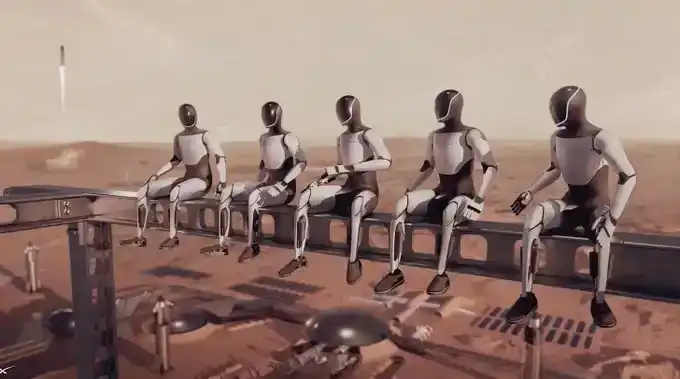
But the hardest part won't be transporting people. The hardest part is building the infrastructure on the Martian side to accommodate them. Lunar rehearsals will help. Optimus will also help. Musk repeatedly mentioned in his May 2025 Mars talk at Starbase that early unmanned Starships will carry Optimus robots to explore resources and begin building infrastructure for human arrival. The company is building a production line in Fremont with an annual capacity of 1 million units and another in Giga Texas with an annual capacity of 10 million units. These robots are still in the early stages of production and haven't yet performed truly meaningful practical work in Tesla factories, but the production capacity that comes online in the next two to three years will be crucial in guiding the initial construction of the Mars base.
Conscious Sun
SpaceX’s mission statement after absorbing xAI in February of this year is: to scale up, to create a conscious sun to understand the universe and extend the light of consciousness to the stars.
This statement is open to interpretation; it could be either the most absurd statement ever made by a serious company on its mission statement page, or the most honest. We believe it is the latter.
At first glance, SpaceX is a launch service provider with an internet subsidiary and a recently acquired AI lab. However, a closer look at its technology roadmap reveals it as the only company on Earth currently assembling the complete prerequisite stack needed for a post-scarce transformation. And its mission statement reveals it as a serious attempt by one of the most capable founders of our time to propel humanity through that bottleneck: the other side of the bottleneck is either us becoming an interstellar species, sharing the universe with the intelligent machines we create, or we ultimately becoming footnotes on a rocky planet, failing to complete that leap.
By the time the first child born on Mars asks their parents why they're there, Starship has been flying every day for thirty years. The factory across the street will be run by Optimus robots, which operate descendant models of Grok and have been improving themselves for twenty years. The computing power that keeps her city running comes from data centers in space; these data centers are built by other robots using lunar soil and launched into space by a mass drive. For almost a generation, this mass drive has been hurling satellites into deep space at a rate of one every few minutes. Her parents arrived on Mars in a spaceship named after the starships in Iain M. Banks' novels, because sometime in the early 21st century, someone who had read those books as a teenager decided to dedicate their life to making them a reality.
Banks understands those who would choose to go to Mars. *Civilization* is paradise, but his most interesting characters are those who leave it. This civilization has solved the problem of scarcity; what remains is humanity's yearning for a difficult journey. Even if paradise is just next door, the frontier is where the meaning lies.
Musk once said that the recruitment rhetoric for early Mars colonists would be "Shackletonian recruitment," derived from the famous 1914 trans-Antarctic expedition's recruitment advertisement: "Looking for men for a perilous journey. The pay is meager, the cold is biting, months of complete darkness are inevitable, the danger is constant, and the return is uncertain. If successful, you will receive honor and recognition." This advertisement is almost certainly not real, but it has been repeated for a century because it captures a certain truth about those who volunteer.
Why would anyone find this appealing?
Musk said, "Life can't just be about solving one painful problem after another. There has to be something in the world that inspires you, that makes you happy to wake up in the morning to be a part of humanity. Earth is the cradle of humanity, and you can't stay in the cradle forever. It's time to set off, to become a civilization that sails among the stars, to enter the stars, and to expand the scope and scale of human consciousness. I find that incredibly exciting. It makes me happy to be alive. I hope you feel the same way."