As one of the most important smart contract platforms today, Ethereum has built the richest on-chain ecosystem and continues to lead the development of Web3 technology innovation. However, with the continuous expansion of its ecosystem, a series of problems accumulated in Ethereum's underlying architecture and development path are gradually emerging and becoming more complex. For example, the ecosystem governance and benefit distribution mechanisms are still controversial; during the scaling process, it is difficult to balance consensus security, verification efficiency, and decentralization; data availability and scaling paths (such as sharding and Blob mechanisms) remain uncertain; the architecture transformation centered on Rollups is impacting the main chain's value capture and ecosystem structure; the power distribution and ranking mechanism formed around MEV is reshaping the block production system; and competition from high-performance public chains is putting external pressure on Ethereum's performance and ecosystem attractiveness.
Against this backdrop, the Ethereum Foundation and its core developers have intensively implemented a series of key adjustments and innovative attempts over the past year. These include restructuring the Foundation's organizational structure, clarifying the responsibilities of the Protocol team, redefining the functions of L1 and L2 layers , adjusting the Foundation's position within the ecosystem, exploring Ethereum's commercialization path, and participating in the development of proxy economic standards. These changes signify that Ethereum is gradually evolving from a single technical system into a comprehensive infrastructure system encompassing execution, verification, coordination, and fund allocation.
Based on this, this research report will take the core issues currently facing Ethereum as its starting point, systematically review its latest progress in technology, architecture and ecosystem, and interpret Ethereum's future medium- and long-term development direction. At the same time, it will also combine its exploration of funding mechanisms and potential commercialization paths to further analyze the strategic direction of the Ethereum Foundation, and assess the potential risks it may face in its development process, so as to help you fully understand the logic behind Ethereum's frequent actions.
Author: Shirley Li, Web3Caff Research Researcher
Cover: Photo by Unsplash+, Typography by Web3Caff Research
Word count: Nearly 22,000 words in total
Note: Due to length constraints, this research report is published in two parts. This is Part 1 (including the chapters: Background and Review of Ethereum's Core Issues). The remaining chapters (Detailed Explanation of the Strawmap Draft, Exploring Compliant Commercialization Paths, Market Competition and Risk Assessment, Other Areas of Interest, Ethereum Foundation's Support Directions, Potential New Risks Facing the Ethereum Ecosystem, and Future Outlook) will be updated and completed in Part 2.
Table of contents
- background
- Ethereum Core Issues Review
- Questions surrounding the Ethereum Foundation and Vitalik Buterin
- Improvements in PoS technology
- Blob storage critically low
- The future centered on Rollup
- The battle surrounding MEV
- Impact from Layer 1 technologies such as Solana and Sui
- Strawmap Draft Explained
- Gigagas L1
- Post Quantum L1
- Private L1
- The seven upgrades planned in the Strawmap draft
- Exploring compliant commercialization paths
- Commercialization attempts
- Compliance
- Other areas worth paying attention to
- Adjustments surrounding the Gas mechanism
- From DeFi to Defipunk
- AI
- Ethereum Foundation's support direction
- New risks that the Ethereum ecosystem may face
- Future Outlook
- Key Points Structure Diagram
- References
background
Since Vitalik Buterin and his team officially introduced Ethereum to global users at an international conference in 2014, the network has undergone nearly twelve years of development. From early niche experiments to today's core infrastructure supporting a diverse ecosystem, Ethereum has grown into one of the most influential underlying platforms in the Web3 world. However, with the continuous expansion of its ecosystem, this "behemoth" of Ethereum has become increasingly massive, and its pace has become increasingly cumbersome. Under the brutal law of the jungle, this internal burden is being amplified by external challengers—it not only has to cope with its own operational pressures but also face the eager newcomers.
For Ethereum, "stability" and "change" have always been two contradictory yet closely intertwined directions. On the one hand, it needs to maintain network stability to ensure the steady progress of the entire ecosystem; on the other hand, it needs to continuously point out new directions for the ecosystem's advancement. To this end, Ethereum constantly confirms and revises its development coordinates by continuously releasing phased roadmaps.
Between 2014 and 2016, Ethereum gradually developed its early phased development plan, divided into four stages: Frontier, Homestead, Metropolis, and Serenity. The first three stages are generally regarded as Ethereum 1.0, mainly focusing on improving basic functions and enhancing network stability; while Serenity represents its long-term evolution goal, with the core being to achieve a leap in scalability and performance through the reconstruction of the consensus mechanism and underlying architecture.
In 2020, Ethereum further clarified the technical path of the Serenity phase, formally established the transition to the PoS ( Proof-of-Stake ) mechanism, and introduced sharding logic, marking the beginning of Ethereum's entry into a systemic architectural reconstruction phase.
In 2022, Ethereum released a relatively complete medium- to long-term roadmap, establishing a scaling path centered on Rollups. This meant that Ethereum would extend its execution layer to a Layer 2 network, while the main chain would focus on security and data availability. This change set a new tone for subsequent ecosystem development, but it also sowed the seeds of future problems.
In February 2026, the Ethereum Foundation released another draft of the "Strawmap" roadmap for the next ten years, proposing more specific optimization goals for multiple dimensions such as the consensus layer , data layer, and execution layer. It further refined the long-term optimization direction of Ethereum, reflecting Ethereum's continuous thinking about the overall architectural evolution direction in its mature stage.
Ethereum Core Issues Review
However, the adjustment and improvement of the development path also reflects Ethereum's dynamic trade-offs among multiple goals such as scalability, security, decentralization, and the distribution of ecosystem benefits based on its actual development process. Each version of the plan or roadmap can be regarded as a phased balancing of the overall system structure.
In a research report published at the end of 2024, titled " The Future Path of Ethereum: Development Amidst Controversy, Can Ecosystem Giants Withstand Potential Crises? ", I discussed some of the problems Ethereum was facing, including:
- The mechanisms for ecological governance and benefit distribution remain controversial.
- During the scaling process, it is difficult to balance consensus security, verification efficiency, and decentralization.
- Data availability and expansion paths (such as sharding and Blob mechanisms) remain uncertain;
- The architecture transformation centered on Rollups has impacted the main chain's value capture and ecosystem structure.
- The power distribution and ranking mechanism surrounding MEV is reshaping the block production system;
- Competition from high-performance public blockchains is putting external pressure on Ethereum's performance and ecosystem appeal.
So, more than a year later, what are the latest developments regarding the above issues? I will summarize them one by one in the following content.
Questions surrounding the Ethereum Foundation and Vitalik Buterin
Since the Ethereum Foundation's inception, the team led by Vitalik Buterin has undergone several personnel changes. Due to Vitalik Buterin's significant influence within the Ethereum ecosystem, the power structure surrounding the foundation has been a subject of long-term scrutiny and discussion.
Against this backdrop, some argue that certain projects may align their development direction with Vitalik Buterin's technical preferences or the foundation's funding direction, leading to periods of resource concentration or even overcapacity in specific sectors. Simultaneously, the distributed nature of Ethereum's technical teams makes it difficult to meet expectations for its rapid iteration and innovation.
Furthermore, the Ethereum Foundation's and Vitalik Buterin's sell-off also sparked market concerns. Although Vitalik Buterin and foundation members stated that the funds were primarily intended to support ecosystem development and project funding, the actions still triggered considerable discussion and interpretation within the market.
Current latest developments:
In early 2025, while the overall market environment was recovering and new narratives were emerging, Ethereum's development pace was relatively slow, which to some extent caused dissatisfaction within the community. Some argued that the Ethereum Foundation and core developers were lagging behind in terms of efficiency, market communication, and ecosystem expansion, resulting in a disconnect from the overall industry pace.
In response to this question, the Ethereum Foundation has made a series of important adjustments.
In February 2025, Aya Miyaguchi, who had served as an executive director of the Ethereum Foundation since 2018, assumed the newly created position of President. Her responsibilities shifted from day-to-day operations and executive management to external cooperation, institutional relations, and cultural outreach. Simultaneously, Tomasz Stańczak, founder of Nethemind , and Hsiao-Wei Wang jointly assumed the position of co-executive directors.
Under the new management structure, the Ethereum Foundation streamlined its organization, laying off 19 employees and shifting its strategic focus back from Layer 2 to Layer 1 itself. Simultaneously, the Foundation began to place greater emphasis on external communication, further enhancing transparency regarding its technology roadmap, development direction, and resource usage to strengthen community trust.
In June 2025, the Ethereum Foundation restructured its internal R&D system. The original department name was simplified from "Protocol Research & Development (PR&D)" to "Protocol," focusing on three short-term goals: expanding L1 performance; expanding Blobs; and improving user experience. This adjustment signified a shift in its R&D focus from research-oriented to engineering implementation and practical delivery. Earlier this year, the Protocol team further refined its objectives, clarifying them as follows:
- Scale (Extendability): This refers to extending L1 performance by increasing gas limits, promoting proposer-builder separation, introducing zkEVM to the mainnet, and optimizing the Blob mechanism.
- Improve UX (User Experience): This means enhancing the user experience by continuously advancing native account abstraction and cross-chain interoperability .
- Harden the L1 (security enhancement): This refers to strengthening the security and Censorship Resistance of L1 through strategies such as enhancing post-quantum security preparation, reducing node burden, and weakening dependence on centralized infrastructure (meaning preventing nodes from censoring transactions).
However, in February 2026, Tomasz Stańczak announced his resignation as co-executive director of the Ethereum Foundation, and was succeeded by Bastian Aue and Hsiao-Wei Wang. During his tenure, Tomasz Stańczak promoted explorations in areas including privacy protection, quantum computing security, and the integration of AI with Ethereum. After stepping down, he devoted more energy to the development of products and infrastructure related to the integration of AI and blockchain . [1]
Interestingly, Tomasz Stańczak's resignation statement revealed a mindset of "realizing he was no longer the core driving force and that it was better to hand over the reins gracefully." This reflects the gradual decentralization of power within the Ethereum Foundation's governance structure. Essentially, this change embodies the friction and balance between the decentralized, open ecosystem of "Ethereum" and the centralized, coordinating body of the "Ethereum Foundation." This contradiction, in fact, exists throughout the entire Web3 ecosystem and is one of the key issues that all projects in the industry must continuously address.
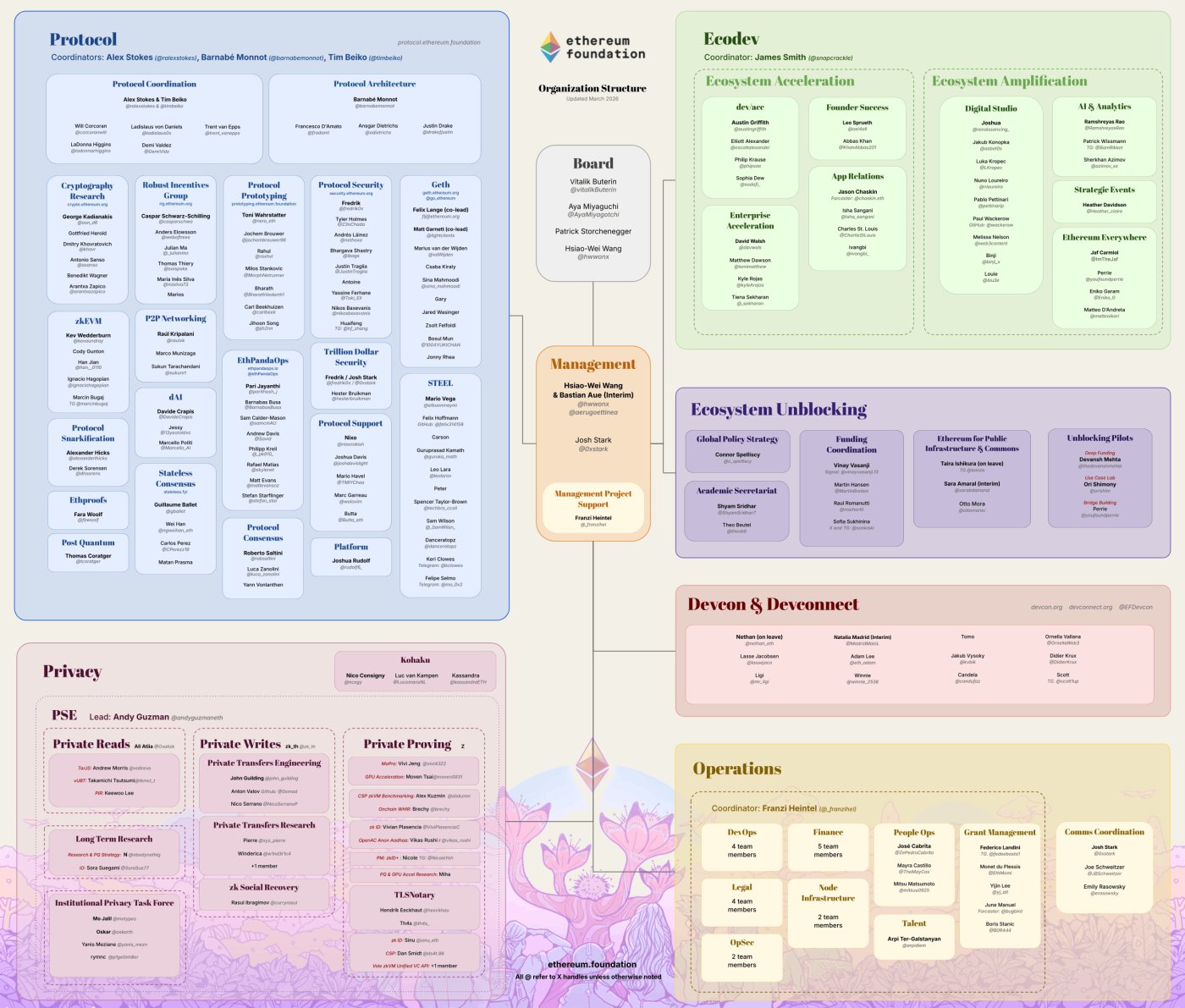
According to the latest internal organizational structure, the Ethereum Foundation's board members include Vitalik Buterin, Aya Miyaguchi, Patrick Stourchenegger , and Hsiao-Wei Wang. They are primarily responsible for Ethereum's governance and strategic direction, while the actual execution and operation are shared by the management team and various functional teams. The Ethereum Foundation divides its overall work into several areas based on function, primarily including:
- Protocol team: responsible for advancing the design and implementation of the Ethereum underlying protocol, covering multiple sub-fields such as zkEVM, post-quantum, and dAI;
- The Privacy team is responsible for promoting the research and implementation of on-chain privacy-related technologies, such as privacy transactions and zero-knowledge proof systems.
- Ecodev team: Responsible for promoting the development of the Ethereum ecosystem, including developer support, project incubation and ecosystem collaboration;
- Ecosystem Unblocking team: responsible for promoting ecological development through funding coordination, research support, and public infrastructure construction;
- The Operations team is responsible for the organization's day-to-day operations, including functions such as finance, legal, human resources, and internal management.
Meanwhile, in order to cope with the changes in the stage of ecological development and the needs of resource allocation, the Ethereum Foundation also made key adjustments to its funding system in August 2025, suspending the open funding program that had been running since 2018, and restarting the new Ecosystem Support Program (ESP) in November. After the adjustment, the funding allocation model will shift from "passively accepting applications" to "actively guiding", and its first batch of funding directions covers multiple areas such as cryptography, privacy, application layer, security, and community growth. At the same time, the foundation also decided to reduce the annual funding expenditure ratio from about 15% to 5% in order to slow down the consumption rate of ETH reserves. [2] This adjustment marks the Ethereum Foundation's shift from a broad-coverage ecological funding model to a refined resource allocation strategy oriented towards infrastructure and core technologies.
In May of this year, Ethereum Foundation researchers Carl Beek and Julian Ma announced their departures , while former Ethereum Foundation researcher Dankard Feist publicly stated that the Ethereum ecosystem needs to establish a new organization more aligned with Ethereum's economic interests to "save" Ethereum. In response, Vitalik Buterin and Ethereum co-founder Joe Lubin both stated that these controversies essentially reflect the friction between Ethereum's "long-term technical development" orientation and its current commercialization process, but this is a necessary stage of "growing pains" in the development process.
Improvements in PoS technology
While the transition to the Proof-of-Stake (PoS) mechanism allowed Ethereum to move away from its energy-intensive consensus model, the 32 ETH staking threshold has inadvertently raised the entry barrier for validators , potentially leading to the risk of centralized validation rights. If the goal is to lower the staking threshold for individual validators, a key issue becomes how to reduce the communication and coordination costs of reaching consensus and increase the cost of malicious attacks as the number of validators increases.
In response, Vitalik Buterin proposed that the security of the network could be enhanced by increasing the participation ratio required for final confirmation of blocks (for example, from the current threshold of about 2/3 signatures to 75% or even higher). [3] The core of this idea is that by raising the consensus threshold to hedge against potential security risks, decentralization and security can be balanced to a certain extent.
Current latest developments:
In May 2025, the Pectra upgrade was activated on the Ethereum mainnet.
In this upgrade, EIP -7251 raises the maximum effective balance limit for validators from 32 ETH to 2048 ETH. It's important to note that 32 ETH remains the minimum staking threshold to become a validator. The main purpose of this proposal is to increase the upper limit of consensus weight that a single validator can contribute, meaning a validator can directly represent more ETH in voting. This adjustment eliminates the need for large stakers to split their stakes into multiple validator nodes to receive incentives, thus reducing the likelihood of a single entity controlling multiple validator nodes and consequently lowering the communication and coordination overhead of nodes during the network consensus process.
EIP-7002 optimizes the staking withdrawal mechanism. This proposal introduces an execution-triggered withdrawal method, allowing stakers to complete withdrawals under certain conditions without the need for validators' active signatures. This mechanism enhances stakers' control over their assets, reduces the complexity of participating in and exiting staking to some extent, and further improves the overall flexibility of the PoS system.
In addition, the Ethereum Foundation has explored applying Distributed Validator Technology (DVT) to optimize staking structures. This technology essentially reduces the risk of single points of failure by distributing the private key and signing capabilities of a single validator across multiple nodes. This is because in traditional models, the system places high demands on the stability and private key management capabilities of validator nodes. In a multi-node collaborative model, the verification responsibility is shared by multiple nodes, thus reducing the requirements for the continuous online capability and operational efficiency of individual nodes. However, multi-node collaboration also introduces additional system complexity. Therefore, the Ethereum Foundation is attempting to introduce lightweight implementations (such as DVT-lite) to simplify the deployment and operation of distributed validators. According to information disclosed by the Ethereum Foundation in March 2026, 72,000 ETH were staked through this mechanism.
Blob storage critically low
EIP-4844 , implemented in the Dencun upgrade , introduced a low-cost data availability space called Blob for Ethereum, primarily used for storing temporary data. Currently, Layer 2 networks can submit bulk transaction data to Blob, reducing the cost of publishing on-chain data to some extent.
By design, the target number of blobs per block is 3, with a maximum limit of 6. To avoid overuse of blob space, Ethereum introduced a floating fee structure: when the number of blobs in a block is too high (more than 3 blobs), its base fee increases; conversely, when the number of blobs is too low (less than 3 blobs), its base fee decreases to encourage usage.
However, as Layer 2's demand for Blob space grows rapidly, the actual number of Blobs used in blocks gradually approaches or even frequently reaches the target value (3 Blobs), and the fee mechanism is repeatedly triggered to increase, resulting in a phased increase in the cost of using Blobs.
Current latest developments:
To alleviate the shortage of Blob capacity, Ethereum incorporated two related proposals into the Pectra upgrade. EIP-7691 increases the target number of Blobs per block from 3 to 6, and raises the maximum number of Blobs that can be carried per block to 9. EIP-7623 , on the other hand, attempts to increase the cost of Calldata usage to encourage Layer 2 to use Blobs more, thereby alleviating some of the pressure on mainnet data distribution.
With the Fusaka upgrade in December 2025, Ethereum further introduced a series of key mechanisms to improve data availability :
- EIP-7594 (PeerDAS) optimizes the verification method for Blob data, allowing Ethereum nodes to download and verify only a small portion of the total data through random sampling. Previously, each node had to download all Blobs in the current block for verification; with PeerDAS, nodes only need to sample and process about 1/8 of the data. This improvement effectively reduces the bandwidth and storage pressure on nodes when processing Blob data, enabling the network to handle more Blob data. Theoretically, this mechanism is expected to further improve the throughput of Ethereum's data availability layer, thereby supporting the release of more data from Layer 2 networks.
- EIP-7892 (Blob Parameter Only Fork , BPO) proposes a parameter-level scaling mechanism that allows clients to dynamically adjust the target number and upper limit of blobs without waiting for a full protocol upgrade. This approach is similar to the adjustment logic of Gas Limit, enabling the network to gradually increase blob capacity based on Layer 2 data demands, for example, transitioning from the current capacity of 6 blobs to 9 or even higher targets, thus achieving a smoother scaling path.
- EIP-7918 supplements the fee mechanism for Blobs. For Layer 2, publishing data to the Ethereum mainnet typically incurs two costs: the data availability fee for the Blob and the execution layer gas cost incurred in verifying this data. When the execution layer gas cost is too high, the Blob fee may lose its effective price-regulating function. In this context, this proposal introduces a minimum price anchor for Blob fees, ensuring a valid price signal under varying network load conditions, thereby guaranteeing that data publishing activities reasonably reflect their network resource consumption.
From a longer-term technical perspective, the introduction of Blob is not an isolated design, but rather a step in the evolution of Ethereum's scaling strategy. Initially, Ethereum proposed a sharding scheme, attempting to improve overall throughput by splitting the network into multiple subchains to process transactions and data in parallel. However, this scheme faces significant engineering complexity and security challenges in implementing execution-layer sharding.
Therefore, Ethereum is gradually shifting its scaling path from "execution sharding" to "data sharding," prioritizing the expansion of the network's data availability capabilities. The Blob mechanism serves as a transitional implementation in this direction. By introducing temporary data space, Layer 2 can publish batch transaction data to the Ethereum mainnet at a lower cost, while the data availability sampling mechanism introduced by PeerDAS further optimizes the verification method for Blob data. Thus, Blob is gradually becoming a key component of Ethereum's scaling system.
On December 11, 2025, the Ethereum Foundation announced that the capacity of each block's Blob had been increased to 15.
The future centered on Rollup
Currently, the number of Rollup solutions continues to increase, and their relationship with the Ethereum mainnet is undergoing structural changes.
On the one hand, Rollups reduce the execution load on the Ethereum mainnet to some extent by migrating transaction execution to Layer 2. However, this also changes the fee distribution structure: more transaction fees paid by users flow to Layer 2, while the mainnet primarily handles data publishing and settlement functions. This change has, however, impacted the fee structure and validator rewards on the Ethereum mainnet.
On the other hand, different Rollups are relatively independent in terms of architecture and ecosystem, gradually forming multiple parallel sub-ecosystems. This decentralization increases the complexity of cross-Rollup interactions to some extent. Although cross-Rollup interoperability solutions have attempted to improve this issue, the relevant mechanisms are still in a stage of continuous evolution in terms of security and implementation complexity.
Furthermore, as some Rollups explore more autonomous designs in areas such as sorting, data availability, or settlement layers , their reliance on the Ethereum mainnet has changed in certain aspects. This trend is altering the long-term relationship between Ethereum and Rollups.
Current areas to focus on:
For the Ethereum mainnet, as more user transaction fees flow to Layer 2, the revenue structure of Layer 1 is also changing, with its main sources gradually shifting to Blob Fee and MEV ( Maximum Extractable Value ).
Regarding the fragmentation issue of Rollups, developers in the Ethereum ecosystem have proposed different solutions. For example, interoperability protocols such as LayerZero and Hyperlane attempt to achieve communication between different Rollups through standardized messaging mechanisms; while shared sorter solutions such as Astria and Espresso start from the transaction sorting layer, attempting to provide a unified sorting service for multiple Rollups. However, this "Rollup — third-party infrastructure — Rollup" communication model is essentially still a non-Ethereum-native extension path. These solutions, while introducing additional trust assumptions, may also bring new security issues. Furthermore, the value capture behavior of shared sorters will also again impact the MEV distribution structure of Layer 1.
Meanwhile, rollups using different technology approaches are also accelerating the construction of their respective ecosystems. For example, Arbitrum is promoting the development of its Orbit chains ecosystem based on its Nitro/Orbit technology stack, with some projects (such as Plume Network and ApeChain) being practical examples of this expansion path; zkSync supports multi-chain expansion through the Elastic Chain architecture, with Abstract and ZERO Network being representative projects of this system; and Optimism has built Superchain around the OP Stack, with members including OP Mainnet , Base, BOB, and Soneium.
However, in mid-to-late February this year, the Base team announced that it would gradually break away from the Optimism OP Stack architecture and switch to the Base Stack unified technology stack maintained by itself. However, since Base was originally built using the OP Stack, this process is closer to a customized extension on the basis of the open source framework than a complete break away from the Optimism system. The Base team also stated that it will continue to cooperate with the Optimism ecosystem and follow relevant open source specifications. [4] This event also reflects that as the scale of the Rollup ecosystem expands, its autonomy in technical architecture and governance is increasing. As a result, the relationship between Rollup and the Ethereum mainnet has gradually evolved from an early cooperative relationship centered on scaling to a subtle structure with both competition and game characteristics on the basis of collaboration.
In response, the Ethereum Foundation has begun to address this issue. While continuously optimizing Rollup data availability, the Ethereum Foundation established the Platform Team (under the Protocol team framework) as a coordinating unit connecting protocol development and ecosystem growth. The team is dedicated to re-evaluating and optimizing the relationship between the Ethereum mainnet and Layer 2, attempting to transform them from a delicate alliance into a highly collaborative and mutually reinforcing unified platform.
On March 23 this year, the Ethereum Foundation once again published a systematic explanation of the evolution of the roles of Layer 1 and Layer 2. In the latest definition, the core positioning of Layer 2 is no longer limited to scaling, but to meet the differentiated needs that Layer 1 cannot provide, such as stronger privacy protection, lower latency requirements, and compliance adaptation for specific scenarios, and to create greater value for the Ethereum mainnet through its own prosperity, rather than competing with Layer 1. At the same time, the Ethereum mainnet will assume the role of "the core settlement layer and liquidity layer of the multi-chain ecosystem", enabling the two to develop together in a positive and collaborative direction. [5]
To achieve these goals, Ethereum plans to proceed along two paths: one is to strengthen the connection between Rollups and the Ethereum mainnet, and the other is to explore the implementation path of Native Rollups.
First, in terms of improving multi-chain collaboration, the Ethereum ecosystem is exploring a more native cross-Rollup interaction framework. With funding from the Ethereum Foundation, Friederike Ernst, co-founder of Gnosis, and Jordi Baylina, founder of Zisk, recently jointly announced the Ethereum Economic Zone (EEZ) plan. [6] The plan attempts to build an L1<>L2 framework that will incorporate cross-chain interactions between Rollups and the mainnet, and between Rollups, into a unified execution framework.
Under the EEZ framework, cross-chain interactions no longer rely entirely on traditional asynchronous messaging mechanisms, but instead promise a stronger form of composability . For example, contract calls between different execution environments can be completed within the same execution flow and possess atomicity —meaning related operations either all succeed or are rolled back entirely, thus reducing the risk of state inconsistency in cross-chain interactions. Once this design is implemented, it will help alleviate the fragmentation problem between Rollups, allowing them to scale Ethereum's performance while remaining reliant on the mainnet's security and ecosystem, rather than developing mainnet. Currently, the specific implementation path of EEZ still needs further clarification.
Secondly, Ethereum ecosystem developers recently released a proof-of-concept prototype of Native Rollup (proposed in EIP-8079 ), attempting to fundamentally reconstruct the verification method of Rollup. Currently, both Optimistic Rollup and ZK Rollup require additional mechanisms (such as fraud proofs or zero-knowledge proofs) to prove the correctness of their results to the Ethereum mainnet after executing transactions and generating state. Furthermore, both must adhere to Ethereum's underlying rules for processing transactions and updating state, making Rollup require maintaining a relatively complex execution and verification system.
EIP-8079 attempts to provide Ethereum's "state transition functions" as an open interface for Rollups to call. In this model, Rollups can submit transactions to be executed to the mainnet, where the mainnet will perform state calculations according to unified rules, thereby reducing reliance on independent proof systems and lowering the maintenance costs of the Rollup itself. This process can be understood as follows: In the traditional model, students need to solve the problem themselves and submit proof that their solution is correct, which is then verified by the teacher; however, in the Native Rollup mechanism, the division of labor between students and teachers changes (more closely resembling a collaborative relationship in a research scenario). Students are no longer responsible for solving the problem and generating proofs; instead, they only need to submit the prepared problem information to the teacher, who will directly perform the calculations according to unified rules, thus eliminating the intermediate proof step.
Overall, whether it's strengthening inter-chain collaboration through EEZ or simplifying underlying verification logic through Native Rollups, both paths essentially point in the same direction: while maintaining the scalability of Rollups, further enhancing their connection with the Ethereum mainnet and preventing the multi-chain ecosystem from developing in a fragmented direction. These explorations largely rely on the continued progress of underlying technologies such as ZK proofs and ZK- EVM .
The battle surrounding MEV
After Ethereum transitioned to the Proof-of-Stake (PoS) mechanism, the network randomly selects block proposers from among validators who have staked ETH. These proposers are responsible for the final publication of blocks. During this process, block proposers can manipulate the order of transactions within a block to extract value exceeding the standard block reward and gas fees (MEV). Therefore, to decentralize control over transaction ordering and value extraction from a single validator, Ethereum previously proposed the idea of "Proposer-Builder Separation" (PBS). This aims to split the responsibilities of "packaging" and "final confirmation" of blocks: dedicated builders are responsible for packaging transactions, while proposers are only responsible for selecting and submitting blocks from multiple candidate blocks. This improves block construction efficiency while reducing the complexity and barrier to entry for validators participating in block production.
However, while this division of labor mechanism brings efficiency improvements, it also introduces new structural problems: as specialization increases, block building capabilities gradually concentrate in a few builders, which in turn enhances their influence in transaction ordering and MEV allocation, thus sparking discussions about power concentration and potential centralized risks.
Current areas to focus on:
Glamster Dam is Ethereum's next major upgrade, with the core goal of systematically improving the mainnet's performance, capacity, and long-term sustainability without sacrificing decentralization or significantly increasing the hardware burden on ordinary nodes.
According to the plan, Glamsterdam will restructure the division of responsibilities among different participants in the network. Its core directions include three points: First, by introducing parallel processing capabilities, it will prepare for future improvements in transaction execution speed; second, by re-dividing the workflow of "block creation" and "block verification", it will give the network more time for data propagation, thereby supporting larger-scale data loads; and third, it will adjust the fee mechanism so that the storage cost of on-chain data can more accurately reflect its long-term resource consumption of nodes (such as bandwidth and storage).
One of the most critical adjustments in this upgrade is EIP-7732 (Enshrined Proposer-Builder Separation, or ePBS for short).
According to Ethereum's previous design, without PBS (Block Proposal and Transaction Packet), validators are responsible for both proposing blocks and packaging and sorting transactions themselves. This not only raises the barrier to entry but also makes it easier for nodes with stronger sorting capabilities to concentrate, thus exacerbating the risk of centralization. Furthermore, validators can directly extract MEVs by rearranging or filtering transactions, which also impacts network fairness.
Under the PBS mechanism, the Builder on Ethereum is only responsible for collecting transactions, sorting them, and packaging them into candidate blocks; while the Proposer is only responsible for selecting from multiple candidate blocks and completing the final block production. In other words, this mechanism separates the "value extraction capability" from the "block confirmation right," thereby helping to alleviate the monopoly of a single role on MEV.
However, in past implementations, the PBS mechanism was not directly written into the protocol. Instead, it was implemented through third-party middleware such as MEV-Boost. The principle is to allow validators to outsource block construction to third-party Builders, with information transmission completed through relays . While this mechanism has effectively improved block construction efficiency in practice, it is essentially still an off-chain market: it relies on trusted relays, carries a certain degree of centralization risk, and the MEV allocation process lacks on-chain transparency and constraints.
EIP-7732 formally incorporated the "proposer-builder separation" mechanism into the Ethereum protocol. It introduced Builders as formal participants in the Ethereum network, requiring them to stake their tokens and submit a block "commitment" (a promise to complete the task) to the network. Simultaneously, this mechanism decouples consensus verification from execution verification, which previously required a very short timeframe. This allows the network to prioritize consensus layer verification during critical block propagation phases, while postponing the complete execution layer verification (transaction execution and state updates) to later stages. This process is similar to a teacher collecting many student papers, but first confirming that each student has submitted their paper before taking them back to the office to grade them at their own pace.
In this way, ePBS not only reduces the network's reliance on relays, but also, by adjusting the block verification process, gives nodes more time to propagate block data. This allows Ethereum to support larger-scale data volumes, especially Blob writes, while maintaining network stability. Therefore, this is not only a structural optimization of the MEV mechanism, but also provides a crucial foundation for expanding Ethereum's data availability.
Impact from Layer 1 databases such as Solana and Sui
As Ethereum advances its vision of a "Rollup-centric future," classic blockchains like Solana and next-generation public chains like Sui are attempting to achieve higher throughput and lower transaction latency directly on the main chain by optimizing underlying execution models and consensus mechanisms. For example, Solana improves overall processing capacity through parallel execution and a local fee market, while Sui, based on an object model and DAG architecture, achieves more efficient concurrent processing in specific scenarios. This characteristic can meet the needs of certain application scenarios (such as high-frequency trading and on-chain games).
The rise of these Layer 1 layers has also brought some potential impacts to Ethereum:
First, high-performance Layer 1 can provide a low-cost, high-throughput execution environment directly on a single chain, which reduces users' reliance on cross-Layer 2 operations and weakens the advantages of the Ethereum ecosystem to some extent.
Secondly, compared to the Layer 1+Layer 2 system, ordinary public blockchains can usually provide a more integrated development environment and execution model. The Ethereum ecosystem, on the other hand, requires developers to handle cross-chain communication and liquidity dispersion between Layer 1 and different Layer 2, which objectively increases the complexity of deploying applications.
However, this competitive relationship is not a simple confrontation. High-performance Layer 1 and the Ethereum ecosystem still differ in their application scenarios, representing the differences in the direction of infrastructure exploration among different blockchains.
Current areas to focus on:
As can be seen from the preceding text, although Ethereum still adheres to the scaling path centered on Rollups, its overall approach has undergone some adjustments, and it is attempting to further converge some key capabilities (such as data availability, settlement, and security) to Layer 1, thereby strengthening the mainnet position as a "unified economic center".
To achieve this goal, Ethereum has proposed the long-term vision of Single Slot Finality (SSF).
In the Ethereum network, validators need to reach a consensus on the transactions that can be included in a block and their order approximately every 12 seconds. This time window is called a Slot, and every 32 Slots (approximately 6.4 minutes) constitute an Epoch , used to organize validator voting and advance the finality of the block. Under the current mechanism, a block in Ethereum requires at least 2/3 of the validators to complete two rounds of voting (i.e., a confirmation process of two Epochs) to be considered finally confirmed (i.e., ultimately irreversible). Therefore, it typically takes about 2 Epochs (approximately 12–15 minutes) for a block to go from generation to final confirmation. This design achieves a good balance between security and decentralization, but from a user experience perspective, the confirmation time is still relatively long.
Based on this, Ethereum proposed a vision to compress the final logic that originally required two epochs into a single slot, thus achieving single-slot finality.
To achieve this goal directly within the existing architecture, strategies such as reducing the number of validators or improving node hardware performance could be used to speed up the confirmation process, but these would also weaken the network's decentralization to varying degrees. Therefore, the key bottleneck for SSF is not "reducing the scale," but rather optimizing the verification and communication process, enabling nodes to complete more verification and signature processing within the same time window. To this end, the Ethereum community has proposed several possible paths, such as introducing a "super committee" mechanism, randomly selecting a portion of validators within a single slot to form a temporary committee for rapid voting and confirmation; or improving confirmation efficiency without compromising security by adjusting the validator participation mechanism and weight distribution. However, completing the collection, aggregation, and verification of large-scale signatures in a very short time introduces new technical complexities.
Therefore, before SSF is fully implemented, the Ethereum Foundation proposed a transitional optimization scheme – the Fast Confirmation Rule (FCR).
In simple terms, FCR aims to reduce the confirmation time for deposits from Ethereum L1 to L2 and centralized exchanges from several minutes to approximately 13 seconds. It doesn't change the existing final confirmation mechanism, but rather uses the results of the first round of voting to assess security in advance. That is, when the first round of voting reaches a high percentage (e.g., significantly exceeding two-thirds), the system can determine that the probability of the block being rolled back is low, thus treating it as "basically confirmed" in advance.
For example, in a vote that normally requires two rounds of formal voting to determine the result, if one side gains an overwhelming majority in the first round, the final outcome can be effectively decided in advance.
However, FCR is not equivalent to true final confirmation. Its security relies on two prerequisites: first, the majority of validators must act honestly; and second, network communication must remain stable and with low latency. If the network becomes congested or attacked, blocks that have been quickly confirmed may still be reassembled, potentially rolling back to the original rules. Therefore, FCR may currently be more suitable for scenarios that are sensitive to confirmation speed and can tolerate low-probability risks.
References
[1] Why did the core figure of the Ethereum Foundation leave again after less than a year in office?
[2] Ethereum Foundation Treasury Policy | Ethereum Foundation Blog
[3] Possible futures of the Ethereum protocol, part 1: The Merge
[4] A new, unified stack for Base Chain
[5] How L1 and L2s can build the strongest possible Ethereum
[7] How big is 128 bit ?! 🤔. Recently, I started working on a… | by Adeojo Emmanuel | Medium
[8] Shipping an L1 zkEVM #2: The Security Foundations | Ethereum Foundation Blog
[9] "Blockchain Privacy and Regulatory Compliance: Towards a Practical Equilibrium"
[10] Wintermute warns Pectra upgrade leaves Ethereum users at risk of automated attacks | The Block
[11] Etherealize Raises $40 Million to Rewire Wall Street's Infrastructure with Ethereum
[12] EU Turns Up the Heat on Crypto Taxes as DAC8 Comes Into Force – FinanceFeeds
[13] We need a good trustless onchain gas futures market
[14] Ethereum Foundation Treasury Policy | Ethereum Foundation Blog
[15] Defi is a central part of the value that Ethereum provides
[16] Allocation Update – Q4 2025
[17] This Is Fine (Until the Grant Runs Out) | Ethereum Foundation Blog
[18] Announcing Protocol | Ethereum Foundation Blog
[19] A new chapter in the infinite garden | Ethereum Foundation Blog
[21] Why do Ethereum developers want to provide institutions with a “one-click staking” feature?
[22] Fulu-Osaka (Fusaka) | ethereum.org
[23] Ethereum 2029 Strawmap: A Beginner's Guide
[24] https://blog.ethereum.org/2026/03/23/l1-l2-ethereum
[25] Introducing the Ethereum Economic Zone (EEZ)
[26] Native rollups—superpowers from L1 execution – Layer 2 – Ethereum Research
[27] Proposer-builder separation | ethereum.org
[28] Glamsterdam | ethereum.org
[29] Fast Confirmation Rule #4747
[30] Single slot finality
[31] zkEVM – Scaling Ethereum Without Compromise
[32] Ethereum 128-Bit Security By 2026: Speed Losses To Safety In Major Shift | MEXC
[33] Glamsterdam Upgrade – Forkcast
[34] Hegotá Upgrade – Forkcast
[35] Checkpoint #9: Apr 2026 | Ethereum Foundation Blog
[36] Working with EF leadership on the dAI Team 2026 roadmap
[37] Introducing the Ethereum Economic Zone (EEZ)
[38] Ethereum Foundation cuts and departures aren't a crisis, Joe Lubin says
Disclaimer: This report was prepared by Web3Caff Research. The information contained herein is for informational purposes only and does not constitute any forecast, investment advice, proposal, or offer. Investors should not rely on such information to buy or sell any securities, cryptocurrencies, or adopt any investment strategies. The terminology and opinions expressed in this report are intended to help understand industry trends and promote the responsible development of the Web3 new economy, including the blockchain industry, and should not be construed as explicit legal opinions or the views of Web3Caff Research. The views expressed in this report reflect the author's personal opinions as of the stated date and are not related to the position of Web3Caff Research, and are subject to change as circumstances warrant. The information and opinions contained in this report are derived from proprietary and non-proprietary sources that Web3Caff Research believes to be reliable, and do not necessarily cover all data, nor is their accuracy guaranteed. Therefore, Web3Caff Research makes no warranty of any kind regarding its accuracy and reliability, and assumes no liability for errors and omissions arising in any other way (including liability to any person arising from negligence). This report may contain forward-looking information, including forecasts and predictions, which do not constitute a guarantee of any predictions. Whether to rely on the information contained in this report is entirely up to the reader. This report is for informational purposes only and does not constitute investment advice, a proposal, or an offer to buy or sell any securities, cryptocurrencies, or to adopt any investment strategy. Please strictly comply with the applicable laws and regulations of your country or region.