The shift from "default" to "optional setting" for public holdings provides a new boost to the institutionalization of DeFi.
Written by: Sanqing, Foresight News
On June 17, Zama, in collaboration with Morpho and Steakhouse Financial, launched Steakhouse Confidential USDC Prime, Ethereum's first DeFi yield vault for Confidential USDC (cUSDC). This means that institutions can finally obtain the same yields as traditional flagship vaults while maintaining confidentiality regarding on-chain deposit size and transaction timing.
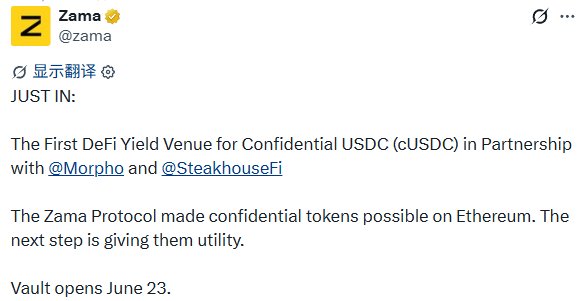
The vault will officially open for deposits on June 23. Morpho's TVL is approximately $7 billion, while Steakhouse Financial manages related vaults with a TVL of nearly $2 billion and manages yield products on major exchange platforms such as Coinbase, Bitget, and Crypto.com.
Institutions are hesitant to embrace "openness".
"One demand we keep hearing from institutions is on-chain confidentiality," said Merlin Egalite, co-founder of Morpho. "Zama's confidentiality stack, built on top of Morpho, allows institutions to allocate funds to the Morpho vault just like any other on-chain configuration, without compromising operational privacy."
Transparency in public blockchains has long been regarded as the moral foundation of decentralized finance, but for institutional funding platforms, it is an invisible shackle.
Existing lending protocols rely on public blockchains, making information on every deposit publicly visible. An asset management institution's actions are immediately captured by arbitrage bots, competitors, and on-chain analytics tools, allowing for the deduction of its liquidity management strategies. Position size, entry timing, and risk appetite for collateral are all readily apparent.
Competitors can use this information to infer the institution's strategic intentions and even conduct targeted replication or reverse operations; arbitrage robots may use their information advantage to gain an early advantage. This means that institutions not only lose the confidentiality of their strategies but may also incur higher execution costs and lower actual returns.
The reason why institutions are not entering DeFi in large numbers, or even building their own networks, is not only due to multiple factors such as regulation, custody compliance and operational security, but also because of the high degree of transparency.
Reuse of mature vaults
"The trend toward stablecoins in the economy is moving rapidly," said Sébastien Derivaux, co-founder of Steakhouse Financial. "Steakhouse USDC Prime is our oldest vault on Morpho, designed with a strong focus on liquidity and risk awareness."
The Steakhouse Confidential USDC Prime vault's product design deliberately maintains a minimal modification principle. The vault's underlying layer directly uses Steakhouse Prime v2, with the credit strategy, risk parameters, and collateral basket (cbBTC, WBTC, wstETH) remaining unchanged. Users deposit cUSDC, the underlying routing remains the original vault, and the yield source remains the Morpho lending market.
The only change is the form of the deposited assets. You need to first confidentialize the standard USDC through the Zama application (Shield, i.e., hide it as cUSDC, one transaction, no need for cross-chain or creating a new wallet), and then deposit it into the vault to start earning returns.
The deposit size, operational direction, and entry time are kept confidential throughout the entire process on the blockchain, while the overall supply and audit data of the vault remain auditable to the compliant party.
FHE's three-step approach: from token issuance to confidential revenue.
Zama is a deep-tech company focused on cryptography and privacy computing, co-founded by CEO Dr. Rand Hindi and CTO Dr. Pascal Paillier. Paillier is a leading cryptographer in the field of homomorphic encryption, and his Paillier scheme remains a widely used core algorithm globally. The team comprises over 90 people, nearly half of whom hold doctoral degrees.
Zama has completed a funding round of over $150 million (a $73 million Series A round led by Multicoin Capital and Protocol Labs, and a $57 million Series B round led by Pantera Capital and Blockchange), reaching a valuation of $1 billion and becoming the world's first unicorn in the FHE (Functional Healing) field. Investors also include well-known founders such as Gavin Wood, Anatoly Yakovenko, and Juan Benet.
Zama's core technology, FHE (Fully Homomorphic Encryption), is hailed as the "holy grail of cryptography." It allows computation directly on encrypted data. In blockchain applications, this means smart contracts can process encrypted balances and amounts without seeing the plaintext, achieving both public verifiability and confidentiality.
As of press time, the total value of confidentiality (TVS) of the Zama protocol has reached $191 million, and the on-chain adoption of FHE has reached a certain scale.
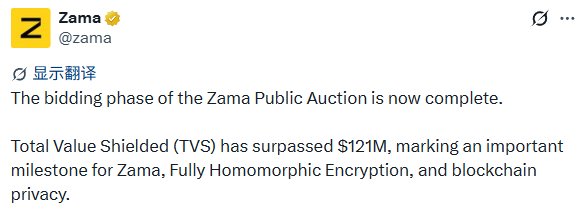
In February 2026, Zama completed its ZAMA token public auction, marking the first ICO on Ethereum to utilize FHE technology. It employed a cryptographically sealed bid method, with all bids encrypted throughout the auction to prevent front-running. The total on-chain committed value during the auction was approximately $121 million, with actual fundraising of approximately $44 million based on the liquidation price.
In May 2026, Zama acquired TokenOps, an enterprise-grade token lifecycle management platform, extending its confidentiality capabilities to token issuance, ownership, and airdrop distribution scenarios.
Steakhouse Confidential USDC Prime is the third step, embedding FHE into existing DeFi yield structures to provide a truly capital-efficient exit for confidential assets.
By validating the technology's feasibility, establishing a token economy, and creating a revenue loop for institutional funds, Zama is expanding the boundaries of the "Confidential Token" application with each step.
FHE, which had long remained in cryptography labs, can now support real institutional funds operating on the Ethereum mainnet. When protocols of Morpho's scale integrate confidential deposit capabilities into their architecture, it signifies that confidential DeFi has entered the "production-ready" stage.