The period from 2024 to 2026 marks a fundamental turning point for the industry. For the first time in history, a public blockchain (Ethereum) can run smart contracts on encrypted data when Zama launches fhEVM on its mainnet on December 30, 2025, while US courts accept that immutable smart contracts are not “assets” under sanctions law. These two events, seemingly opposite in nature, together shape a new reality: blockchain privacy technology has moved beyond the lab, while the global legal framework is deeply polarized between the European Union (prohibition), the Trump-era US (open), and China (“controlled anonymity”). This report begins with the fundamental concept of security and privacy in blockchain, then analyzes nine technological trends with specific examples, and finally presents five opposing viewpoints on whether users should be allowed to use these tools. The target audience is the general readership in Vietnam interested in fintech policy.
1. Privacy in blockchain: Concept, rationale, and current issues
1.1. What are security and privacy in the context of blockchain?
A public blockchain like Bitcoin or Ethereum operates on the principle of absolute transparency. Every transaction, balance, and address is recorded publicly and permanently, and anyone in the world can look it up. This is the core feature that allows blockchains to eliminate the need for a trusted intermediary, as everyone can verify the ledger themselves. However, this very transparency creates privacy issues.
It's important to distinguish between two commonly confused concepts. Security, in a broad sense, refers to the safety of assets and systems against attacks, fraud, or losses. Privacy, on the other hand, is narrower, referring to an individual's ability to control who can see what information about them. A system can be technically very secure but completely lacking in privacy, and public blockchains are a prime example.
Another key point is the difference between anonymity and pseudonym. Bitcoin or Ethereum wallet addresses are not anonymous but pseudonyms, like pen names. The address itself doesn't associate the real name, but once someone links the address to a real-life identity (through an exchange with identity verification, an IP address, or spending habits), the entire history of that person's past and future transactions is exposed. Privacy in blockchain, therefore, is an attempt to break this link using cryptographic techniques.
1.2. Why privacy has become a crucial component of blockchain infrastructure.
In its early years, privacy was seen as a secondary, even questionable, feature, as many believed only bad actors needed to conceal transactions. But as public blockchains gradually moved from a tech enthusiast's experiment to a real infrastructure for payments, finance, and value storage, a new understanding emerged: an exposed ledger would never be suitable for mass use. Privacy thus shifted from a feature to a prerequisite for widespread blockchain adoption.
The root cause lies in the fact that transparency is a double-edged sword. The same characteristic that allows anyone to verify the ledger also makes all of a person's financial information permanently exposed. If a business pays its employees in cryptocurrency on a public blockchain, then all employees can see each other's salaries, competitors can know how much the business pays which suppliers, and anyone can see the company's balance sheet. In real life, no one would agree to display their bank account statement on their door, so a financial infrastructure that forces people to do just that is unlikely to be used for serious transactions.
From a personal perspective, absolute transparency creates direct security risks. When balances and cash flows are made public, individuals are more vulnerable to cyberattacks, blackmail, or even kidnapping for ransom, which has happened to those holding large amounts of digital assets. Privacy also provides a shield for vulnerable groups such as journalists, social activists, or dissidents, who could be traced and punished if their cash flow is exposed.
From a business and organizational perspective, privacy is almost a mandatory requirement. No company can operate on an infrastructure where every transaction with partners, every payment, and every cash flow strategy is visible to competitors. This is the biggest barrier that has made large financial institutions hesitant about public blockchains for many years, and is also why projects like JPMorgan Kinexys and BIS's Project Agorá place transaction security at the core of their requirements.
Privacy is also linked to the fairness of the on-chain market. When all pending transactions are public, intermediaries can see user orders and place their own orders in advance to profit, a problem commonly known as MEV. Without privacy at the transaction layer, ordinary users are always at a disadvantage against parties with greater observational and reactive capabilities.
Ultimately, many experts view financial privacy as a fundamental right, similar to the right to use cash. Cash allows two people to exchange value without reporting to a third party, and proponents argue that citizens should not lose that right simply by switching to digital currency. In summary, these five factors—mass usability, personal safety, business security, market fairness, and fundamental rights—explain why privacy is no longer an add-on, but has become an infrastructure layer that most serious blockchain projects must consider.
1.3. Issues of privacy at the present stage
Despite being acknowledged as important, privacy on the blockchain still has many unresolved issues, and these issues are shaping the technological trends that will be analyzed later.
The most fundamental issue is that public blockchains are inherently transparent, while blockchain analytics capabilities are increasingly powerful. Companies like Chainalysis and Elliptic have developed tools to trace back funds and strip away the anonymity of millions of addresses, turning the argument that blockchains are inherently anonymous into a common misconception. In reality, public blockchains are one of the most easily supervised financial systems ever created, and privacy must be proactively enhanced with additional layers of technology.
The second problem is that optional privacy is often weak in practice. When users are given the choice to hide transactions or not, the majority don't use the hiding feature, resulting in a very small user base that is easily subject to reverse interpretation. The Zcash case analyzed in section 2.1 is the clearest example, where a theoretically very strong protection design is weakened because too few people actually use it.
The third issue is the trade-off between privacy and legal compliance. A completely anonymous system is difficult to control money laundering, while a completely transparent system infringes on individual rights. Finding a balance between these two extremes is the central problem, and also the reason for the emergence of selective disclosure mechanisms such as view locks or innocence certificates. This is accompanied by increasingly severe legal risks, as privacy tools are banned, privacy cryptocurrencies are removed from exchanges, and some programmers who write privacy software face criminal prosecution, putting pressure on both developers and users.
The fourth issue is technical cost. The most powerful techniques, such as non-disclosure proof-of-concept or homomorphic encryption, consume significantly more computational resources than conventional transactions, sometimes being thousands of times slower, although this gap is rapidly narrowing. High costs mean higher transaction fees and slower speeds, reducing competitiveness compared to transparent solutions.
The fifth issue is the complex user experience and the risk of losing keys. Private wallets require users to understand new concepts such as view keys, the scanning and synchronization of transactions takes time, and account recovery is more difficult than with regular wallets. A small mistake can result in permanent loss of funds, and this barrier makes privacy difficult to become the default in practice.
Finally, there are emerging risks, including dust attacks where malicious actors send small amounts of dirty money to innocent people's wallets to freeze their accounts, hardware vulnerabilities in trusted execution environments discovered in 2025, and the long-term threat from quantum computers that could break the digital signatures currently protecting most blockchains.
2. 9 Privacy Technology Trends on Blockchain
2.1. From optional privacy settings to default privacy settings
In blockchains with privacy features, two opposing design philosophies exist. The optional privacy model allows users to decide whether or not to hide transactions, exemplified by Zcash with its transparent and shielded address types. The default privacy model mandates that all transactions be hidden, exemplified by Monero. The key difference lies in the size of the anonymity set, which is the number of transactions that observers cannot distinguish from one another.
The Zcash case illustrates the weakness of the option model. Two classic studies by Quesnelle (2017) and Kappos et al. (USENIX Security 2018) found that approximately 31.5% of coins entering the shielded pool were subsequently withdrawn in equal amounts, creating a “round-trip transaction” that could be traced back using simple reasoning. In this way, over 80% of Zcash transactions at that time could be linked to at least one transparent transaction. However, since the Zashi wallet was launched in 2024 with default shielding settings, the percentage of supply in the shielded pool has increased from around 8% at the beginning of 2024 to nearly 30% by June 2026, with daily shielded transactions peaking at 59.3% in February 2026.
Monero takes the opposite approach. Since 2017, all transactions have been required to use ring signatures, stealth addresses, and RingCT (RingCard Concealment). The FCMP++ upgrade, scheduled for late 2026, will extend anonymity to the entire blockchain, making each transaction anonymous across the network. This demonstrates that privacy is only truly protected when a sufficient number of users are involved, and this only happens when it's the default, or when the user experience is good enough to make it the default in practice.
2.2. Programmable privacy
The second trend expands privacy from the realm of money transfers to the realm of customizable smart contracts. Aztec Network launched Ignition Chain on Ethereum on November 19, 2025 , the first private network to reach the decentralized “Stage 2” level according to L2Beat rankings, with a hybrid model allowing a contract to have both public and private states. The AZTEC token auction in December 2025 raised $60.8 million (19,476 ETH), with half of the funding coming from the community. Co-founder Zac Williamson stated that the period from 2025 to 2035 will be the turning point for privacy technology, and that privacy must be an enforcement tool, not an added feature.
Aztec developed the Noir language, dubbed the "LLVM of zk-SNARKs," allowing programmers to write non-disclosure proof-of-concept circuits using Rust-like syntax, compile them to various proof-of-concept systems, and verify them on any Ethereum-compatible blockchain (EVM). Aleo follows an independent Layer 1 approach, launching its mainnet on September 18, 2024, with over 350 applications and using the Leo language, combining the advantages of Ethereum (smart contracts) and Zcash (privacy). Aleo's total funding reached approximately $298 million, including a $200 million Series B round co-led by SoftBank Vision Fund 2 and Kora Management in 2022. Some applications have already been implemented, such as passports proving non-sanction status without revealing original information, secret ballots for decentralized autonomous organizations, and unsecured lending.
2.3. Full Homomorphism Encryption (FHE) on the Blockchain
Fully homomorphic encryption (FHE) allows for direct computation on encrypted data without the need for decryption. Realized by Craig Gentry in 2009, FHE was once called the "holy grail" of cryptography and has now surpassed the production feasibility threshold.
Zama, a French company founded by Rand Hindi and Pascal Paillier, became the world's first FHE unicorn with a $57 million Series B funding round on June 25, 2025 , raising its total capital to over $150 million and valuing it at over $1 billion. On December 30, 2025, Zama launched fhEVM on the Ethereum mainnet, with the first secure stablecoin transaction (cUSDT) costing only about $0.13 in gas fees . During the testing phase from July 1, 2025 to December 30, 2025, the network processed over 6.9 million transactions and deployed 27,662 secure contracts, with genesis operators including Etherscan, Fireblocks, Ledger, OpenZeppelin, and LayerZero. Rand Hindi believes that most blockchain transactions will eventually require security.
Fhenix, founded by former Intel FHE head Guy Itzhaki, transitioned from a Layer 2 model to off-chain co-processors for FHE (CoFHE), now operating on Arbitrum and the Ethereum test network, raising a total of $22 million. Inco Network built a modular security layer with $10 million raised through three rounds and co-founded the Confidential Token Association with OpenZeppelin and Zama, announcing the ERC-7984 standard for tokens with encrypted balances. FHE performance has improved 100-fold since 2020, with GPU decoding latency below 1 millisecond and a target of 1,000 to 10,000 transactions per second by the end of 2026 with dedicated hardware.
2.4. Selective disclosure and privacy-friendly compliance.
This is perhaps the most legally significant trend. The research paper “Blockchain Privacy and Regulatory Compliance: Towards a Practical Equilibrium” (SSRN, September 2023) , co-authored by Vitalik Buterin with Jacob Illum (Chainalysis), Matthias Nadler, Fabian Schär (University of Basel), and Ameen Soleimani, proposes the concept of separating equilibrium, whereby users with clean money have the incentive and ability to prove it with evidence without disclosing information, while bad actors do not; thus, the two groups naturally separate without needing to disclose their transaction history.
Privacy Pools, developed by 0xbow and launched on the Ethereum mainnet on March 31, 2025 , is a direct realization of this proposal. After about eight months, the system has a volume of $6 million, over 1,500 users, and 1,186 withdrawals. Notably, the Ethereum Foundation integrated Privacy Pools into the Kohaku standard wallet at Devconnect Buenos Aires in November 2025, marking the first time a privacy technology has been incorporated into Ethereum's core infrastructure. Railgun, operating on Ethereum, BNB Smart Chain, Polygon, and Arbitrum, uses a "proof of innocence" mechanism requiring each deposit to be accompanied by proof of non-involvement with sanctions. The total value locked in Railgun increased from $14 million to nearly $90 million in 2024, with a total volume since launch reaching $2.62 billion.
On April 15, 2024, Vitalik Buterin publicly transferred 100 ETH (approximately $330,000) via Railgun and declared that "privacy is normal." He explained that Railgun uses privacy pools, making it very difficult for malicious actors to join without violating users' privacy .
2.5. Proof of non-disclosure of identity (ZK identity)
This trend allows users to prove attributes such as age, nationality, or identity verification without revealing their original data. Anon Aadhaar, a project by the Privacy & Scaling Explorations team of the Ethereum Foundation , applies to India's Aadhaar ID system, which has over 1.4 billion participants and is the world's largest identity system. Users can prove ownership of a valid Aadhaar card without revealing the 12-digit number.
Worldcoin (renamed World Network in October 2024) took a more ambitious but also controversial approach: scanning irises using an "Orb" device to create World IDs as proof of identity. By the end of 2025, the system had nearly 38 million users, with over 12 million verified using Orb in 35 countries. However, at least nine data protection agencies suspended or banned Worldcoin , including Spain (March 2024), Portugal (March 2024), Hong Kong (May 2024), South Korea (September 2024), Germany (December 2024), Brazil (January 2025), Indonesia (May 2025), Kenya (declared illegal in May 2025), and Colombia. Vitalik Buterin, in a July 2023 essay, noted that Worldcoin offers significantly better privacy protection than public facial recognition video systems, but still cautioned against trusting the Orb maker. Other projects like Privado ID (split from Polygon Labs in June 2024) and zkPassport (reading chips in biometric passports from over 130 countries) represent a less centralized approach.
2.6. Post-quantum and zk-STARKs resist quantum computers
The Shor algorithm, published in 1994, allows quantum computers powerful enough to break ECDSA digital signatures, which form the foundation of Bitcoin, Ethereum, and most current blockchains. A 2026 Google study predicts "Q-day," the point at which quantum computers can crack encryption in under 9 minutes, possibly as early as 2029. The current threat lies in the "harvest now, decrypt later" tactic, meaning attackers store encrypted data today to decrypt it later.
On August 13, 2024, the U.S. National Institute of Standards and Technology (NIST) officially released the first three post-quantum standards : FIPS 203 (ML-KEM) for key exchange, FIPS 204 (ML-DSA) for digital signatures, and FIPS 205 (SLH-DSA), a hash-based standard for long-term security. A fourth standard, FIPS 206 (FN-DSA, based on Falcon), is currently in the public draft stage and is expected to be finalized by the end of 2026.
Ethereum has been preparing early. At Devcon Bangkok on November 12, 2024, Justin Drake announced the Beam Chain proposal , dubbed “Ethereum 3.0” by experts, replacing the current Beacon Chain with a hybrid zk-SNARK architecture and post-quantum signatures based on hash functions, while reducing validator staking requirements from 32 ETH to 1 ETH. The projected roadmap includes specification in 2025, development in 2026, testing in 2027, and a mainnet around 2028. Bitcoin is following the BIP-360 (“Pay-to-Merkle-Root”) proposal co-authored by Hunter Beast and Ethan Heilman, with a public test network in March 2026, and Heilman estimates it will take about 7 years for Bitcoin to fully transition. StarkWare has a natural advantage because zk-STARKs are based on collision-resistant hash functions that are quantum-resistant by design, while zk-SNARKs use pairing on elliptic curves that are susceptible to Shor's algorithm.
2.7. Security Calculation and Trusted Execution Environment (TEE)
Trusted execution environments (TEEs) like Intel SGX and AMD SEV-SNP create isolation zones within the CPU, expected to enable secure computation without the need for heavy cryptographic techniques. Secret Network (mainnet launched in September 2020) and Oasis Sapphire, the first secure Ethereum-compatible network, are two prime examples of blockchains built on this architecture.
However, 2025 marked a crisis of confidence for TEE. In September 2025, the KU Leuven, Birmingham, and Durham research group published the Battering RAM attack , in which, with a device costing only $50 between the CPU and memory, an attacker could arbitrarily read and write to the isolated area of Intel SGX and break the remote authentication of AMD SEV-SNP. Around the same time, the Georgia Tech and Purdue group published the WireTap attack , in which, with a device costing around $1,000, an attacker could extract the ECDSA key of the authentication area, meaning that once broken, it could be used everywhere. The WireTap report directly named Secret Network, Phala Network, Crust, and IntegriTEE as the affected blockchains. Intel and AMD both responded that the physical attack was outside the official threat model, thereby shifting responsibility to the data center operator. As a result, TEE remains useful as a layer of defense in depth but is no longer considered a trustless privacy solution, and the trend for 2026 is to combine TEE with non-disclosure proof, multi-party computing, and FHE.
2.8. Zero-Knowledge Machine Learning (zkML) and Privacy for AI Agents
zkML allows for proving that an AI model runs correctly on a specific input without revealing weights, inputs, or outputs. The EZKL library is currently the most widely used de facto standard, approximately 66 times faster than RISC Zero in proof time and using 98% less memory. Modulus Labs, led by Daniel Shorr, raised $6.3 million in October 2023 and partnered with Worldcoin, Spectral Finance, and Ion Protocol on on-chain AI credit rating and validation applications. According to ICME Labs' analysis, the cost of zkML has decreased from 100,000 to 1,000,000 times in 2022 to a level that will allow for full proof of GPT-2 models in 2025, with verification for convolutional networks 521 times faster in under one second.
In the AI agent field, Phala Network combines Intel TDX with NVIDIA's H100, H200, and B300 series secure GPUs, enabling secure large-scale model inference with only a 5-10% additional cost compared to conventional methods. Phala has joined the NVIDIA Inception Program and the Linux Foundation Confidential Computing Consortium in 2025. Daniel Shorr likens zkML to a "green light for AI," helping to solve the problem of distinguishing real from fake content in the age of deepfakes.
2.9. Privacy in business payments and central bank digital currencies
Project Tourbillon by the Swiss BIS Innovation Centre, concluded in November 2023, technically demonstrated for the first time that cash-like privacy is feasible for retail central bank digital currencies (CBDCs) . According to Tourbillon's "payer-side anonymity" model, the payer is completely anonymous to the recipient, commercial banks, and the central bank, while the recipient is identified to their bank to prevent tax evasion. The two prototypes, eCash 1.0 and eCash 2.0, are based on David Chaum's blind signature design and have tested quantum-resistant cryptography.
JPMorgan Kinexys, formerly known as Onyx on November 6, 2024 , has processed a total of over $1.5 trillion with an average volume of over $2 billion per day. Kinexys' Project EPIC integrates non-disclosure proof and homogenous encryption in collaboration with Zama, demonstrating a direct link between open-source privacy technology and the world's largest institutional financial infrastructure. The BIS's Project Agorá, involving seven central banks —the New York Fed, ECB, BoE, BoJ, and BoK—announced prototype results on May 27, 2026, confirming that privacy can be protected at both the balance and transaction levels in cross-border payments.
The ECB's stance on the digital euro is reflected in statements by Piero Cipollone in September and November 2025, according to which the offline mode will offer the same level of privacy as cash, while the online mode will achieve a high level of privacy but not complete anonymity as it will still be subject to anti-money laundering and identity verification regulations. Christine Lagarde affirmed before the European Parliament that customer verification and anti-money laundering regulations are mandatory, and that the ECB is striving to protect privacy in parallel.
3. Conflicting viewpoints on user privacy.
Point 1: Supporting privacy for ordinary users.
In his essay “Why I Support Privacy,” published on April 14, 2025 , Vitalik Buterin builds his argument on three pillars: freedom, order, and progress. He writes that privacy gives us the space to live in a way that meets our needs, without constantly worrying about how our actions will be perceived in every political and social game. Vitalik opposes proposals for government “backdoors,” arguing that data can be compromised (he cites the 2024 Chinese hacking of US telecommunications infrastructure and the 2025 Russian theft of Ukrainian government data), and that a trustworthy government today may not be trustworthy tomorrow. For the average user, he lists many instances requiring privacy, such as salaries, medical records, ballots, and political donations—all normal activities protected by selective sharing.
Edward Snowden served as a symbol for the argument that financial privacy is a human right. He participated in Zcash's first trust initiation ceremony in October 2016 under the pseudonym "John Dobbertin," receiving no compensation or tokens, as a public service. In a 2022 Zcash Media video , Snowden stated that Bitcoin is famously an open ledger, but the problem is that there can be no truly free trade without private trade, and no free society without free trade. Snowden's famous quote, that arguing you don't care about privacy because you have nothing to hide is no different than saying you don't care about free speech because you have nothing to say, continues to be a slogan of the movement.
Zooko Wilcox, former CEO of Electric Coin Company, the developer of Zcash, in a CoinDesk podcast on December 10, 2025, called the modern surveillance economy a radical and dangerous experiment, while cryptographic privacy is simply a return to the stable society that humanity has always known. This view was reinforced by SEC Commissioner Hester Peirce at the Blockchain Science Conference on August 4, 2025 , when she argued that stripping citizens of their financial privacy, whether through widespread surveillance or restrictive protective technologies, destroys the foundations and freedoms of families, communities, and nations.
On the institutional side, Coin Center filed a lawsuit against OFAC in Coin Center v. Yellen in October 2022. Peter Van Valkenburgh and Jerry Brito argued that privacy is normal for salaried employees, charitable donors, and even celebrities, but not on Ethereum unless using tools like Tornado Cash. The Electronic Frontier Foundation (EFF) filed friendly papers in the Van Loon (May 2023) and Roman Storm (January 2025) cases , arguing that publishing computer code is a First Amendment protected statement, and that almost all privacy-protecting software tools are dual-use. The European Digital Rights Organization (EDRi) warned that proposed MiCA, AMLR, and Digital Omnibus could turn public services into mass data collection systems.
The "chilling effect" argument has empirical evidence. A 2016 study by Penney published in the Berkeley Technology Law Journal demonstrated a statistically significant decrease in traffic to Wikipedia articles on sensitive topics such as terrorism or surveillance after Snowden's 2013 NSA revelations. A PEN America survey showed that 28% of American writers self-censored topics after the Snowden affair. The argument for protecting the vulnerable is also concretely demonstrated, with Hong Kong protesters in 2019-2020 switching to cash to avoid Octopus cards, and Tyler Almeida, a co-plaintiff of Coin Center, using Tornado Cash to donate to Ukraine fearing retaliation from state-sponsored hacking groups.
Point 2: Concerns from the regulatory authorities
Global regulators are converging on a common view that enhanced anonymity at the protocol layer is incompatible with modern anti-money laundering frameworks. The FATF, in its October 2021 update, classified anonymity-enhanced cryptocurrencies, mixers, decentralized exchanges, and private wallets as high-risk. The June 18, 2025 revision of Recommendation 16 (Travel Rule) requires all providers of native virtual asset services to collect sender and receiver information up to a threshold of $1,000. The FATF's 2025 update noted that only 1 in 138 assessed countries fully comply with Recommendation 15, a significant obstacle to global risk mitigation.
The U.S. Treasury Department, in a statement dated August 8, 2022, confirmed that Tornado Cash had been used to launder more than $7 billion in virtual assets , including $455 million stolen by the Lazarus group from Ronin and $96 million from Harmony. FinCEN's proposed rule of October 19, 2023, for the first time invokes Section 311 of the USA PATRIOT Act to designate virtual asset mixing as a primary money laundering concern , at the type level rather than the specific institution level. FinCEN Director Andrea Gacki argued that virtual asset mixing services provide an essential service that allows actors in the cryptocurrency extortion ecosystem, rogue state actors, and other criminals to finance illicit activities.
The AMLR (EU) 2024/1624, Article 79, prohibits credit institutions, financial institutions and providers of services for cryptocurrency assets from maintaining anonymous accounts and accounts using anonymity-enhanced coins from July 10, 2027. The 22nd preamble of the AMLR states that the anonymity of digital assets makes them vulnerable to misuse for criminal purposes. Christine Lagarde, President of the ECB, at a Reuters Next event on January 13, 2021, called Bitcoin a highly speculative asset that has engaged in a number of questionable activities and some entirely reprehensible money laundering activities .
In terms of data, the Chainalysis Crypto Crime Report 2026 notes that the total value received by illicit addresses will reach at least $154 billion in 2025 , a 162% increase from 2024, with North Korea stealing $2 billion in 2025 alone, including the $1.5 billion Bybit theft in February 2025, the largest cryptocurrency theft in history. Stablecoins account for 84% of illicit transactions, having replaced privacy coins and Bitcoin as the primary instrument. Notably, mixer activity is projected to decrease by 37% in 2025 following sanctions against Tornado Cash and Blender.io, demonstrating the effectiveness of targeted sanctions. However, the share of illicit transactions in total volume remains below 1%, lower than the UN Office on Drugs and Crime's estimate for money laundering in the traditional financial system, which is estimated at 2 to 5% of global GDP. Senator Elizabeth Warren's statement that the dark side of cryptocurrencies is a key link in financing terrorism, human trafficking, and drug trafficking summarizes the national security argument, that even if the share is low, the absolute value and the degree of concentration on state actors such as North Korea, Iran, Russia, and Hamas are unacceptable.
Point 3: Multinational comparison and 3 main policy models
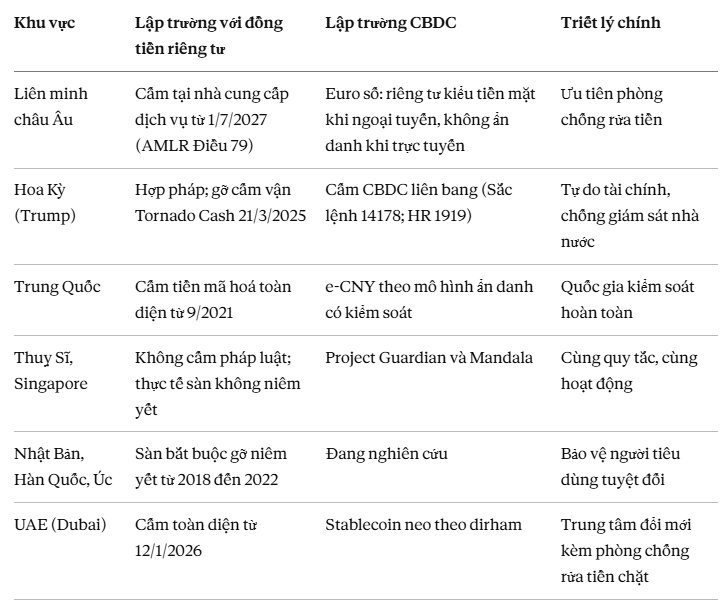
Three distinct models are shaping the future. The first is the “ban to trace” model, applied in the EU, Dubai, Japan, and South Korea, completely banning private currencies at licensed providers, accepting the trade-off that users can still store and trade peer-to-peer but lose their official liquidity channel. The second is the “free but anti-government surveillance” model of the US under Trump, a 180-degree reversal by banning federal CBDCs to protect individual privacy, while simultaneously lifting the embargo on Tornado Cash. Executive Order 14178 of January 23, 2025, explicitly prohibits federal agencies from issuing CBDCs, while Tom Emmer's Anti-CBDC Surveillance State Act (HR 1919) was passed by the House of Representatives on July 17, 2025, with 219 votes in favor and 210 against . The third model is China's "deliberate control" of e-CNY, as Mu Changchun of the Digital Currency Institute of the People's Bank of China defined the principle at the China Development Forum in March 2021 as anonymous for small transactions while traceable for large transactions , with a limit of 500 yuan per transaction for anonymous wallets.
The BIS acts as an ideological intermediary, with Project Tourbillon introducing a technical standard for payer anonymity, potentially the future of global retail CBDCs. The transatlantic divide after 2025 between the EU's ban and the US's protection creates a significant legal gap for individual users, as private currencies remain legal to own in most countries, including the EU, after 2027, but the possibility of formal transactions is increasingly limited in Europe while expanding in the US.
Point 4: Controversial real-life situations
The Tornado Cash case was the most important legal test. After OFAC added the protocol to its sanctions list on August 8, 2022, over 600 public wallets were hacked when an anonymous sender sent 0.01 ETH from Tornado Cash to the wallets of Jimmy Fallon, Shaquille O'Neal, and Brian Armstrong, immediately blocking their access to the interfaces of Aave, Uniswap, and Balancer. Circle froze approximately 75,000 USDC belonging to innocent users. Programmer Alexey Pertsev was sentenced to 5 years and 4 months in prison by a Dutch court on May 14, 2024 , while Roman Storm was convicted by a US jury of operating an unlicensed money transfer business on August 6, 2025 , while two more serious charges were culminating in a jury deadlock. However, the Van Loon v. The Treasury's ruling on November 26, 2024, by the Fifth Circuit Court of Appeals concluded that immutable smart contracts are not assets under sanctions law , leading to OFAC removing Tornado Cash from its list on March 21, 2025 .
In the April 24, 2024, Samourai Wallet case, the U.S. Department of Justice indicted Keonne Rodriguez (CEO) and William Lonergan Hill (CTO) on charges of laundering over $100 million through the Whirlpool service . The controversial point is that FinCEN's FIN-2019-G001 guidance clearly states that the software does not hold customer funds and is not a money transfer business. Furthermore, during the investigation, FinCEN responded to prosecutors that its CoinJoin-style mixing service was not a money transfer service, yet the case proceeded. Rodriguez was sentenced to 5 years in prison on November 6, 2025, and Hill was sentenced to 4 years in prison on November 19, 2025, along with an order to seize $237.8 million . A chain reaction ensued shortly afterward, with Phoenix Wallet withdrawing from the United States and the FBI warning citizens on April 25, 2024, against using the service without identity verification, forcing users to disclose their identities for all peer-to-peer transactions. On June 1, 2024, Wasabi Wallet proactively discontinued its CoinJoin matching service , and CEO Max Hillebrand stated that the decision was made with a heavy heart as they needed more legal certainty.
The wave of delistings of private cryptocurrencies directly impacts individual investors. Binance delisted Monero globally in February 2024, Kraken stopped supporting Monero in the European Economic Area from October 31, 2024 , and any Monero balances not withdrawn in time were automatically converted to Bitcoin, a form of soft confiscation. LocalMonero, the largest peer-to-peer trading platform, closed on November 7, 2024, after 7 years of operation . According to Kaiko, 2024 will see 60 delistings of private cryptocurrencies, the highest number since 2021. As a result, trading volume has shifted to less regulated exchanges like Poloniex and Yobit, accounting for nearly 40%, while users are forced to use atomic swaps via Cake Wallet or Bisq, which lack arbitration systems and increase the risk of fraud.
Vitalik Buterin's public use of Privacy Pools and Railgun in April 2024 created a new type of message. The fact that an Ethereum leader publicly disclosed private transactions, along with a privacy claim, was normal was a clear signal that the movement wasn't a minority group. When the zkLend hack in February 2026 transferred $9.5 million via Railgun, but the protocol automatically returned the funds to the original address thanks to a valid list filter, Vitalik's theory of separable balances was proven in practice, demonstrating that privacy and compliance can coexist.
Point 5: Academic Perspective and a Middle Way Proposal
The "privacy by design" framework, developed by Dr. Ann Cavoukian, former Ontario Data Protection Commissioner, with its seven foundational principles adopted by the International Data Protection Commissioners Conference in October 2010 , provides a neutral analytical framework. The fourth principle, "fully functional win-win, not lose-lose," asserts that privacy and security are not trade-offs but can be achieved simultaneously. Privacy Pools, Railgun, and Zcash's view keys exemplify this principle.
Lawrence Lessig at Harvard, with his "code is law" argument, warns that criminalizing programmers for the technical architecture they choose creates dangerous consequences for digital freedom. Primavera De Filippi at Harvard's Berkman Center proposes the concept of cryptographic law paralleling state law. Rohan Grey at Willamette University warns that if CBDCs lack the privacy of cash, financial privacy could disappear entirely in the next generation. Conversely, Hilary Allen at American University argues that default anonymity facilitates money laundering and sanctions evasion, thus giving the state the right and obligation to apply widespread customer verification.
There's a noteworthy historical lesson: even cash doesn't offer absolute privacy. In the United States, cash transactions over $10,000 are subject to reporting under the Bank Secrecy Act of 1970. Therefore, the neutral argument among academics is that privacy on the blockchain should lean towards a threshold-based cash privacy model—privacy at the level of everyday transactions but triggering disclosure when exceeding anti-money laundering thresholds, rather than absolute privacy. Joseph Bonneau's concept of alias liability, currently employed at NYU and the a16z crypto fund, describes a situation where a user transacts under an alias but leaves a cryptographic trail sufficient to be held liable under a legitimate order. This is precisely the logic of selective disclosure using non-disclosure evidence, a model being developed by Privacy Pools, Aleo, and Aztec.
The debate isn't over, but it has changed form.
The period from 2024 to 2026 has shaped a new reality, where the question of privacy on the blockchain is no longer about whether or not it exists, but under what conditions. Homomorphic cryptography has been developed, non-disclosure proof has matured enough to enforce customizable privacy contracts, and Vitalik's selective disclosure methods have demonstrated that privacy and compliance do not necessarily conflict.
Users are the most clearly affected by Europe's general ban approach and the indirect pressure on exchanges in the Asia-Pacific region. They are subjected to spam attacks, mistakenly frozen accounts, lost access to fiat currency-to-Monero exchanges in Europe, and forced to sell Monero for Bitcoin at automated rates. However, US courts, through the Van Loon ruling in November 2024 and the removal of Tornado Cash from the list in March 2025, have placed legal limits on executive power over open-source software, and the Ethereum Foundation has officially included Privacy Pools in the Kohaku standard wallet in November 2025. The clear signal is that a model compliant from the design stage, with valid listings, optional view keys, and proof of innocence, will be the mainstream of the ecosystem, not blind anonymous mixers.
Between 2026 and 2030, three questions will determine the future. The first is the Roman Storm appeals ruling, expected in October 2026. The second is the progress of the EU's AMLR implementation in July 2027 and the extent of enforcement for smaller service providers. The third is the reaction of China and developing economies to the transatlantic gap between EU bans and US protections. The most viable middle ground is to acknowledge privacy as a fundamental but not absolute right, apply a cash-like threshold to users, and invest in selective disclosure infrastructure as a new technical standard. Vitalik Buterin, Edward Snowden, and Zooko Wilcox, along with the FATF, OFAC, and ECB, will probably never completely agree, but along the line between their positions, a viable technological and legal compromise is being forged, line by line and ruling by ruling.