


In the past 2 days, Bitcoin has continued to rise violently from the bottom, and the industry has been amazed. Based on the highest point above 26,000 on the evening of February 14, Bitcoin's rise in 2 days has reached almost 30%. The last time such an exaggerated increase seems to be October 25, 2019, the anniversary of the industry's name rectification. Regarding this rise, BlockBeats tried to sort out some potential reasons to share with readers.
The Silicon Valley Bank Panic Comes to an End
In the early hours of March 13, when the market had just gained a breather from the Silicon Valley Bank incident, the U.S. Treasury Department suddenly announced that it would provide up to $25 billion in funds to support the Federal Reserve's emergency bank term financing plan. At the same time, a joint statement with the Federal Reserve and FDIC was issued, stating that depositors will be able to withdraw all funds on Monday, and any losses related to the bankruptcy of Silicon Valley Bank will not be borne by taxpayers. The FDIC deposit insurance fund exceeds $100 billion, enough to cover all deposits of Silicon Valley Bank and Signature Bank .
A set of "combined punches" on the news surface ended the panic caused by the shutdown of the Silicon Valley Bank to a certain extent. The short positions opened in the previous panic began to be continuously closed and trampled, officially opening the 2 consecutive days of Bitcoin. Days of violent pull up.
Continuing to raise interest rates may increase risks, and the market calls for a pause or even a rate cut
As the 16th largest bank in the United States, it took only 24 hours for Silicon Valley Bank to go from panic to the announcement of its closure and being taken over by the FDIC. worries about the financial system.
As we all know, every time the Federal Reserve raises interest rates in history, it will eventually induce a crisis, while the US economy stabilizes and takes off again amidst the collapse of the financial systems of other countries. In this financial game, the most important point is that "the United States must not have an accident before other countries."
A sharp sell-off in regional bank stocks on Monday following the collapse of Silicon Valley Bank (SVB) and Signature Bank threatened to push the Federal Reserve into a position it has been trying to avoid for the past year -- fighting inflation without compromising financial stability. The current situation may force the Fed to reselect the issues it needs to focus on.
According to CME's "Fed Watch", after the combination of news and news came down, the probability of the Fed raising interest rates by 25 basis points in March to the range of 4.75%-5.00% increased to 96.0% in a short period of time, and the probability of raising interest rates by 50 basis points directly from here The previous 80% will be reduced to 0, and the interest rate will be cut by 50 basis points before the end of the year.
Goldman Sachs first said it no longer expected the Fed to raise interest rates at its March 22 meeting given recent stress in the banking system. Maintain expectations that the Fed will raise interest rates by 25 basis points in May, June and July, and now expect terminal interest rates to be 5.25-5.5%.
Nomura Securities even predicts that the Fed will cut interest rates by 25 basis points in March and suspend quantitative tightening.
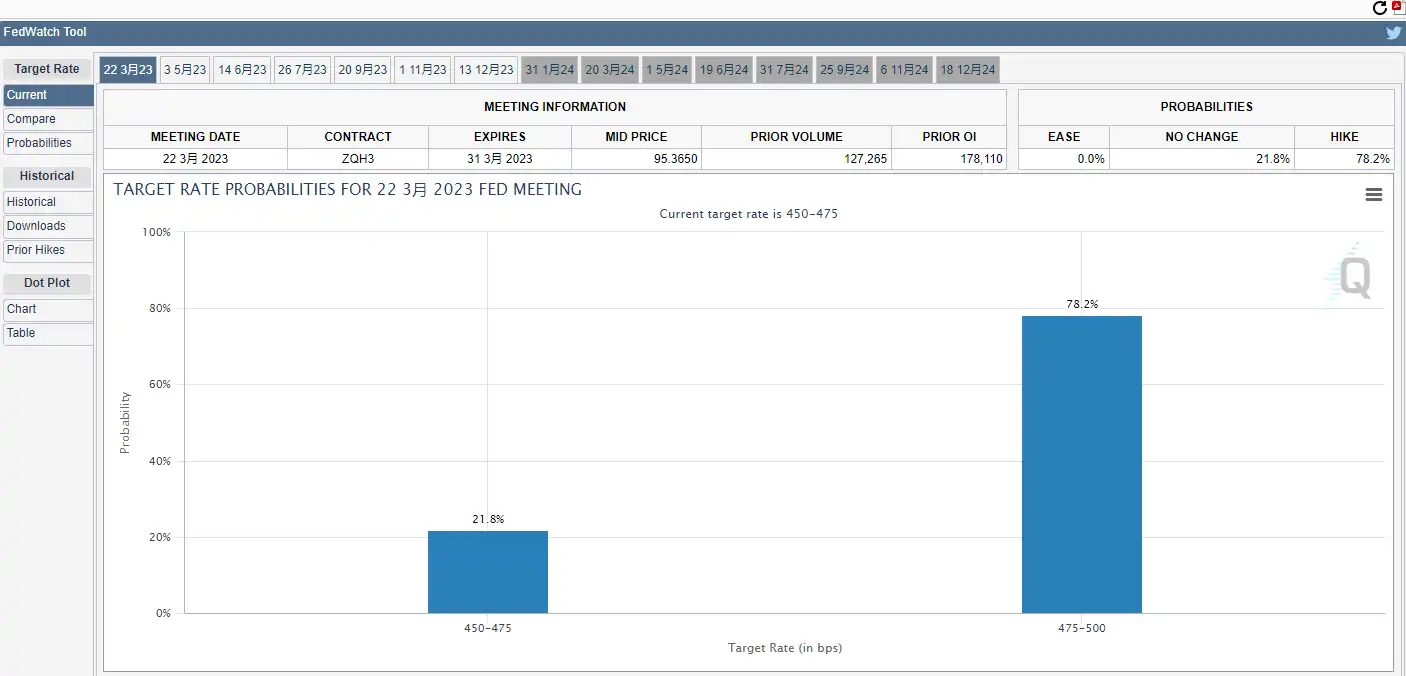
As of the time of writing, according to the CME "Fed Watch", the market believes that the probability of no more interest rate hikes in March is currently 21.8%, and the probability of raising interest rates by 25 basis points is 78.2%.
The bad news may have been exhausted
Since the Luna thunderstorm in March 2022, from the bankruptcy of Three Arrows Capital to the FTX thunderstorm, several skyscrapers in the encryption market have collapsed one after another, and the currency price has fallen from a high of 69,000 to about 20,000 today. It is also gradually approaching the previously expected peak value.
Compared with ETH, the SEC has stated several times before that BTC is a commodity, not a security. Therefore, the market is currently not worried about any attack from the SEC, and Grayscale has launched a tug-of-war with the SEC on March 7 on the issue of "rejecting BTC spot ETF". Grayscale CEO Michael Sonnenshein has said he expects his firm's lawsuit against the U.S. Securities and Exchange Commission (SEC) to reject a bitcoin spot ETF could be ruled in the third quarter of this year.
Sonnenshein also said that all resources are being used to fight the legal battle with the US SEC. If the U.S. regulatory authorities are still unwilling to recognize the legal securities status of Bitcoin ETF, the company will not hesitate to take the lawsuit to the Supreme Court if necessary. In addition, he promised that if the ETF business is approved by the regulatory authorities, he will lower the rate to benefit customers.
This gives the market some reason to believe that we have passed the most difficult period.
The original intention of Bitcoin
Saw a comment that said "People are finally remembering why Bitcoin was created."
From a narrative point of view, this rare surge in Bitcoin really moved us. At the same time that traditional finance has problems, accompanied by the obvious rise of Bitcoin, it is easy for the market to think that the early "digital gold" and risk-aversion attributes of Bitcoin have reappeared.
So is Bitcoin still the "digital gold" that once killed the Quartet?






