Total Value Locked (TVL) is a popular metric in cryptocurrencies to gauge the overall value of assets (in USD or any fiat currency) in one or more DeFi protocols.
What does total locked value mean?
Since the explosion of decentralized finance (DeFi) in 2020, financial market professionals have been interested in a new type of investment and have been XEM at ways to measure its performance.
In addition to market capitalization, trading volume, and total supply and circulation, total value locked (TVL) is a popular metric in cryptocurrencies to gauge the overall value of an asset (in USD or any other currency). any fiat currency) in one or more DeFi protocols.
DeFi assets include rewards and interest, which come from typical services such as lending, staking and Liquidity pools, provided as smart contracts. For example, TVL in staking, is a particularly useful indicator for investors who want to support the DeFi platform with the highest rewards. It represents the total value locked in DeFi staking protocols and represents the amount of assets deposited by Liquidity Provider.
By 2022, DeFi's TVL had reached nearly $2 billion globally, up from $400 million two years earlier. More and more people are XEM TVL as a necessary metric to gauge XEM an entire ecosystem or a single protocol is healthy and worth the investment.
While simply defined as the total value locked in a smart contract, there are fundamental conditions that can affect the TVL of DeFi projects.
In addition to factors such as the amount deposited, the amount withdrawn, and the amount a protocol is actually holding, TVL also varies with the actual value of the native token currency or fiat currency. Deposits of some protocols can be denominated in the project's native token, so its TVL changes according to its value. If a particular token increases in value, so does the TVL of the protocol.
Why is TVL important in DeFi?
For DeFi platforms to work, a certain amount of capital must be deposited. This capital is used to secure loans or represent Liquidity in trading pools. TVL is important because it shows the impact of capital on profitability and the applicability of DeFi protocols.
As the TVL of the DeFi platform increases, it also means that the Liquidity also increases, and the popularity and usability of the protocol also increases. These factors will contribute to the success of the project. Higher TVL means more capital locked up in DeFi protocols, with participants enjoying more substantial gains and proceeds. Conversely, a lower TVL means a lower money supply, resulting in lower yields.
You can track the TVL of DeFi projects through analytics platforms like DeFi Pulse and DefiLlama, which provide data on the amount of crypto assets locked in their respective smart contracts. . DeFi Pulse monitors smart contract movements of protocols on Ethereum simply by extracting the total balance of Ether (ETH) and ERC-20 tokens. Meanwhile, DefiLlama calculates TVL by extracting the total balance of all combined DeFi chains or each individual platform.
How is the cryptocurrency TVL calculated?
As new protocols are constantly emerging in the DeFi space, it will be difficult to determine the exact TVL of the overall market and XEM a particular DeFi platform is a safe choice for users. last or not.
However, participants can choose the $1 billion mark as the standard, because protocols with TVL reaching this level will become secure but no less potent. Of course, a higher TVL is safer, as it represents a healthy platform, high in demand, strong developer team, and good applicability. All of these will attract more participants and investors, contributing to the increase in the TVL of the project.
In contrast, participants should be wary of DeFi protocols with lower TVLs that are giving high yields. These can be promotions for new platforms to gain market share, but they can also be scams because few or no participants trust their assets.
Three main factors are XEM to calculate the TVL of the DeFi protocol:
- The current supply of the protocol
- Maximum supply of the protocol
- Current price
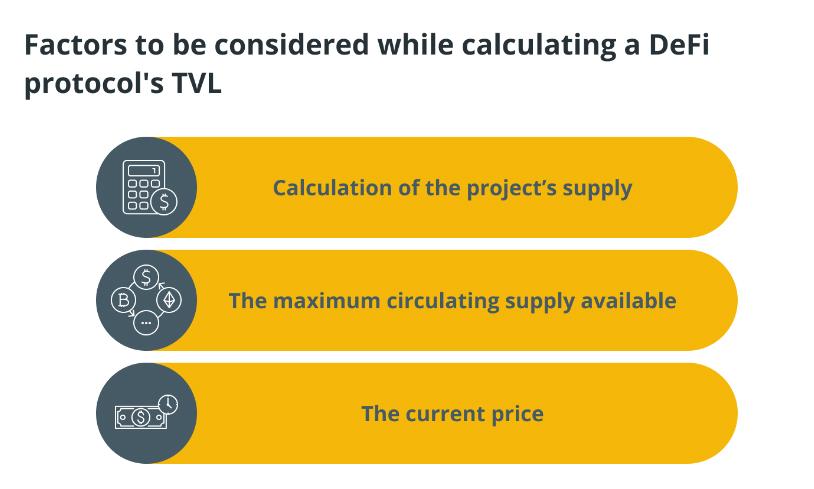
To calculate the TVL of a cryptocurrency protocol, multiply the current supply of the DeFi project by the current price of the token (a value known as market capitalization). Then, dividing the market cap by the maximum circulating supply, the TVL is calculated.
When we divide the total market capitalization of a locked asset by the total locked value, we get the TVL ratio (TVL ratio). The TVL ratio can help XEM DeFi content is undervalued or overvalued. If the ratio is below 1, the property is usually undervalued and more attractive to investors. When market capitalization exceeds TVL in cryptocurrencies, the asset may be overvalued, leaving no room for growth.
Which cryptocurrency has the highest total locked value?
Due to the outstanding growth of DeFi in 2020, the combined TVL of all DeFi protocols has increased rapidly and significantly by the end of 2021.
At the beginning of 2020, combined TVL across all DeFi platforms was around $630 million, according to DefiLlama. However, by the first quarter of 2022, it has reached over $172 billion.
MakerDAO, is one of the most prominent protocols along with Curve and AAVE. Curve is the crypto project with the highest TVL and holds the majority of the market with a 9.7% market share with $17 billion in TVL, followed by Lido with $15.4 billion in TVL, Anchor with $12.6 billion, and MakerDao at $15.4 billion. 11.5 billion USD.
DeFi TVL's Largest Network
In 2022, Ethereum emerges as the largest TVL DeFi blockchain network, accounting for more than half of all DeFi volumes worldwide.
Ethereum DeFi includes less than 500 protocols. It has a TVL of about $73 billion, with a 64% market share. Then there is BNB Smart Chain, which has the second highest TVL with a value of 8.74 billion USD, accounting for 7.7% market share, Avalanche with 4.5% market share (equivalent to 5.21 billion USD) and Solana with 4 .19 billion USD, accounting for 3.68% market share.
The index of total locked value across all chains clearly shows that Ethereum is the network with the highest TVL. In essence, the TVL is an excellent indicator for the DeFi sector and is perhaps most used to gauge the health and growth of the market. Although an indicator that presents a positive outlook for the market, its reliability must be XEM with caution, as it is nearly impossible to interpret the indicator correctly.
Market volatility is one of the major variations that can greatly affect the value of locked assets, starting with the price of ETH, the foundation of which is where most assets are located. A significant increase in the value of ETH will definitely affect DeFi's TVL from 2020, but it means the total value locked up could grow without any new users or capital investment. which is on DeFi.
Furthermore, due to the nature of the DeFi service, funds can easily move and be counted multiple times, thus miscalculating the Liquidity of the protocols. As with all indicators, the TVL is only an estimate of the state of the market and because of its errors and approximations, it should not determine an investor's strategy.
Synthetic PCB