By JEFF JOHN, ROBERTS, YVONNE LAU
Original title: " The making of Binance's CZ: An exclusive look at the forces that shaped crypto's most powerful founder "
Compilation: Guo Qianwen, Lin Qi, Gu Yu, ChainCatcher
Changpeng Zhao is sitting in front of a bookshelf in his home in Dubai, which, like Paris, he calls home. In the video, he is affable, gentle, even humble. It’s the exact opposite of what his rivals are most familiar with: his ambitions to build Binance into the world’s largest and most influential cryptocurrency exchange.
He is used to dealing with others with a different face. “If Americans deal with me, they think I’m Asian—a little more Asian than most Americans, but a little less Asian than other Asians they know. If Asians and When I hang out, they feel like I'm American, but a little less American than the Americans they're used to dealing with. I'm kind of in between."
Recently, Changpeng Zhao's tough side has brought him under intense scrutiny. Changpeng Zhao and Binance have outmaneuvered their opponents and played with lax regulations to great success - whenever a country can offer the most favorable regulations, the founder will set up camp here, governments including the United States have accused Binance is deceptive and violates international sanctions and money laundering rules.
Binance insists it has changed the way it operates and that compliance is now the goal; Changpeng Zhao has always been a soft-spoken, humble man in his endorsement of the reformed company. But Binance's turnaround has raised questions about who Changpeng Zhao really is and how he built his business -- questions that have been made all the more poignant by the paucity of public records about his background and Binance's operations.
A careful study of Changpeng Zhao’s background fills in many of the gaps, revealing how the Binance founder juggled between his years of tough business rivalry and his image of a friendly, everyday guy. The magazine's detailed investigation of his past, drawing on interviews with his acquaintances and extensive commentary in the Chinese-language media, uncovered two worlds that shaped Changpeng Zhao's identity: Canada, where he grew up; China, where he returned as a "sea turtle," In the first half of this century, he took advantage of the rising wind of Shanghai and stood at the forefront of global business in one fell swoop.
Taking lessons from both places, Changpeng Zhao has mastered many of the cutthroat business tactics that prevailed during the early frenzy of China's tech scene, while retaining the casual, non-threatening nature of the Canadians -- a behavior that distracts attention from its tactics .
Until recently, Changpeng Zhao spoke frequently to the cryptocurrency and business media, but over the past few months, he has cut back on such appearances entirely — due to the fraught regulatory environment and Binance’s belief that the media is critical to the company and the business. Changpeng Zhao made distorted reports. This time he broke his usual silence and accepted an interview with Fortune magazine, sharing many details of his life that had not been reported before. This interview provides a first-hand account of Changpeng Zhao's business operations, argues that his success dovetails with trends in the Chinese diaspora, and will shed light on how his wise but icy father influenced Binance's emergence as a cryptocurrency giant.
Scholar father leads family to move abroad
The Keremeos Court building is a neat series of family townhouses that is otherwise unremarkable except for its refreshing setting. Surrounded by a vast rainforest of tangy cedars and ferns, the residences are part of the University of British Columbia's 2,000-acre campus, located on Vancouver's westernmost edge, bordering the Pacific Ocean.
In 1989, 12-year-old Zhao Changpeng came here with his mother and younger sister to join his father. Zhao Changpeng said that his father loved books all his life, and he continued to study even when he was sent to the countryside. His father persisted in academics and finally found a doctoral program in geophysics in Canada. A few years later, he brought his family to UBC to study with him.
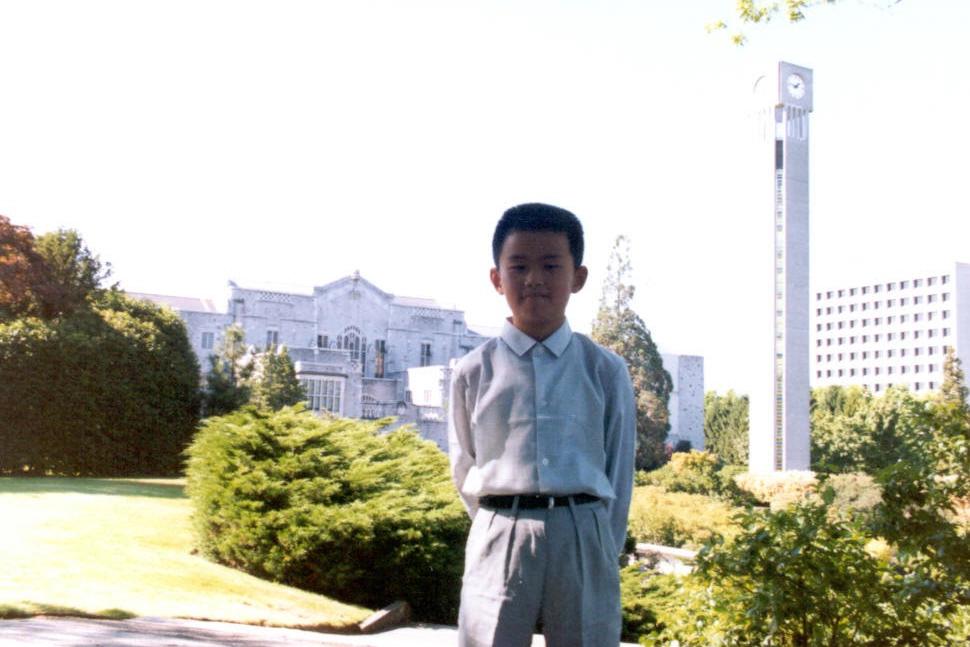
Changpeng Zhao in front of the Ladner Clock Tower in Vancouver, photographed by his father around 1989. Photo provided by Changpeng Zhao
The environment here is completely different from the village where Zhao Changpeng was a child. In Jiangsu province, schools and classrooms are scarce, filled with modest stone desks—a common sight in resource-poor rural areas, where learning is even more difficult in winter. Like his father, Changpeng Zhao understands poverty and deprivation in China, and realizes that academia can be a refuge. At the age of 10, the family left the countryside and moved to Hefei, a small city in China where the University of Science and Technology of China is located.
In this intellectual oasis, Changpeng Zhao would sit and listen to debates among senior students, who sometimes made him play chess. "Changpeng Zhao recalled, "Those people taught me how to play chess and go. They talk about different things on campus, even politics. I think being around people who are seven or 10 years older than you really [makes] you think about things a little bit differently than kids your age. "
When the Changpeng Zhao family came to British Columbia, they moved from one of the oldest civilizations in the world to one of the youngest in the world. Founded in the 1870s, Vancouver was rarely visited by anyone other than the Aboriginal community. The city quickly became a gateway linking the flow of goods and people from China to Canada — and for decades it was a stronghold of anti-Chinese racism. Manifestations of this bias include the infamous "head tax" to discourage Chinese men from bringing their wives to Canada, even though they built the country's railways and much of the city of Vancouver. “Although there have always been Chinese [in Vancouver], they lived under the stairs like Harry Potter. They were servants, not house owners,” said Henry Yu, a UBC historian and Chinese immigration scholar.
However, by the 1980s, the government had completely changed its attitude. Canada, seeking to revitalize and diversify its natural-resource-based economy, has begun attracting immigrants from across the Pacific that it once despised. The plan includes visas for those who invest C$400,000, attracting academics like Changpeng Zhao's father. Ottawa intends to send a signal to ambitious Chinese: "Canada is opening the door for business if you want to succeed in the global economy."
Anti-Asian sentiment still exists in Vancouver, and Asians will remain deeply unwelcome in some parts of the community, but Changpeng Zhao does not often encounter racism. The high school he attended was made up of students of all ethnicities, most of whom had ties to the university. Still, Changpeng Zhao differs from his classmates in a few key ways. He recalls being one of only two students from mainland China, despite dozens of other Asian students. Most hail from wealthier Hong Kong and Taiwan, and unlike Zhao, they do not live in the modest housing reserved for graduate students and campus workers.
Changpeng Zhao recalled the huge wealth gap between his own family and other students, as well as the disparities that existed among wealthy Chinese-speaking immigrant groups. He said: "Kids in Hong Kong are more fond of brands, fashion brands, sports cars and so on. Taiwanese, although they are all very rich...but have a more humble attitude, and I get along better with them. Taiwanese families learn a lot about the value of humility."
Today, the high valuation enjoyed by Binance and its BNB token means Changpeng Zhao is worth billions, but he still maintains “humble values,” at least publicly. Compared to the more obnoxious people in the crypto community — those who buy Lamborghinis they can’t drive and tell crypto skeptics to “have fun with poverty” — Changpeng Zhao has never shown his flamboyant side.
In Vancouver, where his mother sews and his father drives a battered Datsun, Zhao often commutes to and from volleyball games in a friend's parent's BMW, for which he is captain. The only big expense he can remember was that his father spent $7,000—a staggering sum at the time—on an IBM-compatible 286 computer, which he used for research and also for teaching his son. How to program. If you're looking for a glimpse into Changpeng Zhao's early life for a clue that he would become a billionaire, this might be the one. Learning from his father, whom others have called a genius, will be crucial in Changpeng Zhao's later life, as the technology he builds will power Binance. Changpeng Zhao said, "My father is a technical mentor."
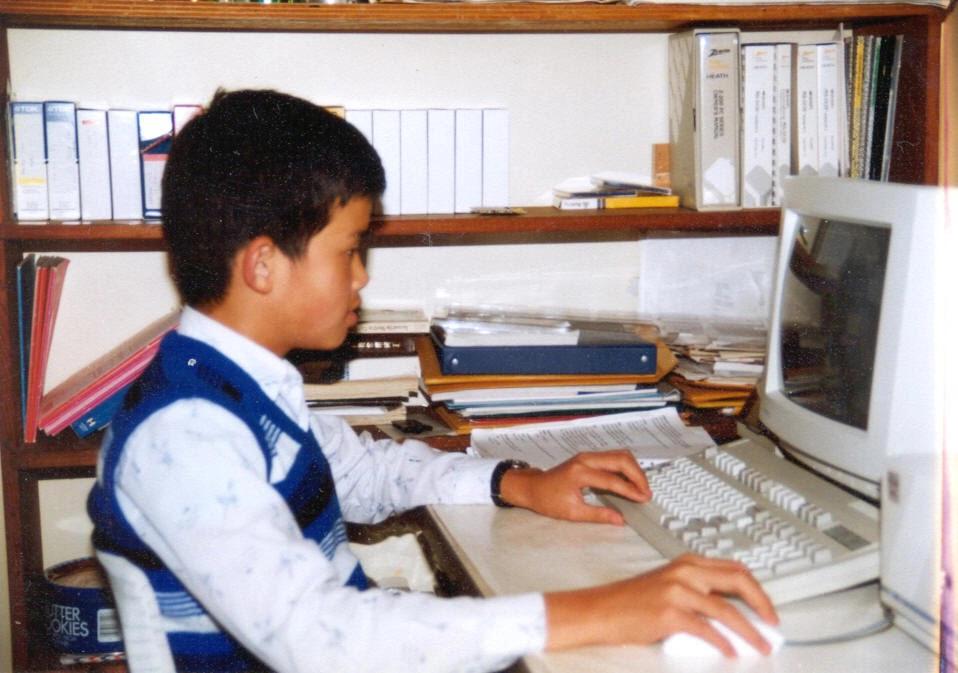
Changpeng Zhao using his first computer in Vancouver circa 1990, photo courtesy of Changpeng Zhao
In high school, some of his wealthier friends started working, mostly for the novelty of it or because their parents wanted them to understand the rigors of work. Changpeng Zhao is one of the only students who can make ends meet by working. That included summer overnight shifts at Chevron and a two-year stint at McDonald's. In his later life as a cryptocurrency mogul, someone made fun of Changpeng Zhao's experience working at a fast food chain. However, unlike some rich people who came from poor backgrounds, Changpeng Zhao never distanced himself from the working class he once lived in, even reposting pictures of himself wearing McDonald's clothes.
Overall, Changpeng Zhao portrayed his high school days as pleasant, even describing it as idyllic. He enjoyed his four years as captain of the volleyball team and competing in the Canadian National Math Competition. He got the nickname "Champion" from a gym teacher. Changpeng Zhao's high school friend Ted Lin said the name was likely due to the fact that many people at the school could not pronounce "Changpeng". Changpeng Zhao adopted his current name, Changpeng Zhao, only after entering the crypto world. He said he had tried using the name "CP" earlier, but dropped it after friends online told him it was short for "child porn" in the illegal market.
Despite his fondness for Vancouver (where he said he wanted to retire) and Canada, some of his actions belied his professed affection. He admitted that he hadn't set foot in the city in years, and that he didn't have any active family or philanthropic connections there. Nonetheless, Changpeng Zhao insists that he is Canadian not only because of his passport information but also because of his character. "I think like a Canadian. We're good people, not aggressive, not overly competitive and generally helpful," he said.
He speaks warmly of Canada (where he grew up) because he has benefited so much from it — but that pales in comparison to what would later make him a billionaire, cryptocurrency.
Best-selling financial book that changes lives
As of early April, Changpeng Zhao was No. 46 on Bloomberg's list of billionaires, with a net worth of $29 billion (a figure that Zhao called "inaccurate" and "difficult to estimate considering all the fluctuations"). His name is in the news every day. Last fall, many media outlets focused on his audacious cryptocurrency trade at FTX, which brought down his rival Sam Bankman-Fried; more recently, reports have focused on constant clashes between Binance and regulators over Changpeng Zhao’s rule-playing. While many nonconformist tech entrepreneurs displayed their bold, defiant qualities in college—think Zuckerberg portrayed in The Social Network—that doesn't seem to be the case with Changpeng Zhao.
After finishing high school in 1995, Changpeng Zhao moved 3,000 miles away to McGill University, leaving the temperate climate of Vancouver for French-speaking Montreal, a place with bitterly cold winters and much of the city center connected by underground tunnels. According to Changpeng Zhao, he had no outstanding academic or social performance at McGill University, although he switched his major from biology to computer science because "in high school, biology deals with humans. In college, the focus goes back to to animals, which I have no interest in." In his spare time, he goes rollerblading or eating pho with friends, and hangs out late at the campus computer lab, typing code into a rudimentary Mac desktop. .

Changpeng Zhao's first residence at McGill University in Montreal
At the end of his studies at McGill University, Changpeng Zhao did publicly display the brilliance he later displayed in his career, and in 1999 he co-authored an academic paper on artificial intelligence with professor Jeremy Cooperstock - a topic for 20 years later became widely noticed. Sitting in a cafe in Montreal, Jeremy Cooperstock said he remembers Changpeng Zhao well, in part because he was the only undergraduate student in his graduate seminar. He told me "it's not going to pay you well, but it's going to give him a good experience". In his memory, Changpeng Zhao was a man of personality and very smart, but many years later he was surprised to find that his former student had become a billionaire.
Changpeng Zhao said that during this time, he read something that changed his life—not academic papers, nor long-winded treatises like "Atlas Shrugged", but a film aimed at typical middle-class, ordinary people. Books: "Rich Dad, Poor Dad". Published in 1997, this bestselling personal finance book tells the story of two fathers—one who worked hard all his life for little, and one who got rich as an entrepreneur or investor—in fable. This book made Changpeng Zhao suspicious of his father's suggestion. By then, he had finished his Ph.D., was working in the private sector, and would enjoy professional respect but little material wealth for the next 20 years.
"My dad always taught me to work hard and get a decent job, and my parents had that mindset. They didn't like business. After I read Rich Dad, Poor Dad, I started thinking maybe I Want to own a business. It’s not that I have to be CEO, it’s about creating something meaningful.”
When Changpeng Zhao turned his mind to wealth creation, he did make the same choice as Zuckerberg and other gifted billionaires: drop out of college. In 2000, he became a regular at the Tokyo Stock Exchange during his summer internship and decided not to return to McGill University. (Many media reports say Changpeng Zhao is a graduate of McGill University, but this is inaccurate).
His math and coding skills soon landed him a job in the financial capital of New York, where he developed futures-trading software for Bloomberg Trading. But four years later, even New York could not be compared with Shanghai, the hottest business center in the world at that time, so Changpeng Zhao moved to China - the last time he set foot on this land was more than ten years ago.
"Returnees" studying social rules in Shanghai
Shanghai, on China's prosperous southeastern coast, was the "locomotive" that drove China's economic engine at the time, said Miu Chung Yan, a social work professor at the University of British Columbia who studies Chinese immigration. In 2005, the year Changpeng Zhao moved to Shanghai, the city became the third-busiest container shipping port in the world, after Hong Kong and Singapore; meanwhile, it achieved 11 percent GDP growth for the 14th consecutive year. China is on the rise, and Shanghai is at the center of it all.
Crucially, Changpeng Zhao's early days in Shanghai coincided with the golden age of Chinese technology, and domestic technology companies and industry leaders were rapidly emerging. Robin Li, Jack Ma and Ma Huateng started their companies at the turn of the millennium and are experiencing an explosion of investment and development.
Changpeng Zhao said: "I was taught to go where it is developing, not where it has been established."
He's not the only young Canadian returning to Shanghai. Canada's deep recession in the 1990s spurred a surge of reverse immigration in the mid-2000s. Returnees like Zhao Changpeng are known as "haigui," a Chinese pun for someone who emigrates overseas but returns to China. One study estimated that nearly half a million returnees arrived in China from Canada and around the world as of 2017.
For Changpeng Zhao and others like him, the timing couldn't be better. English-speaking returnees who are Western-educated and proficient in Chinese language and culture are warmly welcomed in China and earn higher salaries than their local peers, Miu Chung Yan said.
However, even though Changpeng Zhao has come to a city eager to accept him and where he can speak the local language, he admits that in China's fast, furious, free-spirited business environment, it is difficult to deal with the vague rules and regulations. “I didn’t understand the business culture and I had to learn it from scratch,” he recalls. In New York, Tokyo and Vancouver, where rules-based corporations and egalitarian ideas prevailed, for Zhao Changpeng relationships were critical, especially with Relationships with state officials who would be supporters appear unfamiliar. Alcohol has a special place in Chinese culture in forging these business relationships. Baijiu, a strong Chinese liquor, is often used in business negotiations as a sign of goodwill and respect.
Changpeng Zhao said: "I've read about it, I've heard rumors about it. But you know, when you actually go into business, at dinner parties with government officials, they drink baijiu...they talk about relationships, and sometimes There are other things that need to be taken care of, which are all foreign to me, so I never really liked that approach."
Despite this, Changpeng Zhao quickly made a fortune in Shanghai. In 2005, he co-founded Fusion Systems, a software-as-a-service (SaaS) company that provides high-frequency trading systems, with four other expatriates, and has partnered with the world's largest banks such as Goldman Sachs and Credit Suisse. During that time, he quickly learned the rules — which in China, he said, are “deliberately vague,” giving the government enormous powers of interpretation and selective enforcement. The budding entrepreneur put his math and coding skills to use, but his role at the company also taught him how to "think like a salesman" as he used his returnee status to act as a broker between East and West. As a junior partner and the only one who "looks Chinese...in a Chinese environment", Changpeng Zhao has been thinking "how do I market my firm's services? How do I get my next contract?"
Then—just like the legend about Changpeng Zhao, a late-night poker game in 2013 changed the trajectory of his life. In this game, China's top bitcoin evangelist Bobby Lee (Li Qiyuan) and American-educated Chinese venture capitalist Ron Cao (Cao Darong) introduce Changpeng Zhao to cryptocurrencies. Changpeng Zhao went all out. He sold his apartment in Shanghai and invested $1 million in Bitcoin. The future billionaire left Fusion Systems and first joined cryptocurrency startup Blockchain.info — which started out primarily as a website for tracking bitcoin transactions — as head of technology. A year later, he was hired as CTO of Chinese exchange and token startup OKCoin.
OKCoin is the battleground where Changpeng Zhao has honed himself as a bold public cryptocurrency figure, unafraid to engage in open battles. Initially, Changpeng Zhao engaged with the public on platforms such as Reddit, which is not common among CTOs, where he politely but firmly rebutted criticism of OKCoin and cryptocurrencies. However, in 2015, after a dispute with OKCoin CEO Mingxing Xu over the direction of the company, Zhao Changpeng left the company, and instead retracted his previous statements on the same platform and lashed out at his former employer.
In a 1,600-word Reddit post, Changpeng Zhao detailed the use of bots to boost trading volumes, falsified reserve certificates and opaque financials under Xu's direction. In response, Xu accused Zhao Changpeng of forging academic credentials and other fraudulent practices. While the feud eventually died down, it showed that Zhao was willing to strike hard in the debate, while also making China’s regulation of the fledgling cryptocurrency industry more stringent.
Changpeng Zhao's controversies and boundary-pushing with his next company, Bijie Technology, went one step further. Bijie Technology is another SaaS company that provides software for exchanges and trading platforms. Over the next two years, Bijie’s technology became the cornerstone of 30 Chinese exchanges and later became the powerhouse of Binance.
Trouble soon arose, however, as most of the exchanges supported by Changpeng Zhao’s technology involved transactions in “postal currency cards” — postage stamps from China’s imperial and revolutionary eras, sparking a tulip-like frenzy. As the postcard mania spread, online exchanges and dubious sellers for stamps have sprung up. So-called "stamp teachers" and "wealth advisors" lure unsuspecting investors into investment chat rooms on messaging platforms such as QQ and WeChat, where they advise investors to buy stakes in stamps and collectibles through digital exchanges, Promises of super high returns. But many are deliberate manipulation and sell-off scams. According to a 2016 investigation by China's state-owned newspaper Securities Times, ordinary investors, especially elderly Chinese, lost hundreds of millions of yuan, some even losing their entire pensions.
Changpeng Zhao has no direct connection to the stamp scam, but his skills arguably helped it flourish. What’s more, this rampant frenzy has put authorities on high alert: The Chinese government has quickly enacted new regulations that limit the unbridled growth of digital platforms that reward irregular and risky behavior, and are even more skeptical of digital financial innovation. In January 2017, the state ordered stamp and collectible exchanges to be crackdown or closed; by August of that year, operations at these exchanges had been halted. Most of Bijie's clients went out of business.
At the same time, Changpeng Zhao's ambition began to look for other outlets. In 2017, the dramatic rise in cryptocurrency prices attracted millions of new investors into the space. Changpeng Zhao sees the industry leader, San Francisco-based Coinbase profiting from it. He saw an opportunity and launched his own exchange, Binance, in Shanghai in July of that year.
In just one year, Binance surpassed Coinbase to become the world's largest trading platform by virtue of its high-quality trading platform, global customer base and almost unregulated regulatory policies. Soon after, the company became the first exchange to launch its own blockchain — a technological feat. Customers can earn token rewards for trading, and Binance has added the ability to trade hundreds of digital assets, including those of unknown origin. These tactics have helped Binance steal customers from Coinbase and other rivals, as have the company's low transaction fees and policy of asking few or no questions when it comes to vetting customers.
By now, Changpeng Zhao has clearly adapted to the faster and more aggressive business rules in Asia, which makes competing with North American companies relatively child's play. In The King of Cryptocurrency, an Asian-American entrepreneur mocks the media that marveled at Binance’s sudden rise: “What’s happening here is arrogance and favoritism for rising companies in Western markets. Asia isn’t in Coinbase’s DNA.” . I saw a cultural gap that they couldn't bridge."
However, despite its massive success, Binance’s time in China is running out. Back in 2013, China first restricted banks from handling cryptocurrency transactions. In September 2017, Chinese authorities banned initial coin offerings (ICOs) and began shutting down cryptocurrency exchanges in an effort to curb capital outflows, fight financial fraud, and gain tighter control over the country's financial system. In response to the move, Changpeng Zhao secretly and intensely migrated data hosted on more than 200 Alibaba servers to Amazon Web Services and other servers located outside the Great Firewall over the course of several weeks. The effort was a success, and Zhao Changpeng and other Binance employees relocated to Tokyo, ending his 12-year career as an entrepreneur in China.
Changpeng Zhao's power strengthened by exile
In some ways, leaving China is in the long-term interests of Binance and its founder, Changpeng Zhao. Over the years, Changpeng Zhao and his company have been swayed by U.S. rivals who portray Binance as allied with the Beijing government. Such an alliance would make Changpeng Zhao's relationship with U.S. regulators more difficult, especially at a time of tension between the U.S. and China. Over the years, the company has been accused of deliberately concealing its Chinese origin and business activities in China, allegations that Binance has denied.
Yet for a company and founders who prefer to operate outside of government regulation, no country can accommodate them for long. Binance’s stay in Japan is short-lived. In 2018, scammers used fake Google ads to trick customers into entering their Binance login details and then emptying their accounts. Binance was not directly responsible for the losses, but the scandal led to Japanese regulators requiring Binance to register as an exchange, an ill-suited choice for Zhao. As a result, Changpeng Zhao decided to move his crypto empire to Malta, where then-Prime Minister Joseph Muscat was willing to welcome all things related to cryptocurrencies and would not ask any other questions.
The period in Malta was also short-lived, with Binance announcing that it would no longer be looking for a new headquarters location, but would instead operate without its headquarters. For a while, Binance was so decentralized that Changpeng Zhao seemed to have, with all intents and purposes, disconnected from the network. In 2021, an opponent of Binance sued Binance in the United States for delisting tokens. The plaintiff hired a private investigator to find Changpeng Zhao. In his report on the findings, the private investigator said his team had made "extreme" efforts to track Changpeng Zhao but was unsuccessful, and that he suspected that Binance hired others to cover up Changpeng Zhao's past and whereabouts, making him "virtually undetectable". Recently, Fortune reached out to the private eye, who confirmed that the statements in the report are accurate. (The suit was ultimately dismissed.) Zhao will not be seen until 2022 in Dubai, where there are few restrictions on cryptocurrency transactions.
Binance’s approach to migration has been praised among crypto believers obsessed with decentralization. Unsurprisingly, this upset regulators in other countries, who viewed Binance as a lawless offshore casino. Not without reason. Over the past three years, Binance has been exposed to a range of ethically dubious or potentially downright criminal behavior. These include lax "KYC" policies, which allowed Iranian users to trade on Binance's exchange despite the country's international financial sanctions; and a failed plan in 2018 to register a subsidiary in the United States. The company, according to the Binance executive who proposed the plan, is intended to serve as a “regulatory sinkhole” that distracts U.S. regulators from the rest of the company.
Binance admitted to engaging in questionable tactics but said it had dismissed them. In February, the company said it was close to reaching a sweeping settlement with the U.S. Department of Justice and other regulators, addressing past misconduct and charting a path forward. That’s despite the fact that the CFTC’s recent lawsuit against Binance has raised questions about the viability of a settlement.
Meanwhile, companies have said they want to turn the page, but that aspiration has been complicated by widespread distrust of cryptocurrencies by regulators, especially after the collapse of exchange FTX.
Although it was Changpeng Zhao’s tweets that exposed the FTX scandal last November, he said he was as surprised as anyone by the fraud committed by SBF — he knew SBF and invested in it in the early days of FTX company.
During the cryptocurrency boom of 2020-early 2022, Changpeng Zhao and SBF are two of the most influential figures in this field, and their experiences have some obvious similarities. Most obviously, they are the children of scholars, although Zhao Changpeng's father was a fringe figure in the university world. SBF, by contrast, is the son of two law professors at Stanford, owns a nice house on campus, and lives the highest life in academia.
Today, the two men are in very different situations. SBF is still living at his parents' house, awaiting trial on a string of fraud charges that could land him in prison for life. Meanwhile, Changpeng Zhao is already a father of two toddlers with Binance co-founder He Yi.
It's easy to imagine Changpeng Zhao angry at the privilege and power of his rivals. SBF has mocked him on Twitter several times, including suggesting in the summer of 2022 that Changpeng Zhao would be arrested if he ever set foot on U.S. soil. (Binance says Changpeng Zhao has visited Canada several times in recent years, including to attend his father’s funeral, but has maintained a very low-key lifestyle there.) But Changpeng Zhao claims he has no personal vendetta against his one-time competitor.
“He was like those smart, talented but very aggressive young kids to me,” Zhao said. He told Fortune that he had met with SBF three to five times, primarily as a client, Because the latter’s Alameda hedge fund used Binance as a trading platform.
As of mid-April, Binance appears to have weathered the combination of the crypto market crash (following the collapse of FTX) and regulators increasingly aggressively going after the company. While its finances remain a black box, blockchain data shows that Binance has gained market share from rivals in recent months, and its transaction volume and revenue may also be increasing, possibly due to Bitcoin and other The rebound in cryptocurrency prices.
Meanwhile, Changpeng Zhao continues to insist that he and his company are decentralized and do not belong to any country. From this perspective, he has transcended the influence of China, Canada, and other countries, and has become a truly stateless individual.
And yet, the world-travelling cryptocurrency mogul Changpeng Zhao is still a human being; just like the rest of us, he can never fully escape where he came from and the forces that shaped him. For Changpeng Zhao, these forces may have less to do with geography and more to do with family.
father's legacy
Changpeng Zhao's English is not perfect, as can be seen from his Twitter activity. He's never mastered North American idioms—for example, last year he called "MLB umpires" "baseball referees." But his humility and thoughtfulness feel very Canadian. Over the course of the 30-minute interview, his demeanor suggests that — despite his new identity as a billionaire wandering around Dubai with sticky notes — he still has inside him the same french fries he ate at McDonald’s in Vancouver 30 years ago juvenile.
Still, it's hard to pin down what exactly is driving him. Crypto is still a cutting-edge industry, and every major player, including established institutions like Coinbase, is trying to use "cunning" tactics to gain an advantage or just to survive. Despite Binance's recent pledge to "get on the right track," it may be further away from the law than most of its competitors.
Still, when asked if he learned to break the rules growing up in Vancouver, Changpeng Zhao denied: "I've always been a pretty close, rule-abiding citizen...my character has always been conservative, although people may not think so ,” but he said that the culture of cryptocurrencies changed his view: “Then you find that this new thing has different rules in different places. So instead of saying we want to change the rules or even avoid the rules, it’s better to say that we just want to Want to find a more favorable place. ”
The argument is persuasive in some respects, but it also feels tailor-made for Binance’s self-interest. Changpeng Zhao has obviously been able to find the rules that are most beneficial to him and Binance, and it can be said that there are no rules. This is in stark contrast to his father, who played by the rules of a different era.
Jean Legault, a geophysicist at GeoTech in Ontario, Canada, hired Changpeng Zhao's father, Shengkai Zhao, with whom he had worked for six years, on the recommendation of industry leaders. Legault remembered Shengkai as a brilliant geophysicist with an extraordinary technical mind. Shengkai wrote the original code that enabled GeoTech to use the software to create 3D inversions of geophysical data, an invaluable tool for engineers. The company still uses his user manual to this day. Legault added, "Other geophysicists were later asked to do the same work, but they couldn't replicate Shengkai, who is a very good guy."
According to Legault, Shengkai lived to work, he could have reached the top in academia or business, but he was too humble. Shengkai never boast about their knowledge or achievements. Changpeng Zhao agrees, telling Fortune that his father started his career during the Cultural Revolution with poor English and never went into business. Never made any money.
Changpeng Zhao recalled that he watched his father work on complex mathematical equations in the laboratory or on the desktop from morning till night. But despite this, historical forces and changes as an immigrant mean that Shengkai can only work on the fringes of academia, never enjoying the prestige he would have earned if he had been born in a different time or place.
But his son, Changpeng Zhao, was affected by immigration. The success of the Binance Empire may be that Changpeng Zhao fulfilled his father’s destiny that could never be realized before.
Shengkai died of leukemia last year. Thinking of him, Zhao Changpeng's tone was somewhat regretful, as if thinking of his boyhood. "My dad spent all day in his lab and on his computer, he never got to any of my volleyball games. I was captain and played two games a week, but my parents never watched it a match."
The commonality between rich dad and poor dad may be their focus on work. Even for billionaires, this quality comes at a price. Changpeng Zhao worries that, in his own role as a father, he may "inherit" this "negligence" of his own parents. "I do have that quality," he said.