


Apart from being digital gold or currency, Bitcoin has had no new story in recent years. Just in February 2023, the NFT protocol Ordinals on Bitcoin was born, providing a new style for NFT-the first time that digital art (digital artifact) works were all written on the chain, and at the same time, it also gave Bitcoin The currency ecology provides a new possibility.
Ordinals has attracted great attention since its launch. On March 8, Yuga Labs, the parent company of Boring Ape, released 300 NFTs called the TwelveFold series relying on Ordinals. Excluding the reserved part, 288 NFTs were auctioned, with a total value of 16.5 million US dollars . On March 14th, Mempool invited Eason, the founder of Merlin Protocols, and Shier, the founder of NFTScan, to conduct an interview. At the same time, combined with Galaxy and other reports, the following conclusions were drawn:
Bitcoin NFT will bring a new NFT paradigm to the NFT market. Galaxy predicts that the market size of Bitcoin NFT based on Inscription and Ordinals will reach $4.5 billion by 2025;
NFT will have a positive effect on the Bitcoin ecosystem. In the context of Bitcoin halving and miners' income continuing to decrease, Bitcoin NFT can increase miners' income, thereby increasing the enthusiasm of miners to start up, and have a positive impact on Bitcoin network security. At the same time, it will also increase the possibility of large-scale application of the Bitcoin ecosystem.
Various infrastructures supporting Bitcoin NFT will flourish, including wallets, trading platforms, browsers, etc. Galaxy expects these infrastructures to flourish further in the second quarter.
1. What are Ordinals?
Ordinals was proposed by Bitcoin core developer Casey Rodarmor on February 2, 2022, and it will be launched at the end of January 2023. The entire development took almost a year, and it is an unexpected surprise for the Bitcoin ecosystem in 2023.
The Ordinals agreement can be understood from two parts, one is the Ordinals ordinal number, and the other is the Inscription inscription:
Ordinals ordinal number: To understand Ordinals, you must first understand Satoshi Satoshi, the smallest currency unit of Bitcoin. One Bitcoin is equal to 100 million Satoshi. You must also understand the homogenization nature of Bitcoin. There is no difference between them, but just like the numbering of fiat currency by the central banks of various countries, on the basis of the Bitcoin UTXO bookkeeping system, Casey uses a set of technical solutions to serialize Satoshi and track them. Therefore, users It is possible to see when a certain Satoshi was mined and their order.
Inscription inscription: After each satoshi is numbered, a piece of content can be written into the witness isolation area. The content can be pictures, text, audio and video, or even code. As long as the size is below 4MB, this process is to write the artwork Bound with Satoshi to issue and circulate.
According to public data, as of March 25, 780,000 inscriptions have been engraved on the Bitcoin network, and the data has recently increased by more than 20,000 per day.
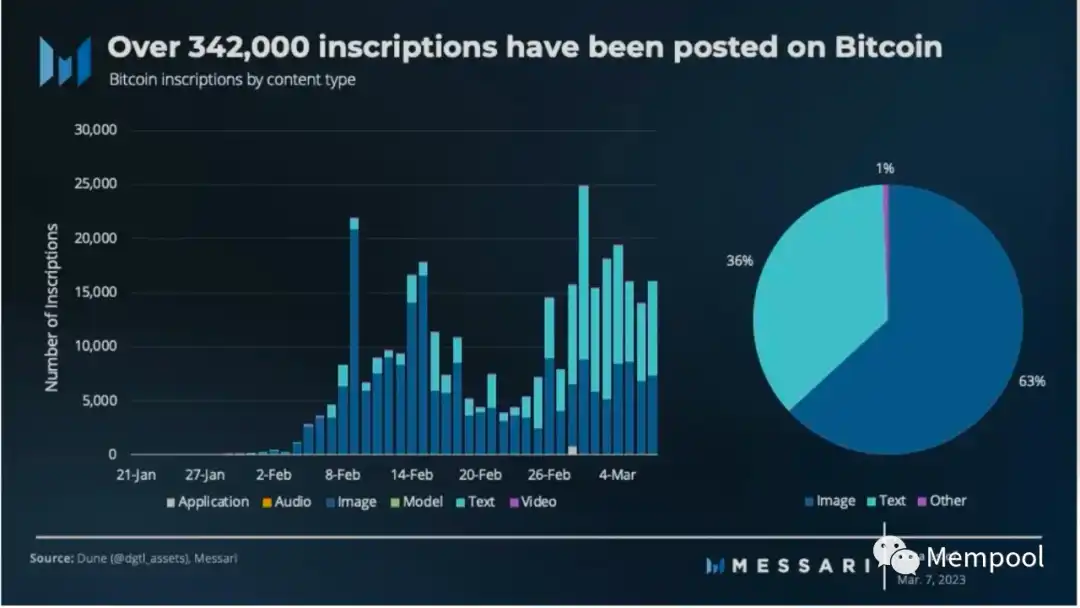
The Ordinal protocol can write code below 4mb into the block, which is actually the first two major technical upgrades of Bitcoin: one is the isolation verification segwit that occurred in 2017, and the other is Taproot in 2021, which is also the core of Bitcoin. Two of the most significant upgrades to date.
After a long-term "war" on the expansion path - in August 2017, Bitcoin adopted a Soft fork upgrade called Segregated Witness (SegWit). Place the end of the transaction so that the block has more space for more transactions to achieve the purpose of expansion.
After Segregated Witness, new block calculation rules are also generated. The block size unit is changed from byte to vBytes, and 1 vByte is equivalent to 4 weight units (wu), which also means that the maximum block size of 1MB is changed to 1vMB, which is 4 million wu. The transaction data structure is divided into transaction data and Witness data in two parts:
Transaction data: contains sender, receiver, input and output information, each byte is 4wu;
Witness data: contains script and signature data, each byte counts as 1wu;
In other words, the data weight of the witness part is only 25% of the transaction part. After the SegWit upgrade, it becomes easier and cheaper to store large amounts of data in the witness part.
After witnessing segregation, in November 2021, another major upgrade to Bitcoin will be Taproot. The main feature of Taproot allows developers to write more advanced scripts in the witness section, and more importantly, Taproot removes the limitation that limits the amount of data that can be contained in the transaction witness section, and can store up to 4MB of data in it.
After the two major upgrades of SegWit and Taproot, it is possible for the Bitcoin network to store a large amount of data. Bitcoin, the public ledger, has the infrastructure to store pictures and create NFTs, and Ordinals was born.
2. Bitcoin NFT market
In the past few years, NFTs on Ethereum have been popular, especially projects like Boring Ape, which have made the public aware of NFTs. In fact, the Bitcoin ecosystem has long made efforts in the field of digital artworks.
In 2012, Color Coins, an open source project on Bitcoin, attempted to bind real-world assets or services to Bitcoin, such as stock issuance, car rental, etc. To put it simply, dyed currency is to use the scripting language of Bitcoin to allow a small amount of metadata to be stored in the blockchain, and use these metadata to represent since, thus forming a new Liquidity. For example, a company wants to To issue 1,000 lots of shares, the company can tokenize 1,000 Satoshi bitcoins as the corresponding colored coins, with 1 Satoshi representing 1 lot of shares.
However, the limitations of dyed coins soon became apparent. Since dyed coins are based on the satoshi of Bitcoin, as the price of Bitcoin continues to rise, the cost of relying on dyed coins to issue assets is also rising; secondly, due to the limitation of Bitcoin script logic At the same time, the 10-minute block time of Bitcoin also makes dyed coins unsuitable for high-frequency trading scenarios.
It is worth mentioning that Vitalik was still active in the Bitcoin community at that time, and also participated in the early activities of coloring coins. A group of developers represented by Vitalik hoped to make some changes to the underlying technology of Bitcoin, but at the time, most of the core development If investors were unwilling to accept this proposal, Vitalik began to write the Ethereum Whitepaper and began the history of Ethereum.
By 2014, Bitcoin's first fork, Namecoin, minted the first-ever NFT. The project was called "Quantum", which was a generative work of art created by Jennifer and Kevin McCoy. Although this historical event did not happen to Bitcoin, the history of NFT started here.
At the same time, attempts to issue NFT on Bitcoin have not stopped, and a company called Counterparty further proposed the idea of issuing alternative digital assets on Bitcoin in 2014. Counterparty is more like an L2 second-layer solution for Bitcoin: a platform built on top of Bitcoin that inherits the security of the original blockchain, but also provides additional functionality.
In simple terms, it is conceived on Bitcoin, through the native decentralized exchange (DEX) and tokens, allowing users to mint, buy and sell unique digital assets, and the principle behind it is to use the OP_RETURN function to any The data is encoded. Based on Counterparty EverdreamSoft developed the first blockchain trading card game on Counterparty in 2015. In November 2016, Counterparty-based Bitcoin NFT Rare PePe Cards came out, successfully bringing NFT into the Bitcoin community for the first time. But Counterparty has its own native token, and it prefers that users use its native token to buy and sell cards. In short, Counterparty has not attracted much attention.
In 2021, Stacks launched its own layer 1 blockchain, adding NFT and DeFi functions to Bitcoin. The outside world regards Stacks as Layer 2 of Bitcoin, but in fact it is more like a side chain of Bitcoin. However, NFTs bought and sold on Stacks can only be traded using the native Stacks token (STX), therefore, NFTs issued by Stack cannot be counted as Bitcoin NFTs—assets do not exist on the native Bitcoin chain and are not linked to BTC for transactions.
The launch of Ordinals in February 2023 will provide a new paradigm for the entire NFT—for the first time, all NFT data will be stored on the chain.
In fact, due to the high cost of writing files to the Ethereum EVM, most of the media files of the Ethereum NFT are stored off-chain—although most of the Ethereum NFTs are stored on IPFS or other decentralized storage platforms , but the hash location of the data knowledge media files actually written on the chain, the files are actually stored on a certain computer, although most miners still have the motivation to operate IPFS nodes, but it does not rule out multiple nodes in the future Closed, causing the NFT that users spent millions of dollars to buy cannot be displayed. At least probabilistically speaking, Ethereum NFT has such risks.
But all the data of Odinals-based Bitcoin NFT is stored on the Bitcoin block. At present, the Ordinals protocol has a limit of 4MB for media files. Some people think that this will be a limit for NFTs on Bitcoin, but we believe that at present, a media file is bound to a satoshi, and a media file may be able to cross over in the future. A few satoshis. But the biggest significance of Bitcoin NFT is that all media files are stored on a permanent public ledger of human beings. Compared with Ethereum NFT, it is more materialized and more valuable for collection.
It is worth noting that the inscription brings a new narrative to NFT. Users can see when Satoshi was mined and their order, that is, the Ordinals number and the time Satoshi was mined become features unique to Bitcoin NFTs. The inscription numbers are arranged according to ordinal numbers, and there is a logic from early to late. Therefore, many projects are currently trying to preempt an earlier serial number in Bitcoin NFT. At the same time, users also think that Satoshi mined earlier is relatively rare. However, 15 million of the 19.2 million BTC currently in circulation were mined in 2016, and the total number of Bitcoins is 20 million. There is not much difference in "years".
Galaxy predicts in the report that by 2025, Bitcoin NFT may grow into a $4.5 billion market, which is also 38% of the current Ethereum NFT market value.
In the past two years, Ethereum NFT has experienced hot money and many bubbles. Taking the trading platform Blur as an example, it stimulates NFT transactions in the form of returning Blur tokens, and Blur tokens also maintain a high market value through stimulating transactions, which seems to form a virtuous circle. Negative impact - the trading model brought by Blur does not rule out some players' false transactions for the purpose of earning Blur tokens, and the entire market will have doubts about the price of NFT: Is the asset price a brush or a real price?
At the same time, new application scenarios have emerged for Ethereum NFT. After entering the second half of 2022, the issuance of NFT has changed from the speculative PFP (profile picture) avatar category in the past two years to application-based chain game NFT, NFT Pass, etc., which have certain intrinsic value to support the track. These NFTs can be combined with certain specific application scenarios, which also means that their prices will not fluctuate as much as PFT NFTs, which may vary by 10% to 20%.
It cannot be denied that Ethereum NFT trading markets such as Opensea still have huge Liquidity. After the rise of Ordinals, some players still hope to maintain Liquidity through the Opensea market. After they issued CryptoPunk on Ordinals, they mapped to On Ethereum, trade through Opensea. Technically speaking, BTC can be packaged to the treasury address of REN through the Cross-chain mechanism of the REN protocol, and then additional renBTC can be issued on the ERC20 of Ethereum through the same party signature and other technologies, although it needs to go through a more centralized mechanism such as Oracle , but a relatively mature technology.
Will there be a split between Ethereum NFT and Bitcoin NFT in the future? For example, Bitcoin NFT is suitable for more collectible NFTs, while Bitcoin NFT has more practical application scenarios? This will take time to verify.
3. Bitcoin Ecology
The emergence of Ordinals also has a certain impact on the Bitcoin ecosystem.
Miners’ income: Ordinal can undoubtedly increase the income of miners. The investment research institution Galaxy calculated based on the data from January to February that it can increase the income of miners by 6.1%, which should actually be more.
Miner's income is actually the transaction fee that traders are willing to pay for the block space. It is calculated by multiplying the amount of Satoshi that the user is willing to pay per byte for a certain transaction by the number of bytes of block space occupied by the transaction. The formula is the number of transaction bytes *N sat/B. That is to say, assuming that a transaction occupies 300 bytes, whether the transaction transfers 1 bitcoin or 300 bitcoins, as long as the block space is the same, the transaction fee is the same.
According to Galaxy's historical data, 182GB (87% utilization) of data is stored in Bitcoin block space in 2021 and 166GB (79% utilization) of data are stored in 2022. Using the average byte count of the first 20,000 inscriptions of 33,114 bytes, over 1.3 million more inscriptions could be created based on the remaining block space in 2022.
Galaxy assumes that if the unused space is fully utilized, that is, 130 inscriptions are created, based on the average transaction fee of 3 Sats/vByte in 2022, it will bring 330 BTC transaction fees to miners, and in 2022, miners will start from transaction A total of 5,374 BTC was earned in fees, which is able to increase the income of miners by 6.1%.
The above is the theoretical situation, but according to the recent situation, because everyone wants to seize the higher order in the inscription, many people will increase the transaction fee, and generally need to pay 4 to 8 Sats/vByte during the day in mainland China , at night, that is, when the European and American markets are active, there will be a transaction fee of 40 Sats/vByte at the highest.
But at present, many miners are opposed to Ordinals, and do not realize the income growth that Ordinals brings to them.
Homogeneity: There is another strong criticism of Ordinals in the Bitcoin community, especially the core developers of Bitcoin. They believe that writing special fields into Bitcoin makes Bitcoin recognizable and loses the homogeneity. Qualitatively, it affects privacy and damages the function of Bitcoin as a currency. In this regard, Galaxy used a model to conclude that even if inscription is very popular in the future, the proportion of Bitcoin affected is far less than 1%.
At present, it costs about 10,000 Satoshi to engrave an inscription, of which 1 Satoshi is used for numbering, and 9999 Satoshi is used as "postage" as the cost of transferring the inscription in the future. Assuming that 500 million inscriptions are to be minted, block space can be obtained every year (such as 2022 The remaining block space outside of mainstream transactions is 1.3 million) which takes 238 years. And 500 million inscriptions affect 5 trillion Satoshi, that is, 50,000 bitcoins, accounting for 0.24% of the total 20 million bitcoins. Therefore, the impact on the overall homogenization of Bitcoin is negligible. 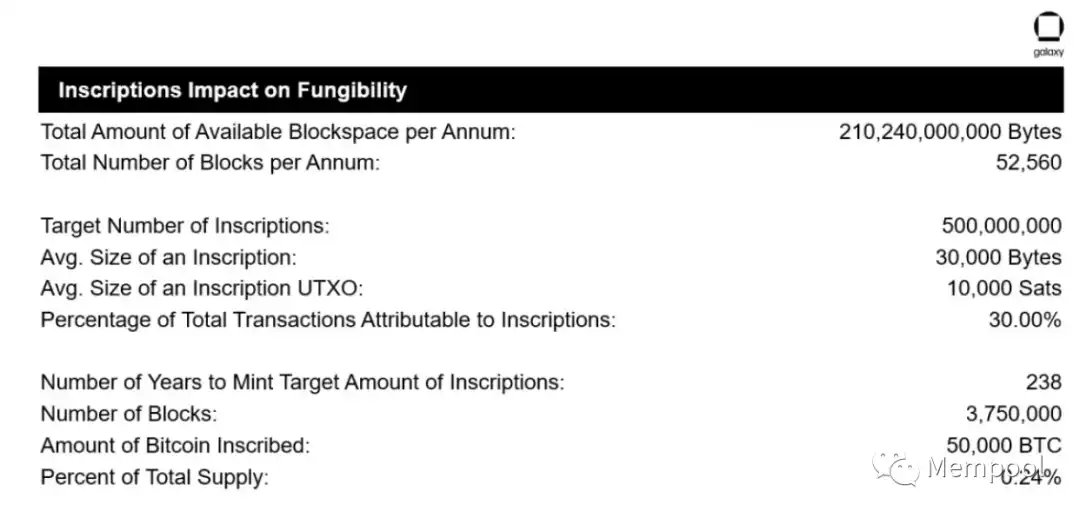
Lightning Network: In the view of Mempool guests, Ordinals will not affect the function of Bitcoin as a currency, but can promote the large-scale application of Bitcoin payment two-layer Lightning Network.
For a long time, as a payment system, the transaction speed of Bitcoin has been criticized. The peak throughput of Bitcoin on the chain is 7 transaction packets per second. In contrast, Visa processes an average of 1700 transactions per second. How to improve The throughput of Bitcoin is a difficult problem that developers have been trying to solve. The Lightning Network was proposed in this way, which represents the improvement of Bitcoin throughput without compromising the security of the Bitcoin network.
The Lightning Network believes that instead of increasing the block space, expanding the performance of the machine, or optimizing the code to the extreme, it is better to let the transaction disappear. The idea of the Lightning Network is to transfer user funds to the off-chain channel for real-time settlement. After the transaction, the final state will be transferred back to the chain for settlement. No matter how many transactions the user performs in the channel, the transaction on the chain is only two steps. For example: Alice has 100 yuan, the first time she buys a product worth 5 yuan from Bob, the remaining 95 yuan; the second time she buys something from Bob for 35 yuan, leaving 60 yuan …No matter how many transactions have occurred, the Lightning Network records these transaction processes off-chain, and writes the final result on the chain, that is, Alice has 60 yuan left, and Bob has 40 yuan.
Guests from Mempool believed that the Lightning Network has not had a good application scenario. With the popularity of Ordinals, the Lightning Network will be further popularized.
4. Ordinals ecology
The emergence of Ordinals will also bring about the prosperity of the infrastructure related to Bitcoin NFT. There is no doubt that this is also an opportunity for developers.
Bitcoin-native NFT : NFTs currently issued on Ordinals, in addition to TwelveFold released by Yuga Labs, and DeGods, a traditional blue-chip NFT project on the Solana chain, are also worth noting. A project of currency community culture.
Bringing the wizard image into the Bitcoin community began in February 2013, when the administrator of /r/Bitcoin, theymos, solicited ideas for community advertisements. In about an hour, a community member named /u/mavensbot submitted an image The work called "Magic Internet Money Wizard" quickly became the most popular idea in the forum, was selected as the official promotional image of the /r/Bitcoin forum, and was put on Reddit for a while.
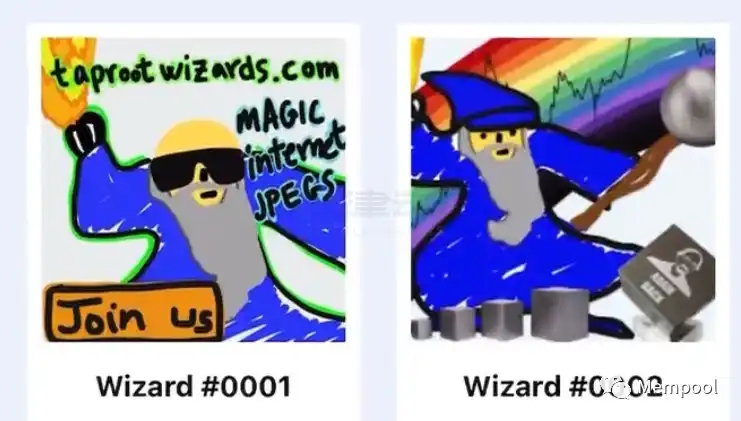
The simple brainwashing design of this image brought a lot of traffic to the /r/Bitcoin forum, and many people learned about, bought, and spread Bitcoin. At that time, the price of Bitcoin was less than $300. An iconic symbol of the Bitcoin community, and the Taproot Wizard recently released on Ordinals is an NFT created by adding elements related to Taproot upgrades based on this image.
At the same time, because Bitcoin NFT has the characteristics of serial number and age, these two characteristics have also become the native culture of Bitcoin NFT. The inscriptions on the early serial number and age are believed to form a unique trading market in the future.
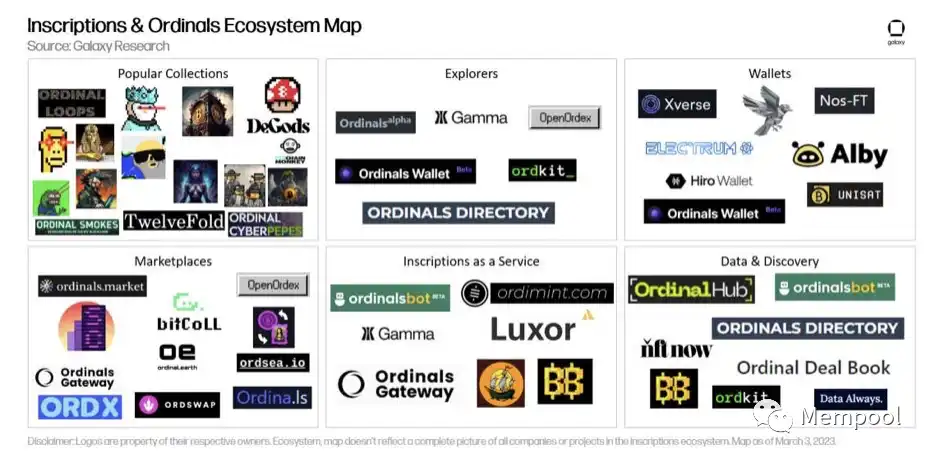
Trading market: In the Bitcoin trading market, there is no doubt that a platform like Opensea will be formed, and there are already players such as Ordswap, Gamma, OpenOrdex, and Magic Eden.
Browser: The browser is also an important infrastructure. At present, Gamma and other products provide users with inscription data analysis, as well as transfer id, address, amount, weight and other data services.
Inscriptions as a service : For individuals, it is relatively complicated to mint an NFT on Ordinals. It is necessary to download the full node of Bitcoin and install Ordinal software. Therefore, some service providers can Provide more convenient services, such as Luxor, Gamma, UniSat, OrdBucks and Ordswap, etc.
Wallet: Of course, the wallet will also be an important infrastructure for Bitcoin NFT, helping users save NFT, and even increase the circulation of NFT. There are already developers such as Unisat, Xverse, and Hiro.
In short, we believe that in the next 2 to 3 months, we will see a new wave of development of Ordinals-related infrastructure, and the current user experience problems can be further resolved.






