Author: LK Venture
TL, DR
Kaspa uses the GHOSTDAG protocol, which can greatly improve network performance while ensuring network security. It will be launched in November 2021. Compared with similar DAG projects, it has greater innovation and theoretically supports the development of smart contracts
The core developers have strong technical strength. They have published papers quoted by the Ethereum Whitepaper and have continued to expand and improve the theory over the years.
The project is 100% community-driven, without investment institutions, and all tokens are produced by POW mining. At present, it is only listed on the second and third tier exchanges, with a circulating market value of 530 million US dollars and a FDV of 850 million US dollars. There is a possibility of listing on Binance in the future
Under the risk-neutral scenario, FDV is expected to reach USD 1.5-4 billion within two years, with room for 1-4 times growth
The progress of technology development is not as expected, the smart contract is delayed or even fails, and the ecological development is stagnant
project details
Kaspa is a POW public chain based on the GHOSTDAG protocol, which aims to solve the impossible triangle problem of the blockchain. The GHOSTDAG protocol is a generalization of the Bitcoin consensus. Since it has no additional assumptions, it is theoretically as secure as Bitcoin. Different from Bitcoin, GHOSTDAG adopts not a single chain structure, but a crisscross Directed Acyclic Graph (DAG) structure, in which one block can point to multiple blocks. To put it simply, Kaspa has the characteristics of fast transaction speed, high throughput and decentralization under the condition of ensuring security.
The Kaspa Mainnet will be launched in November 2021. The total number of KAS tokens is 28.7 billion. The current circulation is about 17.7 billion and the market value is 530 million US dollars.

Changes in Kaspa’s circulating market value, source: CoinMarketCap
Kaspa technical features
Fast transaction speed and high throughput
Bitcoin's block generation is slow, which also means that it takes a long time for transactions to be uploaded to the chain. At present, Bitcoin produces a block every 10 minutes, and each block can accommodate 4,000 transactions, that is, TPS is about 7, which is far from satisfying high-concurrency applications. Kaspa removes security as a bottleneck for high throughput through GHOSTDAG, while optimizing bandwidth cost and network infrastructure for high throughput. Specifically, currently Kaspa can produce one block per second, and each block can accommodate 300 transactions, that is, the TPS can reach 300, which is more than 40 times that of Bitcoin. Kaspa's goal is to generate 10 blocks per second, or even 100 blocks, which is still dozens of times better than the current performance.
Decentralization of mining
For individual miners, it is very difficult to dig out bitcoins with their own computing power. It is a better choice to join a large mining pool to obtain the income corresponding to the computing power. Benefiting from the scale effect, consensus power is concentrated in the hands of a few large mining pools. At present, the computing power of the top three mining pools of Bitcoin accounts for 66%. Kaspa’s high block production speed reduces the difficulty of mining for small miners and helps to achieve decentralization of mining. The top three mining pools account for only 26% of the computing power.

BTC mining pool computing power ratio, source: Mining Pool Stats

Kaspa mining pool computing power ratio, source: Mining Pool Stats
Expansion principle: from PHANTOM to GHOSTDAG
The difficulty of Bitcoin expansion is that if the block generation time is directly reduced or the block capacity is increased, the broadcast speed will not keep up with the block generation speed, resulting in forks in the blockchain, which will reduce the security of the overall network. Even under normal circumstances, forks may occur due to network delays and other reasons. Bitcoin selects one of the effective main chains through the "longest chain consensus" to ensure network security, which also reduces the efficiency of the network.
The choice of expansion: DAG network
DAG is a network structure that allows forking. Multiple blocks can be generated at the same time, and one block can also point to multiple blocks. This means that the block generation speed and throughput can be rapidly improved, so the DAG structure is natural Suitable for improving TPS. However, if blocks are allowed to run in parallel, it is inevitable to encounter transaction contradictions, which is the so-called "double spending" problem. How to determine the order of transactions is the key to the success or failure of the DAG structure.

DAG structure diagram, source: "PHANTOM GHOSTDAG: A Scalable Generalization of Nakamoto Consensus"
Sortable DAG: PHANTOM Protocol
The Kaspa team first conceived the PHANTOM protocol, sorting without considering efficiency, and distinguishing honest blocks from attacking blocks by voting. Take block B in the following figure as an example, the reachable block of B is called B's "past block", the reachable block of B is called B's "future block", and the remaining blocks are called " AntiCone", that is, a block that has nothing to do with block B.

Schematic diagram of PHANTOM block definition, source: "Kaspa — What are We Actually Doing Here?"
Introduce a parameter k, if in a subset of DAG network, the AntiCone of each block in this subset is less than or equal to k, then we call this subset k-cluster. The k-cluster containing the most blocks in this DAG network is called the largest k-cluster. After determining the value of k, find the largest k-cluster, and finally sort the blocks in the collection linearly by topological sorting method.

Schematic diagram of PHANTOM k-cluster, source: "Kaspa — What are We Actually Doing Here?"
The problem with the PHANTOM protocol is its low efficiency and large amount of calculation. First of all, finding the largest k-cluster in a DAG network is an NP-complete problem, and the calculation difficulty is very high. Second, every time a new block is added to the network, the entire calculation needs to be restarted, and the structure of the entire DAG network is also required to be stored.
Improved version of PHANTOM: GHOSTDAG
GHOSTDAG improves PHANTOM through a greedy algorithm to solve the problem of insufficient efficiency. Specifically, assign a "blue score" to each block, recording how many "past blocks" it contains in the k-cluster. First calculate the score of each block, select the block with the highest score to form a main chain, and then find the k-cluster by voting from the genesis block. When a new block is generated, it does not need to recalculate the k-cluster, but inherits from the parent block with the highest blue score.

GHOSTDAG schematic diagram, source: "PHANTOM GHOSTDAG: A Scalable Generalization of Nakamoto Consensus"
When k=0, GHOSTDAG is no different from the Bitcoin consensus, and the "blue score" is the length of the longest Bitcoin chain. Therefore, GHOSTDAG is actually a generalization of Bitcoin's longest chain consensus. Since GHOSTDAG sorts network transactions and meets the requirements of Turing's completeness, it can also be used in the development of smart contracts in theory. So far, the Kaspa team has solved the theoretical problem of expansion, and $KAS will be officially launched in November 2021.
Background of the project
team
Kaspa is mainly led by a development team from Israel. The core developers have strong scientific research capabilities, and the founders have made great achievements in the academic circle. At the same time, Kaspa has a strong community, and many community volunteers actively participate in business activities such as project development, network marketing, and user education.
Yonatan Sompolinsky , Founder
Yonatan has a Ph.D. in computer science from the Hebrew University of Israel, and is currently doing postdoctoral research at Harvard University, focusing on transaction ordering protocols and MEV. In 2013, Yonatan and his mentor, Professor Zohar, jointly conceived the GHOST protocol, which was later referenced in the Ethereum Whitepaper and began to gain reputation in the cryptocurrency academic circles.

Source: Ethereum Whitepaper
Yonatan is the founder of the Kaspa project. He has made great achievements in the theoretical research of blockchain. Many papers have been recognized by the academic community and have been cited hundreds of times. It can be said that Yonatan's research on the impossible triangle problem of the blockchain contributed to the birth of the Kaspa project.
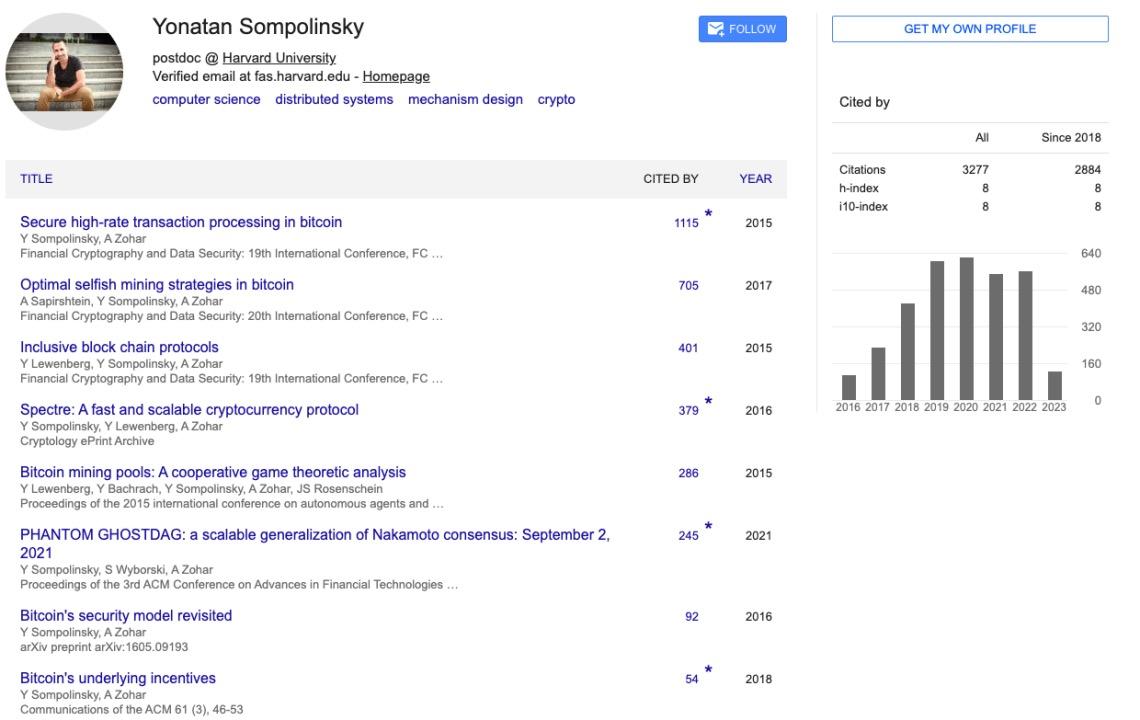
Source: Google Scholar
Michael Sutton , Core Developer
Michael Sutton has a master's degree in computer science from the Hebrew University, focusing on parallel algorithms and distributed systems.
Shai Wyborski , Core Developer
Shai Wyborski is pursuing a Ph.D. at Hebrew University and Ben-Gurion University, focusing on classical and quantum cryptography.
Mike Zak , Core Developer
Mike Zak is mainly responsible for distributed system development.
Elichai Turkel , core developer
Elichai Turkel mainly studies applied encryption algorithms and high-performance system development.
Ori Newman , Core Developer
Ori Newman is mainly responsible for distributed system development.
In addition to the core developers, there are many other community developers, community marketers and volunteers who are actively contributing to the development of the Kaspa ecosystem.

Kaspa community contributors, source: Kaspa official website
financing
Yonatan established DAG Labs in 2018 and received $8 million in financing from Polychain Capital for the development of OPOW ASIC mining machines and DAG research. However, due to the immaturity of OPOW technology and the fact that POW L1 was not popular in the market at that time, DAG Labs decided to disband at the end of 2021, and used the remaining funds to rent mining machines to participate in Kaspa's early mining, and obtained about 800 million KAS. To the employees at the time and Polychain Capital. Strictly speaking, the Kaspa project has not received financing, and the only way to obtain KAS is to participate in fair mining.
Tokenomics _
The total amount of $KAS is about 28.7 billion, which is produced by fair mining, without pre-mining and private equity investment. The current circulation exceeds 17.7 billion pieces, accounting for about 60% of the total.

Schematic diagram of Kaspa output, source: Kaspa official website
At present, KAS's daily output income ranks fourth in the entire network, second only to BTC, Doge and LTC. The computing power reaches 800TH/s, ranking first among GPU mining coins, while ETC only has 110TH/s.

POW mining income ranking, source: f2pool
KAS positions are relatively scattered. The Top 100 positions account for about 36.6% of the total, and the Top 10 positions account for about 18.9% of the total. Among them, the largest holding address is MEXC, accounting for about 8.4% of the total.

Top 10 holding addresses of KAS, source: Kaspa block explorer
Development route
Overall, continuing to improve the performance and security of the network is still the primary goal of Kaspa, and the team is currently focusing on the following events:
RUST rewrite
Kaspa was originally written in the GoLang programming language, and the team is currently rewriting it in the RUST language. RUST is a high-performance programming language that makes efficient use of modern computing hardware to process different blocks on different CPU threads in parallel. This conversion will greatly improve the overall performance of Kaspa, which can process more than 10 blocks per second. The plan will start in July 2022, led by Michael Sutton, has entered the testing phase, and is expected to be completed by the middle of this year.
Upgrade to D AGKNIGHT protocol
Yonatan and Michael Sutton published a new paper, The DAG KNIGHT Protocol: A Parameterless Generalization of Nakamoto Consensus in October 2022, proposing an improved version of GHOSTDAG, DAGKNIGHT, to further improve network performance and security. The team expects to develop DAGKNIGHT after the RUST rewrite.
Mobile Wallet Development
Kaspa already has web wallet (https://wallet.kaspanet.io/), desktop wallet (https://kdx.app) and command line interface wallet ( https://github.com/kaspanet/kaspad ), the current team A wallet for mobile devices is being developed.
smart contract
It is being planned and is expected to be developed after the DAGKNIGHT upgrade.
transaction
At present, KAS is only listed on the second- and third-tier exchanges, and Liquidity is poor. Due to the strong technology and community, it is possible to log in to Binance without listing fees in the future.

KAS listed, source: CoinMarketCap
Valuation Analysis
KAS currently has a FDV of 850 million US dollars, and its value mainly comes from its better answers to the impossible triangle problem. In the short term, the current market value already includes high expectations, and the driving force for further growth may lie in landing on first-tier exchanges. In the long run, future growth depends on whether Kaspa can become a top public chain, and attention needs to be paid to performance improvement, smart contract deployment, and ecological development.
We conduct valuation analysis on KAS through three scenarios of optimism, neutrality and pessimism (the following analysis is based on the current market situation, if the overall market rises or falls, the valuation level should be adjusted accordingly).
Optimistic: FDV reaches over US$ 10 billion
Under an optimistic scenario, Kaspa successfully completes the DAGKNIGHT upgrade within one year, and the TPS reaches the order of thousands. At the same time, the smart contract is successfully launched, the ecology develops rapidly, and is used on a large scale, and the TVL reaches one billion US dollars.
Benchmarking $ Matic(TVL 1.1 billion, FDV 11.1 billion), $ AVAX(TVL 870 million, FDV 12.7 billion), it is expected that $KAS will rank among the top public chains, and the FDV will reach more than 10 billion US dollars. Compared with the current market value There is room for 10 times growth.
Neutral: $ 1.5-4 billion market capitalization
In the neutral scenario, Kaspa has successfully upgraded and launched smart contracts within two years, but a public chain with a better overall solution has appeared on the market. At the same time, due to the lack of capital support and ecological incentives, or the performance is not as expected, and the user experience is not good, the ecological development is slow, and it is difficult to obtain large-scale use, and the TVL only reaches hundreds of millions of dollars.
Benchmarking $ HBAR($35M TVL, $3.3B FDV), $ ALGO($120M TVL, $2.2B FDV), $ FTM($450M TVL, $1.4B FDV), $ EOS($130M TVL USD, FDV 1.3 billion USD), it is expected that $KAS will become one of the second and third tier public chains, and the FDV will exceed $ EOS, reaching USD 1.5-4 billion, which has room for 1-4 times growth compared to the current market value.
Pessimistic: $ 5-2 billion market cap
In a pessimistic situation, Kaspa fails to develop smart contracts, and the ecological development stagnates. The only use is POW mining, and the valuation needs to be discounted.
Compared with $ BCH($2.6 billion in FDV), $ BSV($750 million in FDV), and $ RVN($530 million in FDV), Kaspa has certain advantages in terms of security and performance, but it is not as good as the old projects in terms of user consensus. It is estimated that $KAS FDV is higher than $ RVN and lower than $ BCH, and can roughly reach $500-2 billion, which may double the growth space compared to the current market value.