The NFT trading market Blur announced the launch of the P2P NFT perpetual lending agreement ─ ─ Blend , which is different from the current common NFT lending market, Blend does not rely on oracle machines, and does not have the characteristics of loan settlement dates, allowing both borrowers and borrowers to use more flexibly , and whether the launch of the agreement can save the current market decline, this article will analyze the problems faced by the NFT market from the perspective of "supply and demand".
Further reading: Popular Science | What are the advantages of Blur's P2P NFT lending agreement "Blend"? Detailed function
Analyze the NFT market from a "supply and demand perspective"
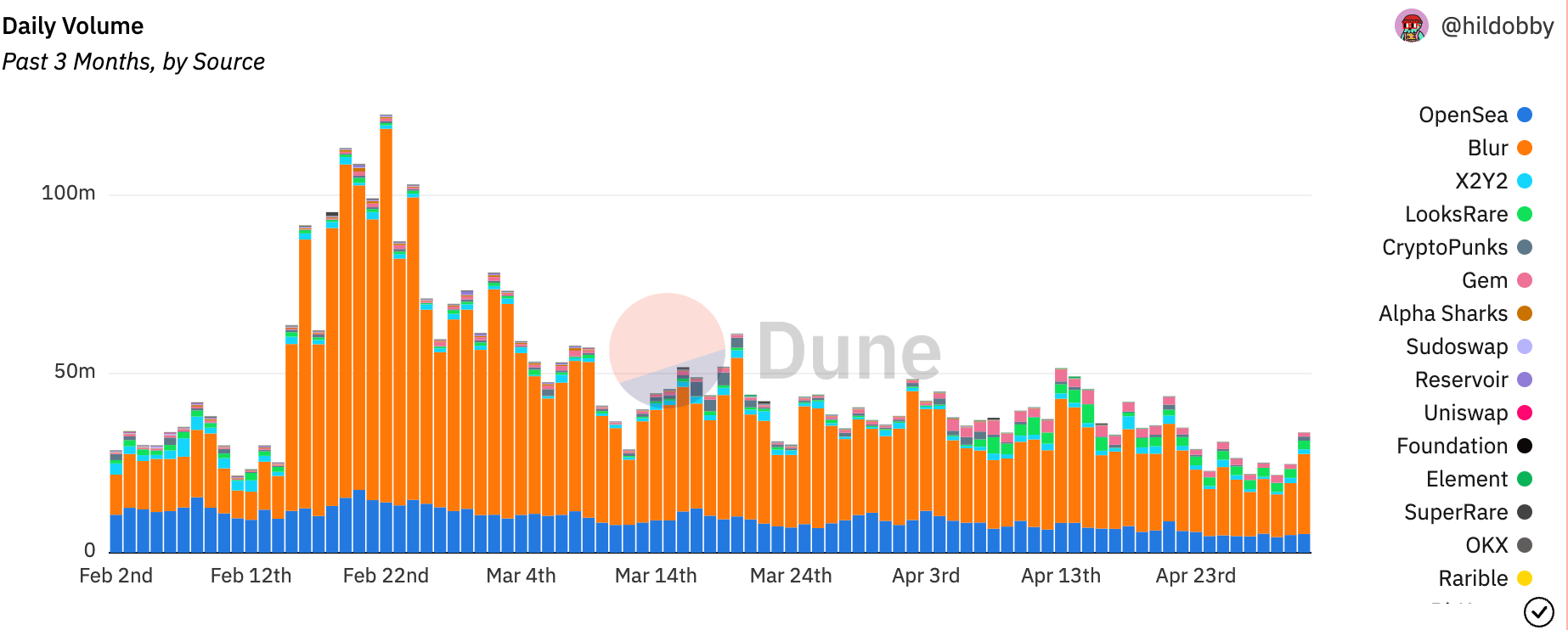
Recently, the encryption market has shown signs of recovery, but the NFT market is still not improving. According to Dune data, since the NFT aggregation platform Blur issued an AirDrop on February 14, the AirDrop NFT market trading volume has begun to drop sharply. At present, there are only less than 30 million US dollars left, which has dropped by nearly 70% in just two months.
Not only that, but the floor prices of most NFT projects have dropped repeatedly. Among them, the floor price of the Bored Ape Yacht Club(BAYC) series, the leader in the NFT market, has been falling from a high of 80 ETH in February, and once fell below 45 ETH last week, setting a new record in the past six months. low point.
Further reading: Why BAYC fell below 55 ETH? NFT giant whale was brutally pulled by Rug, selling 27 boring apes
However, if we analyze it from the perspective of supply and demand, we can find out what problems the current NFT market is facing.
From the perspective of "supply", NFT will start to go to the public in 2021, and will appear with new projects and use cases in 2022, from the rise of the PFP series to exploratory attempts in music, entertainment, games and metaverse experience, NFT Projects continue to pour out like a tide, which also makes the current market oversupply problem.
On the other hand, from the perspective of "demand", new users' interest in NFT has dropped significantly after the NFT boom, and old users have lost confidence in the entire market after facing large losses. The current situation is that no user is willing to continue Buying NFT, except for a few blue-chip projects that are resilient, most projects lack the attractiveness of being held for a long time.
And because of this, Blur launched Blend hoping to solve the problems facing the market from the perspective of "supply and demand".
Solving the "supply" problem: NFT mortgage loans
Market demand for "NFT lending"
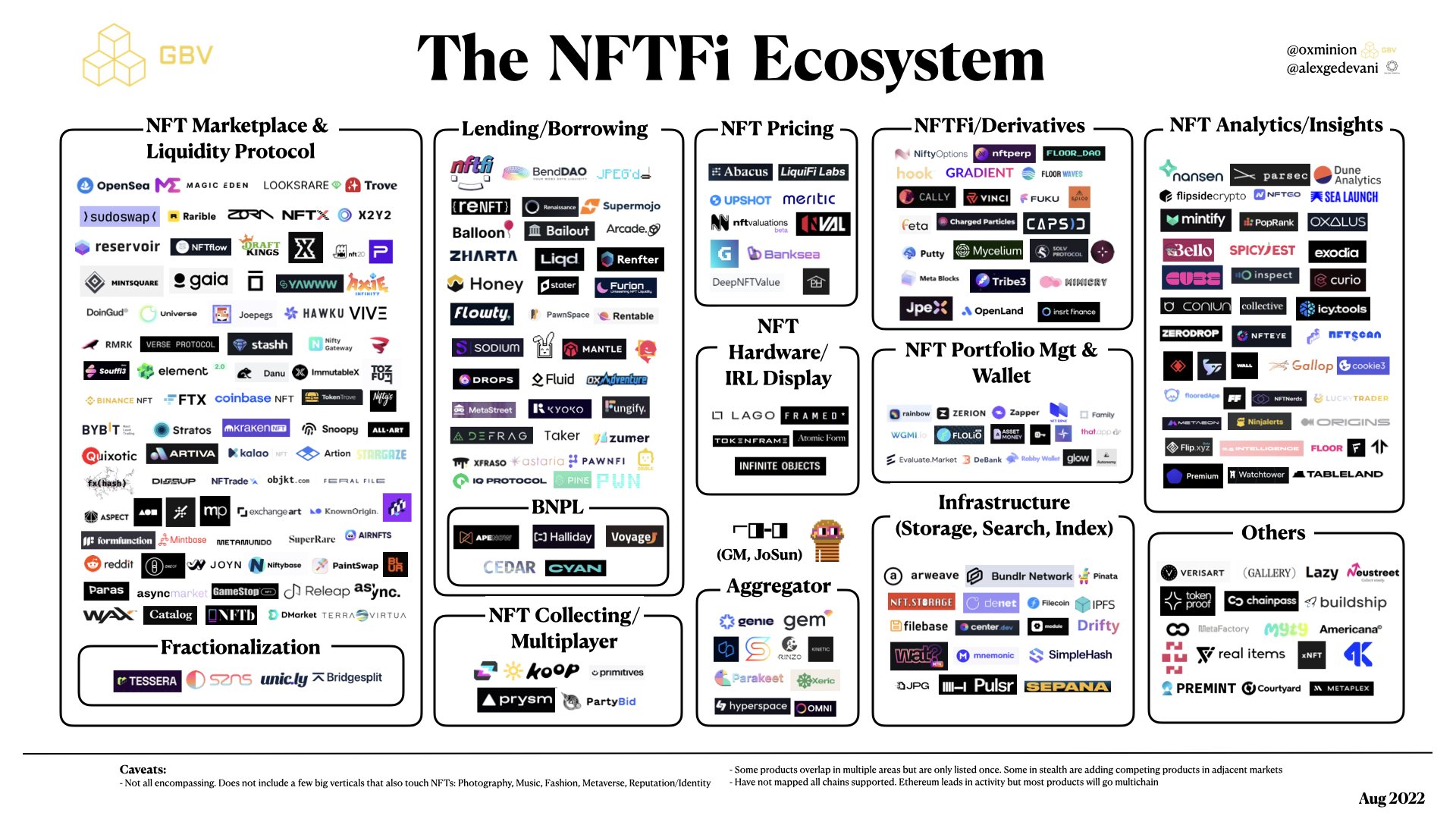
In the current NFTFi (NFT Finance) ecosystem, the largest proportion is NFT trading platforms, such as Blur, OpenSea, LooksRare and other platforms that allow people to buy and trade NFT. The largest category besides trading platforms is the NFT lending agreement.
In the traditional financial market, "borrowing" is an indispensable part, and it is also one of the biggest demands. Just like people obtain funds by mortgaging their houses, the NFT market is no exception. NFT holders want to further improve Fund utilization efficiency, by staking NFT in exchange for cash (Liquidity) for other investment decisions, and when users choose to mortgage NFT instead of listing NFT, this can further alleviate the problem of oversupply.
Blend vs. Existing Lending Protocols: BendDAO, NFTFi
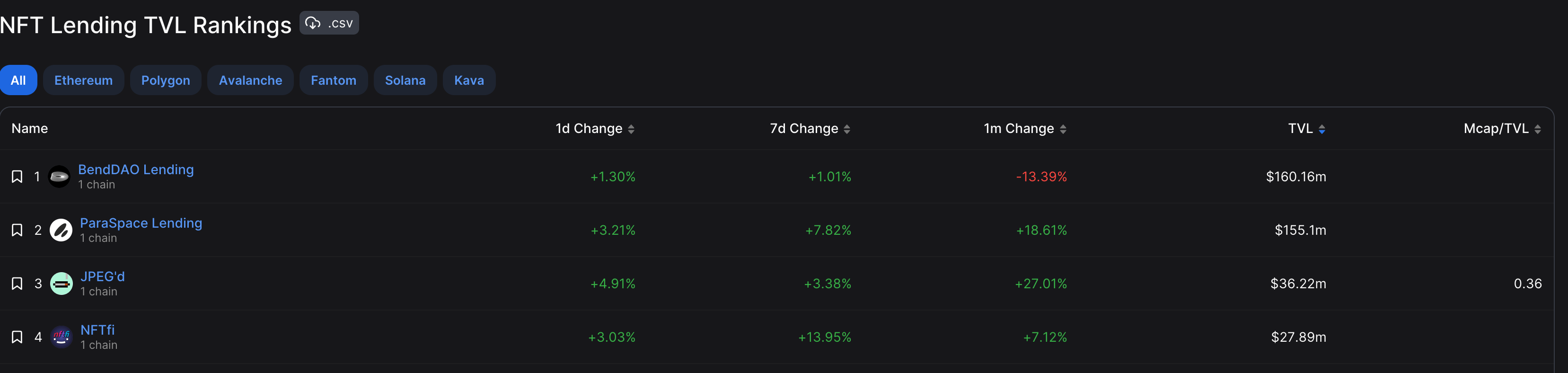
According to DefiLlama data, BendDAO ranks first among all NFT lending agreements with a lock-up volume (TVL) of US$160 million. Its main feature is that it is the first NFT lending agreement to operate as a peer-to-pool (Peer-to-Pool).
BendDAO's lenders (depositors) provide ETH to liquidity pools to earn interest, and then lenders of NFT projects can obtain instant NFT-backed loans through these pools. It can be seen that BendDAO does not emphasize the " NFT fragmentation" to achieve Liquidity, but to optimize the efficiency of capital utilization through point-to-pool.
 As for Blend, it focuses on the Peer-to-Peer NFT perpetual lending agreement, but the biggest problem in the past P2P NFT lending agreements (such as: NFTFi, X2Y2) is the low capital efficiency, and it is necessary to wait for both borrowers to agree to all loans. The pairing can only be completed after certain conditions, which is exactly the same. Even though P2P is relatively safe, it is far behind the NFT lending agreement of the peer-to-pool in terms of mainstream adoption.
Blend is different from these traditional P2P models. It adjusts the three elements of borrowing: mortgage rate, interest rate, and loan settlement date into an "unlimited" flexible model. In addition, the agreement does not have a mandatory liquidation mechanism. After both parties complete the loan process, the lender can take back the loan at any time. At this time, the lender will have 24 hours to repay the loan, which solves the problem of low P2P utilization in the past .
Blend uses a sophisticated off-chain offer protocol that matches users who want to borrow against their NFT collateral with any lender willing to offer the most competitive interest rate. By default, Blend's loans have a fixed interest rate and never expire. Lenders can repay at any time, and lenders can exit their positions by triggering a Dutch auction to find new lenders and new rates. If that auction fails, the lender will be liquidated and the lender will take title to the collateral.
To put it simply, Blend is designed with the core of improving the "experience" and "efficiency" of both borrowers. It is different from most NFT lending agreements in the market. The main design includes four major features: "peer-to-peer", "no oracle", "no loan Term” and “Liquidable Mechanism”.
Solve the "demand" problem: buy now and pay later
Buy now and pay later = loan to buy NFT
For users who buy NFT for the first time, few people can pay all the fees at once, so Blend launched another solution: buy now pay later (BNPL).
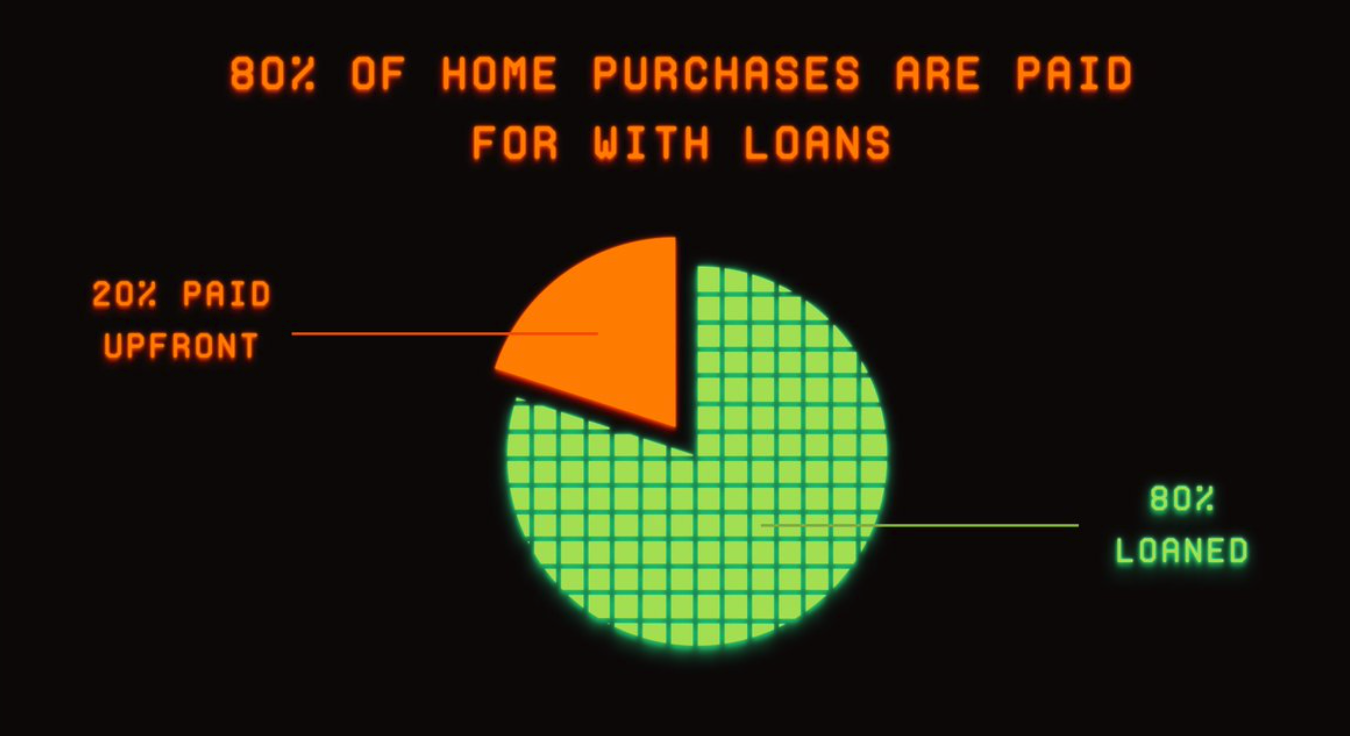
Take houses as an example. 80% of house purchases are paid for by loans. If people need to pay all house prices in full, the demand for house purchases will be greatly reduced, and house prices will also depreciate significantly. The same logic is applied here. The concept of buying first and paying later is actually equivalent to buying an NFT with a loan, that is, you will get an NFT after paying the down payment, and the subsequent payments will be repaid slowly through installments. When the threshold for buying NFT is lowered, It will greatly increase users' "willingness to buy" and further increase demand.
In addition, Blend's BNPL also combines the reward points mechanism of the Blur platform, which is equivalent to turning the bidding (bid) pool into an interest-bearing lending pool.
In addition to the original trading functions of Blur, a new NFT Liquidity market has been formed by relying on the integration of loans, interest, and BNPL. If the loan and reward mechanism are combined, points will be used as incentives to continue to attract users to invest funds , and formed the unique moat model of Blur+Blend, which enables users to achieve a maximum leverage of more than 10 times when purchasing NFT. This is also a business model that other BNPL platforms (such as: Paraspace) cannot currently achieve.
in conclusion
To sum up, Blend starts from the supply perspective of "NFT mortgage loan" and the demand perspective of "buy now, pay later" to try to solve the current problems facing the NFT market, aiming to release Liquidity for NFT.
Blend has been opened to all users, and CryptoPunks, Azuki and Milady are the first to be opened. A closer look can also find that the floor price of the first batch of open NFT series has increased significantly after the launch of Blend. Among them, the floor price of Azuki has increased from 15 ETH to 17.2 ETH, an increase of 15%, which also proves that when the "supply and demand" is effectively relieved, it is expected to improve the current problems faced by the NFT market.
However, whether Blend is a long-term antidote, or has become the biggest poison in the NFT market like Blur for a long time, still has to wait for time to verify.