What is on-chain gaming and why it matters
On-chain gaming is where the entire backend sits on the blockchain - meaning every in-game object, game interaction, and change to the state of the game to be recorded and executed on-chain. The ruleset that defines the in-game digital physics and gameplay is defined within a smart contract, making the game fully decentralized and providing full autonomy to each player.
The game belongs to the active player base and any builder can build on top of the existing layer, or add their spices to make a completely different game experience all within the limit of the defined rules. As players are the key decision makers on the dominating direction of the game world, the game continues to evolve and live on despite generations.
In the beginning, Web2 games offer a seamless and accessible gaming experience, but at its core, they are traditionally walled gardens, where the benefactor of continued use and in-game purchases is solely the game developer or the game publisher. The high risk of centralization, reliance on closed source code, and placement of trust in the hands of a single game publisher were the weaknesses that inspired the birth of what could be referred to as Web2.5 games - a catch-all referring to the blend of Web2 and Web3.
These games experienced a breakthrough in the era of P2E - a breakout area with incredibly high DAUs in 2021, but the lack of transparency in processes in determining rewards, the failure to balance rewards with gameplay difficulty, and the efflux of value from the system resulting in negative price pressures were the reasons why users quickly evaporated from the field. Web3 games came along with the advantages of having an open-source code, bottom-up development, antifragility, and permissionless nature. Trust and accountability are elevated by the transparent and immutable recording of in-game interactions on the blockchain, eliminating the risk of censorship and manipulation. Nonetheless, they are still having drawbacks of UX/UI, as well as latency and information-hiding issues.
As the benefits of digital asset ownership, play-to-earn, and data availability no longer convince the player base, on-chain gaming is a blockchain-only innovation that could not be duplicated by a centralized organization with centralized servers. Zero-knowledge proof (ZKP) can protect sensitive information while allowing for complex mechanics and interactions, while DAOs operate at both protocol and guild levels to help coordinate activity and collaboration, and with the help of AI, the production of generative and procedural output and automation of in-game agents to create rich and vibrant worlds become possible.
The time for on-chain gaming has arrived
All the game logic and statuses once deployed on-chain, are permanent and ensured that they will be playable as long as the chain exists. Eternal games, or autonomous worlds, can go on for generations, and become unsolvable with continuous non-trivial gameplay as an attribute. Persistent, on-chain games offer enhanced interactivity, as their time-based and always-on nature requires a degree of coordination amongst other players with shared incentives and alignment, encouraging worldwide and borderless guilds.With open-source code and permissionless structure, players can customize and bring their own stories into the games they love and create a sustainable game world where defined characters live on. This shift from passive consumption to active creation leads to unparalleled creativity, community strength, and sustainable growth. The game world is not limited by the resources of a single studio, providing an accessible platform for indie game developers and passionate projects with small budgets and big passion.
With the existing characters, external builders can contribute layers on top, not to mention the combination of AI-generated content and user-generated content that may result in diverse and imaginative gaming environments. The open nature means players can contribute not just to the core game, but to all things that surround the periphery.
Introducing zkSync
zkSync Era is a Layer-2 protocol that scales Ethereum with cutting-edge Zk technology, with the mission to not only increase Ethereum’s throughput but to also preserve its foundational values - freedom, self-sovereignty, and decentralization - at scale. To meet Web3’s demand, blockchain needs to scale similarly to the Internet: processing an unlimited number of transactions without a marginal impact on security or cost. This is called hyperscalability - the ultimate goal of Era’s design.
“Our long-term mission is to make self-sovereign participation in the digital economy - i.e. maintaining true control over one’s digital assets - affordable for anyone in the world.” - Alex Gluchowski, Co-Founder and CEO, Matter Labs
Matter Labs has a long-term vision for how its protocol can drive tangible positive change, by making self-sovereign participation in the digital economy easier for more people and increasing personal freedom globally. To realize this vision, the industry needs to focus on the features that will secure crypto’s long-term future - decentralization, security, and scalability. It must also, however, bring these features to more people, in more places, and more verticals, to break down the existing barriers to entry in crypto and realize the dream of true self-sovereignty, financial or otherwise. Particularly, gaming is an industry where the security, scalability, and low fees of zkSync can greatly improve user experience and transparency.
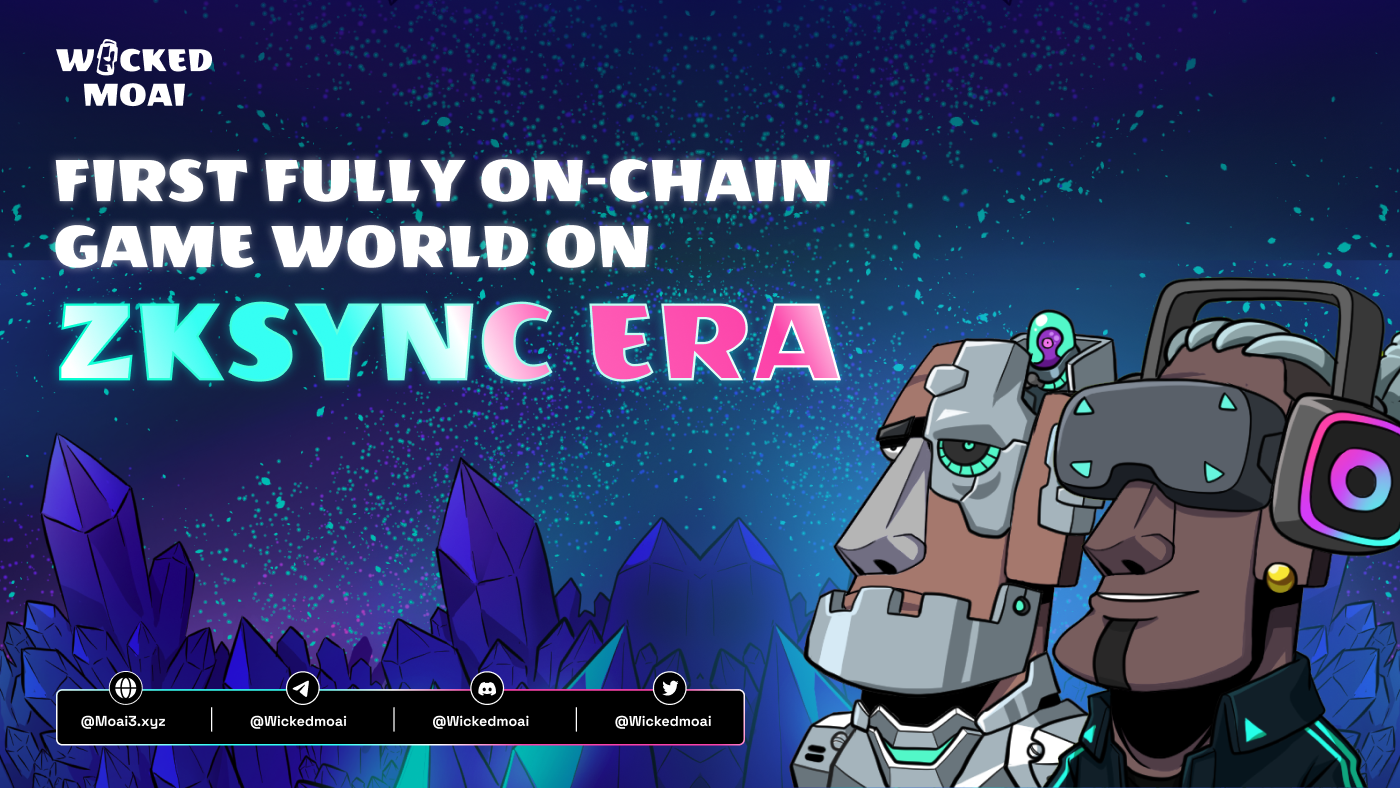
Wicked Moai - the first fully on-chain game on zkSync
Wicked Moai is a fully on-chain game world designed to bring like-minded individuals, Web3 enthusiasts, creators, and lovers of storytelling and fine artwork together on an open journey filled with adventure and excitement. The project is built on the zkSync blockchain which allows the creation of a transparent and decentralized ecosystem where players can fully immerse themselves in the world of Moai.
On-chain games require top-notch architecture and infrastructure from the crypto industry - where ZKP offers a helping hand with hardware acceleration, limited scalability, high gas fees, and hiding on-chain information and security concerns. ZK-rollups like zkSync Era are the only scaling solution that can inherit 100% of Ethereum’s security and promise to make Era by far the most secure L2 in practice, enhancing the security level upon the production on the chain.
Building on zkSync also means transparency and immutability, in which blockchain is a public ledger that is ideal for transparent and auditable applications, as well as keeping the data stored on the blockchain permanent and tamper-proof, ideal for records-keeping. Last but not least, on-chain apps are truly decentralized with no single point of control - perfect for community voting and DeFi applications - and can leverage blockchain’s distributed computing power for handling large amounts of data and processing.