



Note: This article comes from @atgoodm Twitter, MarsBit organizes it as follows:
It all started with an experiment.
Just like all other transformative technologies.
Bitcoin, Ethereum, NFT…the list goes on and on.
We always wonder what is the next Bitcoin? What is the next Ethereum? What is the next NFT?
This is the hardest thing to do, but when you do, it changes your whole life.
The winners are always those who challenge the status quo and are ready to try new things, even if they look crazy.
These guys want to redefine the meta.
Just like when Casey Rodamor created the Ordinals Inscription mechanic.
Or Domo created $ORDI as an experiment.
Everything you see now with BRC-20 and Ordinals is due to two things:
Segwit and Taproot.
A Bitcoin block is like a page in a shared ledger that records all Bitcoin transactions.
Until 2021, the Bitcoin block size is limited to 1 megabyte.
This limit is to prevent spam attacks on the network.
Two Bitcoin updates, SegWit in 2017 and Taproot in 2021, increased the block size to 4 megabytes.
The NFT of Ordinals is not the first attempt to use NFTs on Bitcoin.
Various projects have attempted to embed media on the Bitcoin blockchain using different techniques.
Coloured Coins: Launched in 2014, this is the idea of connecting Bitcoin to real-world assets.
However, it is limited by the Bitcoin block capacity.
Counterparty Protocol: Launched in 2014, it allows the creation of blockchains and encrypted assets (including NFTs) on the Bitcoin main layer.
However, it was overshadowed by the rise of Ethereum.
Another major factor to note is that the use of ordinals also shines some light on the stack.
Layer 2 blockchain solutions related to Bitcoin (BTC).
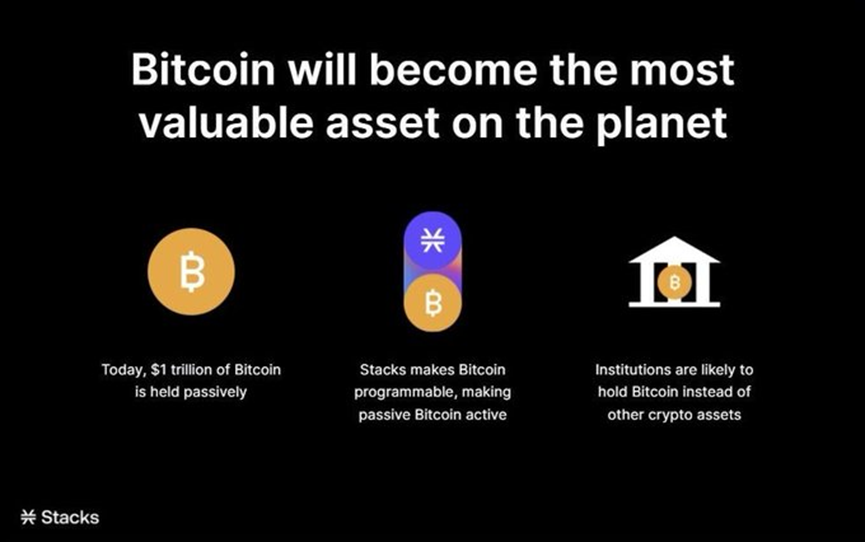
Its purpose is to integrate smart contracts in the Bitcoin ecosystem.
I'll get to that later, because I think it's just as important.
With these elements in place, let's look at an analogy.
Let's imagine that you want to create your own virtual currency on Bitcoin.
You need two things: satoshis and tags.
As we discussed with Ordinals, satoshis are the smallest fractions of bitcoins, similar to how cents are the smallest fractions of euros.
Tags are extra data that you can attach to satoshis, such as tags or stickers.
The Ordinals protocol allows you to add tags to satoshis using a data format called JSON (JavaScript Object Notation).
This format enables you to write easy-to-read information such as the name, symbol and amount of your virtual currency. For example, you can write:
{
"name": "MyCoin",
"symbol": "MYC",
"quantity": 1000
}
In this example, "MyCoin" is the name of your virtual currency, "MYC" is its symbol, and the quantity is set to 1000.
By attaching these tags to satoshis using the BRC-20 token standard, you can create and manage your own virtual currency on the Bitcoin network.
Information (tags) attached to satoshis are encoded and stored in the Bitcoin blockchain.
This encoding is done using a portion of data called witness data.
Now what is the difference between BRC-20 and Ordinals?
BRC-20 tokens are like a sticky coin that can be exchanged for other sticky coins of the same type.
Ordinals NFT is like a unique and unique coin that cannot be exchanged for other coins.
It's that simple.
Now, this is all fun, but why are people complaining?
To be fair, the one complaining the most is bitcoin's maxis.
The current increased interest in Ordinals and BRC-20 has resulted in high transaction fees and slow speeds on the Bitcoin network.
Bitcoin Network Saturation: The Two-Lane Highway Problem
The Bitcoin network can be likened to a two-lane highway, with each car representing a transaction from point A to point B.
Miners act as tollbooths, validating transactions and allowing them through.
Transaction fees are similar to what drivers pay when passing through a tollbooth.
Ordinals NFT and BRC-20 tokens are like trucks carrying digital items, taking up more space on highways and toll booths.
A large number of trucks (NFTs and tokens) can lead to congestion and saturation of the Bitcoin network.
Congestion leads to longer wait times for transactions to be processed.
Some users are willing to pay more for priority processing, increasing the overall transaction fee for everyone.
The creation and exchange of NFT and BRC-20 tokens help increase the demand for transaction processing on the Bitcoin network, affecting transaction fees.
The deployment of Ordinals not only resulted in a significant increase in activity on the Bitcoin blockchain, but also on the Litecoin network.
As of May 10, there were 585,415 confirmed transactions.
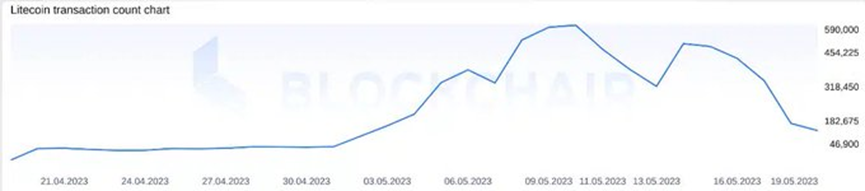
Due to the congestion of the Bitcoin network, a separate blockchain network, Litecoin, was used to create Ordinals.
What should we do now? What does the other party (the trader) think about it?
Well, they DGAF.

Gamblers and ETH jpeg holders come to BTC.
Do as you say? mess things up.
ETH holders are rapidly converting to BRC-20.
We're talking about a community that bet over $500,000 on monkey photos during the last bull run.
As you know, wherever they go, you see a lot of liquidity and wealth being played around in the ecosystem. An opportunity for many, but also a deception for others.
Where is BRC-20 and Ordinals headed?
The meta is changing and BRC-20 will be around for a while.
Bitcoin's largest and most important use case is as money, affecting a large number of people around the world.
Adding non-fungible features to satoshis challenges their use as traditional money on the Bitcoin network.
I believe Ordinals will likely remain niche like NFTs and may not be the first choice for Bitcoin users looking for block space.
And BRC-20 will be used for many other things, such as tokens for Dapp that will be built on BTC .
I keep showing this chart, but even factoring in the hype, we are nowhere near the true potential of this new economy.
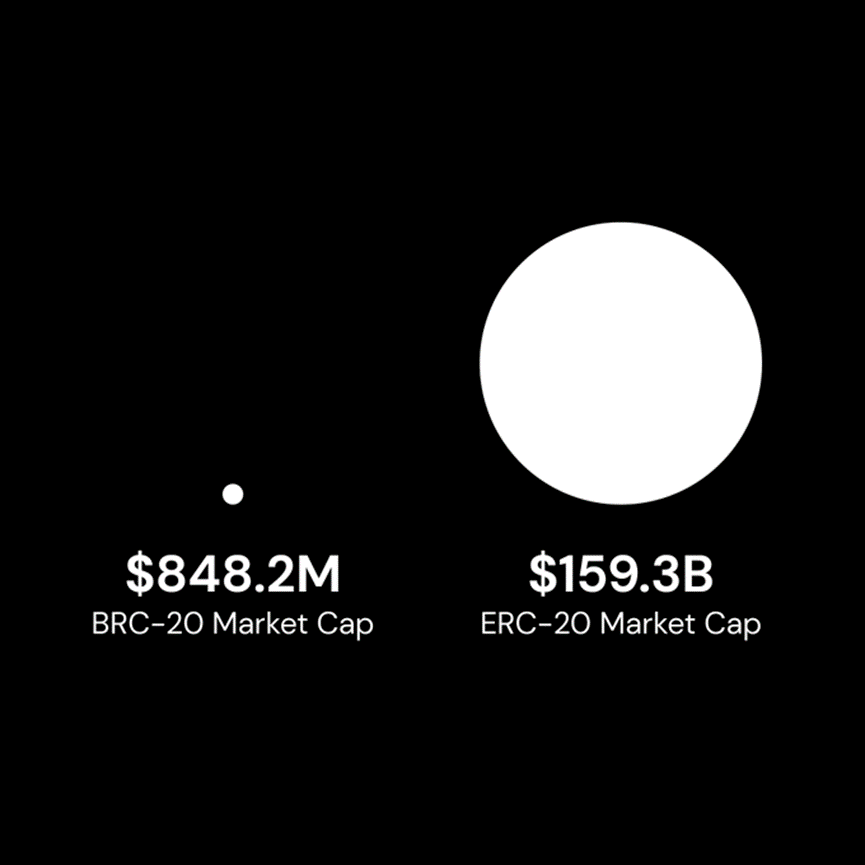
Bitcoin's evolution and changes are influenced by market forces and decisions.
The viability of Ordinal Glyphs as a solution to Ethereum's NFT-related challenges will be determined by the market.
Closing with a few bullish signs:
- Michael Saylor Microstrategy looking to build dApps
- Binance wants to add Ordinals and BRC-20 to its exchange, while many other exchanges have already listed them.
- ZK-Proofs is about to land on BTC and we will witness faster and cheaper transactions.
This is the conclusion of the "Let's Get Ready for Bitcoin Summer" series.
In the meantime, if you understand the nature of this clue, then let the games begin.
@metabrc blow it up and follow instruction 1.






