Will PoW NFTs become mainstream like PoW cryptocurrencies?
Written by: flumen
PoW (proof-of-work) NFT (Non-Fungible Token) is a digital asset created using the PoW algorithm, whose value depends on market demand and supply. Although PoW NFTs may be unique and scarce in some cases, their value is primarily determined by the market.
The origin of the earliest PoW NFT can be traced back to Bit Gold invented by Nick Szabo, the father of smart contracts, in 1998. It is an "expensive encrypted gold calculated by consuming electricity." As an early experiment, it has two interesting features. One is proof-of-work, which proves that the creator has indeed consumed computing power by repeatedly calculating the effective hash value obtained during the creation of NFT. Anyone who obtains a valid hash value through mining will have this NFT. Another feature is "inflation": with the advent of large computing power and the continuous improvement of computers, it becomes easier and easier to generate effective hash values, resulting in less and less scarce hash values, bringing a large number of The hashrate dilutes the overall value.
Until 2018, the Whitepaper"Hacash: An Encrypted Currency System for Large-Scale Payment and Real-time Settlement" solved the inflation problem of PoW NFT by setting the mining difficulty to only increase but not decrease and the bidding auction mechanism.
On May 16, 2019, the first NFT with text was generated at block height 35135 on the Hacash chain: "NHMYYM", which consists of 6 random letters and is called a diamond in the Whitepaper. Later, as the community members called it, its name gradually evolved into the current Hacash Diamond (abbreviated as HACD).
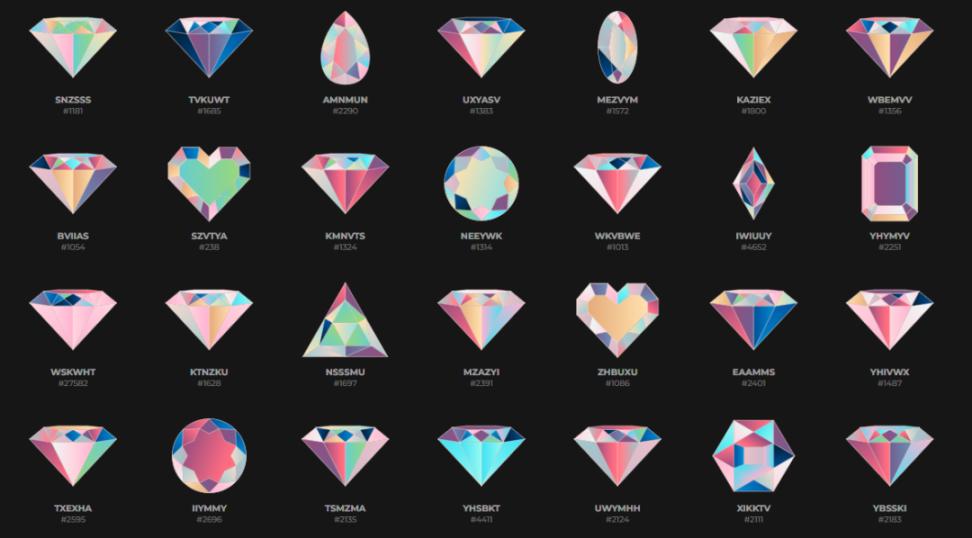
Image source / hacash.diamonds part "Diamond"
In addition to being the originator of text NFT, HACD is also the first PoW-based NFT. Its appearance means that the way to obtain HACD needs to be obtained through mining like Bitcoin, and there is no pre-mining reservation for HACD, and all people use CPU to compete to mine HACD from scratch.
POW NFT acquisition process
POW NFT is the first mineable NFT that uses Proof-Of-Work of Work for mining. When a POW NFT is mined, a unique and increasingly scarce ERC-721 token is created. The mining process prevents front-running transactions and network congestion while maintaining security, while parallel mining difficulty and price-demand curves create natural, market-driven scarcity.
- Start mining: Mining is the starting point of POW NFT. By participating in the computationally intensive proof-of-work algorithm, miners start mining new POW NFTs. This usually involves using computers and specific mining rigs to solve complex mathematical problems.
- proof-of-work: During the mining process, miners must solve complex problems set by the algorithm, which requires them to provide a large amount of computing power and algorithm verification. By solving these problems, miners prove that they have completed a certain amount of work.
- Uniqueness and Scarcity: Once a miner successfully solves the proof-of-work problem, they will receive a unique POW NFT. Each mined NFT is unique and scarce because the outcome of the mining process is unpredictable and each mined NFT has different attributes and characteristics.
- ERC-721 token: After mining is completed, the generated POW NFT will become an ERC-721 token. This means it qualifies as a non-fungible token, each with a unique identifier and properties.
In general, the casting process of POW NFT starts with mining. Through proof-of-work and solving complex problems, miners obtain unique and scarce NFT. This process ensures the uniqueness and security of each mined NFT, while also enabling market-driven scarcity.
What do you think of the value of PoW NFT?
The value of a PoW NFT is a complex question that depends on multiple factors. Compared to other types of NFTs, PoW NFTs may have some appeal due to their association with the cryptocurrency mining process. However, value is still subjective, and different people may value PoW NFTs differently.
To evaluate the value of PoW NFT, the uniqueness and artistic value of NFT, the reputation and popularity of the creator, the demand and popularity of the market, etc. are all factors that affect PoW NFT. Also, due to the continuous development of blockchain technology, the NFT market is also constantly evolving, so future trends may also affect its value.
What kind of existence does PoW NFT have in the NFT field?
In the NFT field, being a non-homogeneous token created using a proof-of-work algorithm means that when creating and verifying these NFTs, a computationally intensive proof-of-work process is required, requiring more computing power and energy consumption (The PoW algorithm requires computers to solve complex mathematical puzzles to prove that work has been done). This gives PoW NFTs some special characteristics:
1. Security: Since the PoW algorithm requires a lot of computing work, it becomes more difficult for attackers to tamper with the ownership records of PoW NFT, increasing its security.
2. Scarcity: Due to the limitations and costs of the mining process, considerable resources and energy are required to create new PoW NFTs, so their total supply may be relatively small and have a certain degree of scarcity.
3. Historical significance: The mining process of PoW NFT is closely related to the origin and development of cryptocurrency, so some PoW NFT may have special historical significance and cultural value.
However, with the advancement of technology and the development of the NFT field, other NFTs using different verification mechanisms and algorithm types have emerged, such as PoS (Proof-of-stake) NFT and PoA (Proof of Authorization) NFT. Therefore, PoW NFT is only one of the forms of existence in the NFT field, and the specific value and recognition may vary depending on market demand and development trends.
What kind of NFT can win the future?
Based on the above, if you imagine the future NFT to win the market and continue to participate in people's lives, what attributes does it need to have? The author considers the following characteristics to be attributes that will win future NFTs.
- scarcity. NFT contains innovation in a certain aspect (technology or thought), has original value, and has a limited amount to prevent inflation.
- Fairness, openness and continuity. Public issuance of NFT, fair and continuous participation of community users.
- decentralized. After the issuance of NFT, the degree of decentralization of the community and the possibility of secondary creation and derivatives of community members.
- Circulation is bound to market economic behavior. After the issuance of NFT, it no longer exists as a separate digital asset, but requires liquidity and is bound to market economic behavior.
- have fair value. Inspired by PoW NFT, it is its particularity that NFT forms a fair value after consuming computing power and cost mining. Future NFTs may also need to have a similar fair value to win the market.
There is a view that the current hot hype in the NFT field has basically been exhausted, and only the PoW-NFT track remains to be discovered. At present, the market value of cryptocurrencies represented by PoW is still the absolute mainstream, so will PoW also become the absolute mainstream in the NFT field that focuses on pure value storage?
I think, might as well give it to time.