The Ordinals protocol that incorporates recursive inscriptions can be further practiced and tried in the two directions of "Inscription Second Creation" and "NFT Fragmentation".
Written by: Entrance Jun
As a common sense, everyone should know that each bitcoin can be divided into 100,000,000 units, called satoshis (or sats), which is called "cong" in Chinese, but was found by Bitcoin core contributor Casey Rodarmor. For exquisite effect.
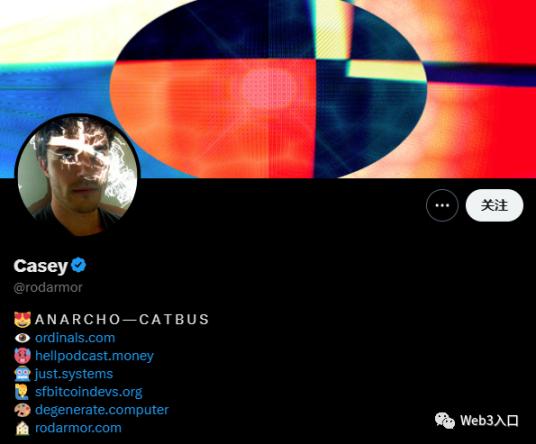
In January 2023, Casey Rodarmor launched the Ordinals protocol . The Ordinals protocol can be simply understood as a system for numbering Satoshi (SATS). By giving each Satoshi a serial number, and then attaching additional data (text, pictures, codes, etc.), which is often referred to as "metadata" in NFT, each Satoshi becomes a unique inscription . This process is called It is called "engraving" or "burning". And this has greatly activated the playability and scalability of the Bitcoin ecosystem.
Five months have passed, and the BRC-20 currency issuance standard based on the Ordinals protocol has led a new wave of Bitcoin narrative and decentralized currency issuance in the market. Although BRC-20 is no longer brilliant, it does not mean that the Ordinals agreement is silent. On June 12, Raph, the chief maintainer of the Bitcoin protocol Ordinals, recently merged the " recursive inscription" (recursive inscription) #2167 update proposed by Ordinals creator Casey Rodarmor into the Ordinals code on Github.
Let's first take a look at Ord.io developer Leonidas.og's explanation of "recursive inscriptions": inscriptions can now use the special " /-/content/:inscription_id" syntax to request the content of other inscriptions, this simple change unlocks a lot Powerful use case.
Leonidas.og also gives an example: instead of inscribing 10,000 JPEG files for a PFP collection alone (which would be very expensive), it would be better to inscribe 200 features from its collection, then make another 10,000 inscriptions, each requesting features with a small amount of code And render the image programmatically. Artwork is simply stored on-chain in a more efficient manner, which in the case of Bitcoin Apes saves over $1 million in transaction fees. In addition, it is possible to completely burn many code packages on the Bitcoin chain, because the code (text form) is called, so the volume is very small, which allows the size of the inscription to break through the 4 MB limit of the Bitcoin block size , and can Fully on-chain complex 3D video games to Bitcoin.
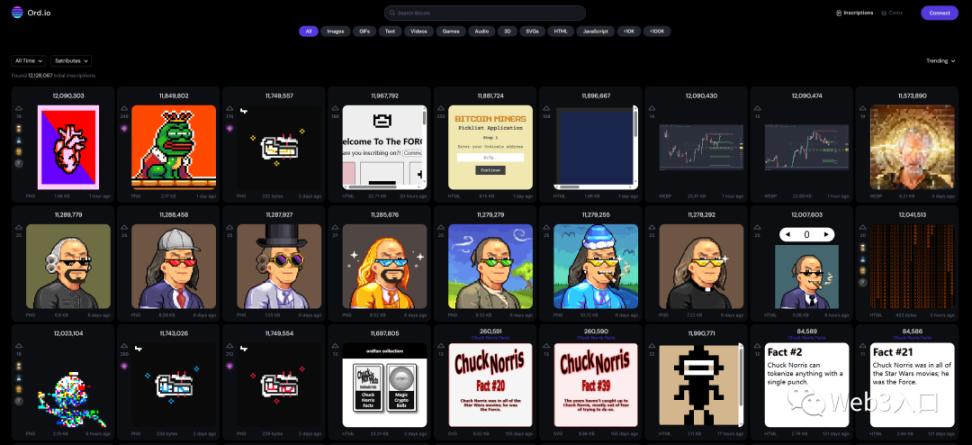
Bitcoin inscription exploration and discovery platform Ord.io officially supports recursive inscription creation and display on June 12. The official shared that someone has used a recursive method to create this dynamic artistic inscription in only 466 bytes.
An easy-to-understand explanation in human terms: Before movable type printing , if you wanted to print a 1,000-page book, a stone carver would need to carve 1,000 stone blocks full of words, which was time-consuming and laborious, and could only be used for this book printing. This is like the Ordinals protocol that did not join the "recursive inscription". If you want to create an inscription of the PFP collection, you need to upload a picture. The higher the quality of the picture, the larger the space, and the more inscription fees and transaction costs.
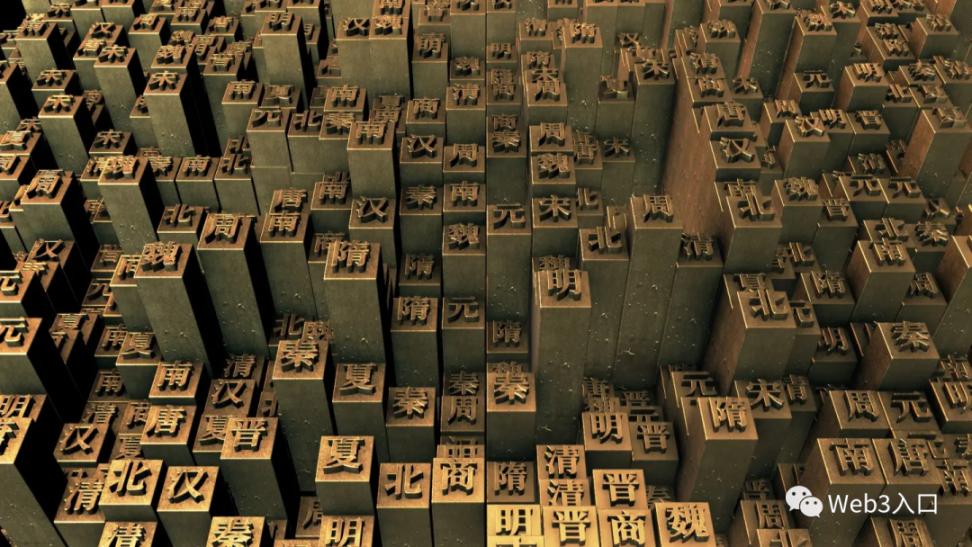
After printing with movable type, if you want to print a 1000-page book, you don’t need to carve 1000 stone blocks anymore, you only need to create a limited font library, and directly take out fixed blocks from the font library for combination and splicing , you can compose the books that need to be printed in a very short time. And this is like adding the Ordinals protocol of "recursive inscriptions". The blocks in the font library are like different attributes and characteristics in the NFT collection. You only need to upload these different characteristics to the chain and combine them to create an NFT collection. , instead of uploading and downloading each NFT image.
The emergence of recursive inscriptions is not just about reducing costs and saving space. The greater significance lies in the composability , which expands the scalability of the Bitcoin ecosystem geometrically. Moreover, recursive inscriptions can request data from other files/file libraries on the Bitcoin chain through a piece of code, and the databases can access each other, reducing costs and increasing efficiency while maximizing the value within the Bitcoin network. For example, it is a bit like the early local area network. People are no longer limited to the content and files on their computers, and can freely browse and download in the internal network.
The Ordinals protocol that incorporates recursive inscriptions can be further practiced and tried in the two directions of " Inscription Second Creation" and " NFT Fragmentation" . However, infrastructure and user scale are complementary. As for whether the impact of recursive inscriptions is enough to attract larger-scale users to enter the Bitcoin network, it still depends on the development of wallets, networks, cognition and other aspects. We will wait and see. .