The high degree of customization of Layer3 may be a double-edged sword.
Written by: flowie
Arbitrum and zkSync seem to coincide. When Optimism changed its name to OP Mainnet to demonstrate the ambition of the hyperchain empire, both Arbitrum and zkSync took up the weapon of Layer3 to roll out a Multichain future.
First, Offchain Labs, the Arbitrum development team, announced the release tool for Layer 3 blockchain Arbitrum Orbit. Subsequently, Matter Labs, the zkSync development team, launched the open source toolkit ZK Stack, which not only supports the construction of Layer 2, but also supports Layer 3.
Why are Arbitrum and zkSync preempting Layer3 when the application has not yet exploded and Layer1 and Layer2 have flooded? What problem does it solve? Is it necessary to rebuild Layer3?
What is Layer3? What problem does it solve?
Although Layer3 is not a new term, it has always been a difficult and abstract concept until there is no actual progress. StarkWare was the first to propose Layer3. At the end of 2021, StarkWare released a blog post "Fractal Scaling: From L2 to L3" to elaborate on the concept of Layer3.
And why do we need Layer3? The root of everything lies in cost reduction and efficiency enhancement and highly customized requirements. StarkWare believes that multiple Layer3s will be built on Layer2, just as multiple Layer2s are built on Layer1.
Specifically, Layer1 can only be used as a settlement layer to ensure security due to its high cost, while Layer2 achieves cost reduction, efficiency increase and scalability on the basis of inheriting the security of Layer1; then Layer3, as a new independent layer based on Layer2 Layers, continue to stack buffs, while inheriting the security of Layer1 and the performance and scalability of Layer2, on the one hand, further reduce costs and increase efficiency. For example, StarkWare said, "If the cost of each layer is reduced by 1000 times, then the cost of L3 It can be 1,000,000 times lower than L1." On the other hand, and more importantly, Layer3 can be better customized, controlling the technology stack to meet various needs and privacy.
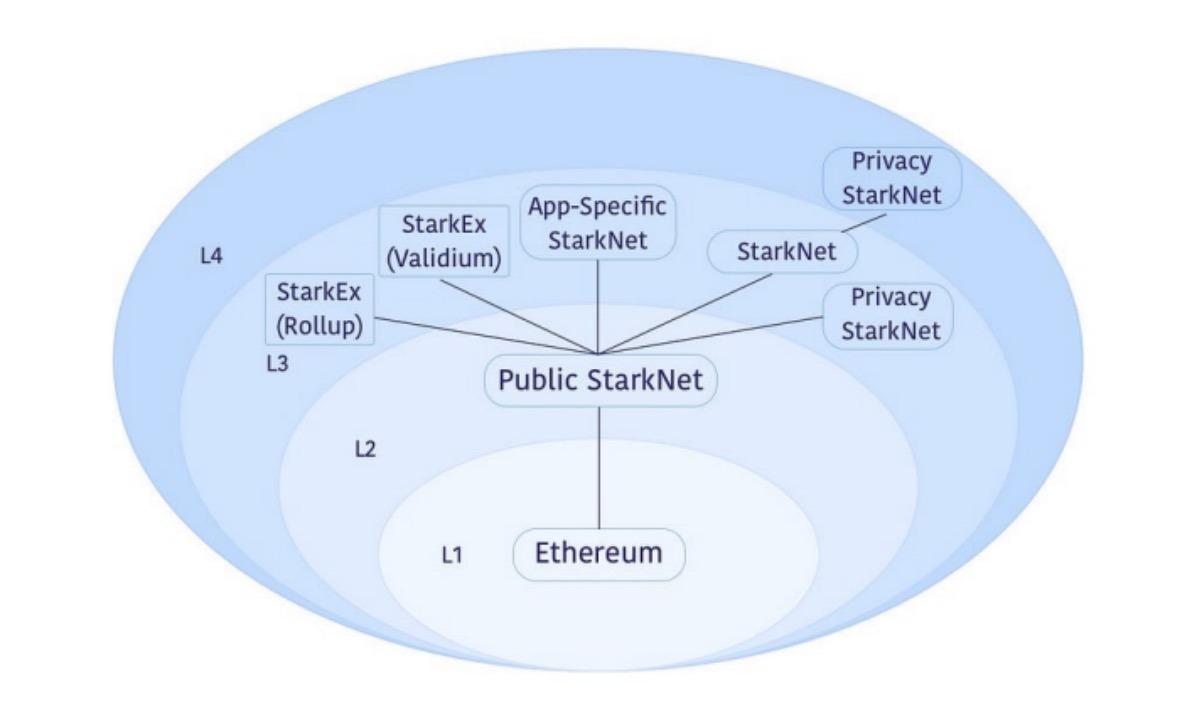
layered ecosystem
In StarkWare's layered ecosystem map, we learned some examples of Layer3 for custom purposes.
1. StarkNet with Validium data availability, for example, is often used in applications that are extremely sensitive to pricing.
2. Application-specific StarkNet systems tailored for better application performance, for example, by employing specified storage structures or compression for data availability.
3. StarkEx systems (such as those serving dYdX, Sorare, Immutable, and DeversiFi) have Validium or Rollup data availability, immediately bringing proven scalability advantages to StarkNet.
4. A private StarkNet instance (also L4 in this example) allows privacy-preserving types of transactions to exist without including them in the public StarkNet.
In summary, compared to the general-purpose expansion of Layer 2, Layer 3 prefers customized expansion to improve performance and low-cost expansion. Half a year later, at the most motivating stage of Layer2, Vitalik published a long article on StarkWare's Layer3 concept. For the idea of StarkWare Layer3 stacking buffs, Vitalik made a further analysis, and also put forward some feasibility analysis.
Vitalik more succinctly summarized StarkWare's Layer 3 vision and recognized the rationality of these vision theories.
L2 is used for scaling, and L3 is used for custom features such as privacy. This vision can be understood as, since Layer 2 has achieved expansion, can Layer 3 inherit the expansion of Layer 2 and then improve some customized requirements that are difficult to achieve in Layer 2. Vitalik believes that this concept does not try to provide "scalability quadratic growth", that is to say, it does not emphasize stacking scalability buffs, but believes that there is a layer in the stack that can help applications expand, and there is an independent layer to satisfy Customized functional requirements for different use cases.
L2 is used for general expansion, and L3 is used for customized expansion. How to understand customized expansion? Generally, some expansion designs in Layer 2 actually sacrifice some performance for the sake of universality and compatibility. Can Layer 3 give up some versatility and compatibility and obtain higher performance through customized circuit design.
L2 is used for untrusted extensions (rollups), and L3 is used for weakly trusted extensions (validiums). Weak-trust extensions can be much cheaper than no-trust extensions, although at a much lower level of security.
Of course, Vitalik also raised many questions about this architecture: Is the three-tier structure the right way to achieve these goals? What's the point of anchoring authentication, privacy systems, and custom environments to L2 rather than just to L1? In other words, many of Layer3's privacy and other customized uses, as well as low-cost and performance requirements mentioned above, can essentially be realized through a two-layer network structure. Why do we need to build another three layers to achieve it?
One possible argument for Vitalik's view that the three-tier model is superior to the two-tier model is that it is cheaper. “The three-tier model allows an entire sub-ecosystem to exist in a single Rollup , which allows cross-domain operations within that ecosystem to happen very cheaply without going through the expensive L1.”
Recently, Scroll researcher Yicheng also conducted an in-depth discussion on L3. In his view, the future landscape of the Ethereum ecosystem is likely to consist of simple L1, scalable L2 and custom L3 solutions.
What is worth paying attention to now is that the concept of Layer3 is gradually being implemented. In October last year, ZkSync took the lead in announcing the development of the Ethereum Layer 3 network "Opportunity", which aims to further improve the scalability of the zkSync blockchain infrastructure, and expects to launch a testnet in Q1 this year. Soon after, Arbitrum disclosed the L3 blockchain Arbitrum Orbit, which can be directly deployed by developers. At this time, the AirDrop feast created by Arbitrum has just passed.
And recently Arbitrum and zkSync seem to coincide. When Optimism changed its name to OP Mainnet to reveal the ambition of a Multichain empire, both Arbitrum and zkSync took up the weapon of Layer3, and the developer tools launched support the development of Layer3 chains, intending to build a Multichain future.
Arbitrum and zkSync's Layer3 vision and Multichain future
Before launching Arbitrum Orbit, a Layer3 platform, Arbitrum has established a diversified ecosystem composed of different technologies.
Arbitrum One, Nitro, etc. are all Layer 2 based on Optimistic Rollup technology, which are generally applicable to DeFi projects. And Arbitrum Nova is a Layer 2 using AnyTrust technology. Although it is not as secure as Ethereum, it has greater scalability than using Optimistic Rollup .
Layer 2 of Arbitrum's existing Rollup and AnyTrust technology routes can meet the common Ethereum expansion needs of most projects. And what is the purpose of launching the Layer3 platform Arbitrum Orbit? In short, they hope that Arbitrum Orbit can help developers be more autonomous and flexible, and unlock more highly customized requirements.
Judging from Arbitrum's description and architecture diagram, Arbitrum Orbit's Layer3 and StarkWare's Layer3 ideas are roughly the same. Arbitrum Orbit allows developers to build exclusive application chains based on Arbitum Layer2 chains (One, Nova, Goerli), and customize functions such as privacy, permissions, fee tokens, and governance. In addition, the Orbit chain is not a completely isolated blockchain network. The chains of the Orbit chain will achieve interoperability, but the interoperability function is currently under development and has not yet been opened.
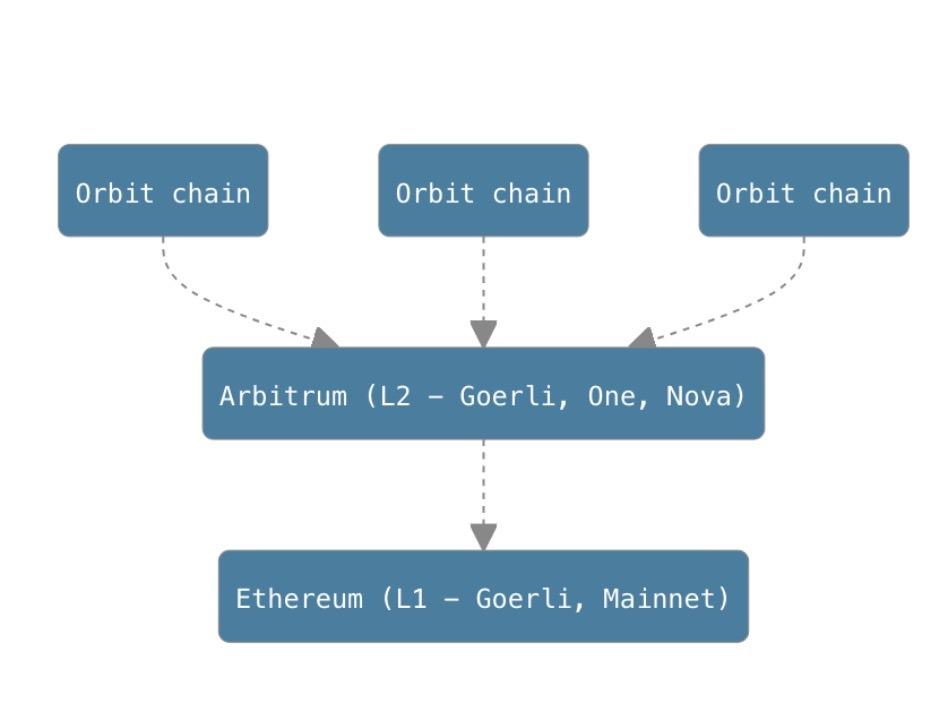
Compared with the application chain, the Arbitrum Orbit chain can be used as an application chain or an open ecological chain, allowing developers to highly customize and have more flexibility and autonomy. Arbitrum believes that the scalability, autonomy, and flexibility of Arbitrum Orbit will help Ethereum move towards a Multichain future.
Currently, Xai, a Layer 3 blockchain designed for video games, will launch on Arbitrum later this year. The Ethereum expansion project AltLayer also announced support for the Layer 3 blockchain Arbitrum Orbit. Recently, the Derivatives trading platform Syndr announced the launch of a test network based on Arbitrum Orbit, becoming the first Arbitrum Orbit Chain ecological DeFi protocol.
Compared with Arbitrum Orbit's focus on Layer3, the zkSync open source framework ZK Stack supports both Layer2 and Layer3, which helps developers build custom ZK-driven Layer2 and Layer3 (called Hyperchain).
At its core, ZK Stack provides two key functions: sovereignty and seamless connectivity. In terms of sovereignty, ZK Stack can allow developers to modify the code according to their needs and customize the chain without restriction. The seamless connection emphasizes interoperability, and ZK Stack's Hyperbridges network promotes the interconnection of each hyperchain to achieve low-cost and high-efficiency interoperability, similar to Cosmos IBC.
And zkSync also clearly shows which requirements ZK Stack applies to. It is more suitable for the needs of developers who need to customize the chain (such as a sorter) and can accept the asynchronous connectivity of the ecology (because it is a new chain, not the contract interaction with the chain). ZK Stack added that if you simply develop a DeFi project, you can directly use its Layer2 protocol zkSync Era.
The main use cases of ZK Stack lie in the following demand scenarios: building super-scaling needs in games or social networks; low-latency needs in DeFi, privacy chain needs such as banks or enterprises, and demands for interoperability and native token.
From the perspective of actual use cases, ZK Stack and Arbitrum Orbit are similar, but compared to Arbitrum Orbit's emphasis on the construction of Layer3 application chains, ZK Stack seems to emphasize the realization of a Multichain empire through inter-chain interoperability. According to the analysis of encryption kol @tmel, "ZK Stack's technical advantages in Account Abstraction, asynchronous Cross-chain calls, and infinite scalability provide the possibility to construct a complex Multichain network era."
Is it necessary to rebuild Layer3?
Many crypto communities have complained that this is an era when there are more tools for issuing chains than chains themselves. Under the various volumes of OP Stack and Polygon 2.0, ZK Stack and Arbitrum Orbit rushed to build Layer3 and Multichain networks, which also caused some controversy.
On the one hand, Layer2 has not been built yet, so how useful can Layer3 built on Layer2 be? If the encryption market still has memory, the Arbitrum AirDrop last year was ridiculed by the crowd due to RPC downtime. And zkSync has been widely criticized for Zk Roullup compatibility issues and downtime issues. ZkSync is also mostly a local dog project ecologically. Is it a bit of a waste of time to rush to build Layer3 at this time?
On the other hand, the highly customized flexibility and autonomy of Layer3 itself is a double-edged sword. Encryption KOL @tmel0211 believes that although it can make some top applications in the game and social fields take off faster, but at the same time allowing developers to design their own advanced technical mechanisms such as Gas fee tokens will also increase the amount of money that the project party makes. risks of.
In addition, Layer3 allows developers to expand customized and exclusive application chains based on its L1 and L2 security foundation. Whether it will weaken the original ecological advantages of Layer2 and fail to obtain more value capture is also a question mark.
At present, in addition to Arbitrum, zkSync and other Layer 2 telling the story of Layer 3, Lens Protocol launched Momoka, an L3 expansion solution, and Zebec launched its first Layer 3 chain, Nautilus Chain.
According to Vitalik's conjecture, the multi-layer network of Layer3 and even Layer4 and Layer5 is a rationalization trend. But is it necessary to push Layer3 when the application has not yet exploded and Layer2 is not yet stable?