Written by: HotairballoonCN
1. Project introduction
1. What is DYDX
DYDX is the world's first decentralized digital currency derivatives trading platform, which aims to establish more open, transparent and secure financial products through decentralized technology.
In the DYDX platform, it mainly supports margin (leverage) trading and derivatives (perpetual contract) trading, and can support up to 20 times leverage.
2. Product Architecture
1) Main transaction mode
As we all know, AMM(Automated market maker) is one of the cornerstone protocols of DeFi. In the AMM model, the counterparty is the capital pool, which completes the quotation in real time. Quickly complete the transaction, which is also the advantage of the AMM model.
DeFi classic projects Uniswap (DEX), Pancakeswap, and GMX(derivatives) all adopt the AMM model.
However, DYDX did the opposite. Instead of adopting the AMM model, it adopted the order book model that the centralized exchange (CEX) has been using to this day.
Users can not only place market orders and limit orders on the DYDX platform, but also includes 5 stop loss modes. In addition, users can also set the effective deadline for orders.
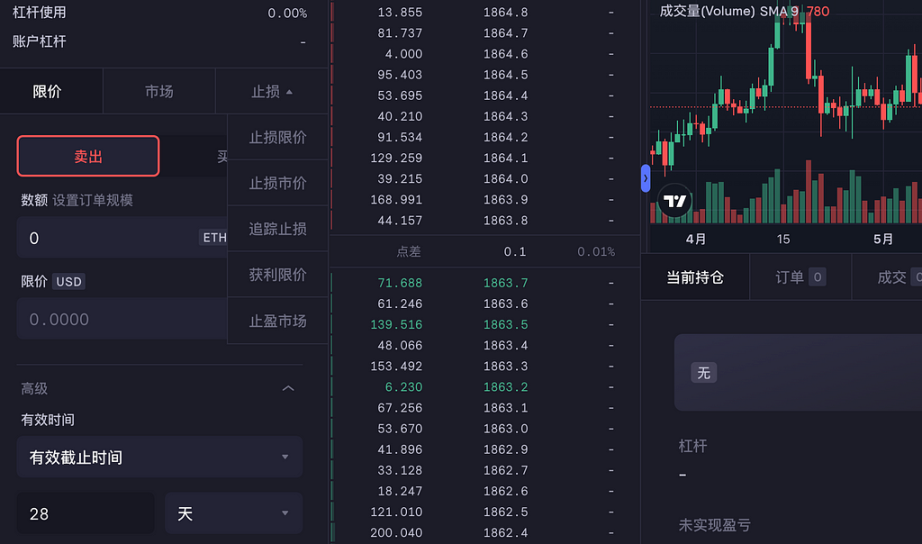
In DYDX 's view, the order book model is more in line with the needs of professional traders, and it also caters to the needs of more cryptocurrency traders. After all, in the current cryptocurrency trading, the market share of centralized exchanges (CEX) accounts for above 95.
Compared with DeFi platforms that adopt the AMM model (passive trading), it is clear that traders have more autonomy on the DYDX platform. Users can combine according to their own needs (customized combination of leverage, order type, stop loss type, order validity period, etc.) to create more complex trading strategies to meet their own trading needs.
2) The underlying technical architecture
DYDX(currently V3 version) is a DeFi derivatives trading platform built on the Starkware network, one of the four kings of the Ethereum L2 track.
With the help of Starkware's high scalability and low transaction fee rate, as well as DYDX silky off-chain order book and on-chain settlement model, users' trading experience on the DYDX platform is almost comparable to that of a centralized exchange (CEX).
The DYDX V4 version will be migrated to the Cosmos network. Based on the Cosmos SDK and the CometBFT PoS consensus agreement, DYDX will create an independent L1 blockchain DYDX Chain of its own, with a fully decentralized off-chain order book and matching engine.
DYDX Chain As a custom L1 blockchain on Cosmos, DYDX will have more autonomy, such as running nodes, adjusting the platform's fee structure, etc., so as to provide users with a better trading experience.
3. Development history
DYDX was established in July 2017. The founder, Antonio Juliano, worked as an engineer at Coinbase from 2015 to 2016. At that time, the first generation of decentralized exchanges (0x, Kyber) had appeared, but DYDX was mainly positioned in margin trading and derivatives trade.
To DYDX founder Antonio Juliano, this seems logical. Because margin trading (led by Bitfinex) had begun to emerge in the crypto space at that time, in his view, the financial market would experience the evolution of "spot-margin-derivatives" over time.
The cryptocurrency seems to be no different, and it will also go through the evolution process from spot, margin (leverage) to derivatives (contracts, etc.).
DYDX 's first product, Expo, is built on top of the V1 Margin Protocol, a simple trading application that can be used to buy leveraged tokens. At its peak, Expo traded around $50 per day.
Then, in 2019, a second version of the DYDX margin trading protocol, code-named "Solo", was launched. This version is more powerful, and it solves some problems of the original protocol. It quickly increased the transaction volume of the platform to about $1 million per day.
Then DYDX started building its own order book system.
DYDX was originally built on Ethereum L1, but the explosion of DeFi has increased the gas cost by 100–1000 times, and the congestion of the Ethereum network has also seriously affected the user's transaction experience.
Then, in April 2021, DYDX moved to the more scalable Ethereum L2 Starkware platform. Whether it is scalability (TPS) or gas costs, the advantages of Starkware are very obvious. Shortly after the launch of L2, DYDX platform transactions Volume soared about 5-fold to about $30 million per day.
- DYDX Foundation issues DYDX tokens
In the summer of 2021, the Swiss independent foundation DYDX Foundation was established. The foundation released DYDX, the Token of the DYDX protocol, in August 21. After the launch of the Token, the transaction volume of the DYDX platform soared.
In June 2022, DYDX announced that its v4 version will be launched as an independent blockchain based on the Cosmos SDK and Tendermint consensus.
The DYDX V4 testnet was officially launched in the early morning of July 6.
4. Financing situation
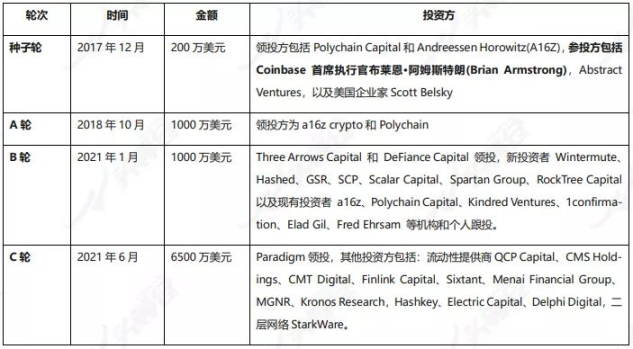
According to public information, up to now DYDX has completed at least 4 rounds of financing:
In December 2017, it received US$2 million in seed round financing, and Andreessen Horowitz (a16z), Polychain Capital, 1confirmation, Kindred Ventures, Caffeinated Capital, Abstract Ventures and many other investment institutions participated in the investment.
In October 2018, it received US$10 million in Series A financing, with investments from Andreessen Horowitz (a16z), Bain Capital Ventures, Abstract Ventures, Craft Ventures, Polychain Capital, Fred Ehrsam (former partner of Coinbase), and Brian Armstrong (CEO of Coinbase) Institutional and individual investors participated in the investment.
In January 2021, $10 million in Series B financing was obtained, led by Three Arrows Capital (Three Arrows Capital) and deFiance Capital, new investors Wintermute, Hashed, GSR, SCP, Scalar Capital, Spartan Group, RockTree Capital and existing investors a16z, Polychain Capital, Kindred Ventures, 1confirmation, Elad Gil, Fred Ehrsam and other institutions followed suit.
In June 2021, it received US$65 million in Series C financing, led by Paradigm, liquidity providers QCP Capital, CMS Holdings, CMT digital, Finlink Capital, Sixtant, Menai Financial Group, MGNR, Kronos Research, and venture capital firms HashKey, Electric Capital, delphi digital and StarkWare also invested.
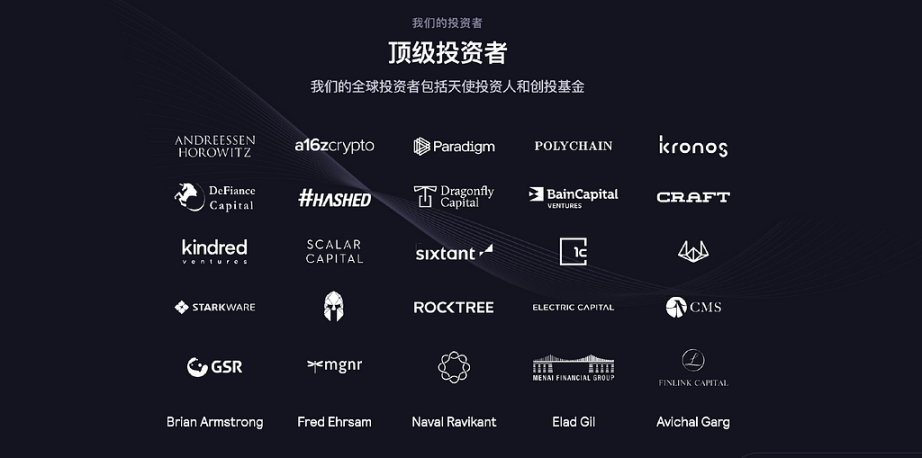
Four rounds of financing raised a total of 87 million US dollars, and the investment list includes Paradigm, Polychain Capital, Andreessen Horowitz (A16Z), Three Arrows Capital and other well-known institutions in the industry, as well as Wintermute, one of the largest liquidity providers on DYDX , etc., the capital The lineup is strong and the project development funds are sufficient.
According to its token allocation plan, 27.73% of the tokens, that is, 277 million tokens belong to investors, and the average cost of DYDX for investors is $0.31.
Taking into account the difference in valuation between rounds, the cost of the last round of $65 million may have been higher than $0.31. Part of the market attention that DYDX has received comes from its strong capital background, and at the same time, this is also part of its current leading position on the track.
5. Fundamental influence
DYDX is the world's first decentralized digital currency derivatives trading platform.
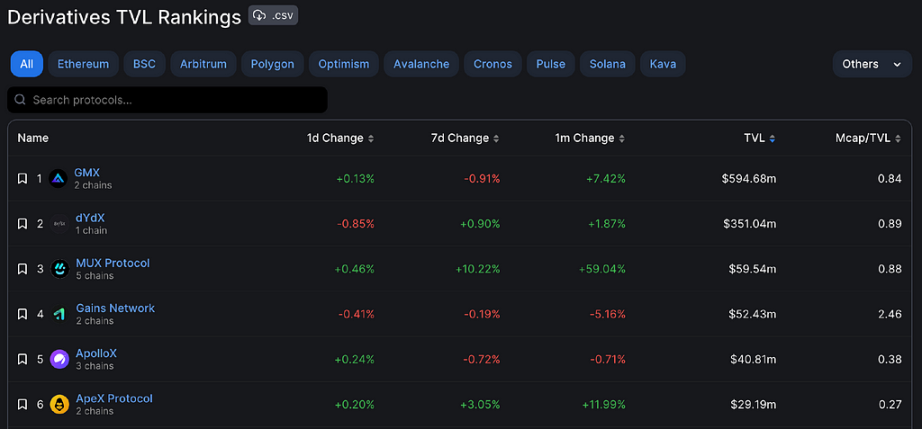
According to statistics from the defillama platform, in the DeFi derivatives track, the TVL of DYDX reached 350 million US dollars, second only to GMX.
According to the statistics of the CoinMarketCap platform, in the DEX track, DYDX ranked first in the trading volume in the last 24 hours, with a market share of 23.3%, surpassing UniswapV3.
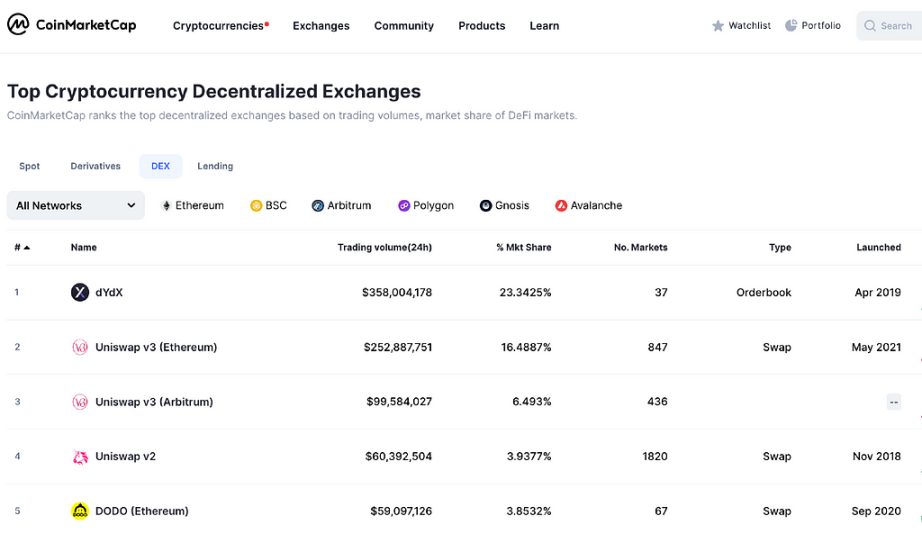
Moreover, the DYDX platform currently supports only 37 trading pairs, which is far lower than the trading pairs launched on other DEX trading platforms.
2. DYDX token
1. Token distribution
The total amount of DYDX tokens is 1 billion, which will be distributed in five years starting from August 3, 2021.
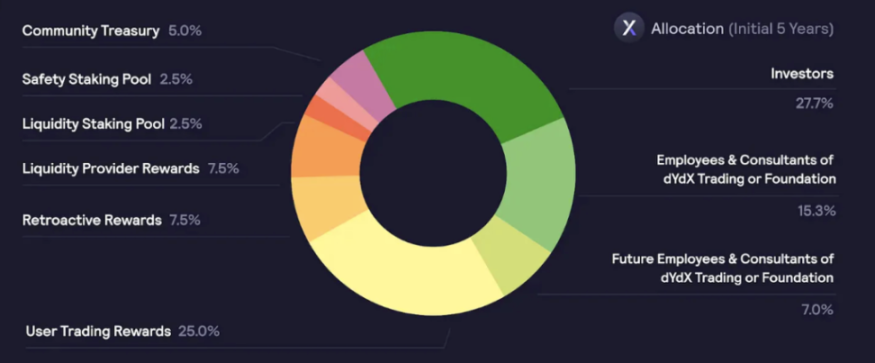
1) 50.00% of the supply will be used for the community, of which:
- 25.00% as transaction reward;
- 7.50% for retrospective mining rewards;
- 7.50% allocated to liquidity provider rewards;
- 5.00% will go to the community treasury;
- 2.50% will be dedicated to users who pledge USDC to the liquid staking pool;
- 2.50% will be dedicated to users who stake DYDX to a secure staking pool.
The remaining 50%:
2) 27.73% will be reserved for past investors.
3) 15.27% will be allocated to founders, employees, advisors and advisors.
4) 7.00% will be reserved for future employees and advisors of DYDX .
After 5 years, the maximum inflation rate is 2.00% per year to support the development of the platform.
2. Token usage
There are three main uses of DYDX coins:
1. Participate in governance and vote
As a governance token, DYDX currency has the functions of voting and participating in governance.
2. Fee discount
As an exchange token, DYDX , like Binance Coin (BNB ), allows holders to receive transaction fee discounts based on the size of their current holdings.
3. Pledge
Stakers will receive DYDX based on continuous distribution based on each staker's share of the total USDC in the pool. To withdraw USDC in the next period, the pledger must request to unstake USDC at least 14 days before the end of the current period. If the staker does not request a withdrawal, their staked USDC will be rolled over to the next period.
3. The latest progress and future imagination space
1. DYDX Chain
In the DYDX community, DYDX V4 is currently the most concerned.
In the current DYDX version, most components have been decentralized, but the order book and matching engine are still centralized components.
The goal of DYDX is to achieve complete decentralization. In DYDX 's view, the decentralization of the system is equal to the decentralization of its least decentralized components, which means that every component of v4 needs to be decentralized, and at the same time while maintaining high performance.
The V4 version is to realize the decentralization of the order book and matching engine, and the platform no longer runs centralized components, thus realizing the complete decentralization of the DYDX platform.
In order to achieve the goal of decentralization, DYDX creates its own L1 blockchain on Cosmos, namely dYdXChain.
Compared with the previous versions, V4 is an independent L1 blockchain. It is an L1 blockchain customized on Cosmos according to its own required functions, whether it is scalability or gas transaction fees. , are better than DYDX V3 on L2 Starkware, and will receive more technical support from Cosmos.
In fact, the main reason why DYDX migrated from Ethereum to Cosmos is to improve users' trading experience.
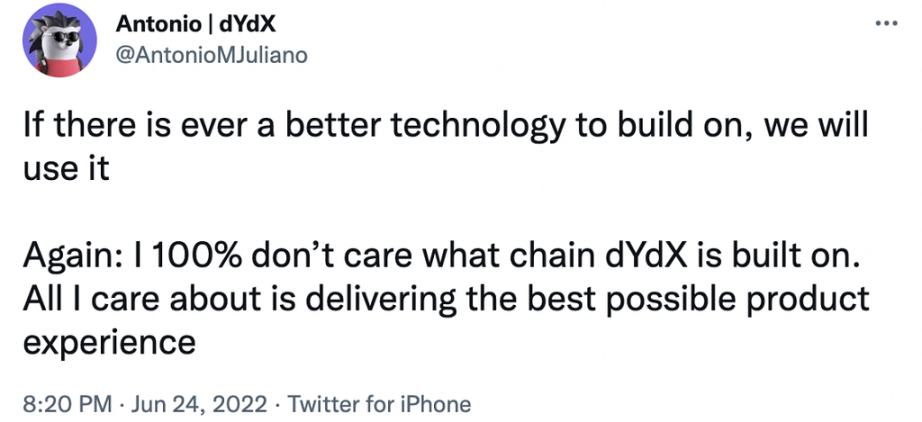
DYDX founder Antonio once tweeted:
"If there is a better technology that can be built (DYDX), we will use it", "I 100% don't care what chain DYDX is built on, I only care about bringing the best product experience to users."
The implication is that he believes that the current construction of a Cosmos application chain by DYDX is the optimal solution to improve user experience.
StarkNet co-founder @TobbyKitty also bluntly said that the biggest reason for migrating to Cosmos is to allow DYDX Token to run verification nodes on the new chain and lock the value of the protocol, but it will not work on L2.
On the future DYDX chain, users will pay transaction fees in DYDX tokens instead of ETH.
At present, DYDX is equivalent to a mining currency. Although the DYDX protocol has developed quite well, it runs on the Ethereum ecosystem, and the gas fees consumed by transactions are paid in ETH.
Moreover, the transaction revenue generated on the DYDX platform will eventually belong to the project party.
The token DYDX lacks rich application scenarios. Therefore, the rapid development of the DYDX platform has not promoted the price of DYDX tokens to a large extent.
In fact, DYDX and UNI have the same problems. Although the platform has developed quite well, the performance of the platform tokens is relatively average.
However, after DYDX migrates to Cosmos as an L1 blockchain with greater autonomy, the token DYDX will become the underlying basic token for the ecological development of the entire DYDX Chain, and the value of the token is deeply bound to the development of the platform.
The token that needs to be pledged to build a node is DYDX, and the gas consumed by the transaction also uses DYDX tokens. The better the DYDX Chain develops, the more DYDX tokens will be consumed.
Moreover, after the V4 version is fully decentralized, the community will take away control from DYDX Trading Inc. Therefore, the community can pass proposals to make more income from the platform flow into the hands of DYDX token holders, while All income flows into the platform like the V4 version.
In this way, the DYDX token can capture more value from the development of the DYDX protocol.
If V3 is just an application chain on Ethereum L2, then V4 (DYDX Chain) is an independent L1 blockchain, and of course there is more room for operation.
2. Derivatives trading volume
In the traditional financial market, the trading volume of derivatives is much higher than that of spot trading.
In the cryptocurrency market, the current derivatives trading volume is not much higher than the spot trading volume, so the derivatives trading volume in the encrypted market still has a lot of room for development.
Moreover, compared with Binance’s derivatives trading volume, DYDX ’s derivatives trading volume is only 2% of Binance’s derivatives trading volume. As the leading decentralized derivatives trading platform, DYDX ’s overall trading volume is still Great upside.
3. PoS pledge lock-up tokens
After DYDX converts to the PoS consensus, it will run its own node, and a certain amount of DYDX tokens must be pledged to run a PoS node. The higher the DYDX pledge rate, the safer the DYDX Chain network will be.
Even some PoS blockchains have a pledge rate as high as 50%. As we all know, the current circulation of DYDX tokens is only 15.63%, and the amount of subsequent unlocking and release is still somewhat large.
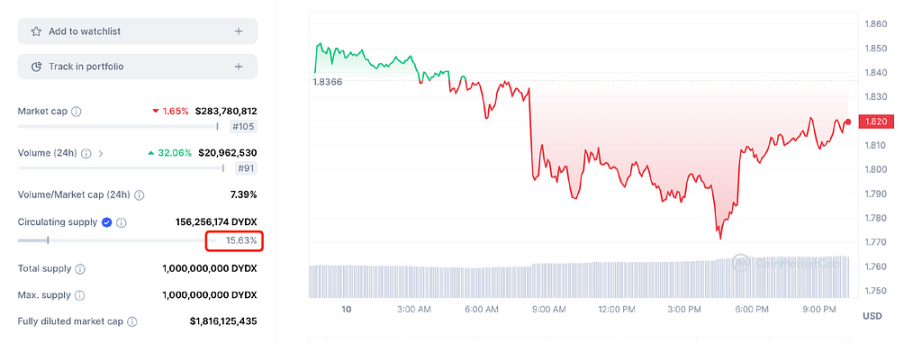
The PoS node pledge will dilute the impact of DYDX token unlocking and selling pressure to a certain extent, coupled with the consumption of DYDX tokens in the DYDX Chain, and the linear unlocking of DYDX in batches, so in general, the DYDX generation The selling pressure of token unlocking will not have a great impact on DYDX tokens.
4. Number of coins listed on DYDX
Currently, only 37 tokens are traded on the DYDX platform. Compared with other DEX platforms, the DYDX platform has very few trading pairs.
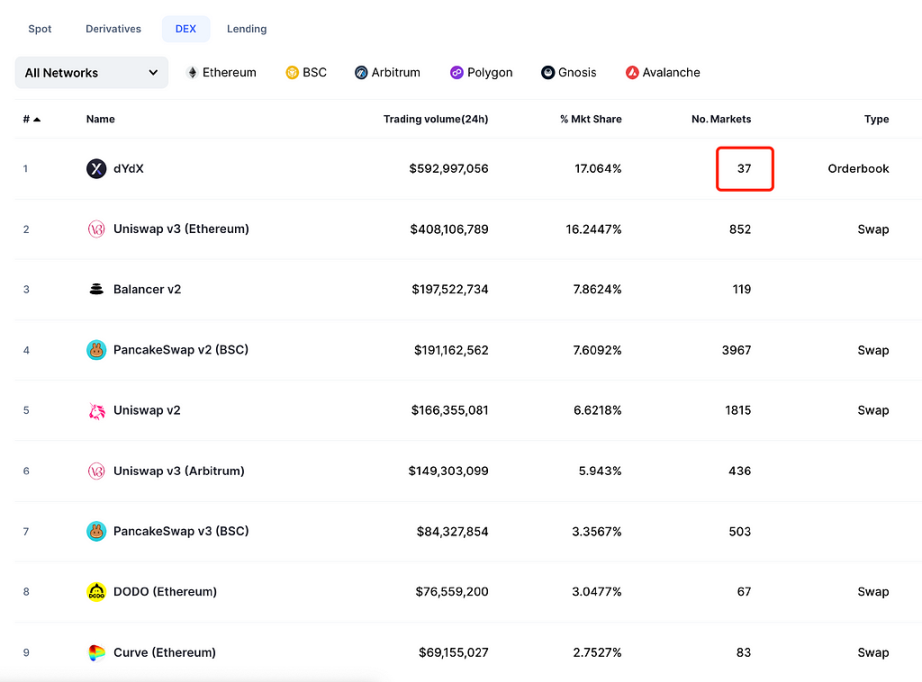
Although the number of currencies listed on the DYDX platform is much lower than that of other DEX platforms, the transaction volume of the platform is higher than that of other platforms.
Therefore, with the continuous development of DYDX , after the V4 version is launched, the community can vote to list more tokens, and the trading volume of the platform still has a lot of room for imagination.
5. Anti-regulation
After the thunderstorm on the FTX platform, the trading volume of the DEX platform has increased significantly. For DYDX , both the platform trading volume and the price of DYDX tokens have performed better.
The reason for this is that the DYDX platform is somewhat anti-regulatory, and in the future V4 version, DYDX will be completely decentralized, and DYDX Trading Inc (the platform side) will no longer run any centralized components, and DYDX will hand over Managed and controlled by the community, which tokens to launch on the platform, how to distribute protocol income, and the future development direction of the platform will all be decided through community voting.
The 100% decentralized operation of DYDX Chain will avoid some unnecessary regulatory issues.
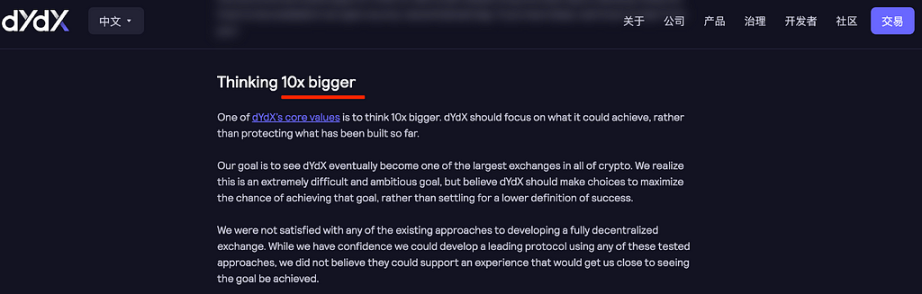
The DYDX team is an ambitious team. The team mentioned in the blog: One of the core values of DYDX is to think ten times bigger. DYDX should focus on what it can achieve rather than protecting what has been built so far. The goal of DYDX is for DYDX to eventually become one of the largest exchanges in the cryptocurrency space.
4. Comparison of competing products
In the decentralized derivatives track, the most noteworthy are GMX and DYDX . Let’s compare these two projects below.
First, the models adopted by the two are different.
DYDX adopts the order book model, where users and users (or market makers) are counterparties to each other, and the platform operates the orders of buyers and sellers.
GMX adopts the AMM(Automatic Market Maker) model, and the user and the asset pool are counterparties to each other.
Now we analyze from three aspects: liquidity, price discovery mechanism and funding rate.
1. Liquidity
Liquidity on a cryptocurrency exchange refers to the amount of cryptocurrencies that can be bought and sold on that exchange and how stable the prices of those cryptocurrencies are.
DYDX has introduced market makers to provide liquidity and pursue matching efficiency, but slippage cannot be avoided, and transactions will not be traded at a stable price. When the transaction amount is huge, the slippage will be higher.
The GMX platform adopts a zero-slippage mechanism. The counterparty is the fund pool, and the quotation is provided by the oracle machine, which can quickly complete the transaction. Because it is zero-slippage, traders can buy and sell at a relatively stable price, even when the transaction is completed. When the amount is huge, its oracle machine zero slippage mechanism still ensures the stability of the price.
For example, if 1,000 ETH is traded on the DYDX platform, the price will definitely increase (for example, by 10%), and the trader will have to bear a higher slippage. However, if 1,000 ETH is traded on the GMX platform, the price will remain stable because the price of the fund pool is determined by the oracle machine. Offered, and with zero slippage.
In this sense, GMX has better liquidity.
However, when more users of CEX derivatives are transferred to the chain in the future, the users and trading volume of DEX derivatives will increase significantly. In theory, the upper limit of liquidity of DYDX is higher than that of GMX.
Because DYDX adopts the order book model, there is no need to consider how to maximize the profitability of LPs, so as to encourage more LPs to provide liquidity for the platform. As long as there is a match between buyers and sellers in the market, there will be liquidity.
However, GMX adopts the AMM model, which is based on the betting between users and the asset pool. There is no matching of buying and selling orders between users. The liquidity of the platform depends on the LP provider. The platform needs to consider the profitability of LP, so as to motivate more Many LPs provide liquidity for the platform.
2. Price discovery mechanism
The price discovery mechanism determines whether the exchange has pricing power.
The order book has pricing power and can determine the price. Relatively speaking, there will be no large deviation of OI, because the order book is the counterparty between users, so the positions of both long and short sides need to be matched 1:1, and most positions are It can be offset, and the part that is not offset and causes the position to shift is manifested as a rise or fall in price, which is the same as the mechanism of the centralized exchange.
The oracle machine has no pricing power and does not affect the price. Only passively receive the price feed from the oracle, so that the party receiving the price can only digest the price change by itself. This can lead to problems with oracle attacks. For example, GMX was attacked in September 2022 because of zero slippage.
Because GMX uses a zero slippage mechanism, zero slippage actually means that attackers always have unlimited liquidity and low attack costs.
If a user long$1 billion of AVAX on the GMX platform, according to common sense, such a high transaction volume will definitely increase the price of AVAX , but GMX uses 0 slippage, and it still opens positions based on the quotation given by the oracle machine .
However, a transaction of this size will definitely increase the price of AVAX tokens on other trading platforms. Assuming a 20% increase, the oracle machine will feed back the latest AVAX price (which has increased by 20%) to the GMX platform. At this time Then you can close the position according to the latest price that has increased by 20%.
On the GMX platform, due to the use of oracle machine quotations, there is a zero slippage mechanism. If the transaction volume of the future platform is huge, but the way to obtain the price is still from the outside, then it is easy to be attacked by the price.
Because no matter how large or small the transaction volume is, there will be no slippage on the GMX platform. When a large transaction occurs, there will be a difference and delay between the price of the external platform and the quotation of the GMX platform, and this price delay will be attacked by the attacker. use.
But for the DYDX platform, it does not use the oracle quotation mechanism, and the price can reflect the fair price in the market. When competing with CEX, the DYDX model has more advantages.
3. Funding rate
The fee collection mechanism of DYDX is consistent with the centralized exchange (CEX).
However, on the GMX platform, whether it is long or short, it can be understood as lending risky assets or stablecoins in the GLP pool to establish a position. The long and short sides of GMX have always paid funding fees instead of charging funding fees.
That is to say, on the GMX platform, it is impossible to balance long and short positions. Once a strong unilateral market appears, resulting in a large shift in OI, the GLP pool may bear huge profits or losses.
For example, in a bull market, most people choose to long . If short on the GMX platform, not only will they not receive funding fees, but they will also have to pay a certain amount of borrowing fees. Therefore, traders will not choose to short on GMX , which will lead to The long and short positions on the platform are in an unbalanced state.
But in the DYDX platform, it adopts the same strategy as the centralized exchange, which can balance the long and short sides well.
4. Capability of value capture
Obviously, GMX has a stronger value capture ability, 30% of the platform fee is given to GMX pledgers, and the remaining 70% is given to GLP pledgers. GMX gives 100% of the platform fees to token pledgers. The better the platform develops, the higher the token holder’s income, that is, the value of GMX tokens is deeply bound to the development of the platform, which is also The main reason for the price increase of GMX .
However, the value of DYDX tokens is not deeply bound to the development of the DYDX platform, and the platform tokens have not captured much value from the development of DYDX . Although DYDX has developed quite well, the price performance of DYDX tokens is very the average.
From the above comparison of DYDX and GMX , we can find that both sides have their own advantages and disadvantages.
The value capture ability of GMX and the degree of decentralization are beyond the DYDX platform.
However, it remains to be seen whether GMX ’s “cash burning” method of returning 100% of platform fees to token holders is really sustainable.
The degree of decentralization of DYDX and the value capture capability of platform tokens will be resolved in the future DYDX V4 version.
DYDX V4 claims to achieve complete decentralization, which is mainly reflected in the order book and matching engine, and the platform side no longer operates any centralized components of the agreement, which means that the community has more control over the development of DYDX , such as voting Tilting the distribution of protocol income to the holders of the platform currency, giving DYDX more application scenarios, etc., will improve the value capture ability of DYDX.
Therefore, although GMX tokens have a better price performance at present, in the long run, it is clear that DYDX has greater room for imagination in the future.
5. Market Value Forecast
At present, the price of GMX is around US$2, and its market value is only over US$200 million, ranking around 100, while GMX market value ranks at 80.
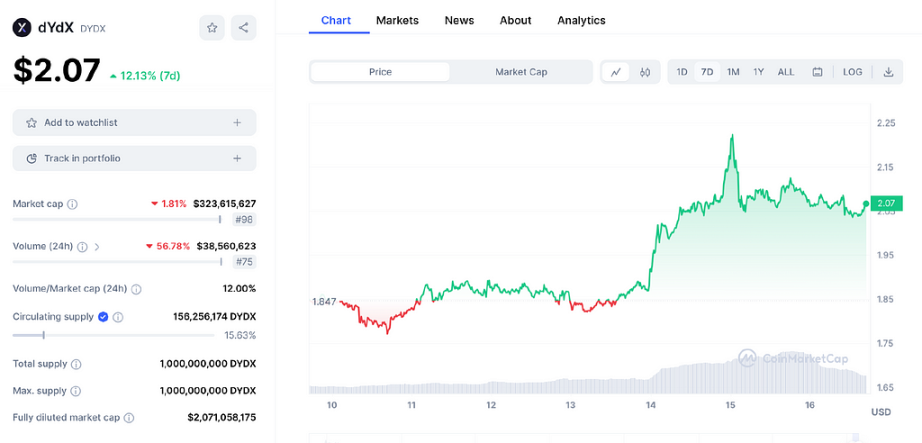
Observing the historical K-line chart of the DYDX token, it can be found that the highest increase in DYDY is after the token is issued and mining is started, and the price rises to more than 27 US dollars. Later, because the platform did not give DYDX more application scenarios, DYDX has always lacked enough application scenarios. Although DYDX has developed quite well, the price of DYDX has been sluggish for a long time.
The current price of DYDX is far from the highest price, and the drop has exceeded 93%. Basically, it has been at a low level for a long time, and it can even be said to be in an oversold state.
But after the V4 version is launched, these problems will be resolved, and the community will vote to distribute more platform revenue to DYDX holders.
Of course, a non-negligible problem facing DYDX tokens is that the unlocking selling pressure is relatively large, but after the V4 version is launched, the token pledge is likely to absorb the unlocking selling pressure.
In addition, the current trading volume of decentralized derivatives is still very low. With the advent of global regulatory policies, more transactions will be transferred to decentralized trading platforms, and the future development of decentralized derivatives is relatively large.
Based on the above predictions, in the future bull market, the market value of DYDX will most likely enter the TOP30–50, and it is not ruled out that the market value will enter the TOP30. The price of the token DYDX is conservatively estimated to increase by 5-10 times, or even higher.