Too much entanglement with the definition of RWA does not make much sense. Token is the carrier of value. The value of RWA depends on what kind of rights/values of the underlying assets are brought to the chain and its application scenarios
Authors: Will A Wang , Master of International Business Law, Diane Cheung, Master of Accounting, University of Sydney and MEM, Peking University

With the onset of the Crypto Winter in 2022, superimposed regulations and thunderstorms from CEX, the high APR in the crypto market that year no longer exists, and investors who are still surviving in the market have begun to explore risk-free returns. Coinciding with changes in the macroeconomic environment and the rise in U.S. bond yields, the tokenization of real world assets (Real World Asset Tokenization) has become an important value capture channel in the current encryption market.
This article attempts to clarify the logic of the current RWA narrative by sorting out the implementation paths of the main RWA projects holding underlying assets in the current market (Compound & Superstate, Franklin Templeton, MakerDAO, Ondo Finance, Matrixdock, Centrifuge).
TL;DR
- Too much entanglement with the definition of RWA does not make much sense. Token is the carrier of value. The value of RWA depends on what kind of rights/values of the underlying assets are brought to the chain and its application scenarios;
- In the short term, the driving force behind RWA comes more from the unilateral demands of DeFi protocols in the encrypted world, such as asset management, investment diversification, and new asset classes;
- The DeFi protocol uses the RWA project to capture the interest-earning value of the underlying assets. Its essence is to establish a U-based asset class with a real yield(Real Yield) of the underlying assets. Its logic is basically the same as that of LSD to establish an ETH-based interest-earning asset;
- Therefore, U.S. bond RWA is sought after. According to the different paths to achieve U.S. bond yields, it can be divided into (1) the Off-Chain to On-Chain path represented by traditional compliance funds, and (2) the On-Chain path dominated by DeFi protocols. -Chain to Off-Chain path, but there are still major obstacles to regulatory compliance;
- RWA mapping interest-bearing assets to the chain is only the first step. How to graft DeFi composable Lego in the future will be worth exploring, and it is expected to further open the ceiling of RWA+DeFi;
- In the long run, RWA should not only be one-way, but the future will be two-way. On the one hand, it can bring real-world assets to the chain, and on the other hand, TradFi can also use the advantages of DeFi to further release its potential;
- The focus of future exploration: How to realize that investors can not only enjoy the Beta income brought by RWA assets in the real world, but also enjoy the Alpha income of the encrypted market.

1. Narrative geometry of this round of RWA
For the current $1 trillion crypto market, investors mainly earn income based on on-chain activities (such as transactions, loans, pledges, derivatives, etc.), and the entire market lacks a stable source of real yield(Real Yield).
Since the conversion of Ethereum to POS, ETH-based liquid staking (LSD) can be regarded as a source of real yield(Real Yield) native to the encryption market, but it currently accounts for a small share of the overall encryption market. To truly break through the bottleneck of the existing market, strong external support is needed.
Therefore, a new source of real yield(Real Yield) is coming into reality: the real world assets (Real World Assets, RWA) that exist off the chain are brought to the chain through tokenization (Tokenization), which can be used as An important source of real yield for U-standard assets in the encrypted market.
The potential impact of RWA's on-chain entry on the crypto market is almost transformative. RWA can provide the encryption market with a sustainable, rich type of real yield backed by traditional assets. In addition, RWA can bridge the decentralized financial system and the traditional financial system for DeFi, which means that in addition to introducing incremental funds into the encryption market, RWA can also obtain massive liquidity and a broad market in the traditional financial market Opportunity and great value capture.
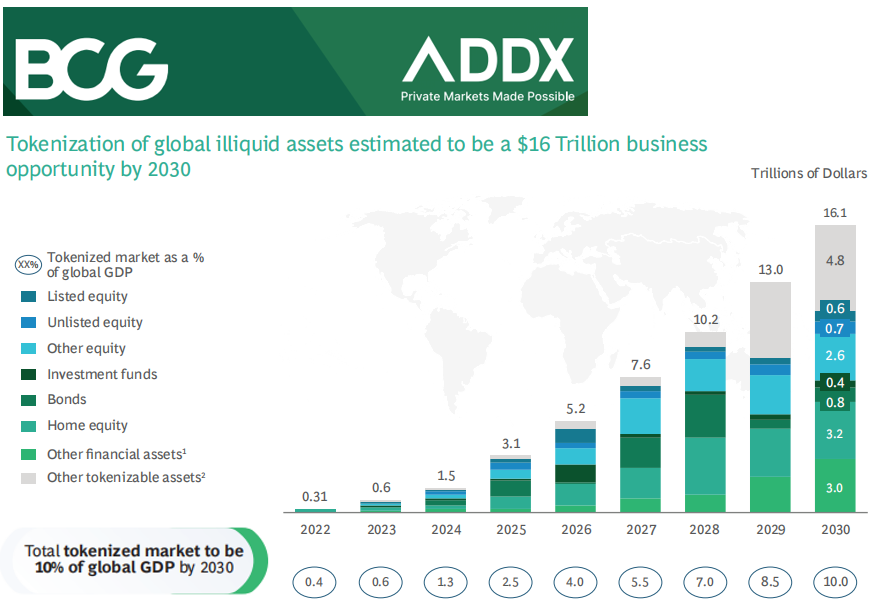
According to research by BCG and ADDX, the global tokenization of illiquid assets will generate a $16 trillion market (this will be close to 10% of global GDP in 2030). Citigroup's RWA research report "Money, Tokens and Games" also predicts that by 2023 there will be a $10 trillion market that will be tokenized.
1.1 What is RWA
The full name of RWA is Real World Assets Tokenization (Real World Assets Tokenization), which is the process of converting the value of equity in tangible or intangible assets (which can be ownership, right to benefit, right to use, etc.) into digital tokens. This enables the storage and transfer of assets without a central intermediary, and the value is mapped to the blockchain to achieve transaction circulation.
RWAs can represent many different types of traditional assets (both tangible and intangible), such as commercial real estate, bonds, automobiles, and just about any asset that has a store of value that can be tokenized. Since the early days of blockchain technology, market players have been looking to bring RWA on-chain. Traditional TradFi institutions such as Goldman Sachs, Hamilton Lane, Siemens, and KKR are all working hard to put their real-world assets on the chain. In addition, native encrypted DeFi protocols such as MakerDAO and Aave are also making adjustments to actively embrace RWA.
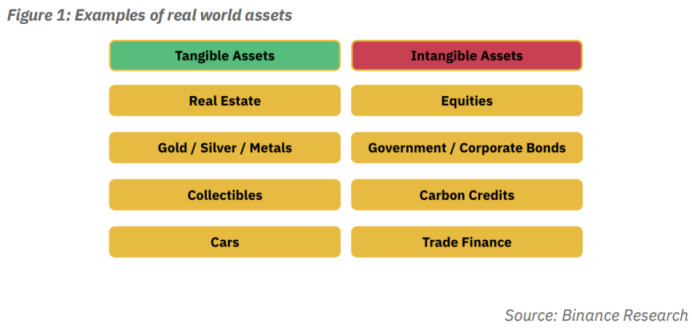
Compared with the monotonous token financing narrative of ICO/STO (Security Token Offering) in 2018, today's RWA narrative covers a wider range: not limited to the primary market in traditional finance, almost any asset that can be marked by value can be tokenized. In addition, the DeFi protocol and many infrastructures that did not exist in 2018 can also open up endless ceilings for RWA today.
1.2 Driving force behind RWA
At present, the main driving force behind bringing real-world assets into the encrypted world is that real-world assets (especially U.S. debt) can provide a stable risk-free return for the encrypted market in a macro context.
Therefore, most of the current implementation paths of mature RWA projects are based on the unilateral demand of DeFi protocols for real-world assets, such as
- Demand for asset management: The income on the original chain mainly comes from pledge, transaction and lending activities. However, in the context of the Crypto Winter, the sluggishness of on-chain activities has directly led to a decline in on-chain yields. In the context of the current higher yields of U.S. debt, the old DeFi protocol began to gradually introduce U.S. debt RWA. For example, MakerDAO has adopted a recent proposal to gradually convert stablecoin assets (no or low yield) in the treasury into U.S. Treasury RWA interest-earning assets (4%-5% risk-free yield). This can ensure the safety of treasury assets while obtaining stable income;
- Portfolio diversification: When there is an extreme market situation, the high volatility and high correlation of encrypted native assets are easy to mis-allocate and liquidate assets. The introduction of RWA assets that are less correlated and stable with encrypted native assets on the chain can effectively alleviate Such problems. Investors can diversify and build more robust and efficient portfolios;
- Introduce new asset classes: Grafting DeFi Lego on the basis of RWA can further release the potential of RWA assets. For example, Flux Finance provides loans for Ondo Finance's OUSG, Curve allows MatrixDock's STBT to trade, and Pendle provides an AMM transaction pool for interest-earning assets.
In the short term, the realization of this demand is only based on the one-way rush to the encryption market. In the real world, traditional finance does not have much willingness to enter the encryption market, and some are just tentative. In the long run, RWA should not only be one-way, such as the current unilateral demand of DeFi for TradFi. The future will be a two-way rush. On the one hand, real-world assets can be brought to the chain, and on the other hand, the real world can also use various technologies and advantages of the blockchain to further release potential.
1.3 How to capture the value of RWA underlying assets
Depending on the underlying asset of the RWA, the classification can vary.
In the short term, we narrowly divide RWA into "interest-bearing RWA" and "non-interest-bearing RWA". Because we believe that most RWA projects on the market today are more about capturing the interest-earning value of the underlying assets, such as the yields of interest-earning assets such as U.S. bonds, government securities, corporate bonds, and REITs.
The essence of interest-bearing RWA is to establish a U-based RWA asset class with a real yield on the underlying assets, which is logically consistent with LSD’s establishment of an ETH-based interest-earning asset. Although the rate of return of RWA assets is not large, they can be further combined in DeFi Lego.
Rather than interest-bearing RWA, it is more suitable to capture the commodity value of the underlying assets themselves, such as the value of gold, crude oil, collectibles, artwork itself, and the RWA value of South American players.
2. RWA asset on-chain path
According to Binance Research’s research report, it divides the RWA implementation process into three stages: (1) Off-chain packaging; (2) Information bridging; (3) RWA protocol demand and supply.

2.1 Off-Chain Formalization
To bring real-world assets into DeFi, assets must first be packaged off-chain to make them digitized, financialized, and compliant, so as to clarify the value of assets, asset ownership, and legal protection of asset rights and interests.
In this step, it needs to be clarified: (1) Representation of Economic Value: The economic value of the asset can be expressed by the fair market value of the asset in the traditional financial market, recent performance data, physical condition or any other economic value. indicators to represent. (2) Ownership & Legitimacy of Title: Ownership of assets can be established by deed, mortgage, note or any other form. (3) Legal Backing: In cases involving changes affecting asset ownership or equity, there should be a clear resolution process, which usually includes specific legal procedures for asset liquidation, dispute resolution, and enforcement.
2.2 Data on-chain (Information Bridging)
Next, the information about the economic value and ownership and rights and interests of assets is brought to the chain after being digitized and stored in the distributed ledger of the blockchain.
In this step, it will involve: (1) Tokenization: After the information packaged in the off-chain stage is digitized, it will be uploaded to the chain and represented by the metadata in the digital token. These metadata can be accessed through the blockchain, and the economic value and ownership and rights of assets are completely open and transparent. Different asset classes can correspond to different DeFi protocol standards. (2) Regulatory Technology/Securitization (Regulatory Technology/Securitization): For assets that need to be regulated or regarded as securities, assets can be included in DeFi in a legal and compliant manner. These regulations include, but are not limited to, licenses for issuing security tokens, KYC/AML/CTF, listing exchange compliance requirements, etc. (3) Oracle (Oracle): For RWA, to refer to external data in the real world to accurately describe the value of assets, such as stock RWA, you need to access the performance data of the stock, etc. However, since the blockchain cannot directly centralize external data to the blockchain, a data connection such as Chainlink, which connects on-chain data to real-world information, is needed to provide data such as off-chain asset value to the DeFi protocol.
2.3 RWA Protocol Demand and Supply (RWA Protocol Demand and Supply)
RWA-focused DeFi protocols drive the entire process of tokenizing real-world assets. On the supply side, DeFi protocols oversee the formation of RWA. On the demand side, DeFi protocols drive investor demand for RWA. In this way, most DeFi protocols that specialize in RWA can serve as both a starting point for RWA formation and a market for RWA final products.
2.4 The specific realization path of RWA
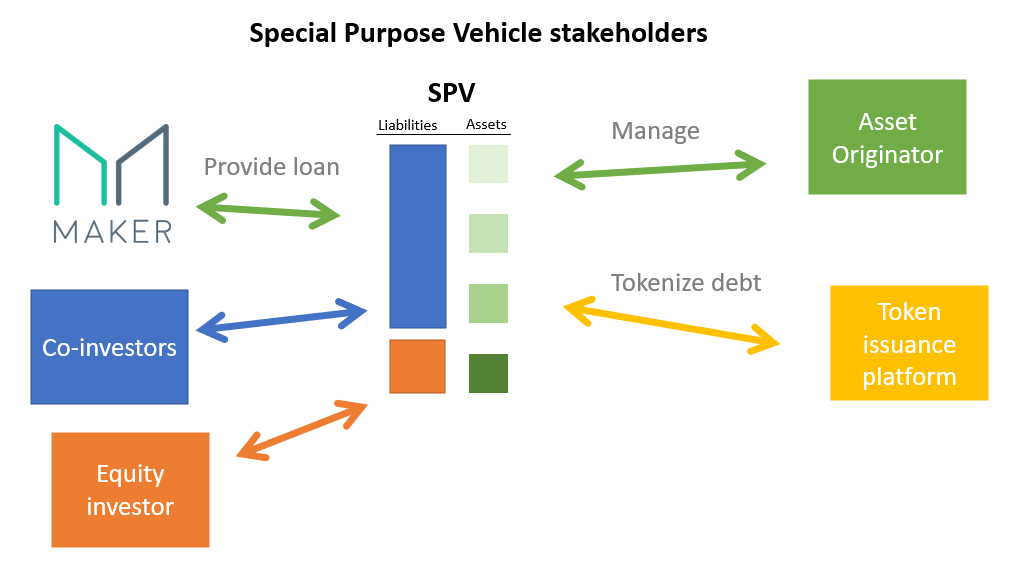
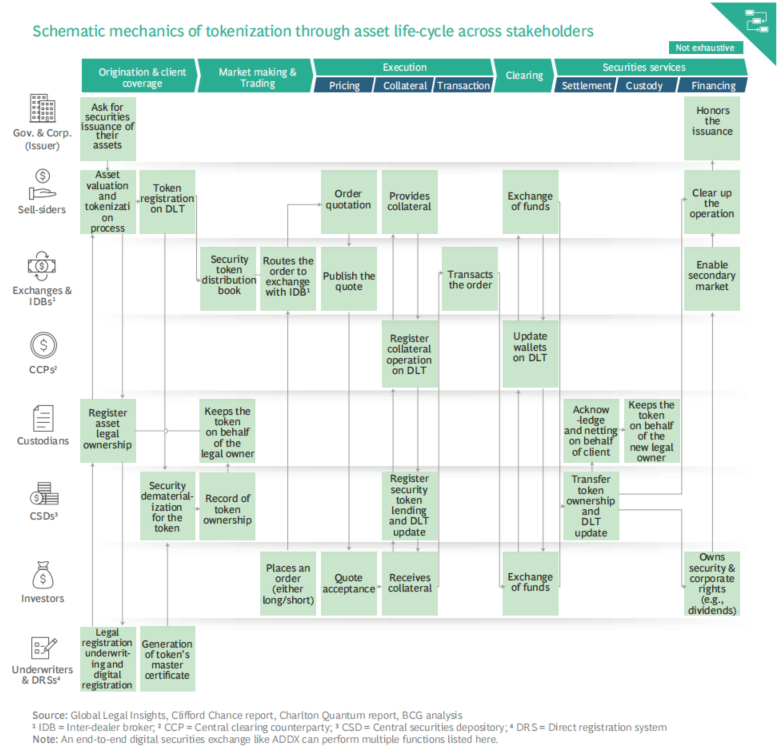
On the specific implementation path of RWA asset on-chain, an idea similar to asset securitization can be adopted, and the underlying assets can be supported by setting up a special purpose vehicle (SPV) to play the role of control, management, and risk isolation. At the same time, the research report of BCG and ADDX also provides a roadmap for various ecological participants (asset initiators, issuance platforms, asset custody, fund settlement, etc.) from the perspective of RWA asset initiators:
3. The realization path of the current U.S. debt RWA
We have made it clear that RWA is the tokenization of real-world assets under the chain, so it is very important to clarify how asset rights and asset values convert between the real world and the encrypted world, that is, how to interpret RWA as a legal representation of real-world assets, and how to interpret RWA as a legal representation of real-world assets. Or how real-world assets are mapped to the chain.
By sorting out the most mature RWA project - U.S. debt, we found two paths: (1) Off-Chain to On-Chain path represented by traditional compliance funds, and (2) On-Chain dominated by DeFi protocols to Off-Chain path. Since the current main driving force behind RWA comes from the encrypted world, the exploration of DeFi protocols in RWA projects is more mature.
At present, except for the T protocol, which is a license-free agreement, the rest of the projects have set up strict KYC/AML verification procedures for compliance reasons, and most of the U.S. debt RWA projects do not support the transfer transaction function, and the usage scenarios are very Limited, to be further explored and excavated.
3.1 Off-Chain to On-Chain of traditional finance
3.1.1 The founder of Compound’s new company Superstate
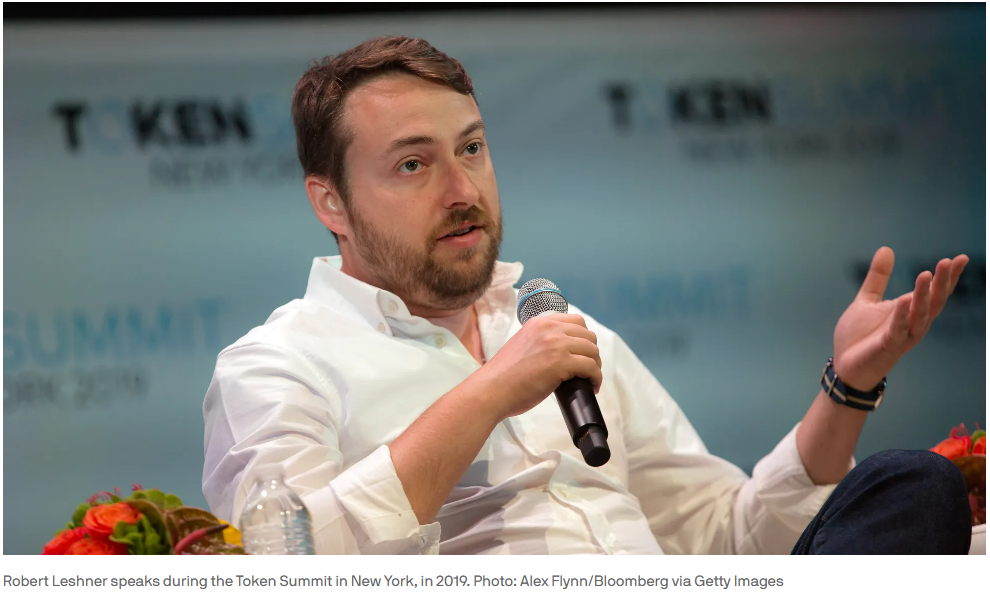
Robert Leshner, the founder of Compound, aimed at the current hot RWA narrative. On June 28, 2023, he announced the establishment of a new company, Superstate, dedicated to bringing regulated financial products from traditional financial markets to the chain.
According to Superstate’s filing with the U.S. Securities and Exchange Commission (SEC), Superstate will use Ethereum as an auxiliary bookkeeping tool and create funds that invest in short-term government bonds, including U.S. Treasury bonds, government agency securities, and more. But the document is very clear that the Fund will not directly or indirectly invest in any assets that rely on blockchain technology, such as cryptocurrencies (The Fund will not directly or indirectly invest in any assets that rely on blockchain technology, such as cryptocurrencies).
In short, Superstate will set up an off-chain SEC-compliant fund to invest in short-term U.S. Treasury bonds, and process the fund's transactions and records through the chain (Ethereum), and track the fund's ownership share. Superstate stated that investors must be whitelisted, and it will not whitelist smart contracts such as Uniswap or Compound, so such DeFi applications cannot use it.
In a statement from Blockworks, Superstate said: “We are creating an SEC-compliant investment product that will enable investors to obtain a record of your ownership of this mutual fund ), just like holding stablecoins and other cryptoassets.”
3.1.2 Franklin OnChain US Government Money Fund
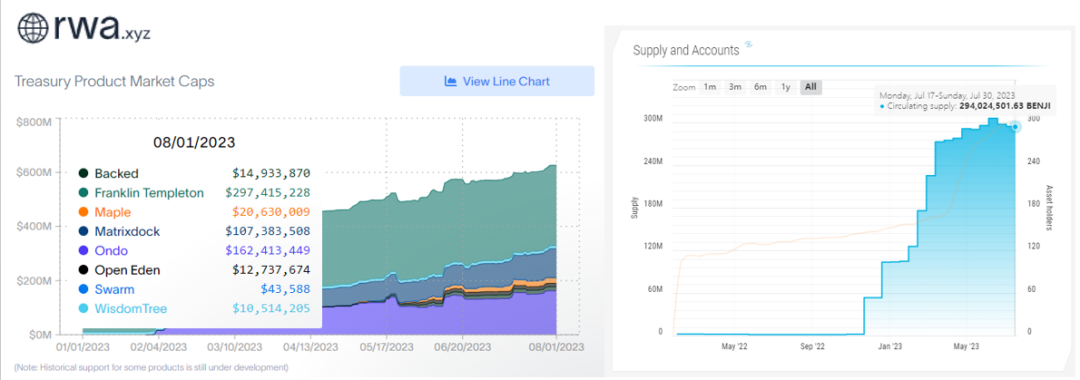
Before Superstate, we saw that Franklin Templeton has launched the Franklin OnChain US Government Money Fund (FOBXX) in 2021, which is the first SEC-approved fund in the United States, using blockchain (Stellar) technology to process transactions and record ownership fund. As of now, its assets under management (AUM) have exceeded US$29 billion, and investors can enjoy an annualized return of 4.88%.
Although 1 share of the fund is represented by 1 BENJI token, there is currently no interaction between the BENJI token and the application of the DeFi protocol on the chain. Investors need to go through Franklin Templeton's App or website for compliance verification to enter its whitelist.
3.1.3 Hamilton Lane's Private Equity Fund Tokenization
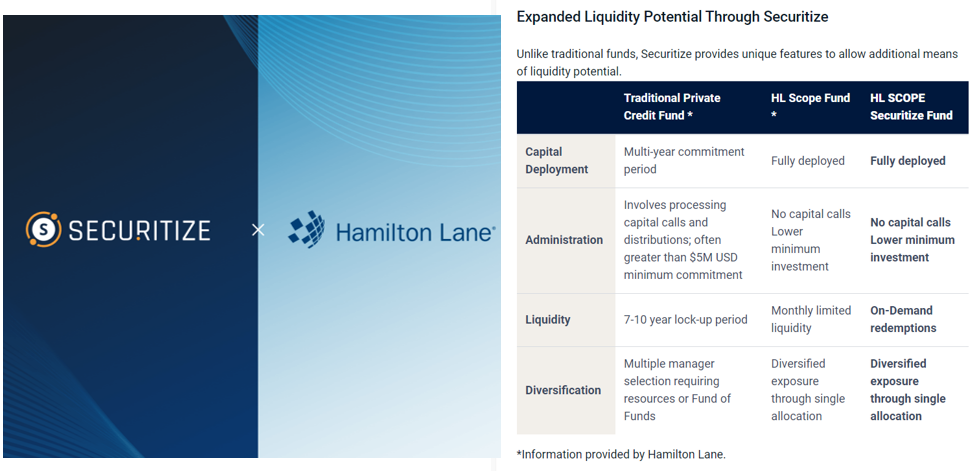
Hamilton Lane is a leading global investment firm with $823.9 billion in assets under management. The firm is tokenizing portions of its three funds on the Polygon network and making them available to investors on the trading platform Securitize. Through cooperation with Securitize, part of the fund's shares will form a feeder fund on the platform and be managed by Securitize Capital.
Securitize’s CEO said: “Hamilton Lane offers some of the best performing private market products, but historically they have been limited to institutional investors. Tokenization will enable individual investors to digitally participate in private equity for the first time Invest and co-create value.”
From the perspective of individual investors, although tokenized funds provide a "parity" way to participate in top private equity funds, and the minimum investment threshold has been greatly reduced from an average of US$5 million to only US$20,000, individual investors still need to There are still certain thresholds for passing the verification of qualified investors on the Securitize platform.
From the perspective of private equity funds, it is self-evident that tokenized funds can provide real-time liquidity (compared to the 7-10-year lock-up period of traditional private equity funds), and can achieve LP diversification and capital deployment flexibility.
3.1.4 Summary
The path from Off-Chain to On-Chain is more of an innovative exploration of traditional finance on the basis of its compliance. Considering the strong supervision of traditional finance, the current exploration is only to apply blockchain technology to traditional financial products themselves, but to use blockchain as its accounting method instead of directly accessing DeFi for interaction. To achieve external expansion. However, a record of your ownership of this mutual fund (a record of your ownership of this mutual fund) is basically the same as a Token. Just imagine the difference between a record of your ownership of this mutual fund and a stable currency.
We expect Robert Leshner, founder of Compound, to provide more value exploration for RWA's Off-Chain to On-Chain path from a more Crypto-native/DeFi perspective.
3.2 On-Chain to Off-Chain of Encrypted Finance
3.2.1 Makerdao's Monetalis Trust Legal Structure
MakerDAO is a decentralized autonomous organization (DAO) designed to manage the Maker protocol running on Ethereum. The agreement provides the first decentralized basic stable currency DAI (which can be simply understood as the dollar on Ethereum) and a series of derivative financial systems. Since its launch in 2017, DAI has always been pegged to the U.S. dollar.
Due to the high volatility of the cryptocurrency market, relying on a single collateral asset can lead to large liquidations. Therefore, MakerDAO has been actively exploring ways to diversify collateral, and RWA is an important part of it. After years of attempts, MakerDAO has realized two mature RWA paths: (1) direct purchase and holding of assets in the form of DAO + trust (MIP65 proposal); (2) direct purchase of tokenized RWA assets (through decentralized Lending platform Centrifuge), including Valut such as New Silver (real estate loans) and BlockTower (structured credit) currently held.
According to MakerBurn.com, there are currently 11 RWA-related projects being used as collateral on MakerDAO, with a combined TVL of $2.7 billion.
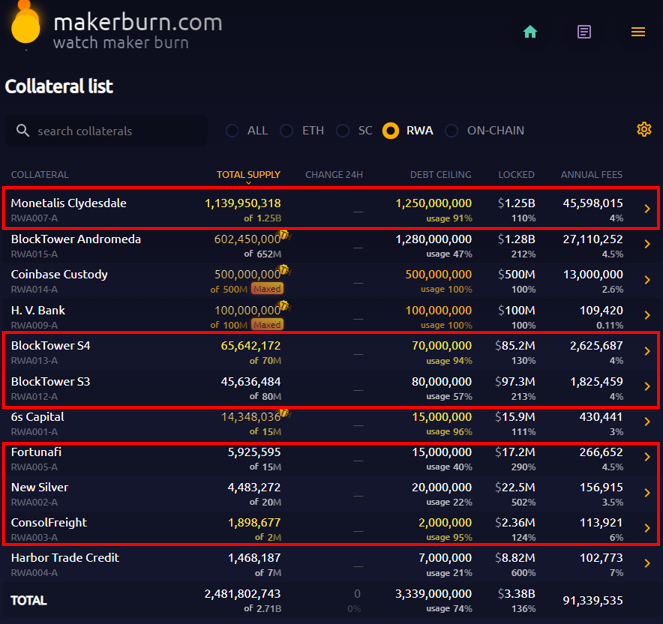
Let's look at the MIP65: Monetalis Clydesdale: Liquid Bond Strategy & Execution proposal. The proposal was proposed by Monetalis founder Allan Pedersen in January 2022. It aims to transfer part of the stablecoin assets in the MakerDAO vault to high-liquidity, low-risk bond assets in the real world through trusts managed by Monetalis. The proposal was voted by the MakerDAO community and will be implemented in October 2022 with an initial debt ceiling of $500 million. In May 2023, a follow-on proposal raised the cap to $1.25 billion.
According to the MIP65 proposal, MakerDAO voted to entrust Monetalis as the executor of the project, responsible for designing the overall legal structure, and periodically reporting to MakerDAO. Monetalis has designed a set of trust legal framework arrangements based on the British Virgin Islands (BVI) to connect on-chain governance (MakerDAO), off-chain governance (authorization resolutions of trust companies) and off-chain execution (off-chain transactions) unity.
First, MakerDAO and Monetalis authorize a Transaction Administrator to review all transactions and ensure that the execution of the transaction is consistent with MakerDAO's proposal; secondly, MakerDAO's on-chain proposal is used as a precondition for the off-chain entity to make a decision, and any decision that has nothing to do with MakerDAO's resolution Matters related to this will be excluded from the scope of authorization of off-chain entities; finally, according to the flexibility of BVI laws, the unity of on-chain governance and off-chain governance and execution will be guaranteed to a certain extent. After complex legal arrangements and trust authorization, the arrangement between MakerDAO and Monetalis is as follows:
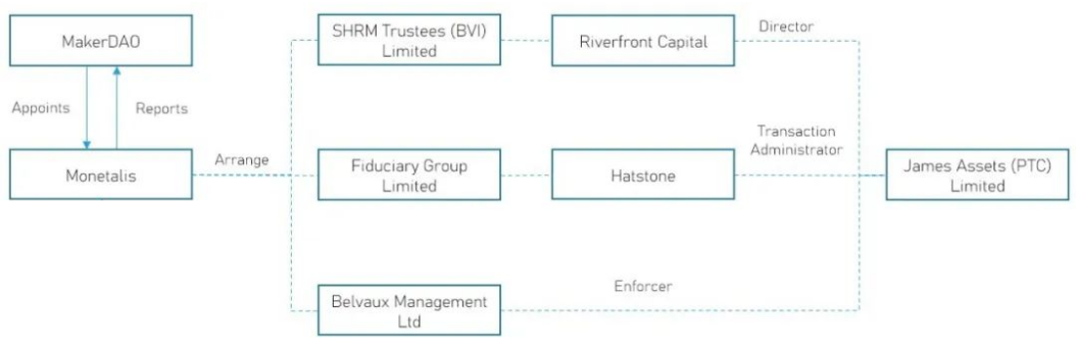
After sorting out the unification of on-chain governance and off-chain governance and execution of MakerDAO and Monetalis, James Assets (PTC) Limited, a trust company established in BVI, will carry out the procurement of US debt ETFs externally. The procurement targets include BlackRock's iShares US $ Treasury Bond 0-1 yr UCITS ETF and iShares US$ Treasury Bond 1-3 yr UCITS ETF. The specific process is as follows:
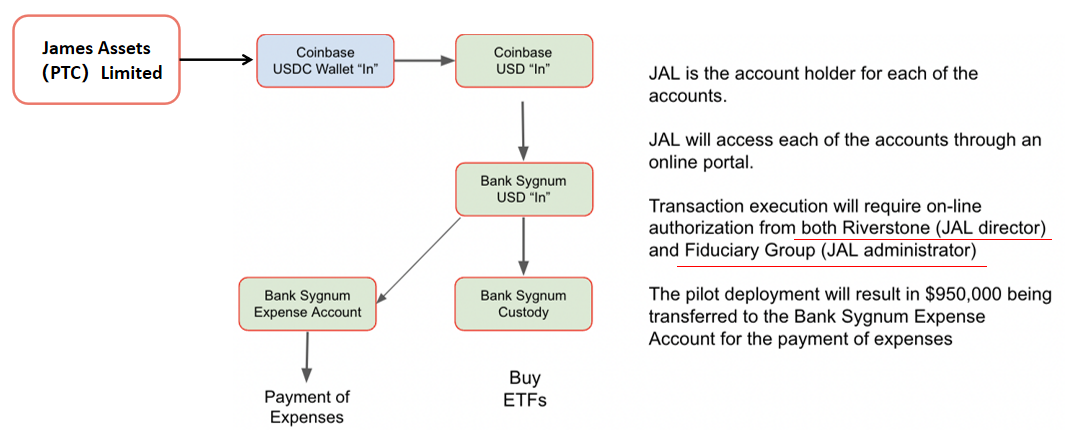
In the overall process, James Assets (PTC) Limited, as the external subject of MakerDAO and Monetalis, processes each transaction under the premise of obtaining on-chain authorization and off-chain authorization. Among them, Coinbase acts as an exchange agency for legal currency deposits and withdrawals, and Sygnum Bank provides trust asset transactions and custody, and sets up another account for trust operation expenses (initial fees reached 950,000 US dollars).
3.2.2 Centrifuge's SPV tokenization path
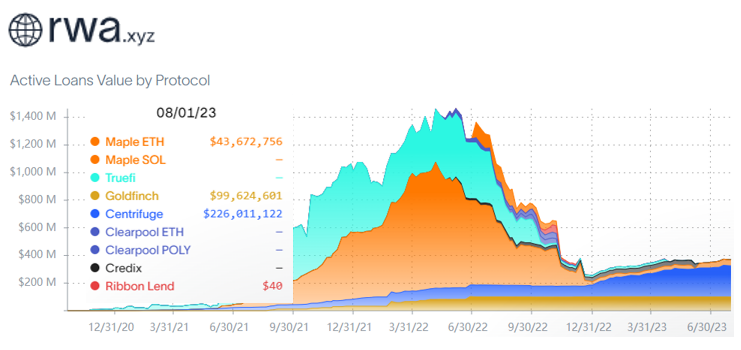
Centrifuge is a decentralized lending platform, which is committed to introducing real-world assets into the encrypted world, providing more investment opportunities and liquidity through tokenization, fragmentation, and structuring. Centrifuge is one of the earliest DeFi protocols to set foot in the RWA field, and it is also the technology provider behind leading DeFi protocols such as MakerDAO and Aave. According to the data of rwa.xyz, Centrifuge is currently a relatively comprehensive project in the RWA field, and has its own Centrifuge Chain and the main product Tinlake protocol.
The implementation path of Centrifuge's RWA can be roughly summarized as follows: (1) The borrower tokenizes off-chain assets into NFTs through asset promoters (underwriting), and locks them in Centrifuge's smart contract asset pool; The asset NFTs of the same type of borrowers are gathered together to form an asset pool, and the liquidity provider provides funds for this asset pool instead of individual individuals; (3) In a structured way, the asset pool is divided into primary (Junior ) and Senior Tranche (corresponding to different ERC20 tokens respectively), among them, investors in Junior Tranche get more benefits and take more risks, while investors in Senior Tranche get more benefits and take more risks Low, which can meet the needs of people with different risk preferences.
Centrifuge has done a considerable amount of work on compliance with the US securitization legal structure (506 (b)(c) under US Securities Act Reg D), and is constantly improving. For example, Centrifuge and Securitize cooperate to help investors complete compliance verification such as KYC/AML; each asset promoter on Centrifuge needs to set up a corresponding independent legal entity for the fund pool, namely a special purpose entity (SPV) , SPV plays the role of bankruptcy isolation. Legally, these assets have been sold to the SPV. Even if the asset promoter goes bankrupt, it will not affect the assets held by the SPV, thereby protecting the interests of investors; the investor signs an investment agreement with the SPV corresponding to the asset pool, which includes After confirming the investment structure, risks, terms, etc., use DAI to purchase DROP or TIN tokens corresponding to different Trench.

MakerDAO and New Silver released the first RWA002 Vault on Centrifuge in February 2021. Since then, the relatively large-scale BlockTower S4 (RWA013-A) and BlockTower S3 (RWA012-A) are based on the above-mentioned RWA realization path, and the main underlying assets of BlockTower S4 are mainly consumer loan ABS products.
After that, the MIP6 proposal improved the implementation path of Centrifuge's RWA, introducing the concept of trustee (Trustee) and safe (LockBox). MakerDAO believes that this transaction structure regulates asset pool transactions and can better protect Benefits for investors and DAOs. Two of the most notable changes are:
1. The asset issuer entrusts a third party as a trustee to act on behalf of DAO and investors. The trustee will protect the interests of DAO and ensure the independence of assets. In extreme cases of default, the trustee is also able to dispose and distribute assets so that they are no longer under the control of the issuer or liquidator;
2. Introduced the concept of a safe (LockBox). A safe means a segregated account that holds assets outside the control of the asset issuer and the SPV. This structure means that SPV assets are no longer controlled by the asset issuer, but by the trustee. The role of the trustee is to receive and process payments in segregated accounts and ensure that the correct party (e.g. MakerDAO) receives the payments. This means that asset issuers no longer control the flow of funds from borrowers to MakerDAO reserves, reducing the risk of issuers losing or misusing their funds.
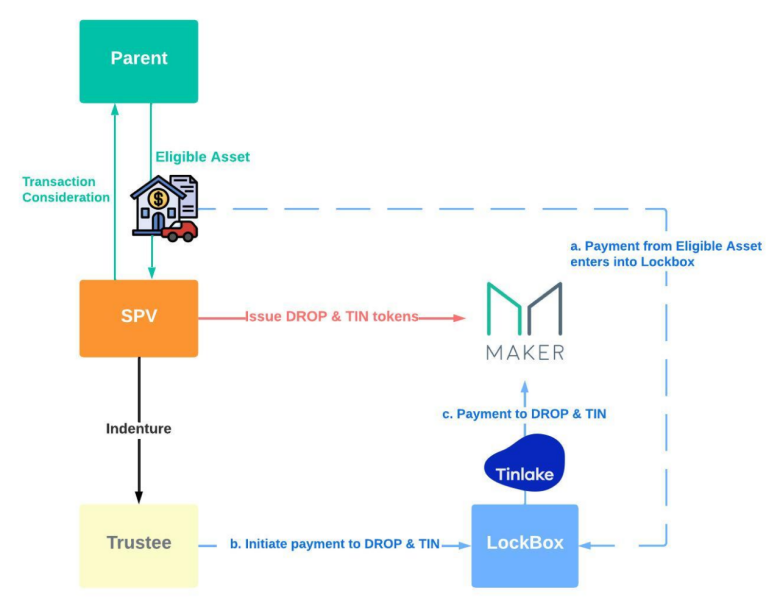
In the above-mentioned improved RWA implementation path, first, the underlying assets are sold to the SPV, and the SPV reaches an agreement with the trustee to pledge the underlying assets to the trustee, and then the SPV issues DROP and TIN tokens to MakerDAO according to the Tinlake agreement . When the cash flow payment of the underlying assets occurs, according to the agreement, the payment is directly paid to an isolated account called LockBox, which is independent of SPV and MakerDAO. When LockBox receives the payment, the entrusted party initiates an instruction to LockBox to pay DROP and TIN to MakerDAO, and LockBox then completes the payment through the Tinlake protocol.
It should be pointed out that MakerDAO and SPV have no chance of touching DAI or USD cash flow, because all cash flow is handled through the LockBox and Tinlake protocols. The only role of MakerDAO and SPV is to sign the subscription agreement and make decisions as token holders.
This structure better protects investors and asset issuers from potential litigation claims and provides a consistent and coherent resolution for discussions with regulators and third-party service providers such as custodian banks. Once this structure has been widely recognized in the industry and accepted by many traditional financial industry participants. Using this structure should make it easier to bring traditional financial industry players into DeFi, expanding the type and amount of real-world assets available to Maker and reducing the volatility of DAI.
3.2.3 Ondo Finance's exemption path and Flux Finance (DeFi lending agreement)
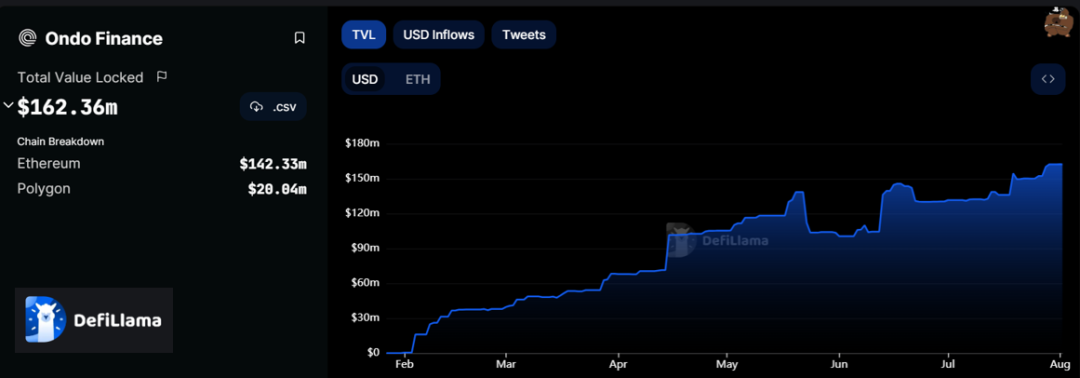
Ondo Finance launched a tokenized fund in January 2023, and is committed to providing institutional-level investment opportunities and services for professional investors on the chain. It brings risk-free/low-risk rate fund products to the chain, allowing the Holders are able to invest in government bonds and U.S. Treasury bonds on-chain. At the same time, Ondo Finance has cooperated with the DeFi protocol Flux Finance on the back end to provide OUSG token holders with on-chain stablecoin lending services.
According to data from DeFiLlama, as of August 1, Ondo Finance’s TVL was US$162 million, its lending agreement Flux Finance’s TVL reached US$42.78 million, and the borrowing amount reached US$280.2 billion.
Ondo Finance currently launches 4 tokenized fund products, namely (1) U.S. money market fund (OMMF); (2) U.S. Treasury bonds (OUSG); (3) short-term bonds (OSTB); (4) high-yield bonds (OHYG). The fund with the most investors is OUSG, and the underlying asset held by the fund is the BlackRock iShares Short Tearsury Bond ETF. OUSG anchors the USD stable currency, and the OUSG token obtained by investing in the OUSG fund is collateralized by short-term U.S. Treasury bonds. OUSG token holders can also mortgage OUSG through Flux Finance, a decentralized lending agreement developed by Ondo Finance, and borrow USDC and DAI Wait for stablecoins.
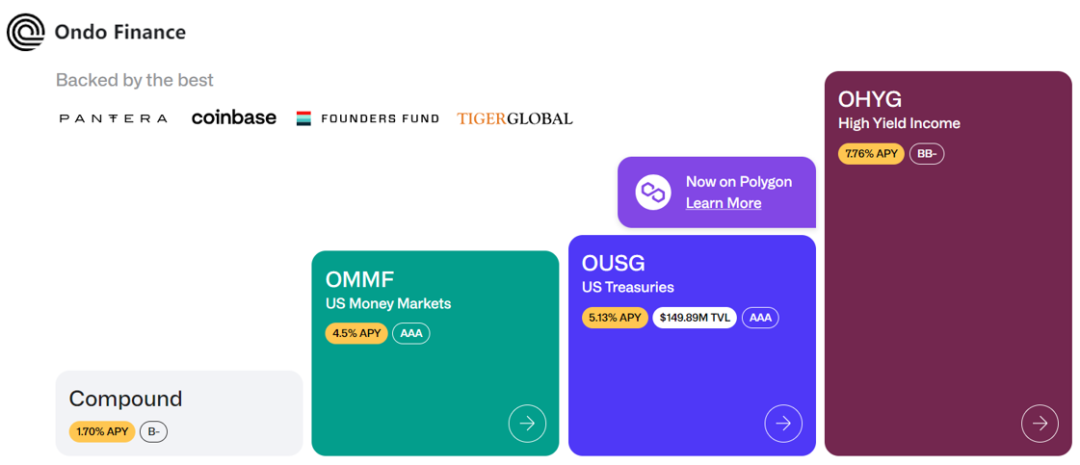
For regulatory compliance considerations, Ondo Finance adopts a strict whitelist system for investors, and only opens investment for Qualified Purchasers. The SEC defines a Qualified Purchaser as an individual or entity investing at least $5 million. A fund with only qualified purchasers is exempt from the Investment Company Act of 1940 and does not have to register as an investment company with the US SEC.
Investors first need to pass the official KYC and AML verification process of Ondo Finance before they can sign the subscription documents. Investors who meet the requirements will invest the stable currency into the OUSG fund of Ondo Finance, and then deposit and withdraw legal currency through Coinbase Custody, and then through a compliant broker Trader Clear Street executes trades in U.S. Treasury ETFs.
It should be noted that the concept of a qualified purchaser (Qualified Purchaser) is not the same as that of a qualified investor (Accredited Investor). The latter only needs to have an annual income of more than 200,000 US dollars or a net worth of more than 1 million US dollars excluding the main residence.
3.2.4 Matrixdock and T protocol (U.S. bonds on the chain without permission)
Matricdock is an on-chain bond platform launched by Matrixport, a Singapore-based asset management company. Short-term Treasury Bill Token (STBT) is a US Treasury-based product launched by Matrixdock. Only qualified investors who have passed KYC can invest in Matrixdock's products. Investors deposit stablecoins and mint STBT through whitelist addresses. STBT's underlying assets are 6-month U.S. Treasury bonds and reverse repurchase agreements collateralized by U.S. Treasury bonds , STBT can also only be transferred between whitelisted users, including in the Curve pool.

The implementation path of STBT is as follows: (1) Investors deposit stable coins into STBT issuers, and STBT issuers mint corresponding STBT through smart contracts; (2) STBT issuers exchange stable coins into legal tender through Circle; (3) The fiat currency is entrusted to a qualified third-party, and the qualified third-party escrow purchases short-term bonds due within six months through the U.S. bond trading account of a traditional financial institution, or puts it into the Fed's overnight reverse repurchase market.
The STBT issuer is an SPV established by Matrixport. The SPV pledges its US debt and cash assets to STBT holders. STBT holders have the first priority to repay the entity asset pool.

T protocol will be launched in March 2023, and the underlying asset of its TBT token is MatrixDock's STBT. T protocol removes STBT's whitelist restrictions through token encapsulation, and realizes a permissionless (permissionless) U.S. debt tokenization product. TBT uses a rebase mechanism to anchor its price at $1, and can trade on Curve.
TBT meets the requirements of the STBT whitelist by accumulating investors' stablecoin assets, thereby purchasing STBT from its partner MatrixDock. TBT realizes the permissionless of U.S. debt RWA assets in an indirect way.
3.2.5 Summary
In the case of MakerDAO, for the purpose of asset management, it is necessary to convert some of the stablecoin assets in its treasury into RWA assets. In terms of realization path, compared to the large-scale purchase of U.S. debt under the legal structure path of Monetalis trust, the RWA asset pools currently adopted by MakerDAO from Centrifuge are relatively small in size, and the largest BlockTower S4 has just reached hundreds of millions as a whole dollars. The advantage of Centrifuge's RWA solution is that the process is simple and does not require MakerDAO itself to build a complex legal structure.
Matrixdock's RWA implementation path is basically the same as that of Ondo Finance, and due to compliance requirements, a strict whitelist system is required. In view of the high threshold of the whitelist system, after Ondo Finance realizes RWA on-chain, it can realize OUSG lending by linking Flux Finance's DeFi lending agreement, thereby improving liquidity; while Matrixdock can realize U.S. debt RWA through the T protocol agreement license-free circulation.
4. Collision between RWA and DeFi Lego
We believe that the subsequent application logic of U-based RWA interest-earning assets is consistent with the DeFi application logic of ETH-based LSD interest-earning assets. RWA mapping interest-bearing assets to the chain is only the first step (Staked US Dollar). How to combine it with DeFi and how to graft DeFi Lego will become very interesting.
We also saw the combination of Ondo Finance with Flux Finance, MatrixDock with T protocol and Curve in the above case. The following will list the "Web3 Yu'e Bao" product of TRON ecology - stUSDT, to further understand the application of RWA to bring interest-bearing assets to the chain, and then refer to the Pendle project based on the LSD track to further analogize the possible application scenarios of RWA+DeFi.
4.1 stUSDT —— Web3 Yu'e Bao
On July 3, 2023, the TRON ecosystem officially launched the RWA stable pledge product stUSDT, positioning it as "Web3 version Yu'ebao", allowing users to pledge USDT to obtain real-world RWA benefits, and the pledge certificate stUSDT will also become a An important building block built in the TRON ecological DeFi Lego world.
Specifically, when a user pledges USDT, USDT can mint the pledge certificate stUSDT at a ratio of 1:1. stUSDT will anchor real-world assets (such as national bonds, etc.), and the stUSDT-RWA smart contract will distribute income to holders through the Rebase mechanism. stUSDT was designed with reference to Lido stETH design ideas, so stUSDT is also a packaged TRC-20 token, which will further enhance the composability of stUSDT in the TRON ecosystem, graft DeFi Lego, and release the infinite possibilities of assets.
In an exclusive interview with Foresight News , Justin Sun said: "stUSDT is very combinable. It can exist in various DeFi lending, income, contracts and other agreements, and can also be listed on the online exchange for users to trade. stUSDT will become the entire wave field TRON in the future. An anchor for the basic income of 50 billion U.S. dollars in assets on the chain is also very important for the entire DeFi Lego.”

4.2 Pendle —— Interest Rate Swap Agreement Based on Interest-earning Assets

Pendle is an interest rate derivatives agreement based on interest-earning assets. Through Pendle, users can implement various income management strategies based on principal and interest rates according to their own risk preferences. Since the conversion of Ethereum to POS, the popularity of the ETH liquid staking (LSD) track has brought Pendle's TVL to the $145 M mark.
First of all, Pendle defines "Yield-Bearing Token" (Yield-Bearing Token, SY), which generally refers to any token that can generate income, for example, the stETH we obtained by staking ETH on Lido, etc. Then, Pendle splits the interest-earning token (SY) into two parts: "Principal Token" (PT) and "Yield Token" (YT), that is, P (PT)+P (YT) =P(SY). PT represents the principal part of the underlying interest-earning assets, giving users the right to redeem the principal before the maturity date, and YT represents the income generated by the underlying interest-earning assets, giving users the right to obtain income before the maturity date.
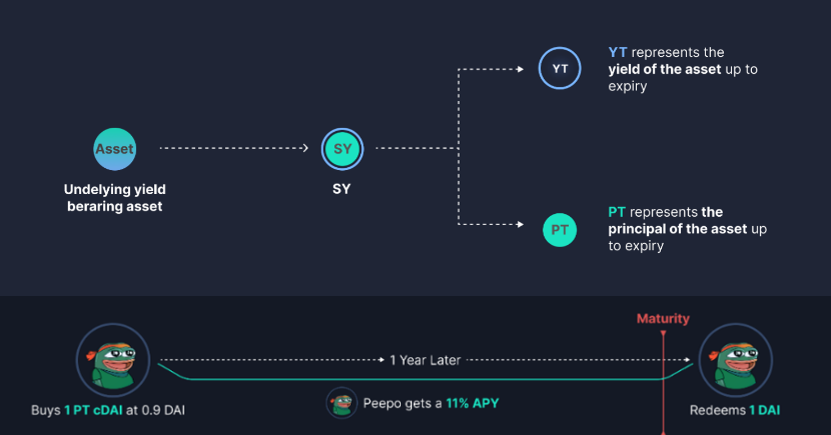
Since then, Pendle AMM (Automatic Market Maker) has come on the scene, and a transaction pair of principal token (PT)/yield token (YT) has been set up in the Pendle liquidity pool. Users can use the constant formula X*Y=K to formulate trading strategies according to market conditions, such as increasing the yield exposure in a bull market and hedging the decline in yield in a bear market.
As an interest rate derivatives protocol, Pendle brings the TradFi interest derivatives market (worth over $400 trillion) to DeFi, making it accessible to all. By creating an interest rate derivatives market in DeFi, Pendle unlocks the full potential of interest rates, enabling users to execute advanced income strategies such as: (1) fixed income (earn fixed income through stETH); (2) long yield (through Buy more yield to bet on the rise of stETH yield); (3) Earn more yield without additional risk (use stETH to provide liquidity).
5. Write at the end
Too much entanglement in the definition of RWA makes no sense. Token is the carrier of value. The value of RWA depends on what kind of rights/values of the underlying assets are brought to the chain and its application scenarios.
In the short term, the driving force behind RWA comes more from the unilateral demands of the DeFi protocol in the encrypted world, such as asset management, investment diversification, and new asset classes; the DeFi protocol uses the RWA project to capture the interest-bearing value of the underlying assets. It is to establish a U-based asset class with a real yield(Real Yield) of the underlying assets. Its logic is basically the same as that of LSD to establish an ETH-based interest-earning asset. Therefore, U.S. bond RWA is sought after. According to the different paths to achieve U.S. bond yields, it can be divided into (1) the Off-Chain to On-Chain path represented by traditional compliance funds, and (2) the On-Chain path dominated by DeFi protocols. -Chain to Off-Chain path, but there are still major obstacles to regulatory compliance.
It is only the first step for RWA to map interest-earning assets on the chain (such as the "Web3 Yu'e Bao" product of TRON ecology - stUSDT). How to graft DeFi's composable Lego in the future will be worth exploring, and it is expected to further open the ceiling of RWA+DeFi. It can be compared to the Pendle interest rate swap project on the LSD-Fi track, or the LSD-based stablecoin project.
In the long run, RWA should not only be one-way, such as the current unilateral demand of DeFi for TradFi. The future will be a two-way rush. On the one hand, it can bring real-world assets to the chain, and on the other hand, TradFi can also use the advantages of DeFi to further release its potential.
About the author:
Will Awang , a master of international business law in the United States, has ten years of legal experience, a serial entrepreneur in the technology industry, a Web3 lawyer, and the principal of the public account "Web3 Xiaolaw".
Diane Cheung , Master of Accounting, University of Sydney and MEM, Peking University, ten-year FinTech product manager, Web3 practitioner.
This article is for learning and reference only, and I hope it will be helpful to you. It does not constitute any legal or investment advice, not your lawyer, DYOR.
REFERENCE:
[1] Citi GPS, Money, Tokens, and Games (Blockchain's Next Billion Users and Trillions in Value)https://icg.citi.com/icghome/what-we-think/citigps/insights/money-tokens-and-games
[2] Binance Research, Real World Assets: The Bridge Between TradFi and DeFihttps://research.binance.com/en/analysis/real-world-assets
[3] BCG ADDX, New BCG report: Asset tokenization projected to grow 50x into a US$16 trillion opportunity by 2030https://mp.weixin.qq.com/s/CBg_-jmYjaTAZdzdsRjuUw
[5] Huobi Research, RWA Tokenization: The Next Crypto Wealth Password? [6] Mint Venture, RWA Talk: Compliance, Track Segmentation and Prospectshttps://www.digift.sg/weekly_roundup/insights_RWA_US_T-bill_tokenization.html
[8] DigiFT Insights, How do DeFi protocols adopt real-world assets (“RWA”) – An overview of MakerDAO's RWA layoutshttps://www.digift.sg/weekly_roundup/research_DeFi_protocols_adopt_RWA.html
[9] MakerDAO, [RWA 007] MIP65 Monetalis/Clydesdale Legal Assessmenthttps://forum.makerdao.com/t/rwa-007-mip65-monetalis-clydesdale-legal-assessment/17834/1
Disclaimer: As a blockchain information platform, the articles published on this site only represent the personal views of the authors and guests, and have nothing to do with Web3Caff's position. The content of this article is for information sharing only, and does not constitute any investment advice or offer, and please abide by the relevant laws and regulations of your country or region.