Author: Steve_4P, fourpillars; Translation: Jinse Finance xiaozou
Main points of this article:
· Following the events of Terra and FTX, the blockchain industry has undergone market reforms around Ethereum and rollup networks.
· In this market situation, the Sei network claims to be a fast monolithic L1 chain.
Ultimately, for a blockchain to be successful, it needs to be easily usable by a large number of users, which places high demands on scalability and chain stability.
· Sei Network developed the Twin Turbo consensus mechanism to achieve the fastest finalization time in the world while maintaining stable operation.
· Now, with the mainnet launch just around the corner, there is a lot of interest in what performance the Sei Network can offer.
1. The latest trend in the blockchain industry — Sei
The mainnet launch of SEI network is coming soon, it will be one of the fastest blockchains in the world and the leading monolithic blockchain. The SEI network, which has been postponing the mainnet plan until now, announced on August 1, 2023 that SEI will be listed on the launchpool of Binance, the world's largest exchange. In addition, Binance will list the Sei network token SEI on August 15, officially confirming that the SEI network mainnet release is not far away. As the SEI network mainnet release is approaching, let us briefly understand the SEI network to understand the network's philosophy and latest achievements.
1.1 Rollup Era
Following the events of Terra and FTX, the blockchain industry has undergone market reforms around Ethereum and rollup networks. Terra and Solana, which positioned themselves as competitors to Ethereum, either went out of business or were decimated, and the view that "the new L1 blockchain is no longer needed" became the mainstream view. Such a market situation will only further strengthen the already strong Ethereum ecosystem. As more power pours into the rollup-centric multi-chain ecosystem adopted by Ethereum, the period from 2022 to 2023 can It is logically called the "rollup era". During this time, rollup chains, L2 solutions, and several modular blockchains have received significant attention. Let's look at a few representative projects among the many rollups:
1.1.1 Optimism and OP Stack
OP Stack received a lot of attention when it became known that Coinbase (one of the largest exchanges in the world alongside Binance) deployed its BASE Chain via OP Stack.
OP Stack is a set of open source codes that provide the ability to build Optimistic Rollups. Rollups can be created very easily with OP Stack. It can be seen as a software development kit (SDK) for Optimistic Rollup. Recently, Worldcoin, co-founded by Sam Altman, known as the father of Chat GPT, also launched the Optimism mainnet, showing their support for the multi-chain vision of OP Stack. With two well-known companies, Coinbase and Worldcoin, actively utilizing Optimism and OP Stack, there is a growing need to use OP Stack to build Optimistic Rollup chains.
1.1.2 ZK Sync and ZK Stack
While Optimism is a rollup that builds an Optimistic Rollup that verifies transactions through fraud proofs, ZK Sync builds a ZK rollup that verifies transactions through validity proofs. Although they are both rollups, their approaches are significantly different. Currently, due to long-term technological progress, ZK Sync has not only become the third largest L2 rollup in the Ethereum ecosystem, but also joined the SDK war by announcing the launch of ZK Stack similar to Optimism OP Stack in June 2023. Of course, there's no notable use case yet, since it hasn't been released yet. However, for those looking to build rollups, there is now an alternative to the OP Stack, suggesting that the rollup market will be very competitive in the future.
In addition to these two projects, the blockchain market is also full of various discussions about rollups, L2 and modular blockchains, because various infrastructures, such as RaaS (rollup as a service), are designed to simplify the creation of rollups developed by the process. So, is building L2 now the ultimate solution? Has the effort to create a new L1 become pointless? At least the SEI network doesn't seem to think so.
1.2 SEI's reverse bet on monomer L1 chain: why didn't they choose L2 ?
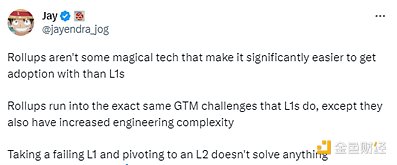
In any industry, when a technology garners a lot of attention, it is inevitable that talent will flock to it. However, critical thinking is also necessary before blindly embracing these technologies. Jay believes that the construction of rollup cannot immediately solve the current problems faced by blockchain technology. This view is worth pondering by people in the industry. Perhaps, in some quarters, rollup may be an overused term used slyly to deceive people who are turned off by the term "L1 blockchain".
Of course, rollups and L1 blockchains are not identical in all respects. But depending on the type of application and asset being built, L1 and rollup may have similar properties. Since all assets issued on an Optimistic rollup are not secured by Ethereum, if the measure of a chain's success is "many users should be able to use it without inconvenience", then from the SEI network's perspective, building L1 seems to be incompatible with Building rollups is just as valuable.
It is said that Sei Labs originally considered building the Sei network as Ethereum L2. However, they chose L1 due to the obvious limitations of scalability and the inherent single-sequencer problem of L2 rollup.
Wait, how to solve the scalability problem? Wasn't rollup introduced to solve the inherent scalability issues Ethereum faces?
While proponents of modular blockchains see rollups as a solution to the scalability problem, rollups remain an ambiguous option from Sei Labs’ perspective. After all, rollup still requires storing processed data into Ethereum blocks. Since Ethereum block space is not infinite, there is a definite upper limit to the number of transactions they can process.
1.2.1 Calculate the maximum TPS (transactions per second) that Rollup can handle
The target size of an Ethereum block is around 15 million gas. To verify 1 byte of data in Ethereum requires 16 gas. This means that Ethereum can verify and process approximately 937,500 bytes of data (15 million/16) per block. If we assume that a very "simple" rollup transaction uses 12 bytes when packaged and submitted to Ethereum (this number varies by rollup and transaction type, but the estimate is based on Vitalik ETH transfer performed in the rollup calculation), then the number of rollup transactions that can be processed by one Ethereum block is 78,125 (937,500/12). Given that Ethereum's block time is about 13-15 seconds, dividing 78125 by 13-15 seconds results in a maximum of 6,000 TPS and a minimum of 5,208 TPS. However, this calculation is based on the assumption that Ethereum's block space is dedicated to rollups. Let's not forget that the Ethereum blockchain itself can also function as a monolithic blockchain. Applications like Uniswap and Opensea currently run on the Ethereum base layer. This means that rollups are also competing for block space with Ethereum native apps. Therefore, the upper limit of TPS that rollup can achieve is likely to be less than 5000. Even with the introduction of Proto Dank Sharding, the TPS cap will not increase significantly. While Dank Sharding may provide significant increases, it will take quite a while to achieve.
For these reasons, Sei chose to build an L1 solution with its own consensus mechanism and block times, rather than relying on rollup (and ETH or Celestia). Of course, for many users to have a seamless and smooth experience, the network must be very fast, while still ensuring the inherent security of the blockchain. So how exactly did Sei build its network, and how fast is it?
2. Overview of Sei Network
The SEI network is often seen as an L1 blockchain dedicated to transactions, but it is actually a general-purpose blockchain. While the SEI has its own "order matching engine," it is more accurate to describe the SEI network as a general-purpose blockchain with a hardened transaction infrastructure. This is because trading assets is considered one of the fundamental features of blockchain technology. Additionally, SEI boasts incredible speed, surpassing many other blockchains in terms of "time to finality," in addition to its internally hardened transaction infrastructure. Therefore, it is more important to study the consensus mechanism that SEI uses to achieve this speed.
2.1 Twin-Turbo consensus mechanism: What makes Sei so fast?
The Twin Turbo consensus mechanism can be understood as a consensus mechanism equipped with two turbos, namely the Intelligent Block Propagation ( Intelligent Block Propagation ) and Optimistic Block Processing (Optimistic Block Processing ) emphasized by the SEI network. What role do they play? How do they increase the speed of SEI?
2.1.1 Intelligent block propagation
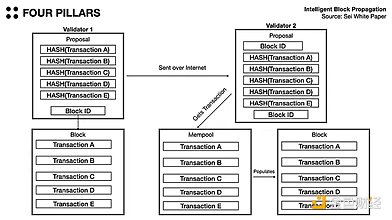
In a traditional blockchain, block propagation consists of two steps:
(1) When a user initiates a transaction, the node receives and verifies the transaction, adds it to its memory pool, and propagates this transaction to other nodes.
(2) The verified transaction is included in a block by the leader (mining node in PoW, block proposer in BFT). This block is then propagated throughout the network. Only when all nodes have received the block can the transaction be considered successfully processed.
However, this traditional approach is inefficient because the same transaction is transmitted twice: first during transaction propagation, and then again during block propagation. This will result in a waste of network bandwidth.
To solve this problem, the SEI network introduces a mechanism whereby block proposers propagate a proposal containing transaction hashes and a block ID referencing the full block, rather than the actual transaction data. The hash value is a summary of the original transaction data processed by the hash function, which occupies a relatively small space.
The block proposer first propagates the block proposal to the network, and then gradually propagates the complete block part by part.
Form blocks without having to wait for full blocks to arrive. If any transactions are missing, they wait until the entire block arrives before processing the transactions.
The SEI managed to increase network performance by about 40% using this block propagation process. (In addition, SEI reduces the finalization time to 210ms through intelligent block propagation, which will be mentioned below.)
2.1.2 Optimistic block processing
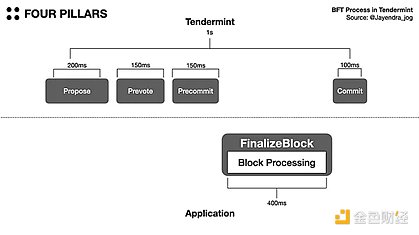
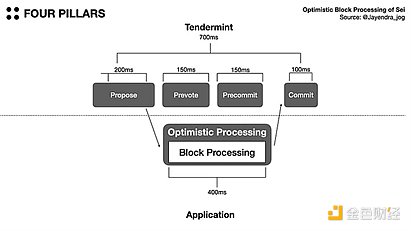
Prior to SEI's Optimistic processing, consensus on blocks must be established before blocks can be processed. However, SEI starts processing once it receives a block, processing Prevote and Precommit at the same time. This structure may seem potentially risky, but since the Prevote and Precommit processes are also performed during block processing, if a block is deemed invalid during this process, the block can simply be discarded and the process restarted. So it's not a huge problem. The SEI network does not omit the traditional consensus process, but processes these processes in parallel.
SEI managed to improve network performance by about 33% through Optimistic block processing.
2.2 Transaction Parallel Processing
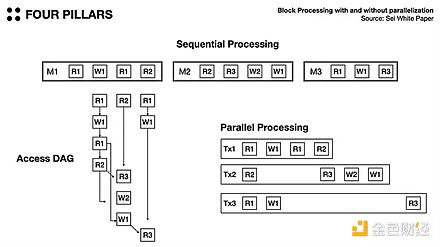
SEI also works with the Twin Turbo consensus mechanism to perform transaction parallel processing, and the important thing here is to find out which transactions can be processed in parallel. Not all transactions can be processed in parallel, since obviously there are transactions that affect each other. Ultimately, in order to achieve safe parallel processing of transactions, it is very important to find transactions with potential conflicts. SEI pre-identifies the relationship between transactions through a directed acyclic graph (DAG), and if these transactions are confirmed to be independent of each other, transactions can be processed in parallel. In this way, SEI has been able to process 20,000 orders per second.
3. Still yearning for speed: How Sei can further reduce finalization time
3.1 What is the final determination time? Why is it important?
Many people often consider TPS (transactions per second) when calculating blockchain performance and scalability, but in reality, TPS can be a rather vague metric. Here's an example to explain why. Let us assume that blockchain A can contain 600,000 transactions in one block. But if blockchain A takes 1 minute to create a block, then TPS (= number of transactions in a block / block time in seconds) will be 10,000, but actually, since the network contains 600,000 transactions It takes 1 minute, so it cannot be considered as processing 10,000 transactions per second in real time. TPS is just a number that divides the processing power of the blockchain in seconds, so the apparent TPS is different for users.
My example may not be extreme enough, but even if you drastically increase the number of transactions per block, and extend the block time to 1 hour, the TPS can still be very high (although the user will have to wait an hour for the transaction to be included in the network). For this reason, TTF (Time to Finalize), a metric that indicates how long it takes for a transaction to be confirmed, seems to be more commonly used than TPS when discussing blockchain scalability recently. Especially for an L1 chain like the SEI network that focuses on financial transactions, it is important to process transactions instantly and reflect them in the network, so it is very important to make the TTF as fast as possible.
3.2 Comparison of Sei with other blockchains
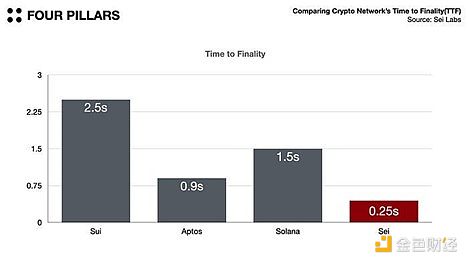
Through the above-mentioned Twin Turbo consensus mechanism (especially through smart block propagation), the SEI network has successfully reduced the finalization time to about 250ms. This is the fastest finalization time among existing blockchains and can actually be seen by users as near-instant transaction confirmation. Of course, this is the finalization time under very positive conditions, the most stable finalization time is 410ms after many attempts on the SEI testnet Atlantic-2. They managed to get the finalization time down to 250ms, but some nodes struggle to maintain the network, and infrastructure players like RPC nodes have fallen behind. This is unavoidable as blockchain nodes, by their very nature, are scattered around the world, so there are bound to be difficulties in spreading and communicating. So how to include all these nodes while reducing finality time?
3.3 Sei Optimization: Fastest Even in the Most Conservative Cases
In order to solve the above problems, the SEI network adds a commit timeout of about 100ms (commit timeout) during the consensus process.
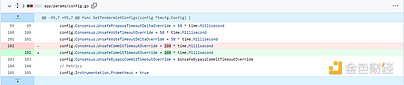
Depending on network conditions, the commit timeout may be shorter in the future, but for now, in this test network, the added timeout is 100ms. With this, we were able to achieve a faster finalization time of 380ms, versus a solid 410ms without adding a timeout. Interestingly, even with a timeout of 100ms, SEI achieves the fastest confirmation time among existing blockchains. Depending on future network conditions and adjustments to the added timeout, the SEI finalization time may be further reduced. It is a very interesting fact that SEI achieves faster finalization times than other existing blockchains in a conservative environment.
4. Future Prospects of SEI
In fact, the SEI mainnet launch has been delayed for the last year and has just been finalized. I'm not affiliated with the SEI Foundation, so I can't explain exactly why the SEI mainnet plan was delayed, but during my research on SEI I learned the fact that SEI has been working hard to improve network performance. It seems that they have been delaying the mainnet launch in order to reach their ideal finalization time. Of course, reducing the finalization time is necessary, but what is more critical is the operation of the network in a stable environment. Over the past year, SEI has been focusing on network improvements, delaying the mainnet launch to ensure speed and stability.
Of course, after the release of the mainnet, it can be considered as a different environment from the test network, with many external variables, so it is impossible to confirm whether the performance obtained on the test network can be directly transferred to the past. However, since the testnet environment is set up to be as conservative as possible, it is very possible to achieve a fast finalization time right after the mainnet launch.
High stability and high speed - If the SEI network can achieve these two points, it can create an environment where many users can use the chain without any inconvenience. Ultimately, whether it is L1 or L2, it needs a large number of users to succeed, so the release of the SEI mainnet has attracted the interest of many participants in the blockchain industry. As someone who prefers monolithic blockchains to modular ones, I sincerely hope that SEI will succeed and bring a fresh start to L1 competition.