


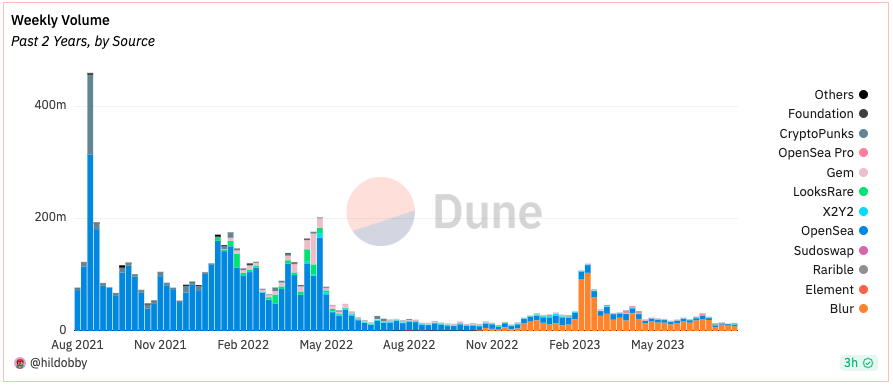
Since May last year, the NFT market has entered a cold winter. The major blue chips that the market pays the most attention to and the indicators have dropped sharply in terms of price and transaction volume. The transaction volume has plummeted by 95% from 17 billion US dollars in January 2022 . Not only that, but during this painful downturn, the relationship between NFT technology and digital creators has become more ambivalent.
Creators give up on using NFTs
The "NFT" technology that previously advertised that the return of creative income to the creator, as time progresses, the actual situation seems to be different. Beginning in October last year, the NFT trading platform Blur was born, and the competition among all trading platforms has become fierce. "Zero-royalty" transactions have also become popular, and all major platforms hope to increase buying momentum by reducing royalties. Messari's research analyst Ally Zach says:
With the launch of Blur, NFT is gradually becoming financial…
Further reading: NFT royalties continue to decrease, 4 ways creators can cope
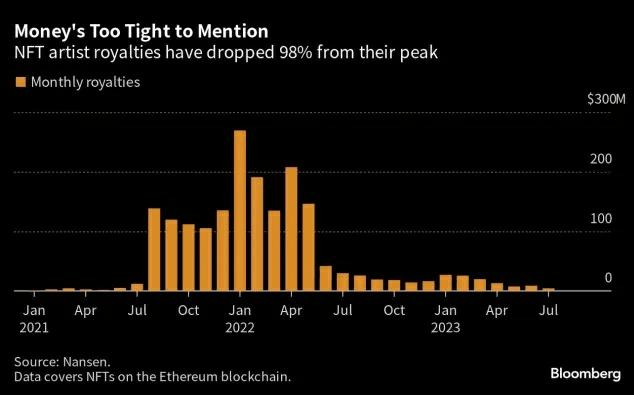
For creators, under the background of declining buying momentum in the primary market and the inability to continue to receive royalties for previously sold works, there is no incentive to use NFT as a medium for creation, which means that the possibility of NFT innovation will also increase. reduce. According to Nansen data, royalties once reached US$269 million in January 2022, but only US$4.3 million remained in July this year. Research firm Nansen also said that the ratio of royalties paid per transaction has dropped from 5% to 0.6. %.
Phillip Kassab, NFT and Gaming Growth Manager at Sei Labs, had this to say:
This is a short-sighted strategy that ignores the fact that sustainable success in this space is built on a delicate balance of power between traders and creators.
Where does NFT go in the future?
At present, the NFT market is looking forward to the next catalyst and the next direction, so as to prove that they are not just "small pictures" on the blockchain. Shiva Rajaraman, the business chief of OpenSea, who once stood firmly on the leader of the NFT trading platform, gave examples such as launching NFT-related physical goods and providing artists with income through different sales channels:
The onus is on us to explore new opportunities for creators to engage with their communities and make a living doing so, even beyond creator fees.
Artist Matt Kane, who made more than $100,000 selling Right Place & Right Time in 2020, points out how the overall market is different now than in the past:
One of the promises of this technology is to move us into a non-zero-sum economy where one's victory is all's victory.
But now, we're regressing to zero-sum, where one man's win is another's loss.






