August 2023 Summary
In early August, overall financial markets corrected as the U.S. dollar strengthened and risk appetite declined. The S&P 500 Index fell 5.1% from its high, and the Nasdaq Composite Index fell as much as 7.6%. In addition, the maximum retracement of gold is 4.4% and the maximum retracement of Bitcoin is 11%. Then at the end of the month, the S&P 500, Nasdaq Composite and gold showed signs of recovery, while Bitcoin remained weak.
Annual inflation data released in August showed the first clear rise after 12 consecutive months of deceleration. Rising energy costs have raised concerns about near-term inflation forecasts. The unemployment rate rose to 3.8% in August (previously 3.5 %). Investors remained cautious over concerns that rising unemployment and persistent inflation could lead to stagflation.
Cryptocurrency trading activity remained at yearly lows in August. A Commitment of Traders (COT) report showed that commercial institutions on the Chicago Mercantile Exchange (CME) held the highest net short position in Bitcoin in 2023, hinting at bearish sentiment.
A sharp selloff in Bitcoin in mid-August triggered the liquidation of more than $150 million in long positions. Total open interest fell by $5 billion. This leverage reduction event reduced approximately 25% of the total Bitcoin holdings.
On August 29, a federal appeals court ruled that the U.S. Securities and Exchange Commission (SEC) must re-evaluate its rejection of Grayscale Investments’ application to convert its Grayscale Bitcoin Trust (GBTC) into an exchange-traded fund (ETF). Bitcoin prices rose about 6%. However, the SEC has not yet approved any application for a Bitcoin spot ETF. Therefore, we expect that the cryptocurrency market will continue to remain depressed in the uncertain macroeconomic environment until the SEC approves a Bitcoin spot ETF.
macroeconomic
Long-term U.S. bond yields surge as inflation fears mount
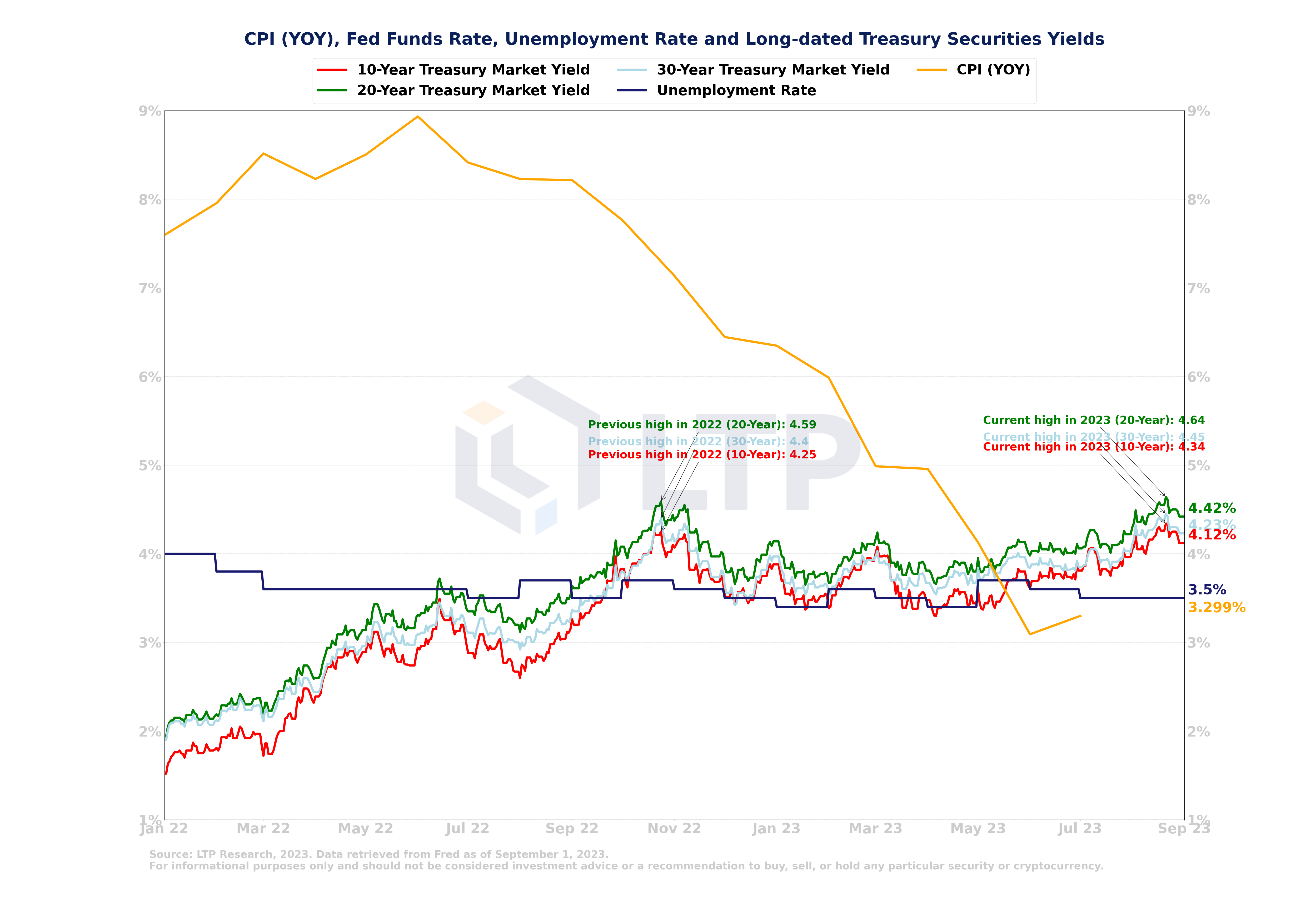
The U.S. Consumer Price Index in July 2023 showed that its year-on-year inflation rate increased significantly, rising from 3% in June 2023 to 3.29%. This marks the first increase in inflation (CPI year-on-year) after 12 consecutive months of declines, compared with 8.93% in June 2022.
At the same time, crude oil and gasoline prices have also risen significantly, bringing inflationary pressure. Since the beginning of 2023, gasoline prices have increased by more than 20%.
Long-term Treasury yields have surpassed their peak in November 2022 as concerns about inflation have increased, indicating increased investor concerns about near-term inflation and longer-term higher interest rate policies.
Bitcoin follows broader market pullback
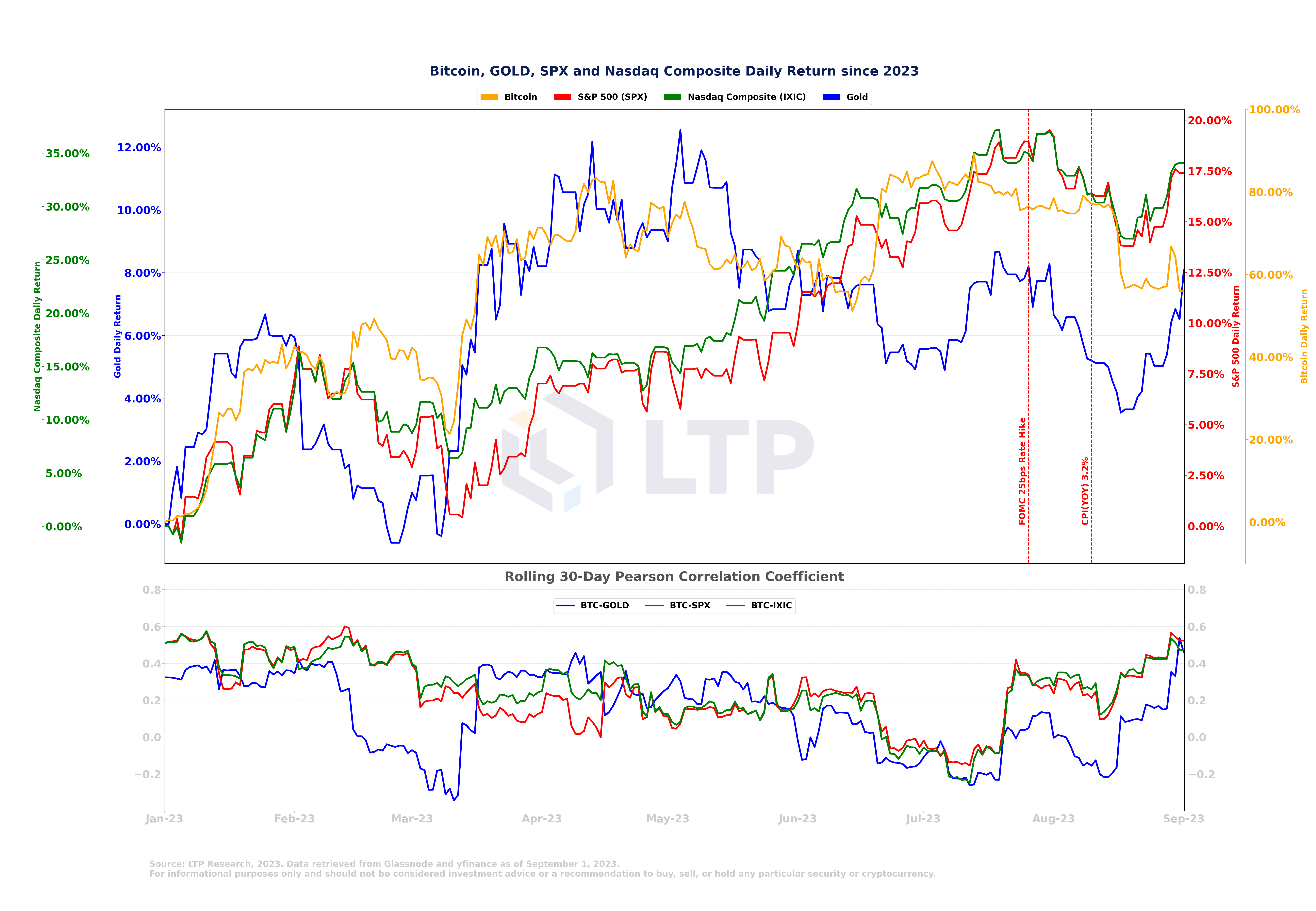
In early August, major asset classes saw volatility, with the S&P 500 down 5.1% from its peak and the Nasdaq Composite down 7.6%. In addition, the maximum retracement of gold is 4.4% and the maximum retracement of Bitcoin is 11%. The pullback began with the July FOMC meeting, where Chairman Powell hinted at a possible extension to the rate hike cycle, while July CPI rose month-on-month on August 10. 3.2%, the first rise in 12 months, further adding to downward pressure on the market. At the end of the month, the S&P 500, Nasdaq Composite and gold showed signs of recovery, while Bitcoin remained weak, showing weakening risk appetite for cryptocurrencies.
Cryptocurrency Market Review
Commercial institutions’ net short positions in the Bitcoin CME futures market reached a record high
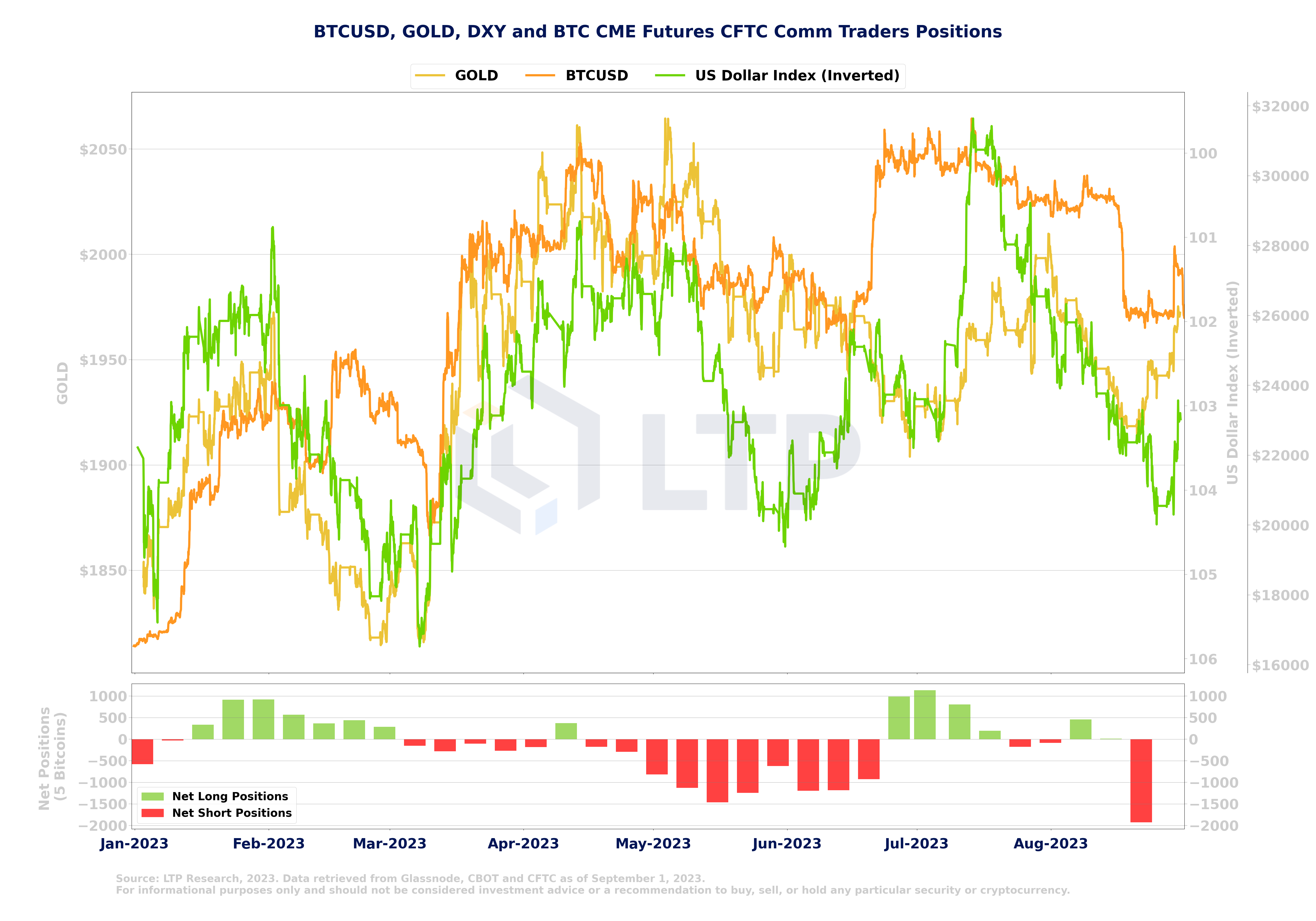
Commercial institutions turned to net short positions in Bitcoin in August. Commercial institutions’ current net short position is at its highest level so far in 2023.
Bitcoin price drops below short-term holder cost benchmark
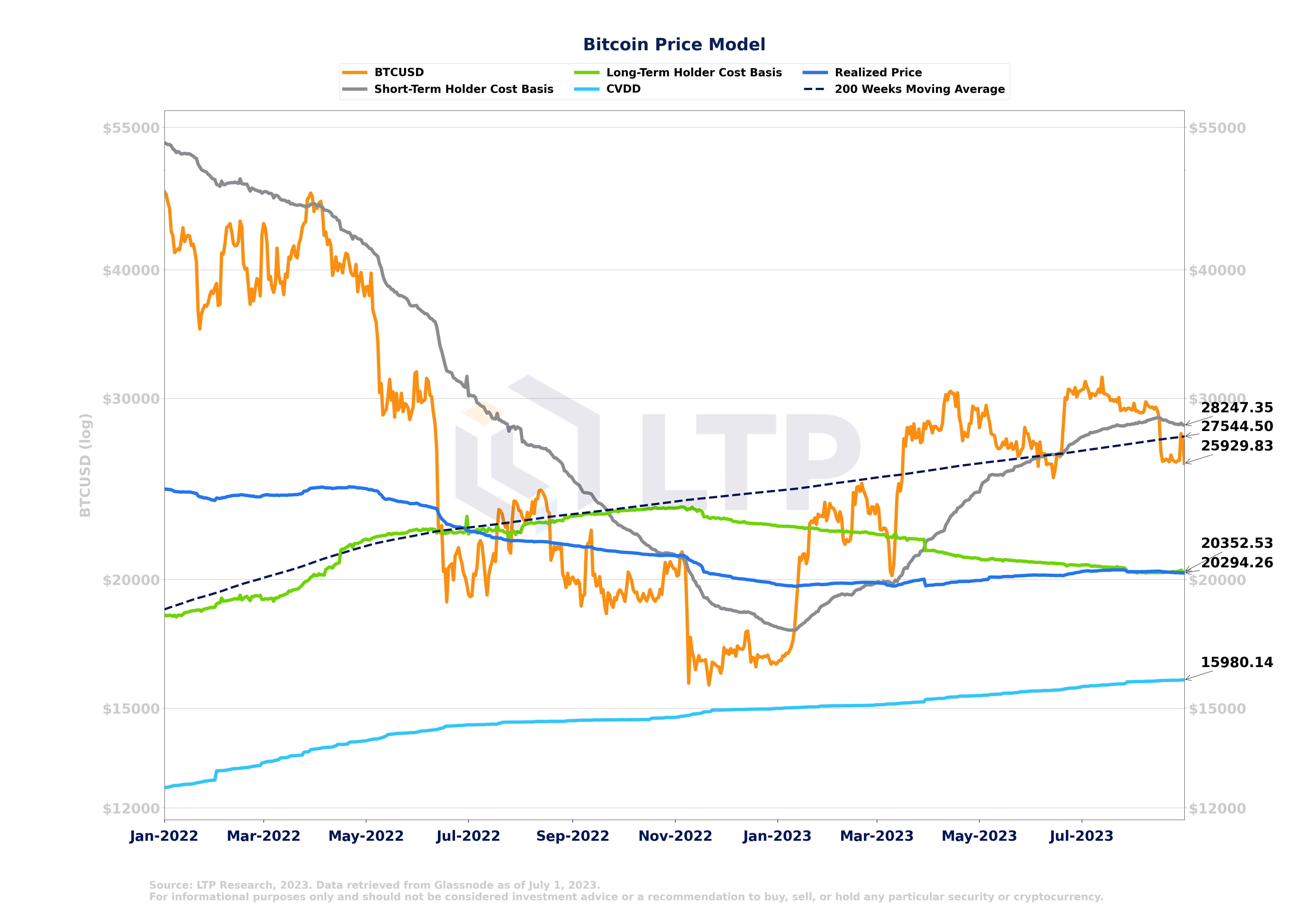
On August 17, the price of Bitcoin fell below the short-term holder cost benchmark price. Meanwhile, the long-term holder cost base and realized price remain at $20,300.
The total circulating supply of the top 4 stablecoins continues to decline, the number of ETH pledges increases, and the stablecoin supply rate oscillator indicates that the current price of Bitcoin is in the middle area
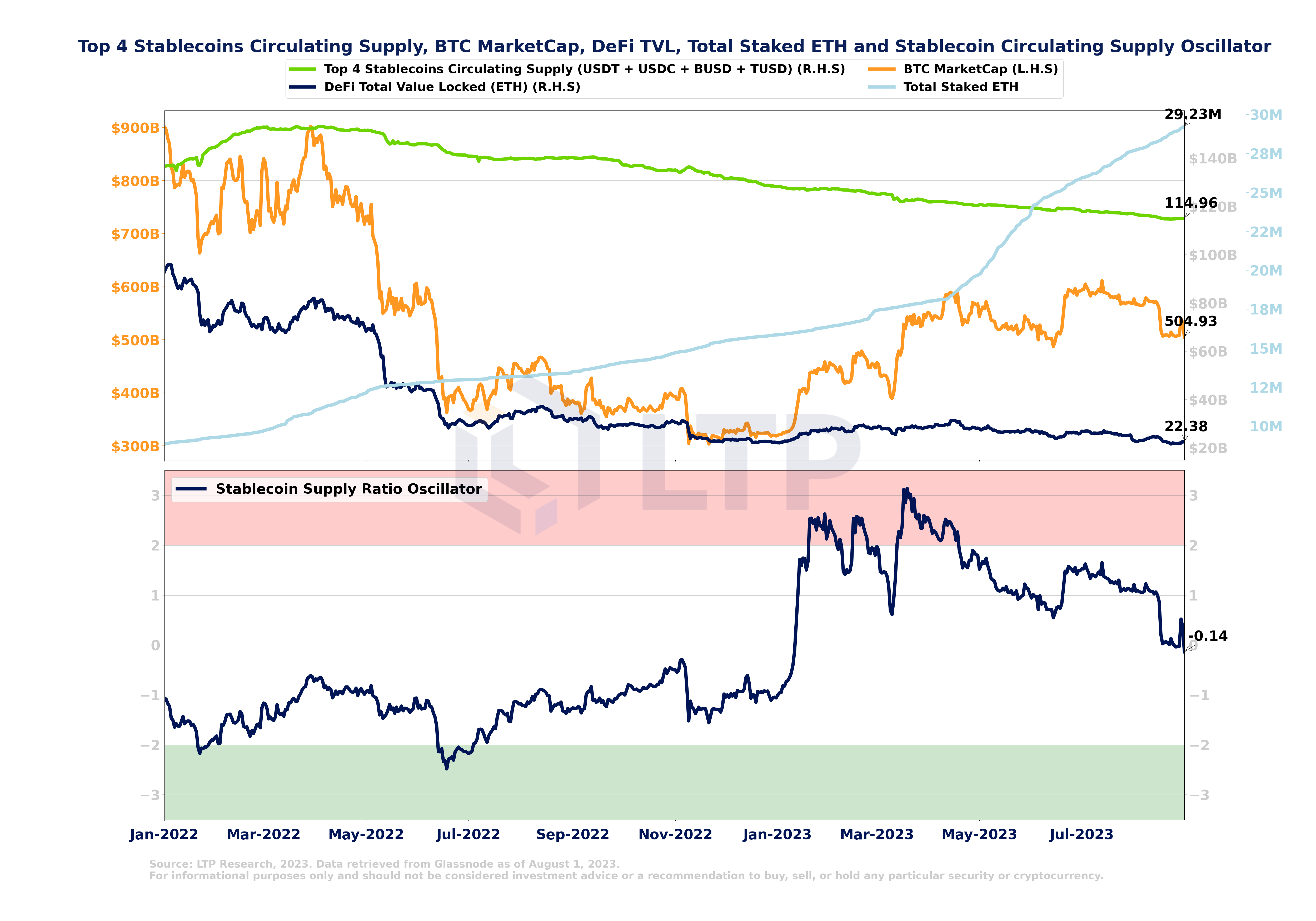
In August 2023, the circulating supply of stablecoins (including USDT, USDC, TUSD, and BUSD) continued to decline, falling to $114.9 billion by August 31. Additionally, the total value locked (TVL) in decentralized finance (DeFi) protocols also declined, falling to $22.4 billion in the same month. However, the total amount pledged on Ethereum continues to grow, reaching 29.23 million ETH. Bitcoin's total market capitalization dropped to $508 billion.
Cryptocurrency exchange trading volumes decline in August
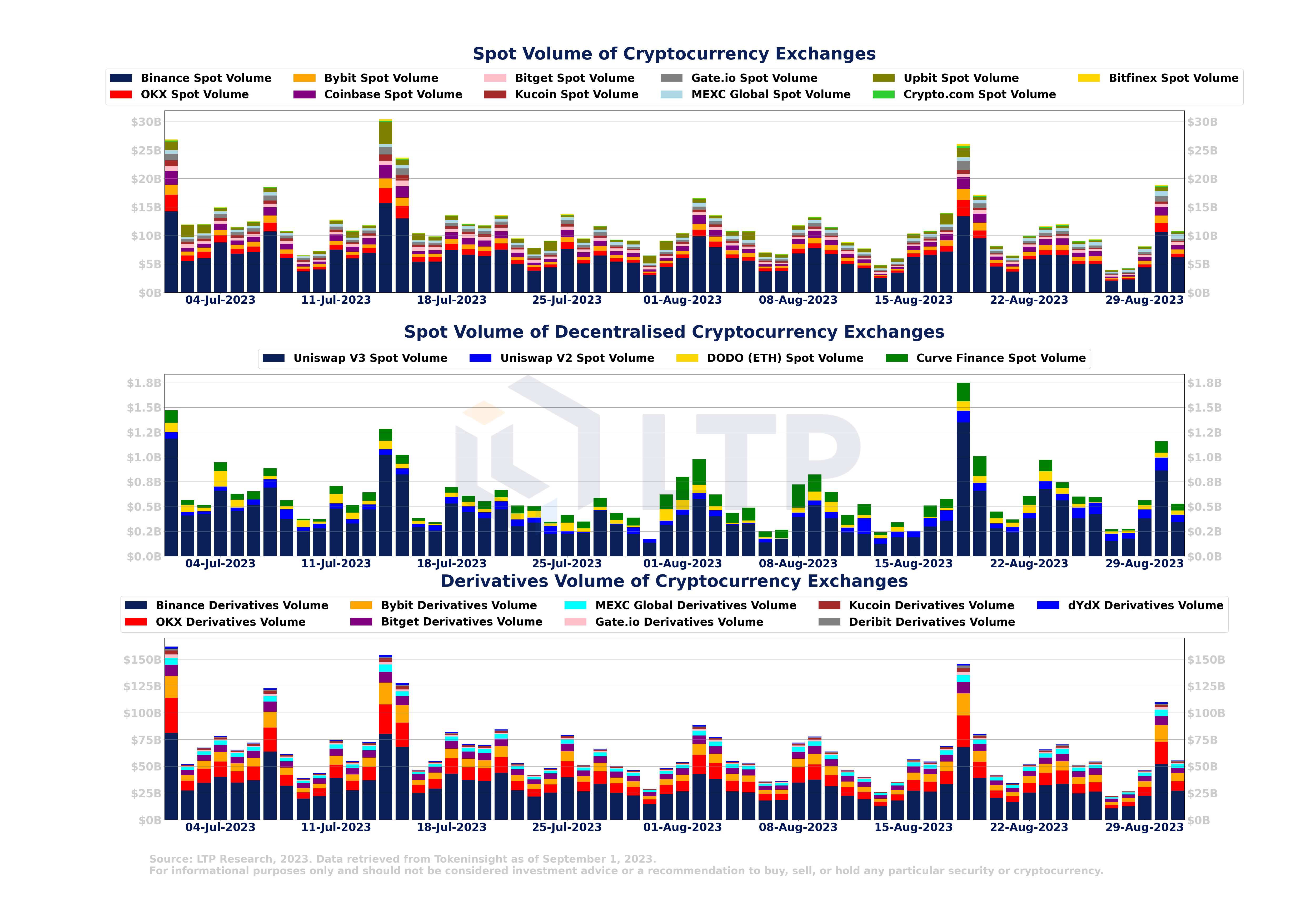
On August 18, trading volumes on exchanges (CEX) and decentralized exchanges (DEX) surged following the previous day’s sell-off. But overall, transaction volumes in August remained at year- low levels.
Binance Bitcoin and Ethereum Spot/ Perpetual Futures Volume
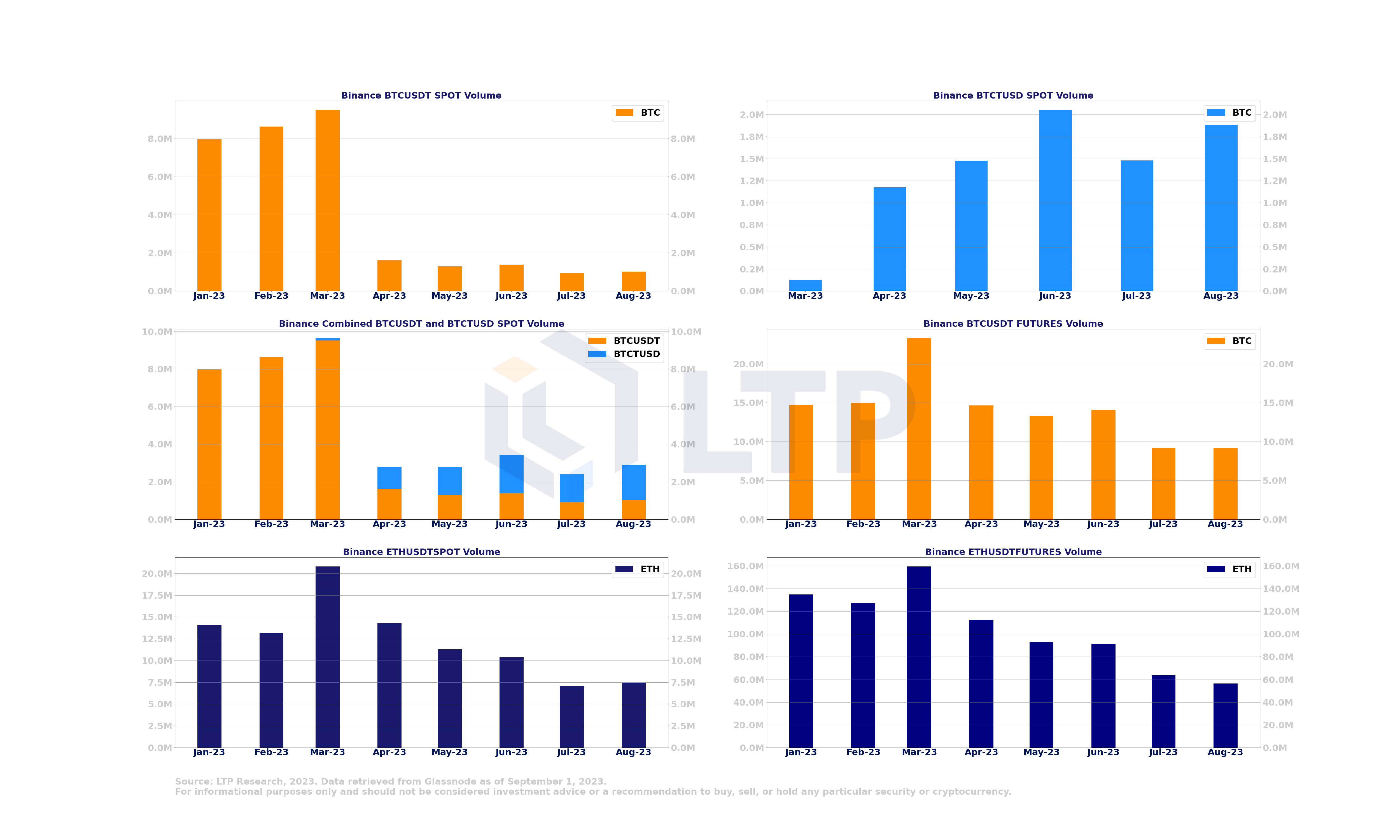
In August 2023, Binance’s Ethereum perpetual futures trading volume continued to decrease. Compared to July 2023, BTCTUSD spot market trading volume has increased slightly.
BTCUSDT/ETHUSDT spot and perpetual futures trading volume on BYBIT
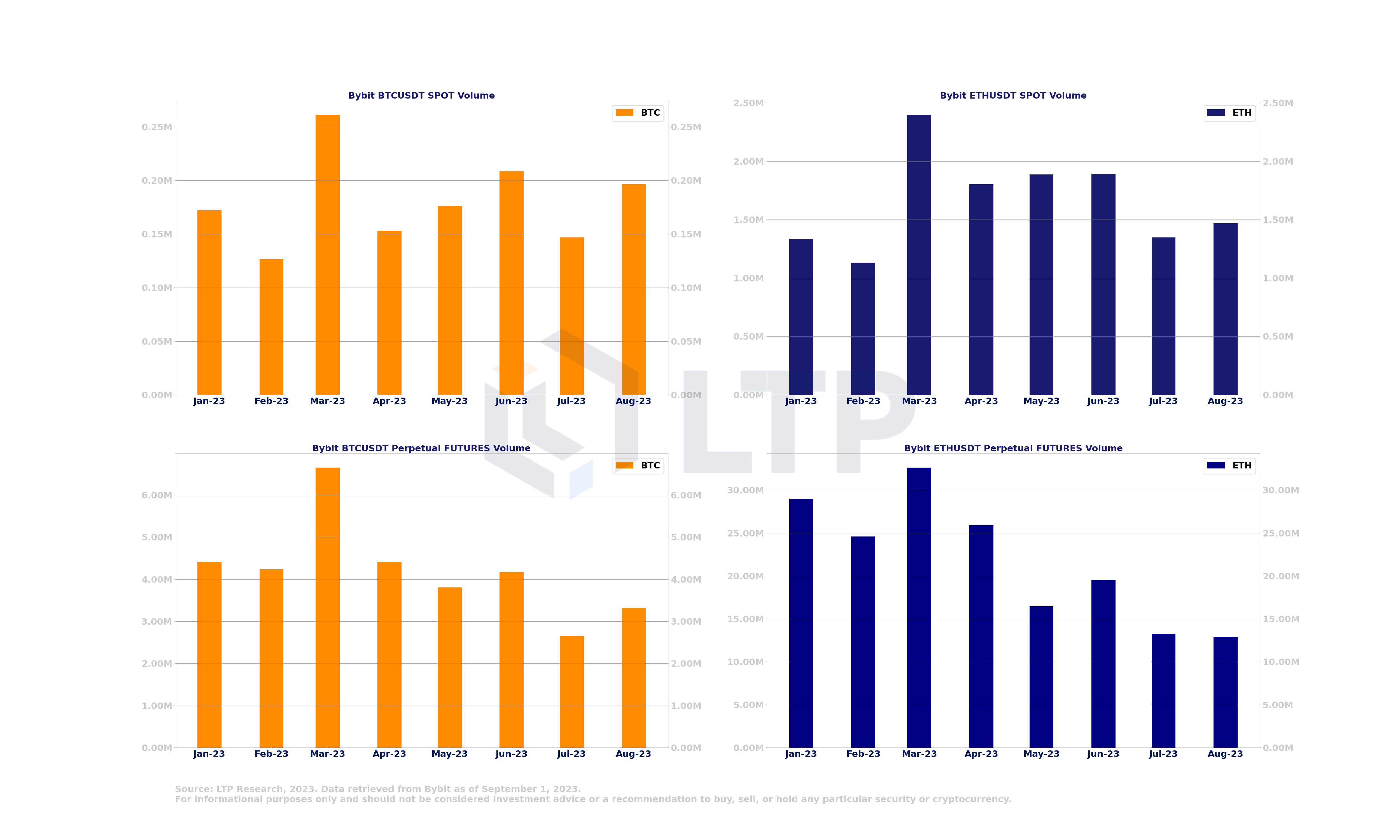
In August 2023, Bybit’s Ethereum spot trading volume continued to decrease. Compared to July 2023, Bitcoin spot and perpetual futures market trading volumes increased slightly.
BTCUSDT/ETHUSDT spot and perpetual futures trading volume on OKX
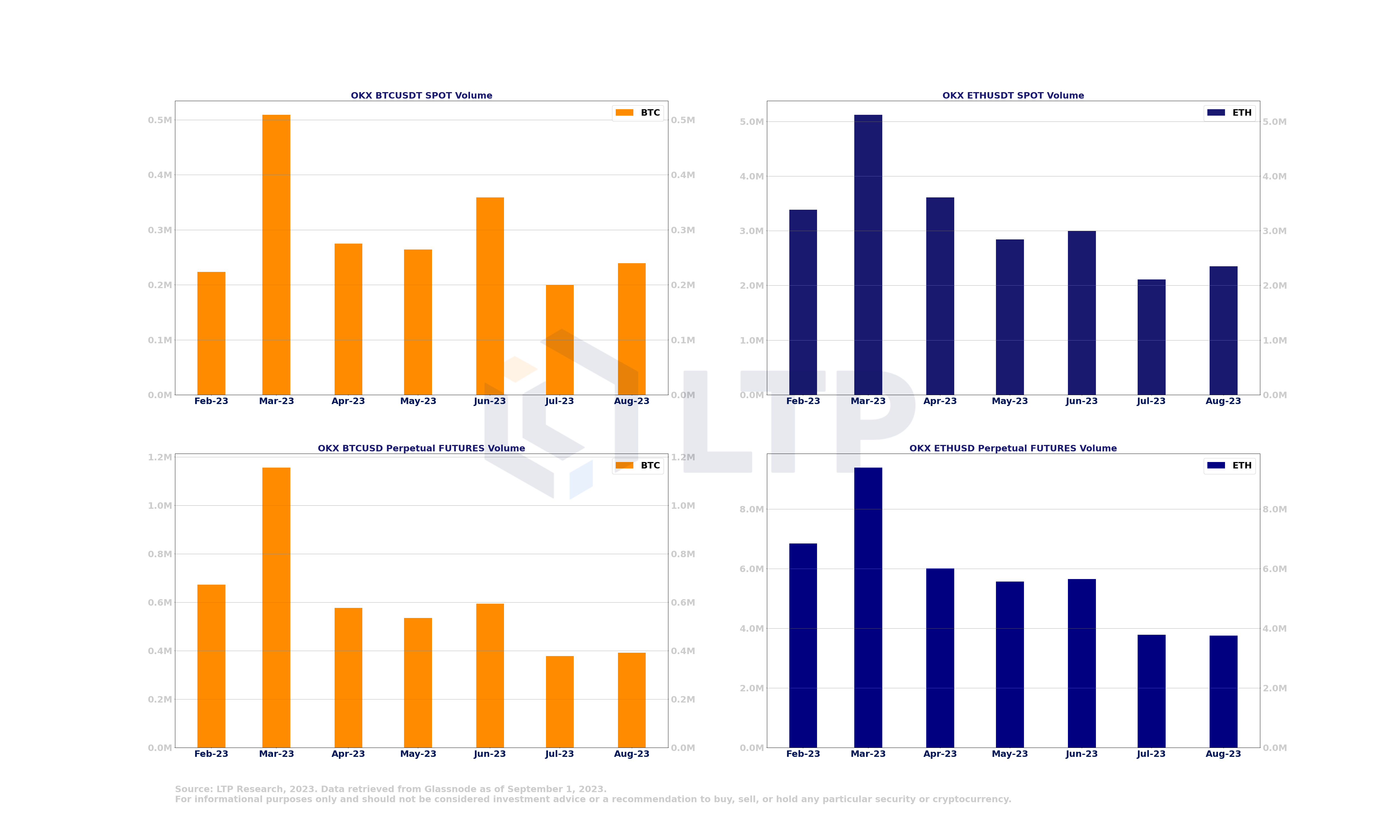
In August 2023, OKX’s Ethereum perpetual futures trading volume continued to decrease. Bitcoin and Ethereum spot market volumes increased slightly compared to July 2023.
Relative trading volumes for major cryptocurrencies declined in August, falling below the 90-day average benchmark
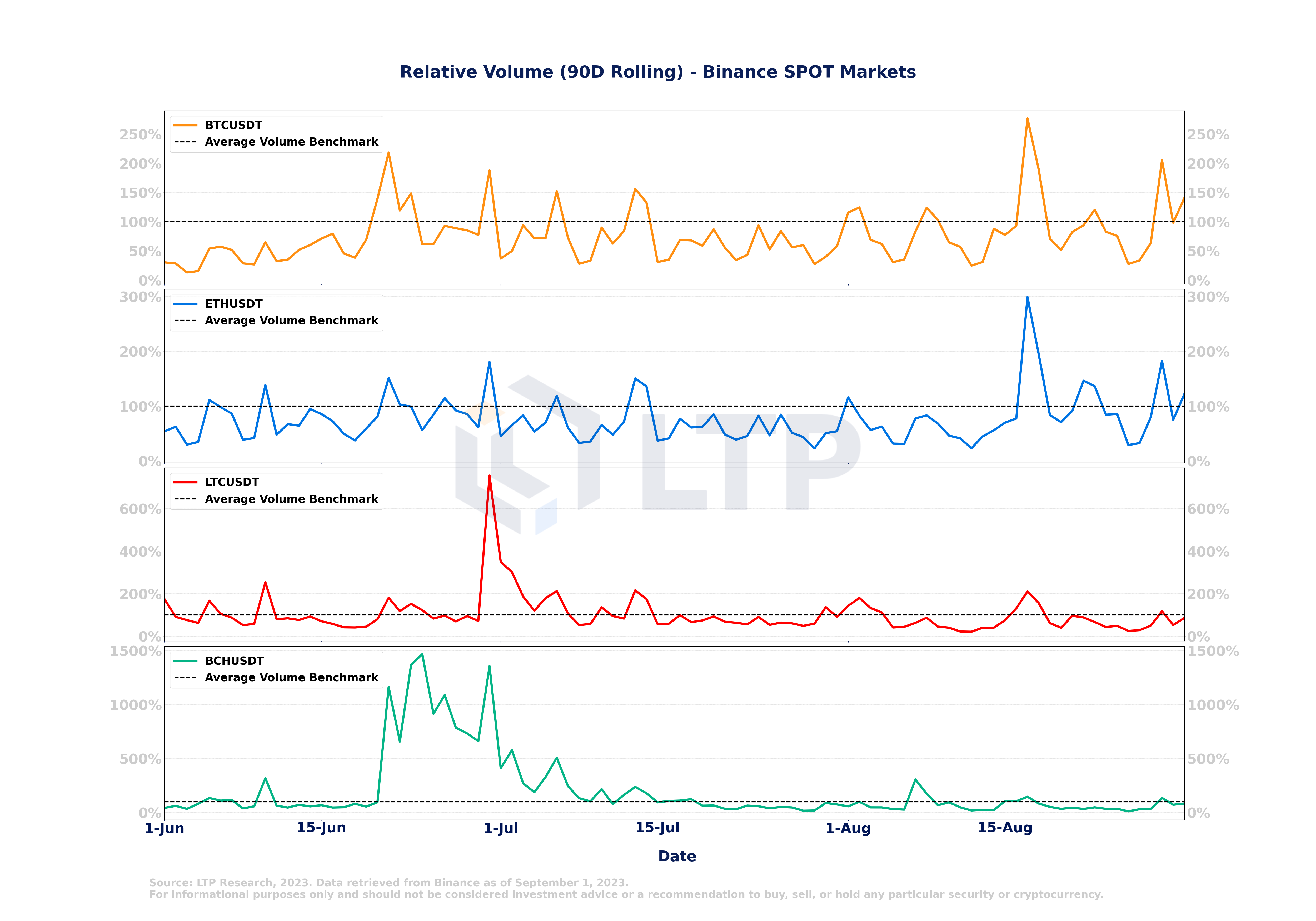
In mid-August, as the market sold off, Bitcoin, Ethereum, Litecoin, and Bitcoin Cash saw significant increases in relative trading volume. However, trading activity in Litecoin and Bitcoin Cash did not continue to pick up, and the market volume declined accordingly, with relative trading volume falling below the 90-day benchmark, and trading activity was mainly concentrated in Bitcoin and Ethereum .
Annualized volatility of major cryptocurrencies declined in August
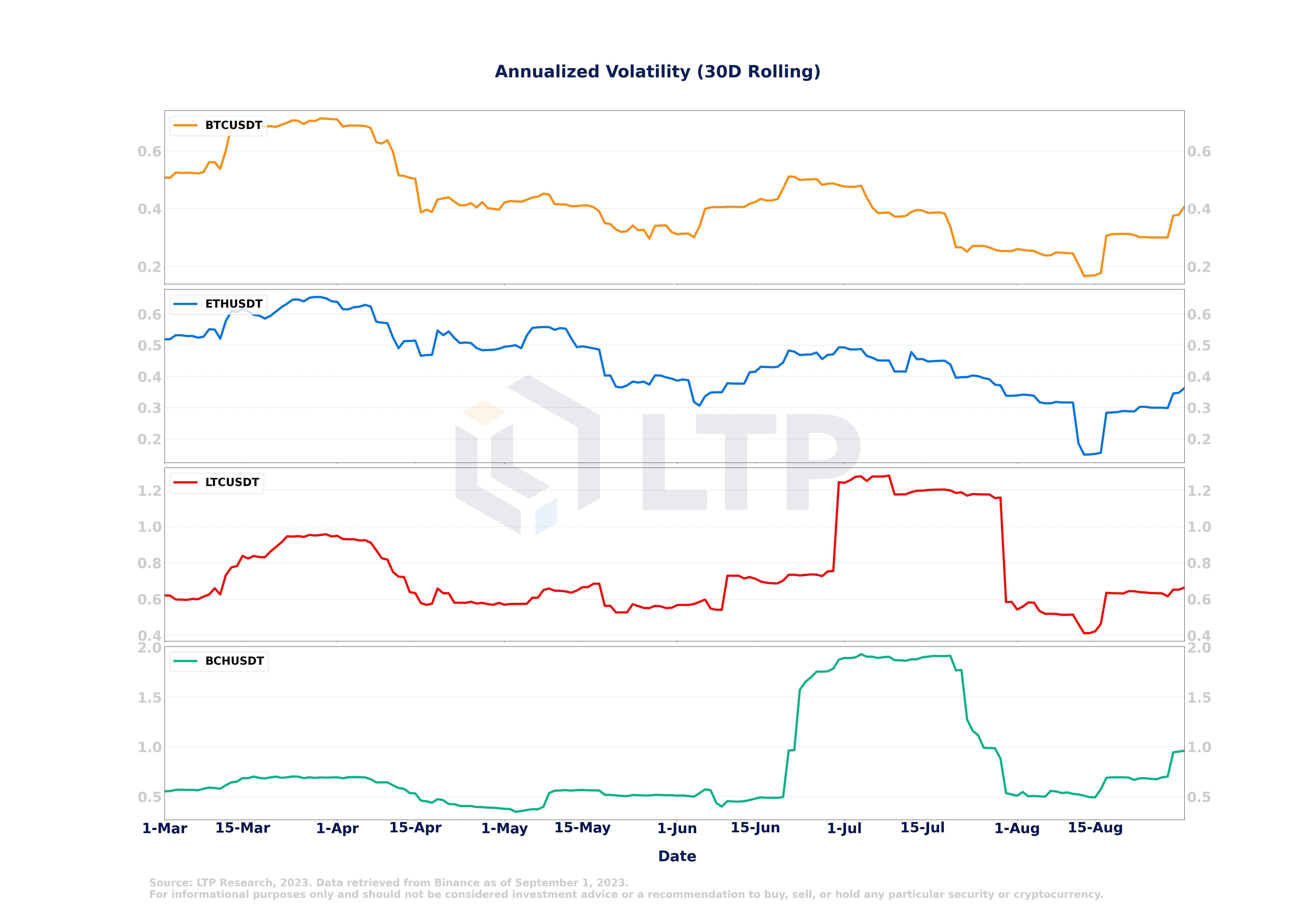
In early August, annualized volatility for Bitcoin and Ethereum reached its lowest point in 2023. However, the subsequent sell-off caused their volatility to rise. With current macroeconomic conditions limiting risk appetite and with the SEC still processing bitcoin spot ETF applications, we expect trading activity to remain subdued, with major volatility driven by industry news.
Bitcoin Transaction Traffic (UTC )
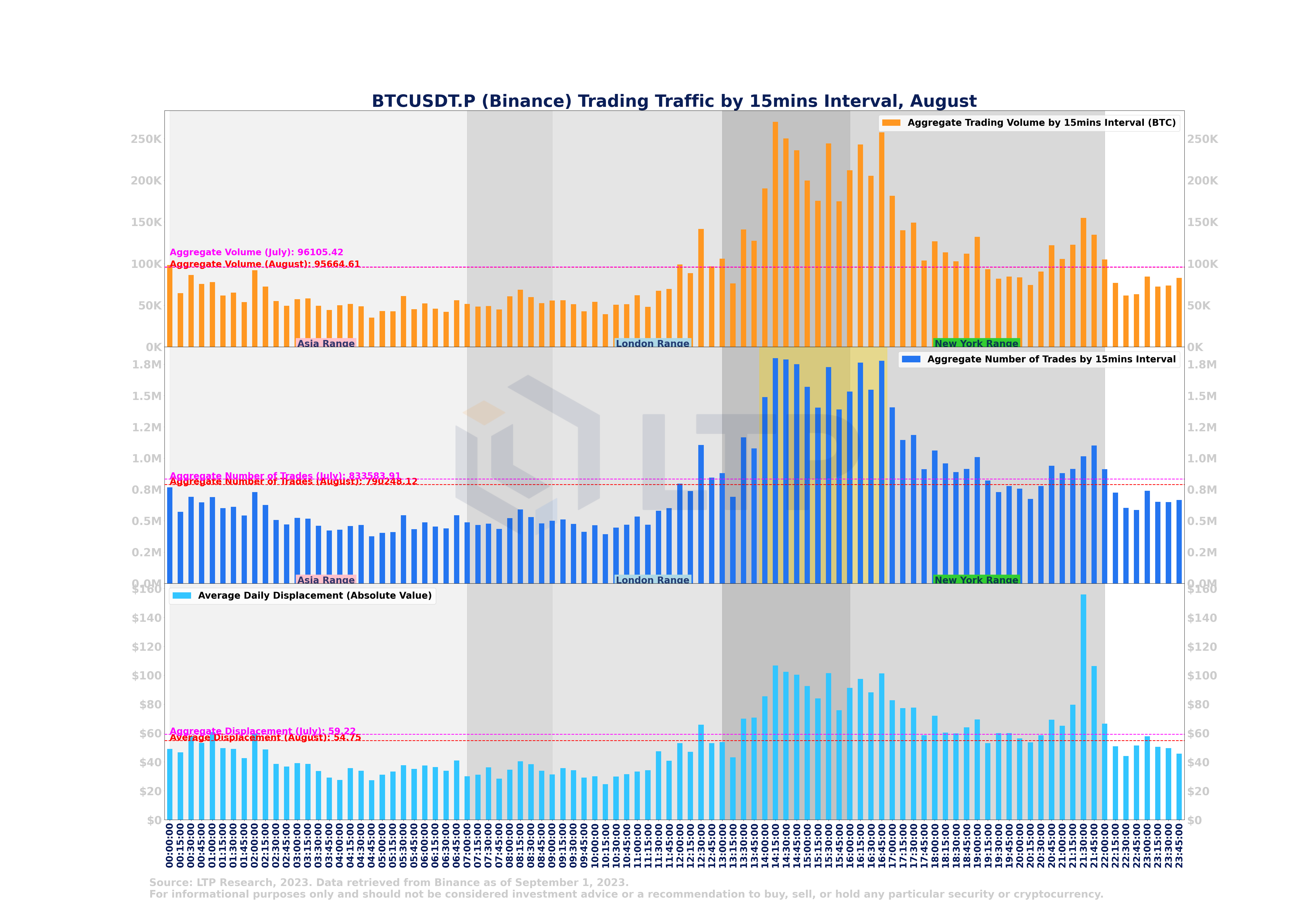
In August, trading activity was concentrated between 14:00 – 16:45 (UTC), when the opening times of the London and New York trading sessions overlapped. Trading activity also increased at the end of the New York trading session. The surge in the daily average displacement (15-minute period) at the end of the New York session can be attributed to the sell-off and a series of long liquidations that occurred at 21:30 (UTC) on August 17.
$5 billion in total Bitcoin holdings wiped out
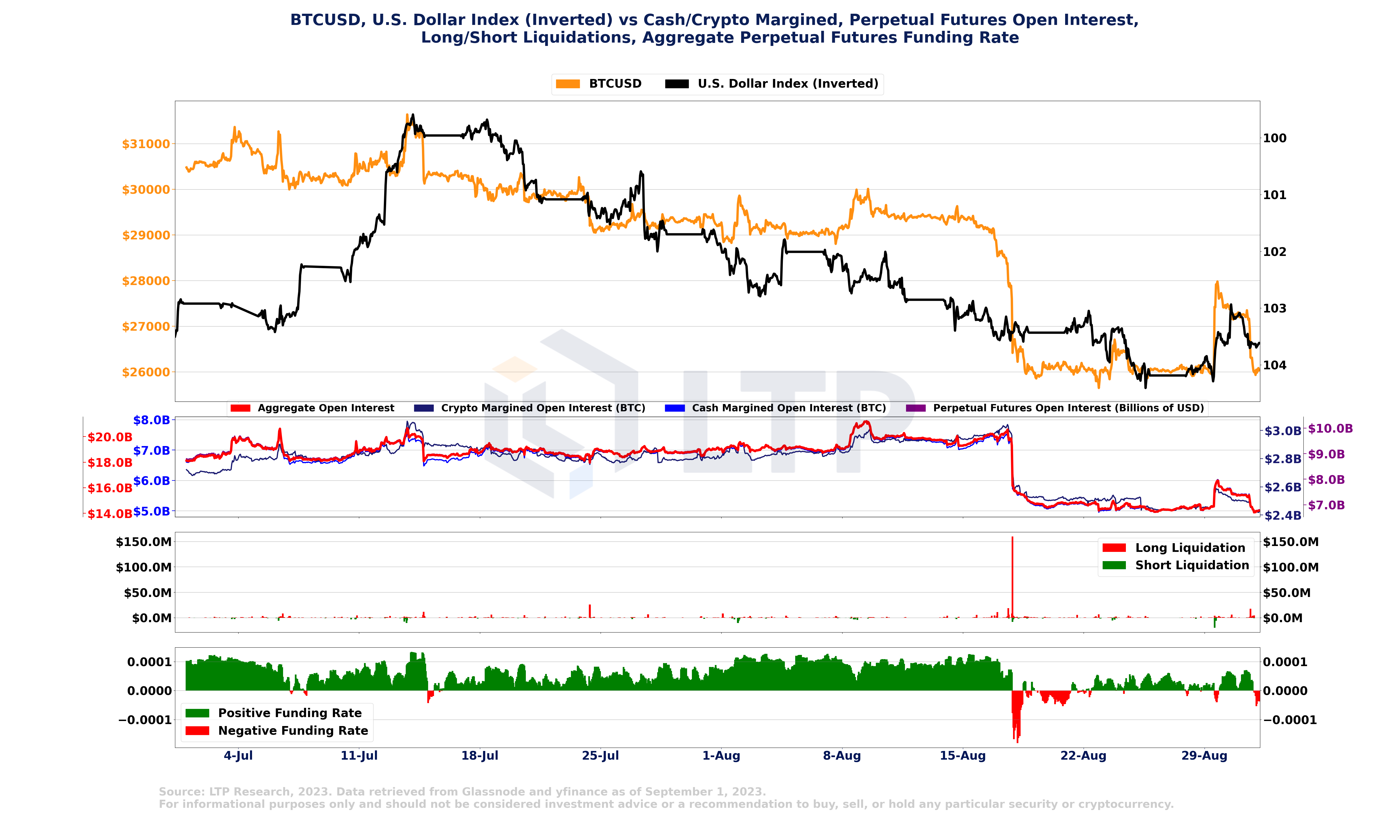
The U.S. dollar index performed strongly in August. Bitcoin saw a major sell-off on Aug. 16, reducing total open interest by $5 billion and triggering the forced liquidation of over $150 million in long positions. This deleveraging event reduced Bitcoin’s total open interest by approximately 25%.
Bitcoin perpetual contracts see massive liquidations and sell-side pressure amid market sell-off
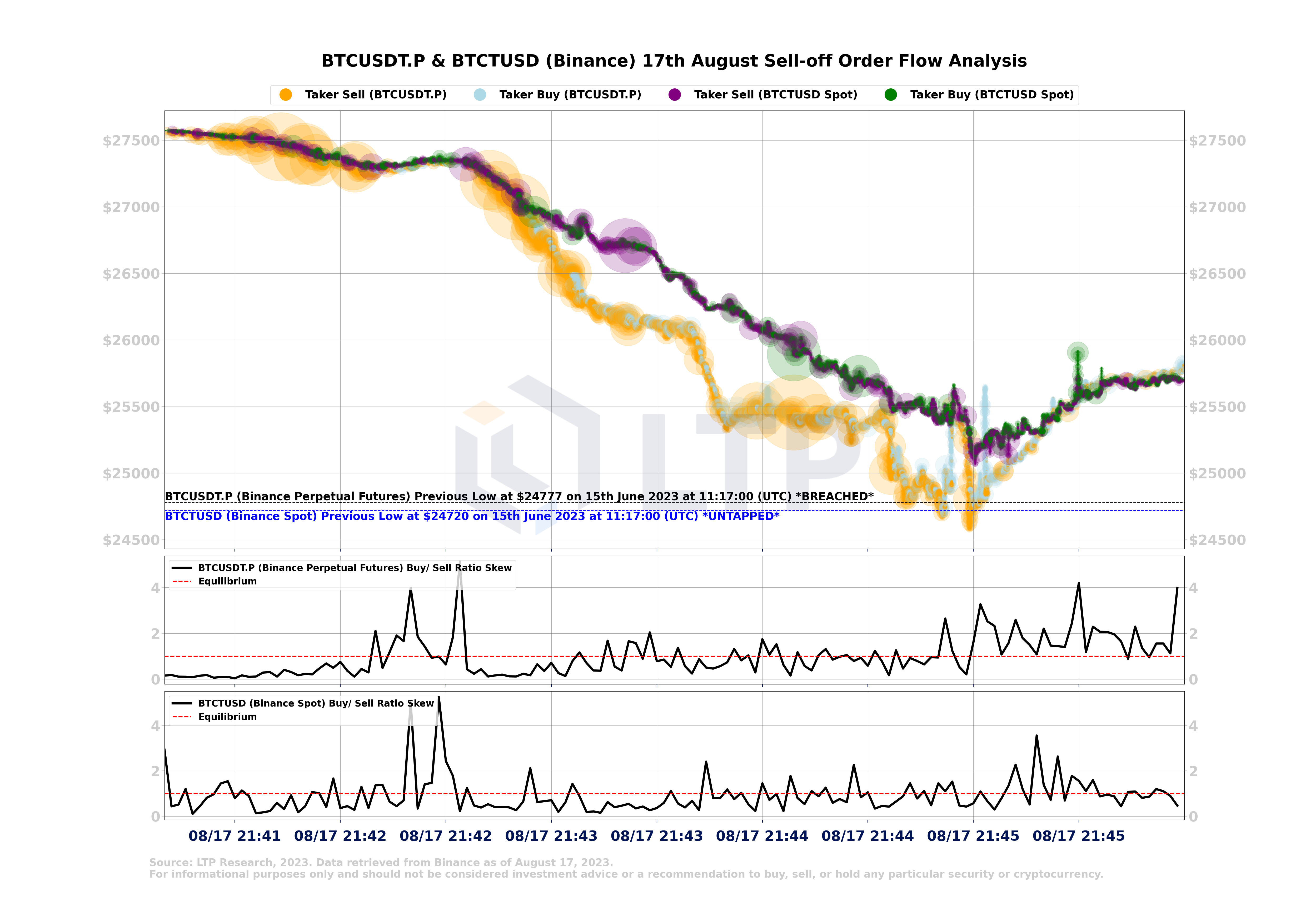
Between 21:41 and 21:45 (UTC) on August 17, a series of long liquidations occurred. The above visualization shows that the Binance Bitcoin perpetual contract market shows a clear sell-side bias, causing the price to deviate from the price of the BTCTUSD spot market during the liquidation period. Also, starting at 21:45, it is evident that speculative buyers entered the market when the buying and selling bias returned to the equilibrium level. Meanwhile, the Bitcoin perpetual contract price was just below its previous low of June 15 ($24,777) at 11:17 UTC, which logically triggered the remaining stop and liquidation orders. It is worth noting that the spot price did not reach the previous low of 11:17 on June 15 ($24720).
Ethereum perpetual contracts see massive liquidations and sell-side pressure amid market sell-off

The above visualization shows that the Binance exchange has a clear sell-side bias in the Ethereum perpetual contract market, causing the price to deviate from the price of the ETHUSDT spot market during the liquidation period. In addition, it can be clearly seen that at 21:45 (UTC), the buying and selling bias returned to the equilibrium level, and speculative buyers entered the market. The ETHUSDT Binance spot market also saw a buyer-biased growth at 21:45, and spot buyers stepped in and bought the spot.
Layer 1 Token Performance
Hedera Hashgraph (HBAR) performed strongly amid the market sell-off as the Federal Reserve's FedNow listed its micropayments platform Dropp. Most first-tier blockchains have seen declines. Bitcoin and Ethereum recorded an 11% drop, while other popular layer-1 blockchains also faced sharp declines.
Popular Layer 2 Token Performance
L2s also experienced sustained selling throughout August.
DeFi Token Performance

While most DeFi tokens continue to fall, Rune has come out strong amid the market sell-off.
Popular GameFi/ Metaverse Token Performance

Most GameFi tokens suffered a sell-off in August .
Performance of Popular Centralized Exchange Tokens and Meme Tokens

The BitMEX token (BMEXUSDT) outperformed other CEX tokens. Mainstream Memecoins fell.
Broader market sell-offs are historically common in September
Bitcoin’s August sell-off matched the month’s historical seasonality. Looking ahead, September is typically a relatively subdued period, accompanied by a sell-off in broader markets such as the S&P 500 and Nasdaq.
Grayscale Bitcoin Trust Premium/Discount to NAV
The gap between Grayscale Bitcoin Trust's NAV and market price/share price is narrowing as the SEC needs to re-evaluate the Grayscale Bitcoin Trust's application to convert it into an ETF based on a court ruling, indicating investors' interest in recent developments increasingly optimistic. GBTC is a closed-end fund that holds Bitcoin. Unlike ETFs, which can create or redeem shares based on investor demand, GBTC has a fixed number of shares. This structure creates an imbalance between supply and demand, which creates a discount or premium in the value of the underlying asset.