Written by: 1kx
Compiled by: Meta Era 237
From a historical perspective, each new computing paradigm unlocks a new set of possibilities for gaming:
- Transistor/Microprocessor/Television - the concept of computer games
- PC – Game categories expand to include strategy and simulation games
- Internet – Multiplayer Online Games
- Social Network - Social Network Games
- Mobile Devices – Casual Games
- VR - space field game
With each new chapter of change, we can see new teams succeed by adopting new models and technologies. Not by traditional companies, but by emerging thinkers—game designers who can bring new experiences to users by taking advantage of the new capabilities offered by each computing medium. This is also happening to the active pioneers of Web3 gaming, each innovating in their own way.
- In 2017, Crypto Kitties created the first crypto game that allowed players to collect and breed new kittens.
- In 2018, Axie Infinity put assets on the chain as NFTs and created an open-flow SLP economy.
- In 2020, Dark Forest combined zero-knowledge proofs with on-chain game logic to create the first on-chain game that can hide information, has no entry barriers, and is scalable.
- In 2021, the Loot Project was released, becoming a symbol of a base-layer IP that people can extend without permission, and has spawned hundreds of games and applications, and these derivatives integrate Loot into the gameplay and storyline.
- By 2023, the new full-chain game/autonomous world is developing rapidly as a new industry.
As we continue to experiment with on-chain gaming, we discover new experiences enabled by on-chain assets, game state and logic, permissionless scaling, and composability that point us to the next generation of crypto platforms—the autonomous world. possibility. At 1kx, we believe we are in the process of going from 0 to 1 on the next generation of gaming – on-chain gaming.
What is an autonomous world/full-chain game?
Let’s borrow gubsheep’s definition of crypto-native games (excerpt):
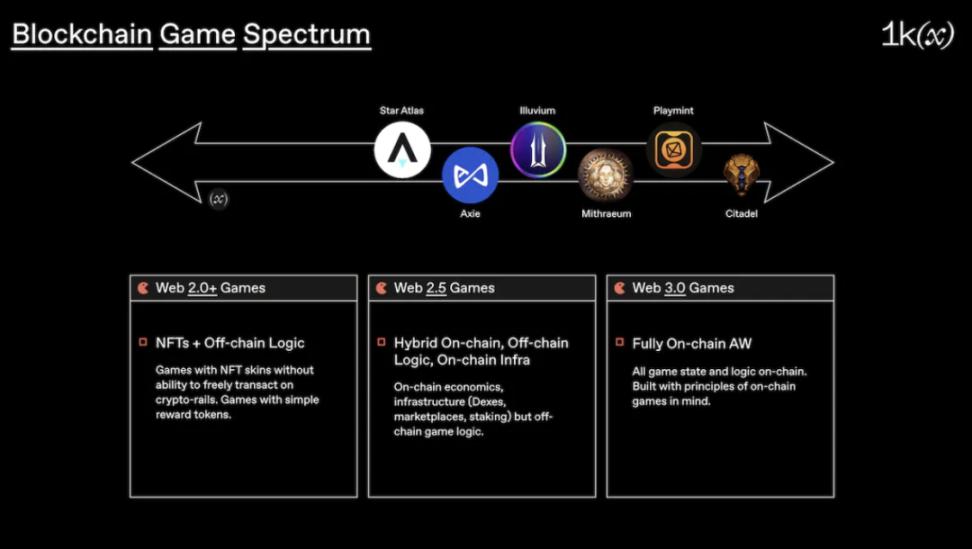
Full-chain games have the following characteristics:
- All game logic and status (assets and others) are on the chain and implemented through smart contracts.
- The true source of game data is the blockchain. Blockchain will not just be used as secondary storage for data or a "mirror" of data stored in proprietary servers. All meaningful data (not just asset ownership) will be stored on the blockchain. This allows games to take advantage of the programmable benefits of blockchain: transparent, permanent, and permissionless interoperable data storage.
- The game is developed according to the principles of an open ecosystem.
- Game contracts and (usually) accessible game clients are both open source.
- Third-party developers can customize and fork new game experiences through comprehensive deployment of plug-ins, third-party clients, and interoperable smart contracts. In turn, it will allow game developers to leverage the entire (incentive-aligned) community for creative output.
- The game is client (front-end) agnostic.
What we often see in the full-chain game literature is the "autonomous world" or equivalent "on-chain reality" that is isomorphic to this model. This nomenclature is similar in the following ways:
1. On-chain game state, where the blockchain is the true source of game data and "world" state (think of the situation in a snapshot at any point in time).
2. On-chain game logic defines how players interact with the game, while the physical rules of the real world define how people interact with reality.
3. Emphasis on open ecosystem principles and other mutable elements of the base layer, as well as community and governance structures in the form of citizens and governments.
This world is "autonomous" because:
“A world with a blockchain underpinning can achieve almost maximum autonomy: anyone can enforce the introduced rules without compromising its objectivity. The disappearance or betrayal of any particular individual does not harm the world: its narrative boundaries Still as hard as a wall." - Lattice
The autonomous world will be the frontier of the next era
Two transformative unlocks make autonomous worlds extremely attractive:
1. By placing the game state and logic on the chain, so that the actions therein have real economic benefits, players will pay more attention to their on-chain game behaviors and be happy to experience a deeper sense of immersion and unlimited participation. The censorship resistance of on-chain games will allow this immersion to grow without platform risk. Running on a public blockchain also means the game can live forever.
2. By allowing anyone to extend or change the game, on-chain games encourage development, which will better align the interests of modders and game developers, and allow players to control a standardized game experience, thus moving towards an interoperable moving in the direction of the metaverse.
Game state and logic are on-chain (and open source)
On-chain game state and logic will be able to achieve:
1. Permanence and fault tolerance as inherited properties of the underlying network. In-game actions, asset ownership, and earned qualifications are incorruptible, verifiable, and permanent. At the same time, the game and surrounding ecosystem will also be censorship-resistant.
2. Pledgeability. Assets inherently have monetary value because they can be traded (if not NFTs, then private key markets). Gas is consumed to implement state transitions. This means that participating in on-chain gaming will have a real economic impact, often with unlimited possibilities for economic upside.
“We must also remember that trading costs money. Therefore, the most effective approach is to imbue any trading action in the game with strategic meaning. This means that players should strive to put as much intellectual work into a trade as possible " - Bohdan from Mithraeum
Due to the interplay of these qualities, we hypothesize that players of on-chain games will develop deeper, more immersive relationships with autonomous worlds for the following reasons:
1. Have a stronger sense of ownership of in-game assets and achievements. We have observed people building digital identities around on-chain actions and achievements such as degen scores, wallet analytics, game leaderboards, C4. This is also what we see in web2 games with high value economies and items, where players spend thousands of hours and tens of thousands of dollars acquiring rare items in the game and forming communities around their ownership. True ownership of assets and achievements will amplify this sentiment. As evidence, we see Dark Forest NFTs (the NFTs obtained for winning the Dark Forest round) selling for historically significant prices despite having no functionality/utility.
2. A stronger desire to master the game to obtain high-value assets and high-value titles. We've seen Dark Forest players build bots, monitoring tools, and custom clients in an effort to climb the leaderboards. We also see a strong community in web3 that is closely connected to their PFPs, especially high value PFPs.
3. No need to worry about platform risks: In Web 2, there are many game modifications and auxiliary platforms that have been issued stop and ban notices by their parent IP. Regulatory arbitrage aside, on-chain censorship resistance, permissionless deployment and permissive open source license/culture ensure that on-chain games and their surrounding ecosystem cannot be shut down arbitrarily.
Overall, we speculate that due to the impact of these on-chain states and logic, web3 games will have deeper immersion and longer life than web2 games.
Autonomous world as a permissionless platform
The history and development of games are closely related to modding. Many era-defining games began or became popular as mods for popular titles. There's plenty of evidence that players want to be involved in the development of games they love, and many times they end up creating experiences that others enjoy as well (e.g. Roblox, Minecraft).
One downside to the popularity of mods is that while they theoretically increase a product's popularity, they can have an impact on the main product's daily active users. For this reason and the desire to tightly control IP, strong end-user license agreements (EULAs) and enforcement actions came into practice, which have hindered the growth and monetization of mods over the past two decades.
Recently, games based on user-generated content (UGC) have been viewed as a solution because of their ability to capture the value created by the community. Studios can provide creator tools and a limited set of freedoms to make the process of creating new experiences easier. However, Web2 UGC is still plagued by demanding EULAs, high fees, inflexible monetization schemes, and limited freedom.
Compared to Web2 UGC, an autonomous world that can be extended and modified without permission is undoubtedly a more powerful solution because:
1. The on-chain game logic exposes every public aspect of the underlying game by default for modification and expansion. Any developer can create a series of smart contracts that interact with game state and logic without having to ask a game studio to expose a limited subset of creative freedom (e.g., the ability to create custom maps). This might look like games that read and use raw game state, the results of the game controlling inputs to the base layer game, direct calls to functions on the raw game logic, multiple games that share state, components, etc.
2. The culture of open source and the anonymity of smart contract deployment means that it is almost impossible to enforce traditional web2 end-user license agreements to prevent module monetization and control of ownership. Modules and extensions deployed on the blockchain have the ability to arbitrarily define value-added parameters (the cost of calling a function) and contracts that - if decentralized - either have no owner or upgradability is protected by a decentralized Entity control. This provides the resulting mod with freedom to capture value and prevents enforcement of the EULA.
Due to restrictive EULAs and backed by ill-informed and outdated court rulings, modders cannot claim copyright for their hard work, cannot easily monetize or control the use of their creations, and cannot easily protect themselves against Violated by bad actors. Even without the restrictions imposed by most EULAs, mods are considered derivative works that fall outside the scope of fair use.
While modders can generally create mods and distribute them for free, they can neither claim ownership of the mods they create nor legally profit from their work without infringing the copyright of the underlying game.
1. There will be better incentive alignment between the creators of the mod and the original game, and there will even be character fusion. While a game's mod may be distributed as a completely separate piece of software, the value flow through the on-chain mod can be via the base layer's core game logic. The more modules and extensions the base game state has, the greater the value of its assets and achievements, and the more value it will accumulate from the application activities it supports. This is the same incentive structure as NFT IP and L1 blockchain, where developers are encouraged to provide new experiences for NFT holders to gain value accumulation, or to create dapps that increase block space requirements.
2. In on-chain games, every addition of content will lead to a diversified expansion of playable content. Economic actors and resource accumulators can find new financial opportunities from the imbalances created by new content. There is more content for players who want to play the game, and for players who want to build/modify the game they can merge and build new games.
Regarding the permissionless expansion of full-chain games, we speculate:
- We will see an explosion of game mods and expansion modules (on-chain downloadable content, or DLCs).
- Each expansion pack will create more "fun" opportunities for different types of players.
- As long as there is an active and engaged community, this cycle will continue. Within a community, there are always some people who are builders.
- This results in games with a truly lasting player base.
- Over time, some extensions and mods will become popular. The gaming ecosystem itself will become an evolving entity.
In order for the player's actions in the world to be meaningful, there need to be positive and negative consequences. Meaningful engagement is more engaging than any VR headset. In The Citadel, we want things to be worth betting on, worth fighting for. We envision a world driven by economic, political, and military competition for scarce resources. The initial game loop revolves around economic competition, but over time new risks and forms of competition will be introduced.
The current state of the autonomous world
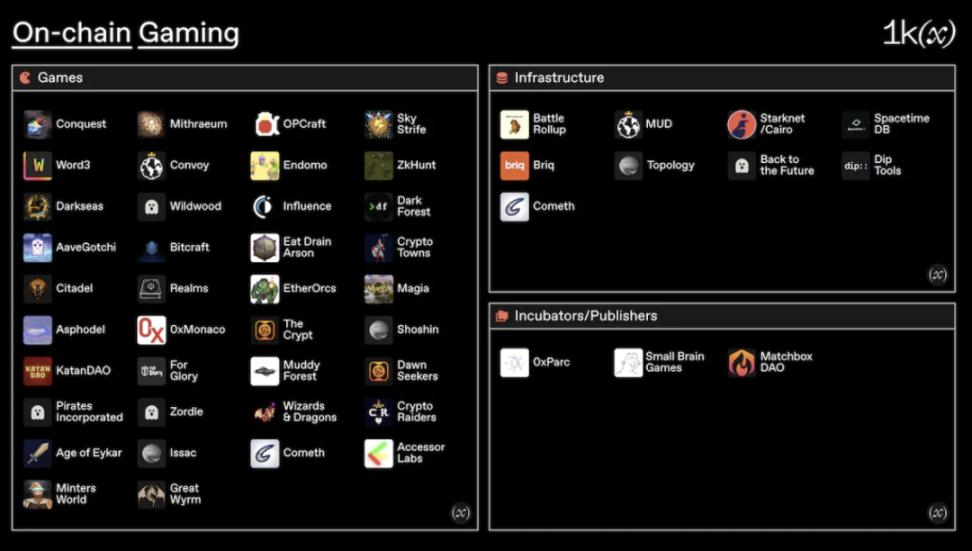
As you can see, there are many teams building on-chain IP, infrastructure that makes autonomous world development easier, and other development platforms for on-chain games and autonomous worlds.
Why we'd be excited about an autonomous world
There are many similarities between the early stages of nascent base layer systems – currently active ecosystems such as Ethereum – and today’s on-chain games:
1. Technical differentiation from existing platforms makes possible new types of applications that did not exist before.
2. A strong community that gathers around a vision or idea—a vision or idea that often aligns with the technology’s differentiating characteristics.
3. A group of outstanding developers attracted to the basic layer by 1 and 2 have jointly built a strong initial developer ecosystem for new applications.
4. People generally question the commercial potential, feasibility or user-friendliness of these new experiments.
We observe the same flywheel pattern again and again:
1. The initial community uses the computing properties of the base layer to build very cool and innovative protocols.
2. See other builders of these products and join the community.
3. Among thousands of experiments, some key successful applications have emerged.
And the autonomous world is at the beginning of this cycle.
An autonomous world in the next three years
What we foresee happening in the next few years:
1. The number of playable on-chain games has exploded, leading to an explosion of community-driven development based on popular games. Games with the strongest communities will see multiple third-party clients, bots, plugins, and first experiments in game modules, extensions, and mods that are not forks, but extend and interoperate with the base layer game. At the same time, at least one such mod will be more popular than the base-tier game.
2. Permissionless UGC experiments, including games whose output is the input of another game, games that share state across multiple different games (thus naturally interoperable), custom frontends that index different game components, and system subsets. Given the availability of open source implementations of game elements (components and systems), we will see rapid growth.
The autonomous world will be the frontier of the next era
We believe that on-chain gaming will be the beginning of a new paradigm that will penetrate mainstream ideology. We see the hallmarks of successful networks of the past: complete differentiation from the status quo, a unique value proposition, a concentration of energy, and a community of great builders.