Looking back at the development history of Bitcoin over the past ten years, each cycle has a different narrative, and the narrative of each cycle is beyond everyone’s expectations.
Original author: Foresight News
Original source: Foresight News
Moderator: Zhou Zhou, deputy editor-in-chief of Foresight News
Guest: Tian Hongfei, founding partner of Yuanwang Capital;
Emma CUI, co-founder and managing partner, LongHash Ventures;
Liu Qi, founding partner of SevenX Ventures
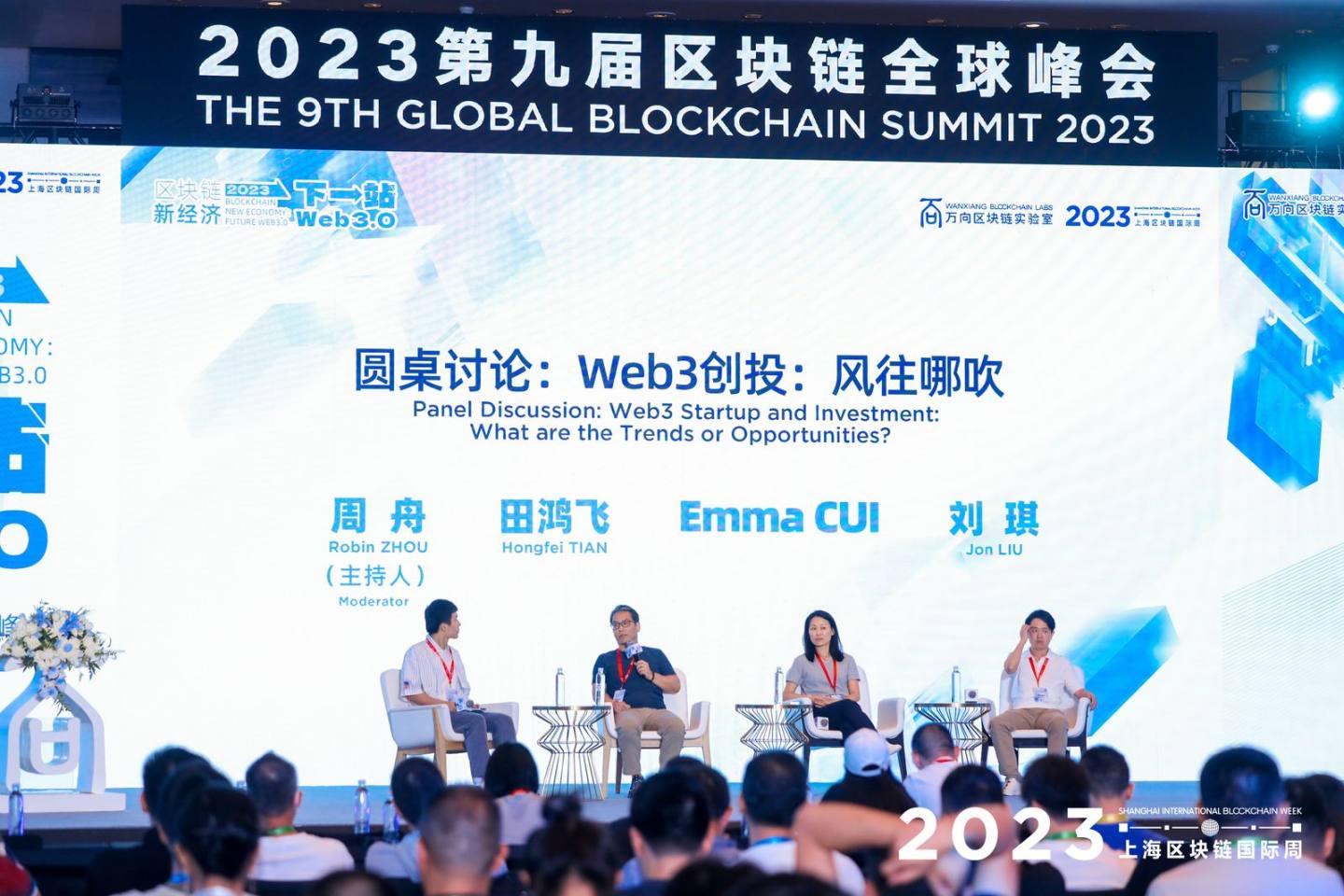
Zhou Zhou: We have invited three top investors to share "The Wind of Web3 Investment: Where Is It Blowing?". First, we would like to ask the three guests to introduce themselves and their institutions.
Tian Hongfei: Hello everyone, my name is Tian Hongfei, from Yuanwang Capital. The fund was established in 2016. It has RMB funds in China and US dollar funds overseas. I have been involved in Crypto myself earlier, starting in 2012. There was a period of time before that when I was doing public key management for data security at Oracle. I was working as a wallet and was exposed to the same technology as Bitcoin, but with the application of blockchain. This is the background of our fund.
To answer the question, what is the next trend? Looking back at the development history of Bitcoin over the past ten years, each cycle has a different narrative, and the narrative of each cycle is beyond everyone’s expectations. But there is a certain trend, which is the trend of decentralization. From trading Bitcoin and Litecoin before 2015, to except Uniswap in 2017, and then to Defi, decentralization is a definite trend. On this premise, applications were created. Because of the background of our fund, the three partners are all engineers from Silicon Valley. One of our partners is the founder of Xunlei and is very knowledgeable about P2P technology. We also focus on layer investments.
Emma CUI: Hello everyone, I am the founding partner of LongHash Ventures. We now have team partners in Singapore, Silicon Valley, Malaysia, and India. We have been investing and incubating the cryptocurrency industry since 2017. Our business is divided into two parts, one is accelerator, and we cooperate with top Web3 protocols, such as Cosmos, and we also have ZK accelerator. We are building our second fund. We have invested in many Defi-related projects before, but now we are investing in infrastructure-related projects. We have a global perspective and can invest in anything that fits our investment theme. The investment stage is from the seed round to the C round. To answer the host’s question just now, where is the outlet?
From 2017, when I joined the circle, to now, there is a clear trend, that is, the infrastructure construction is almost complete, and many things are already available. . The application layer is about to emerge. In the next three years, we will also focus on investment opportunities in some applications.
Helping many infrastructure projects to promote and incubate in Asia is also our focus.
Liu Qi: I am a founding partner of SevenX Ventures. I joined the industry at the first Wanxiang Blockchain Summit in 2015. At that time, I bought Bitcoin and invested in a relatively well-known public chain in China called Xiaoyi. This is my ninth session, and I have been in the industry for eight years. Prior to this, I had been in the payment and financial industry and witnessed the development of this industry in three cycles. SevenX Ventures was established in 2020 and is a relatively new fund. Currently we have three funds, three direct investment funds and one FOF fund, with a scale of US$240 million. Last year, the third fund raised US$100 million, and the main fund was the third fund. Our team did not have an office at the beginning and was a distributed organization. I am personally in Singapore, attending various conferences around the world, and just returned to Shanghai from Singapore yesterday to attend this conference.
Our team of five to six colleagues stayed in hotels abroad for more than 200 days and saw various infrastructure projects around the world. Frankly speaking, now that we have entered the bottleneck stage of infrastructure development, we have focused on two themes since the establishment of the fund. The first is called expansion, and the second is called application. The development of the entire industry is also an iteration of cycles, and a process of alternate iterations of infrastructure and applications. We believe that this stage is the freezing point of this industry, and we will focus on applications in the future, which is also our investment focus in the next year. We will talk about our investment direction in detail later.
Zhou Zhou: Thank you to the three guests! After listening to the sharing of the three guests, I found that the three funds are different, and everyone has different backgrounds. Emma CUI has an incubator, and Mr. Liu has a payment background. Now he is looking at more application projects.
Ask three guests a question. What are the differences between you in investment strategies or tendencies? In the current market, what other investment opportunities do you think exist?
Tian Hongfei: From the perspective of our fund strategy, on the one hand, it is a good direction for Chinese companies to go overseas and develop international markets. I came into contact with going overseas relatively early, from the Iphone that came out with IOS in 2006, to Android in 2008, and then to Facebook. You will see that these giants have brought standardized platforms and traffic advantages, making it easier for startups to obtain traffic overseas. You will see that Chinese companies have gone from the first batch of APPs to overseas markets to games and mobile phones. Travel overseas, then cross-border e-commerce overseas, and blockchain will go overseas after 2019. China's talent advantage is also obvious around the world, and many Chinese companies have gained competitive advantages globally. We have also established an artificial intelligence incubator in Hong Kong.
There are specific opportunities for specific investment directions, DID and on-chain asset parts. Let me say it again, we are a little different from the crypto. We are more focused on Web3 investment. In the past ten years, I feel that the crypto has been over-financialized and over-assetized. There is relatively little decentralization and user application development. This time I saw some decentralized protocols, which I think are of guiding significance. We have done something on the road to decentralization without excessive assetization and tokenization. Funds consider this aspect more.
Emma CUI: The DNA of our team is more international, and we have three partners. I grew up in China, went to university in Singapore, and previously studied consulting and banking at McKinsey. One partner graduated from Stanford, worked as a project manager at Amazon, worked in AI entrepreneurship, and has a strong technical background. The projects we invested in before basically did not invest in centralized platforms and businesses. If we want to create a crypto-native business model, we must use decentralized methods and encryption methods, and we must use it to implement it in order to better reflect its benefits. Value, this is a company we are willing to invest in.
At present, some of the projects we have invested in are decentralized finance, and some are infrastructure construction, such as expansion, multi-chain, and making the user experience better as Mr. Liu just talked about. Because currently there are many obstacles in using decentralized wallets, how to send private keys and recover lost keys. We like to invest in projects like this to make the user experience smoother and attract a larger number of users.
Looking forward, next we want to take a look at some application layers, such as social networking. Some interesting social applications have recently been released. I personally come from a financial background and have great expectations for Defi. The previous wave of Defi was from 0 to 1, and the next wave is the amplification process from 1 to infinity. If we can solve many technical application layer challenges.
Liu Qi: When I helped some overseas companies enter the Chinese market in 2010 and 2012, I found that policy barriers and financial control barriers were relatively high. In this industry, we have spent more time overseas in recent years, and the track that is gradually becoming more and more stable is stablecoin payment. I now use an encrypted credit card to make purchases around the world. When I returned to China, I applied for a UnionPay card through UnionPay International. I have VISA and Master overseas. The bottom layer is to recharge digital currency, and connect VISA and Master Bank to the legal currency team of compliant banks for payment and consumption. At present, the use of stablecoins is increasing around the world, and the payment scenarios have changed from a relatively gray industry to shops, e-commerce, and cross-border trade, and are increasingly penetrating into our daily consumption. Except that my credit card cannot buy a house in Singapore, it can basically make other purchases, including large payments. This track will be a relatively large infrastructure in this industry in the future. What I am more optimistic about is decentralized asset-anchored stablecoins or algorithmic stablecoins. I think there are opportunities in the future. Because the decentralized trust cost of assets is relatively low, the usage scenarios will become larger and larger. On this basis, I personally see many game teams and game producers from Tencent and NetEase. I have a lot of contact with them, and this is also the track we are currently focusing on. The essence is to use better content to carry the diversity of future assets or the scalability of users, bring more users, bring newer assets, bring assets that can be consumed, and bring things that can be entertained or traded. assets. This is the track we are currently paying more attention to, and this is from the application side.
Zhou Zhou: Just now, the three guests mentioned the application-side products and would look at the DID track. Emma CUI mentioned the content of SocialFi, and Mr. Liu mentioned the combination of stable currency and infrastructure. We have seen that the combination of foreign Didi and stablecoins has gradually become popular among the public. This is something we are very much looking forward to. We often hear that investors suddenly miss out on projects and have their legs broken. I wonder if the three of you have ever encountered such a thing? Are you paying attention to a certain track, trend, or company, but you have been paying attention to a manager who has not invested in it? Can you share your experience of paying attention to it but not investing in it?
Tian Hongfei: Because I have been in the crypto for a long time, I missed a lot of projects. The first one is Ethereum. I came into contact with Bitcoin relatively early. At that time, we focused on the side chain solution. We were also a star team in Silicon Valley, with a financing round of US$21 million. At that time, we felt that the expansion plan for Bitcoin should be side chains or lightning networks. When Ethereum came out and said it would be Turing complete, we felt that Bitcoin was specifically designed to be Turing incomplete. If you want to be Turing complete, you have to sacrifice decentralization. , it feels unreliable. As a former Bitcoin trader, I missed out on Ethereum and did not make big money. When Uniswap came out, the founder promoted it. Uniswap was an idea written by V God. I had an idea to vote together, and the founder wrote a program to implement it. He didn't know how to write websites, so he found someone to write about the website we were investing in. We also felt that the investment value was not great. Now Uniswap has become the leading company in Defi and the most awesome company in Defi. Of course, when we invest, we miss more than we get hit. Sometimes I miss a rare opportunity by mistake, and it feels like a pity.
Emma CUI: There are too many stories of broken thighs, which is sad!
Blockchain is a very emerging industry. In emerging industries, no one can take a big look at it. I believe that if you ask all investors, they will have their legs broken.
For example, I personally invested in YGG at the time, but the fund missed it. We started its founder in 2019, and I participated in his two previous projects. But when it came to YGG, the market was too hot at the time, and I felt the value was a bit If it's overvalued, don't chase the trend. You won't invest with funds at that time, and you'll miss out on good returns.
To sum up,
First, in the early stage of investing, it is better to invest in the founder, because the market trend will change, and the entrepreneurial direction may always change with the market, but if the founder caliber continues to work in this industry, he sticks to his original intention, and has perseverance and ability, he is likely to succeed. There is still great potential, and there are many opportunities in emerging industries and industries with paradigm shifts.
Second, if you are very optimistic about a project, sometimes the price is a relative thing. You cannot completely say that because you think the price is high at this point, I will not enter.
Because of these two points, in addition to funds, there are accelerators. Through accelerators, very powerful talents can be brought into the network. No matter what projects are planned in the future, visibility can be used.
Liu Qi: Our fund just happened to invest in YGG, but unfortunately we missed out on AVG. At that time, our partners were in Vietnam and lived very close to each other. We drank beer together many times and could always see their demos and the fun of the game. , the playability is indeed difficult to understand. Even if you drink beer more than a dozen times and talk about the future of blockchain game development together every day, it will still be easier to miss it in the end.
It is easy for people to fall into the trap of thinking that games such as "Honor of Kings", "Fantasy Westward Journey" and "CSGO" must be pursued. They are very fun, but the infrastructure and user base at the time were unable to support blockchain games. Traditional Web3 games were not as playable. So demanding.
But why can we discover YGG? Because when AVG first started, the labor union’s gold-mining model had many favorable opportunities, places and people. At that time, many poor people in Southeast Asia could no longer get wages and could not even afford to eat. The founder of YGG is a Filipino. In the early days, he led a group of poor people who were severely affected by the epidemic to make gold. We can trace this business model.
Entrepreneurship, especially in very new industries, is fringe entrepreneurship, and it is difficult to find entrepreneurial ideas. Understanding many business models requires continuous knowledge and understanding. This is our relatively large experience.
Two important pressures occurred last year, Terra and FTX. We invested in both cases. What impressed me deeply was that these two teams had very good visions, missions and values during their entrepreneurial stages. FTX was the first The focus was on product innovation. At that time, in the derivatives field, basically everyone was designing and trading derivatives around particularly large assets such as Bitcoin and Ethereum. There were also some trading platforms that might be used by user operators to do so. Volume, only FTX is developing four new users around product innovation.
The same goes for Terra. Terra’s previous background was as the founder of a relatively large e-commerce company in South Korea. The vision from the beginning was to make payments, and later added a layer of stable currency under the payment track.
The experience these two cases gave me is that entrepreneurship in this industry still has very high requirements on human nature. This is also because these two projects have developed too fast, and the original intention and the pattern to be changed will have great changes.
In this industry, it is possible that "slow is faster", so original intention is very important, persistence is very important, and it is very important to think repeatedly about what you want to do in the first place. Opportunities can often be precipitated.
Many people say that they should invest in native blockchain practitioners. Compared with native blockchain practitioners, it is more important to be entrepreneurs who continue to iterate their own thinking, continue to make interesting innovations, continue to learn, and continue to find new opportunities in the industry. Even if he comes from other industries, as long as he has such qualities, if he can be contacted for 6-12 months, he will put a lot of effort into helping him and investing in him.
The cases in these two directions are quite interesting to share.
Zhou Zhou : Thanks to the three guests, we are doing an archeology of previous Web3 investments. Mr. Tian missed Ethereum and Uniswap, Emma is YGG, and Mr. Liu is talking about FTX and Web3 games.
No matter what kind of company it is, the reasons are different. Some may be due to high valuations, and some may be due to Bitcoin fundamentalism, mainstream ideas and future expectations, and the changes are different. Thank you very much to the three of you for sharing your previous investment experiences.
There is another question. Now in the deep bear, there is an urgent need for a catalyst to allow more Web2 users to enter Web3. I would like to ask you three, what do you think the catalyst is and what kind of event it is.
Tian Hongfei: First, not counting Deep Bear, I personally feel that the Web3 circle is much more fun now than before 2017 and 2016. Before 2016 and 2017, all trading platforms could only trade two currencies. Of course, there are some particularly good ones. Outcoin is a small currency. Mini coins are now released at least every month. Different mini coins are released and innovative product concepts are released every six months.
Of course, there is no money-making effect when it is expanded to the entire industry, but from a product perspective, the blockchain industry is still the most dynamic industry among all the investment industries I have seen. I do not think it is a bear market.
There is no money-making effect, no new user growth, and no new capital inflow are all existing problems. I can't answer the question you introduced, but from the Web3 industry we are concerned about, from the so-called data governance rights and ownership, more and more users have their own privacy awareness. In 2016 and 2017, I wrote an article, Chinese people don’t pay much attention to privacy, while foreign countries pay great attention to privacy. Before the EU came out with GPDR in 2018 and 2019, users did not pay much attention to their own ownership, but now users attach great importance to their own ownership. It can be seen that the activity of community users with home storage devices on reddit has exceeded that of the Bitcoin reddit community. Communities where users own their own data are becoming more and more active. It is a bit like the early days of Bitcoin when it was active. Web3 users may become more and more active. People are becoming more and more concerned about putting their privacy and data in their own hands, which is an obvious trend in itself.
As for when the money-making effect will come, I don’t have any more insights, but I am waiting for the Bitcoin halving. A common narrative may emerge, and I don’t know the specifics.
Emma CUI: I quite agree with what Mr. Tian said. Not counting Shenxiong, the Metamask Wallet now has 30 million users. Research reports say that more than 400 million people in the world may hold cryptocurrency. Everyone is talking about it all day long: when will large-scale applications come? Maybe it is already happening quietly when you are talking about it. Compared with two or three years ago, many new users have been brought in, so the entire industry has been moving forward, but there is a process.
What can bring about the next round of applications and trends? Two aspects:
On the one hand, there must be new applications, whether they are DiFi or SocialFi applications, which may bring new users and new funds. The funds may be brought in first through approval by large institutions, ETFs, and Sport ETFs. When market funds are abundant, be conservative. Those who enter Bitcoin will gradually move towards some application layers with higher risks.
Both of these things must happen to bring about the next opportunity.
Liu Qi: Nowadays, everyone pays relatively close attention to the macroeconomic environment and monetary policy. It is still relatively difficult to predict. Like many of our previous macroeconomic analysts and private banks, the policies were constantly adjusted based on inflation data and business data. So prediction is relatively difficult.
What we pay more attention to is the fundamental data of the industry and the founders’ thoughts on the industry. This is our experience from reviewing the data and communicating with the founders every week.
Although some U.S. encrypted digital currency banks closed down last year, there are still new encrypted digital currency banks emerging in the United States, and major banks can open bank accounts in some states.
Switzerland has SEBA, and SEBA has now opened a branch in Hong Kong. HashKey has taken compliance one step further in Hong Kong and invested in bank DCS in Singapore. DCS has a history of more than 100 years and is a fully licensed bank. Previously, there were no traditional banks like DBS or OCBC in Singapore as big as DBS or OCBC. However, new banks and small banks have the courage to regulate digital currencies upwards and cooperate downwards with blockchain tools, domestic payment companies, and trading platform partners. One encryption What behind the currency credit card is the connection between the agreement and traditional banks.
The capabilities of the underlying infrastructure are not necessarily all decentralized. There will be the opening up of centralized compliance channels. Opening up will be very helpful for opening up asset channels, user channels, and user usage habits in the future, so we will pay more attention to it. How complete is the construction of this fund? At the same time, what applications will be used by users that are relatively more in line with the current infrastructure capabilities and user behavior habits? In 2020, Uniswap’s innovation around long-tail assets will indeed bring A wave of DeFi users has opened up the composability of decentralized borrowing, decentralized transactions and DeFi. These require a lot of infrastructure, macro environment, user habits and protocol optimization, and they all broke out at a certain point in time. Now that we have reached this stage, we are still looking forward to the birth of larger-scale applications in the next year and the next year, but the way of birth may have many different focuses.
Emma CUI: Just to add, Mr. Tian and Mr. Liu both talked about Uniswap, which is also the leading company in DeFi. There is a possibility that the AMM model currently used by Uniswap is suitable for the previous infrastructure construction model and technology, but before Uniswap came out, everyone All I think about is unchanging order books. There are currently innovations in this area. It may be a phased thing. In the next stage, when your infrastructure reaches a certain level, there was no way to carry unchanging order books before. Now you can use unchanging order books. order book, it is possible to replace the previous leading model.
Zhou Zhou: Thank you to the three guests. Just now, the three guests mentioned that macro forecasts and catalysts are difficult to predict, but we also see trends. The channels between crypto financial institutions and traditional financial institutions are slowly being opened by builders. Regardless of Whether it is Hong Kong, Singapore, or some other relatively developed financial regions, we are all seeing this trend happening. We also see some native forces and institutions replacing Uniswap are being born.
The last question is about genes. Genes obviously have a very big impact on a company. I would like to ask the three of you how they think about the impact of genes on investors themselves, investment results, and invested companies.
Tian Hongfei: First, the biggest difference in blockchain is values. Do you believe in centralization or decentralization? I feel that I have experienced Mentougou and FTX. I have not lost money because I never believe in centralization. My own The point of view is that if it is a centralized approach, it must be supervised, because the centralized approach and supervision are equivalent to two sides of a playing card. If it is centralized, it must be supervised. If it is decentralized, it can be through the transparency of the blockchain. Safety and traceability save the trouble of supervision to a certain extent. But for us, we believe more in the decentralized approach, so when evaluating founders, the first thing to consider is whether your values are so-called decentralized, whether you believe in so-called DeFi or democracy, and return value to Community and return to users. This is the biggest problem of Web2 and successful entrepreneurial players in the past. When they are used to controlling the community and controlling products in a centralized way, it will be difficult to manage the community in a decentralized way. This is very difficult. Big question.
Second, innovativeness. For innovative projects and enterprises, blockchain is a good reward. All blockchains are open source and transparent. After an innovative project becomes popular, there will definitely be countless forks, which is worse than the so-called "Thousands of Teams War" It comes faster, because the code can be forked, and there is absolutely no threshold for copying.
In the past, the blockchain circle was very good at rewarding innovative projects. The first project was a thousand-fold return, the second fork was a 10-fold return, and the third project might be a loss.
So we mainly look at the values and innovation of the team.
Emma CUI: What we are looking at now is more Web3 understanding spirit + Web2 training. This is a more ideal model. We hope that the founder can do it as a long-term career rather than a short-term project. I hope he will have a long-term concept. Do this.
Liu Qi: The word I prefer in Web3 is permissionless.
We happened to be chatting about a project recently, which was a game project focusing on mahjong and poker. We asked him what kind of help he needed, and he said he needed to help us get a license. But our ability as a fund to help you obtain a license is indeed relatively poor.
On the other hand, why do you need a license? Is there a better way to do protocol-level projects in a permissionless way, which would lead to arbitrage compared to regulation? Of course, after the agreement comes out, if there are channels and partners are willing to do markets that require compliance, these can be done in a compliant way. But what I prefer is the lowest-level permissionless protocol, on which various applications and channels (compliance channels) can be built. This is the future infrastructure of Ethereum and Bitcoin, and the applications are similar to Uniswap. The greatness of the lower-level protocols and the inconvenience of the business model are more penetrating and more competitive than the traditional ones that rely on the government, supervision, and various data monopolies. Because there are no boundaries, we What I like more is this gene.
Zhou Zhou: Thank you to the three guests for their wonderful sharing. After just 40 minutes of sharing, the three guests shared their important investment experiences as investors, including the investment projects they are looking at recently, and also shared their own experiences. What qualities are required of investors in the invested projects? This roundtable "Web3 Venture Capital: Which Way the Wind Blows" is over. Thank you all for listening to our roundtable. Thank you all!