Author: William M. Peaster, Bankless; Translation:Jinse Finance0xjs
1. What is blobspace?
Blobspace is a new resource market based on blockchain, which is different from the traditional blockchain space we are familiar with.
Ethereum will soon start selling “blobs” instead of just blocks. These blobs are essentially temporary blocks of transaction data that can be processed efficiently and flexibly.
Blobspace originated from Danksharding, a design proposed by Ethereum researcher Dankrad Feist that moved from the idea of sharding of multiple different blockchains to the idea of data sharding of multiple blobs within a block.
Later, developer protolambda proposed a prototype of this system, which we called Proto-Danksharding, and later became an official upgrade proposal through EIP-4844.
Once implemented through EIP-4844, blobspace will significantly reduce gas costs and significantly increase the throughput capacity of the Ethereum mainnet. Nonetheless, this upgrade is only a transitional upgrade, paving the way for greater expansion and efficiency optimization in future comprehensive Danksharding implementations.
2. Operating principle of Blobspace
Blobspace introduces transactions that carry blobs. As Ethereum researcher Ben Edgington previously said, “EIP-4844 connects blobs to blocks.”
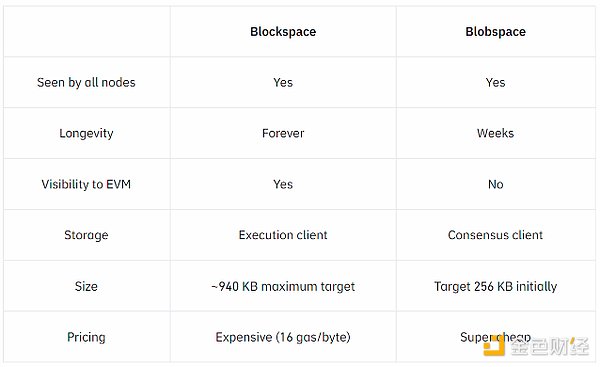
For specific details, an invaluable resource is Domothy's Blobspace 101 Getting Started Guide. In it, he explained that the actual blob data is not stored in the transaction, but in a "sidecar" that will be inspected and shared on Ethereum's consensus layer.
Creating a blob requires some serious math, but in practice:
You divide the data into small chunks
These chunks of data are then used to create a mathematical equation
This equation is then evaluated at specific points to create a "promise" or a kind of unique identifier for the blob
This commit is then processed to create a final version that can be used by the Ethereum Virtual Machine (EVM)
Ultimately, blobs will be stored for about 18 days and can be deleted after the 18-day storage period has passed, but even after being deleted, they can still be found through other means (such as block explorers). Efficient and long-lasting!
It's worth noting that blobs also have their own pricing system, called "blob gas." This is separate from Ethereum’s regular gas system and is not affected by mainnet congestion. Instead, the price of blob gas will depend on how many blobs are used in a given time.
3. Why is blobspace important to NFT?
EIP-4844 will not only increase Ethereum’s throughput to 1,000 transactions per second, but it will also significantly reduce the gas costs associated with Ethereum usage.
The second reason is big news for Ethereum L2 scaling solutions because their main cost comes from having to publish data to the Ethereum mainnet. Once it becomes cheaper to publish this data, it will become cheaper to use L2 too!
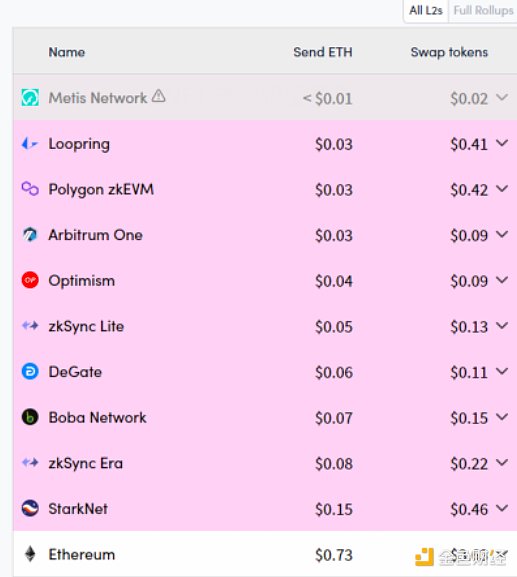
Don't get me wrong, the cost of using L2 is already very low. But this is why EIP-4844 is so important, it will make L2 much cheaper to use than it is today.
This is great for the future prospects of NFTs, which are based on L2 (and L3 based on L2, etc.). NFT-centric rollups, such as Zora Network, Base, and Frame, will achieve better performance, which will bring a better user experience to their users because the cost of minting NFTs will drop significantly.
During the initial NFT craze in 2017 and 2021, we did not have ultra-low-cost, ultra-fast transactions. And now, ultra-low-cost, ultra-fast transactions are coming. Will they pave the way for the third NFT boom?
Maybe, because more and more things are possible in such a paradigm. New efficiency, new experimentation, NFT app can provide a good user experience for millions of users (not hundreds of users).
Note, however, that blobspace will not only exponentially reduce the cost of NFT transactions – it will also open up new design possibilities that we are just beginning to imagine.
For example, Pob Studio recently noted that blobspace could eliminate the need for intermediary platforms like Blur and OpenSea by cultivating a fully decentralized NFT marketplace within a “bulletin board” space of blobs. This is just an idea, there will be more to come.
In short, the arrival of EIP-4844 will mark a change in the entire NFT ecosystem. We are standing on the cusp of this new era, and more inclusive, efficient, and innovative NFT projects are about to emerge. Creators and collectors alike should prepare for another renaissance in the NFT world!