


Since the crypto market entered a deep bear market in the second quarter of this year, the investment strategies and scale of major VCs have been shrinking. According to incomplete statistics from BlockBeats, in the past few months, the number of weekly financings in the encryption field has stayed at around 10. Last year, this number was still around 30 per week, and the highest number could even be 60 financings per week.
However, at the end of the third quarter, some first-tier crypto VCs became active again. Take a16z as an example. In the past week or so, it has successively led investments in 4 crypto projects, with project financing reaching US$76.6 million. The buy the dips operation of "a16z" in the encryption industry seems to have begun.
In the past six months, what has the encryption market experienced without "a16z"?
The same goes for a16z, the industry leader. According to incomplete statistics from BlockBeats, a16z participated in a total of 58 investments in the encryption field in 2022. Among them, the total financing amount of the investment projects participated in in March 2022 was the highest, exceeding US$2.1 billion. At the same time, the highest investment led by a16z in 2022 was given to Yuga Labs, amounting to US$450 million.
However, after entering 2023, its investment frequency and amount have shown a downward trend. In the first quarter of 2023, a16z completed 13 investments, and the total amount of project financing it participated in dropped by 86.7% year-on-year. The highest amount of investment it led was US$150 million, which went to the AI startup Character.AI. The maximum amount of lead investment dropped from 450 million in 2022 to 150 million in 2023. The degree of shrinkage can be imagined.

By the second quarter, a16z fell into a period of relative silence. From April to August, a16z only completed 4 lead investment financings, including a US$29.3 million seed round of on-chain IP infrastructure Story Protocol and a US$43 million Series A round of blockchain-based artificial intelligence computing protocol Gensyn. Financing, open source software security solution Socket raised US$20 million in Series A financing, and generative AI tool Ideogram AI completed US$16.5 million in seed round financing.
In the past second quarter, crypto VCs have ushered in a “tide wave”. In addition to a16z, Paradigm also modified its official website information at the end of May, calling itself a "research-driven technology investment company" instead of a company that specializes in investing in "disruptive encryption/Web3 companies and protocols". It seems that there is Exit encryption.
Institutions with the attributes of "spiritual leaders" in the industry have gradually faded out of the market, and the industry, like headless flies, has gradually entered a chaotic stage where memes and local dogs fly everywhere.
In March, Arbitrum’s airdrop started a short-lived but massive wealth creation movement in the crypto. The legendary stories of “swiping thousands of accounts”, “taking hundreds of thousands of tokens” and “freedom overnight” are widely circulated again. The community instantly ushered in the era of national hairdressing, and the number of daily active users of zkSync and StarkNet increased by more than 10 times.
After a brief period of hair-raising, the BRC20 season took over. In May, the price of BRC20 token Ordi exceeded US$10, and its market value exceeded US$200 million, creating a FOMO atmosphere in various communities. Compared with airdrops, the wealth creation effect of BRC20 tokens seems to be easier. Users do not need to participate in the involution of on-chain operations, nor do they need to worry about being unable to meet the harsh conditions. They only need to mint the tokens as soon as they are issued. Even when there was no congestion on the early Bitcoin chain, they only had to pay a few dollars in initial issuance costs. You can get a lot of Ordi tokens for U's Gas fee.
In the BRC20 era, Meme is not to be outdone. The Meme token named PEPE was quietly launched and rose thousands of times in just four days. The myth of sudden wealth has made PEPE famous. PEPE's successive surges have allowed Meme Coin and Dogecoin to once again ascend to the main stage of the encryption market. In the past few days, dozens of Meme coins have been born to "follow the trend", often increasing dozens of times, causing half of the market to revel in the myth of wealth creation, and the other half to remain anxious in Fomo.
Let’s go back to the recent popular public chain Base. Instead of relying on "Odyssey" or airdrops to build momentum, the Layer 2 network Base launched by Coinbase detonated the market with just a thousand-fold increase in the meme myth BALD, attracting countless eyeballs and achieving a 2,000-fold increase in about 14 hours.
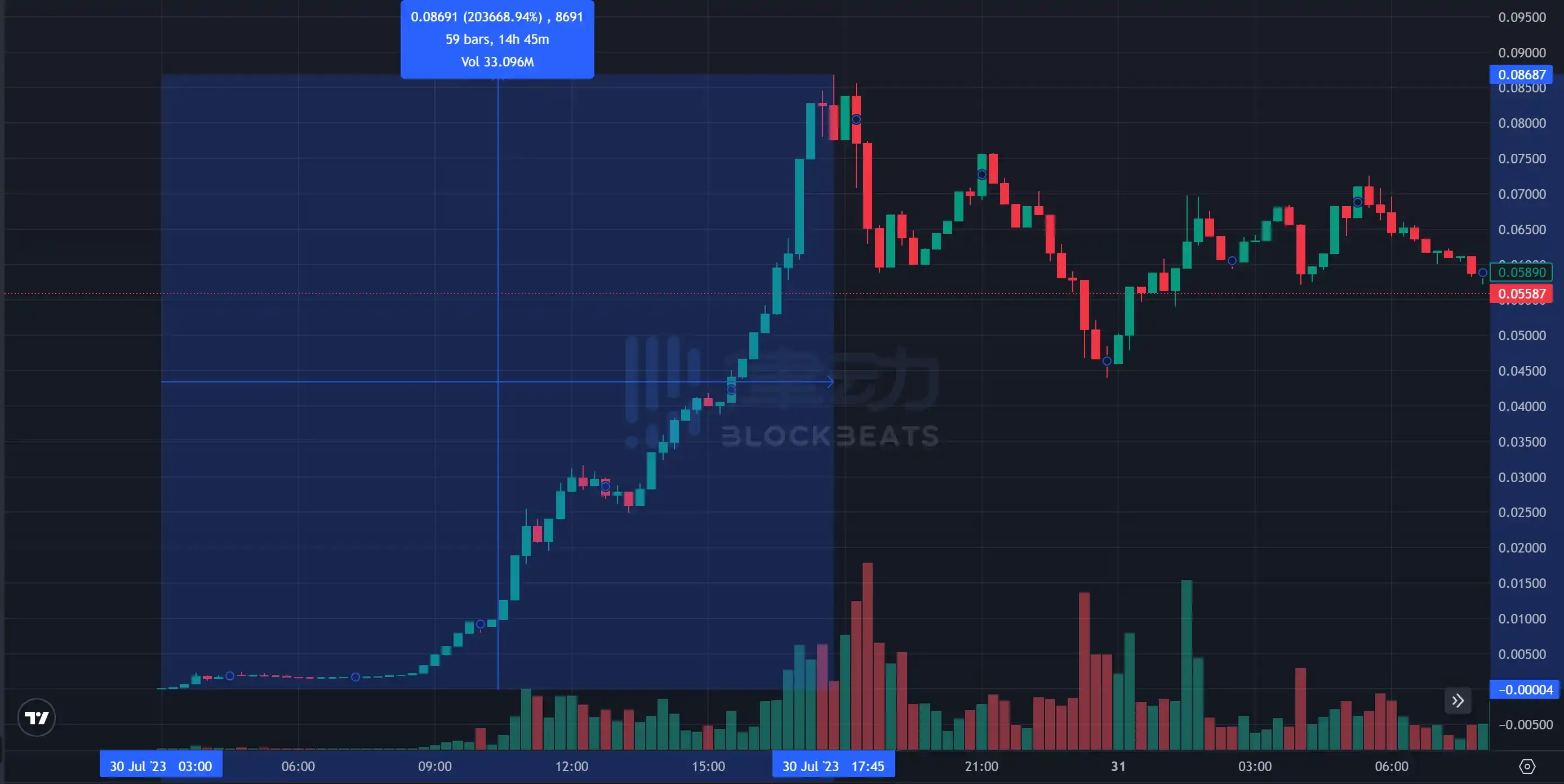
But just over 3 hours later, BALD showed its fangs and destroyed everything. The project team suddenly withdrew a total of 8,660 ETH and 179 million BALD in 7 minutes, realizing RUG. What’s interesting is that some On-chain detectives believe that SBF may be the leader behind BALD.
Is the "leading investor" here to buy the dips?
On the other side of the chaos, someone left sadly. Since the beginning of this year, many projects have successively announced dissolution and closure, and the number of suspended projects has increased faster and faster, from an average of 1 project per month to an average of 5 per month. In September alone, 4 projects were suspended. Projects have announced their closure one after another, including NFT platform Voice, DeFi project Gro Protocol, DeFi project Fuji Finance, and DeFi and NFT trading robot None Trading. Most of these projects came to an end due to "insufficient funds."
Related reading: " Multiple projects have announced closures one after another, is the encryption industry ushering in a "wave of shutdowns"? 》
The reason for "insufficient funds" may be seen from an article published last week by Jocy, founder of IOSG, one of China's largest crypto industry venture capital institutions. After the TOKEN 2049 conference, Jocy issued an article pointing out that the cold brought by the bear market may prevent many project developers from surviving this winter. He also pointed out that the current crypto industry investment institutions are more inclined to cut back on food and clothing.
"For many teams, this time 2049 has basically become their last hope for financing. If the bear market does not end, this may be the last brand exposure of their team, because most early-stage teams have expanded in the past two years, leaving runway It’s basically bottomed out, and the burn rate of some teams is very high.”
However, in sharp contrast to Jocy’s pessimistic view, the Western crypto investment institution “Leading Sheep” has returned to the lively scene of the market.
After Paradigm changed the description of its official website homepage in May to "a research-driven technology investment company" and deleted any content related to cryptocurrency, in just over a month, Paradigm reversed this change and announced its return to the cryptocurrency field. Paradigm co-founder Matt Huang said it was "a bit ridiculous and a mistake" to remove all mentions of cryptocurrencies from its website's login page. And emphasized that Paradigm will not give up its investment in cryptocurrency.
After returning to the encryption industry, Paradigm immediately entered the "industry's largest" MEV market and participated in the US$60 million Series B financing completed by Flashbots in July, increasing its valuation to more than US$1 billion. In addition to Flashbots, what is even more impressive about Paradigm in the past few months is its selection and investment in friend.tech, which has single-handedly created a Web3 social upstart with a market value of over US$100 million in just two months.

In addition to investment, Paradigm’s official blog has also become extremely active. In July, Paradigm issued a "Collaborate with Paradigm" announcement, stating that it hopes to cooperate with more outstanding talents in the encryption field and calls on entrepreneurs or projects that are already in the seed stage or Series A financing stage to fill out a form to introduce their projects to Paradigm.
Yesterday, Matt Huang published another long article, not only refuting the current pessimistic view that Crypto is too speculative and slow to develop from another angle, but also expressed his confidence in the prospects of Crypto.
Recommended reading: " Paradigm founder: Cryptocurrency, a new planet being colonized "
With Paradigm's high-profile return, a16z has also regained its vitality.
As can be seen from the figure below, from April to July this year, a16z seemed to have gone silent for the entire second quarter, with the average number of investment pens for several months being 1; but starting from August, a16z seemed to be active again, starting from 8 The number of investments in September increased from 2 to 5 in September, which is equivalent to the total number of investments in the past few months. And in mid-to-late September alone, a16z made 4 investments within 10 days.
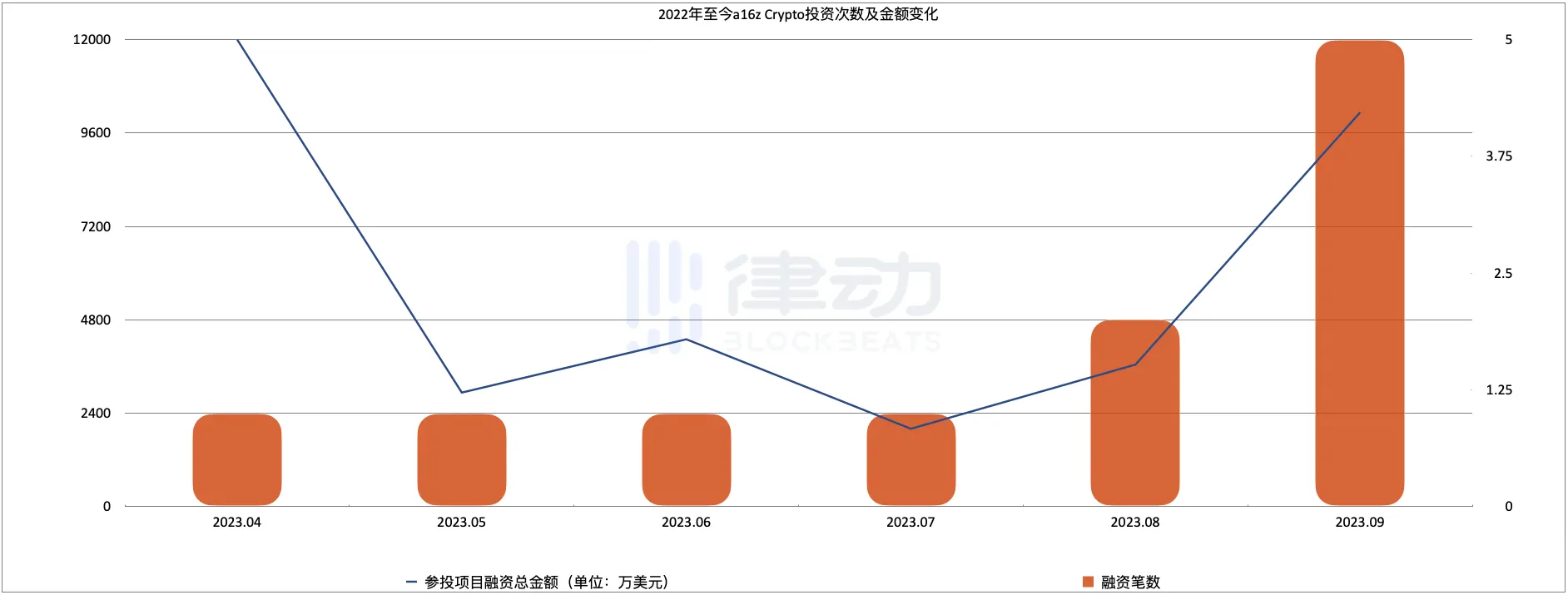
On September 12, a16z led a US$15 million Series A round of financing for Pahdo Labs, a metaverse platform development studio. On the 18th, a16z led a US$25 million seed round of financing for Bastion, a startup that provides cryptocurrency custody and other services. On the 20th, a16z led the decentralized information market protocol Freatic to complete a US$3.6 million seed round of financing, and then led the chain game startup Proof of Play’s US$33 million in seed round financing the next day.
In a market situation where many project parties have ceased operations one after another and Oriental Capital is stretched thin, "a16z" have made high-profile appearances and frequently made moves. Are they buy the dips in the encryption industry?






