


"If everyone is seeking the benefits of decentralized ownership, why is the Web3 industry still struggling to find a path to mass adoption?"
People have been talking about the potential of Web3 for years, but it seems we've only scratched the surface when it comes to user adoption. Currently, there are two challenges to Web3 adoption in the mainstream world - functional barriers and cultural barriers. The new L1 public chain XION was born to solve these two problems. Let's take a closer look at XION's vision and how it can help achieve mass adoption of Web3.
XION: An L1 network dedicated to abstracting cryptographic complexity
Speaking of XION, we have to mention its developer Burnt.
Burnt's journey in Web3 began by burning Banksy's paintings. In March 2021, the Twitter account BurntBanksy burned Banksy's painting "Morons (White)" live and issued it as NFT, aiming to transfer the value of the physical painting to NFT. The purpose of this behavior is to inspire more artists to explore NFT. Over the next year, Burnt focused on creating Burnt Finance, a no-code product for creators and early NFT standards.

Along the way, Burnt has seen firsthand NFTs hit a wall, with the Web3 industry unable to adopt them at scale due to complexity. "Keeping real users out while making us feel superior in a niche" is definitely not the end of Web3.
Therefore, Burnt built XION, an L1 blockchain based on Cosmos that abstracts cryptographic complexity, to overcome adoption scalability limitations due to cryptography. XION enables a frictionless user experience while retaining the core features of Web3 — decentralization, transparency, verifiable ownership, and more.
The purpose of XION is to help achieve mass adoption of Web3 by solving the functional and cultural barriers to optimizing Web3. By focusing on user experience, accessibility, and scalability, XION aims to create an ecosystem that empowers developers and users to unleash the full potential of blockchain technology.
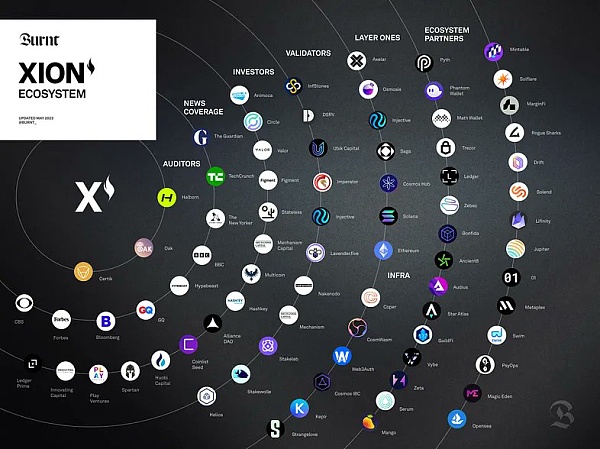
Additionally, Cosmos’ Inter-Blockchain Communication (IBC) protocol allows XION, ecosystems, and applications to quickly integrate other application chains and their related applications. For example, if a product requires private user status, XION can connect to the Secret network. If a product requires DeFi, XION can be connected to the Injective chain and the Osmosis chain. For legal assets and non-Cosmos ecological assets, Cosmos also has Axelar chain and Noble chain. Cosmos' "chain interconnection" enables XION to immediately provide users with more features and paves the way for developers on XION to create new use cases.
As for what innovations XION has brought in terms of infrastructure and functionality, perhaps we can return to the topic of this article and find the answer from the question "What are the obstacles to the large-scale adoption of Web3?"
Web3 Barrier 1: Complex and novice-unfriendly features
For new users using a Web3 application for the first time, it may take up to 15 complex steps and several days to successfully complete the interaction. From figuring out which wallet program to download to having the necessary funds to submit a transaction, it’s no surprise that user churn is as high as 95%. As new L1 blockchains proliferate, it will become even more overwhelming for new users. These problems have become a breeding ground for scammers, who steal the assets of new users, and deepen the mainstream world's negative view of the Web3 industry.
While user education can help make the process of using a Web3 application for the first time more approachable, it is clearly not a solution in itself. Just like Web2, Web3 should not require new users to understand encryption before they can benefit from it.
How does XION solve the above problems?
XION can be said to be an L1 built from scratch, with comprehensive optimization in terms of user experience.
The admission process does not have to be CEX → onchain
Currently, it usually takes more than 15 steps for new users to purchase goods on the chain. The first step is to set up an on-chain wallet, then register with a centralized exchange (CEX), verify your identity, then transfer funds from CEX to the on-chain wallet, exchange them for the correct token in the DEX, etc. before you can make a purchase.
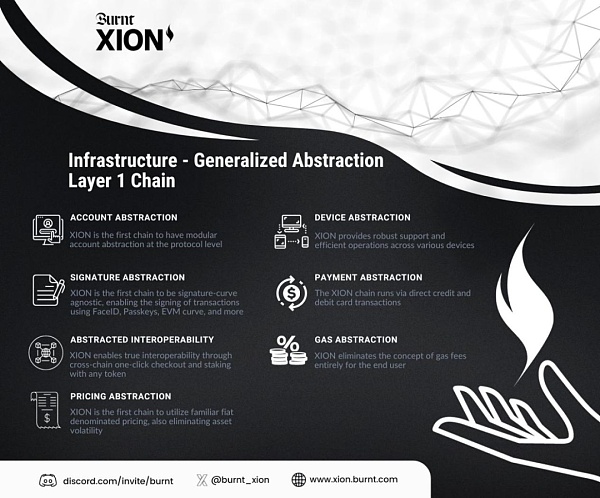
However, on XION, users can use credit/debit cards to directly purchase on-chain goods, and the authorization rate is as high as over 95%, which can immediately cover approximately 6 billion credit/debit card holders. This not only eliminates complicated processes for users, but also provides a purchasing experience that is truly similar to a Web2 e-commerce website.
No gas fee
Another major barrier to new user adoption is gas fees, as this forces them to own a chain’s native token in order to transact.
XION completely removes this barrier with Gas-free transactions, allowing new users to start interacting with on-chain applications immediately.
Abstract wallet complexity
It is well known that the complexity of traditional crypto wallets has reduced user adoption by more than 95%. They require users to download browser plug-ins, make complex settings, pop up windows with each transaction, and require users to store seed phrase securely. This user experience will deter most non-technical/professional users.
To solve this problem, XION completely abstracts the cryptographic wallet on the entire chain. There is no need to download plug-ins. New users can seamlessly interact with the application by simply using their email to create an MPC wallet. Crypto-native users can also interact with XION using any wallet of their choice. XION has something for all audiences.
Support mobile phone
In many ways, supporting better operations on mobile phones is also one of the ways for Web3 to be truly adopted on a large scale.
However, many current crypto wallets cannot be freely switched between PC and mobile phones. Switching devices still requires re-importing seed phrase, and the browser UI/UX performance within the wallet application is very low.
XION ensures mobile support through the aforementioned “complexity of abstract wallets”. Additionally, it allows for the separation of logins from assets, creating a secure way for users to interact with new applications without putting their assets at risk. Essentially, it allows users to securely access the XION ecosystem anytime, anywhere.
Pricing with USDC
As we all know, there are thousands of cryptocurrencies in the Web3 industry with highly volatile prices, and for new users, understanding the pricing of assets/products can be very confusing.
With the support of USDC issuer Circle, XION will become the first blockchain to use USDC as the primary transaction currency. All products built on XION will be priced in USDC, allowing new users to seamlessly use familiar fiat currency pricing.
Web3 Obstacle 2: Not an “indigenous” person, difficulty understanding terminology?
In addition to functional barriers, there are also cultural barriers to mass adoption of Web3.
Imagine your first contact with Crypto. Is it like entering a new universe? It’s filled with unfamiliar terminology, confusing ecosystems/applications/tokens, and complex user experiences. Additionally, the mainstream world's perception of cryptocurrencies has been bogged down by news of misdeeds by bad actors and high-profile scams.
How does XION solve the above problems?
XION was designed from the ground up with abstracting the complexity of cryptography at its core.
abstract term
To make Web3 more accessible to new users, either replace complex terms with the most basic, easier-to-understand terms, or make them completely abstract.
XION works to simplify and remove technical jargon and industry-specific jargon, which is critical to enhancing user experience and enabling wider adoption.
Improve credibility
Given the widespread skepticism of cryptocurrencies in the mainstream world, building trust is one of the most important factors in reaching a broad audience. This is also the reason why XION has strategic cooperation with many well-known companies in the Web2 and Web3 fields. For example, well-known Web3 companies/investors such as Animoca and Circle Ventures have invested in XION, working with companies such as Web2 giants Checkout.com, Stytch and Stripe.
Eliminates education for new users
XION's unique infrastructure removes all complexity for users and plays a key role in removing not only functional barriers, but also cultural barriers. For example, whether it is no gas fees, abstract wallet complexity, or using bank cards to directly purchase on-chain goods, the complexity of interactions can be greatly reduced, eliminating the education traditionally required for users to interact with applications.
Conclusion
Creating a powerful, practical infrastructure that enables innovative users is only a small part of the problem currently facing Web3. To truly usher in mass adoption, we must also build the experience layer for user interaction to ensure it is as intuitive and popular as the Web2 platform.
Poised to be a catalyst for mass adoption of Web3, XION's mission goes beyond pure technological advancement to lay the foundation for a "Web3 cultural revolution."






