Changpeng Zhao (CZ), the former CEO of Binance, is a “sinner,” but not in the way you might think because of recent lawsuits. In the eyes of Satoshi Nakamoto, CZ and we are both sinners because we profit from centralization. Centralization is the devil's tool. Humans – and possibly artificial intelligence in the future – will leverage decentralized structures to collaborate, without coercion, to achieve common goals. The state promotes centralization and uses the threat of violence to achieve collaboration.
In just six years, from 2017 to now, CZ and the Binance team have grown from nothing to the largest centralized cryptocurrency exchange in the world. Not only is Binance the largest cryptocurrency trading venue, but globally – both traditional and otherwise – it’s probably in the top ten in terms of average daily trading volume.
A few years ago, CZ was an unknown Canadian of Chinese descent. His last name is not synonymous with power, as it is with Rothschild, Rockefeller or other descendants. But he rose to become one of the richest men on the planet in less than a decade, a rise built on getting millions of people around the world to trade cryptocurrencies. For some, this means Binance is their path to financial freedom. For others, it is a highly effective way to speculate on new political, economic, and technological systems.
The problem for the financial and political establishment was that the intermediaries that facilitated movement in and out of the Industrial Revolution were not run by members of their class. The owners of intermediaries and crypto assets are the people themselves. Never before have people had the ability to be part of the industrial revolution through desktop and mobile trading apps in just ten minutes. From a fundamental perspective, those who own centralized exchanges use the tools of state, corporate, and legal structures to disintermediate the institutions that are supposed to enforce the global financial and political system under the American system. CZ paid a heavy price for this.
How much did CZ pay? CZ and Binance paid the largest corporate fine in US history: $4.3 billion!
This seems a bit strange. Bad woman US Treasury Secretary Yellen stood up and denounced all the crimes of CZ and Binance. Did former Goldman Sachs CEO Lloyd Blankfein get the same treatment as GS under his rule, helping former Malaysian prime minister Najib Razak? And financier Jho Loh stole more than $10 billion, burdening a developing country with more expensive international debt? No, Llyod retired with his stock options intact, and GS was not deemed criminally responsible. Has any bank CEO who was too big to fail been criminally prosecuted for triggering the worst global financial crisis since the Great Depression of the 1930s? No, they got a free pass because prosecuting them would threaten the banking system. Has the CEO of HSBC ever taken the time to have employees personally change cash deposit points so that Mexican drug cartels could launder money more efficiently? The money they made selling drugs to the American public?
So why should a company less than ten years old be subjected to such severe punitive measures? Could it be that Binance has committed more crimes than any bank in U.S. history, some of which have been around for centuries? Clearly, the treatment of CZ and Binance is ridiculous and only highlights the arbitrary nature of state punishment.
I'm no Dostoevsky, and this isn't a philosophical discussion of crime and punishment, but what does this absurdity tell us about our beliefs? It taught me that cryptocurrencies are one of the most important political, financial, and technological developments in the history of civilized humanity. We are trying to create a parallel financial, political and economic system based on voluntary participation rather than violent coercion. It is so transformative that in less than a decade a man can become one of the richest men in the world, and his company can become more indispensable than a well-established financial institution that has been around for centuries . For the first time in history, with the swipe of a smartphone, We the People have within our reach the building blocks of a new era of digital human society. If you don’t want to jump on the bandwagon of Bitcoin and other cryptocurrencies after seeing so much state pressure on CZ and Binance, I don’t know what else you need to see.
If you hold cryptocurrency, make sure you store it in a wallet where you control the private keys. Otherwise, you gain nothing and will always be a slave.
With that being said, let’s get to the real point of this article. China and the United States are friends again. The result of this renewed friendship will be that China's money-printing press will kick into gear. Let’s take a look at how this Eastern giant is about to fuel the nascent crypto bull market.
The time has come
What has changed is that China and the United States have reunited. Even if this closer relationship only lasted a few years, it gave China cover to behave in accordance with global expectations, just as they did between 2008 and 2015 by printing money profusely.
Let me start with some charts to show that now is the time to inject renminbi credit into the world.
The yuan will strengthen
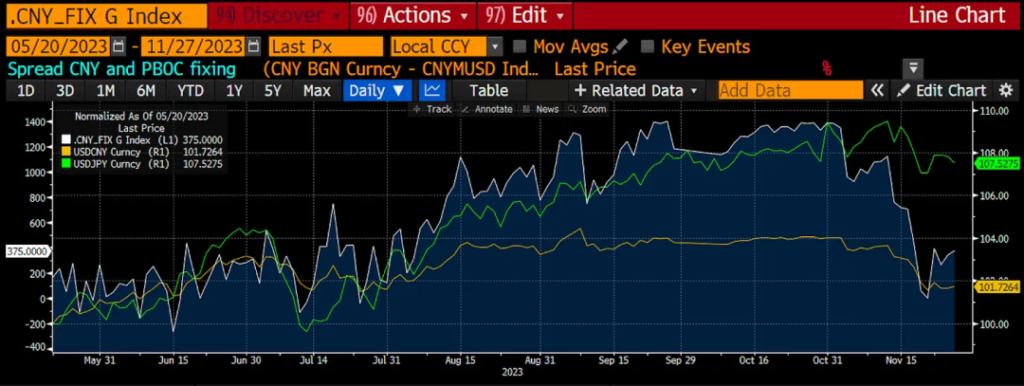
The blue shaded area is a chart showing the deviation of the People's Bank of China's (PBOC) pricing of the yuan against the U.S. dollar from fair market value. The higher the value, the more obvious the depreciation of the RMB against the US dollar. As you can see from the chart, the yuan (yellow) has been under pressure to depreciate due to the depreciation of the yen (green), but the People's Bank of China has maintained it stronger than it should have been. This is expensive because it means the People's Bank of China is selling dollar assets to maintain artificial strength in the yuan.
Now that bad girl Yellen is implementing a weak-dollar policy, the People's Bank of China doesn't have to spend precious dollars to support the yuan. The yen is strengthening and rejoining the strong yuan. Japan is China's biggest export competitor. If the yen weakens, the yuan must depreciate in order for Chinese exporters to remain globally competitive. The yuan is now fair value and will actually strengthen as the dollar continues to weaken. This gives China significant room to significantly increase the size of its onshore renminbi credit without devaluing the currency or putting significant pressure on the People's Bank of China to keep the currency stronger than it is actually worth.
China is in deflation
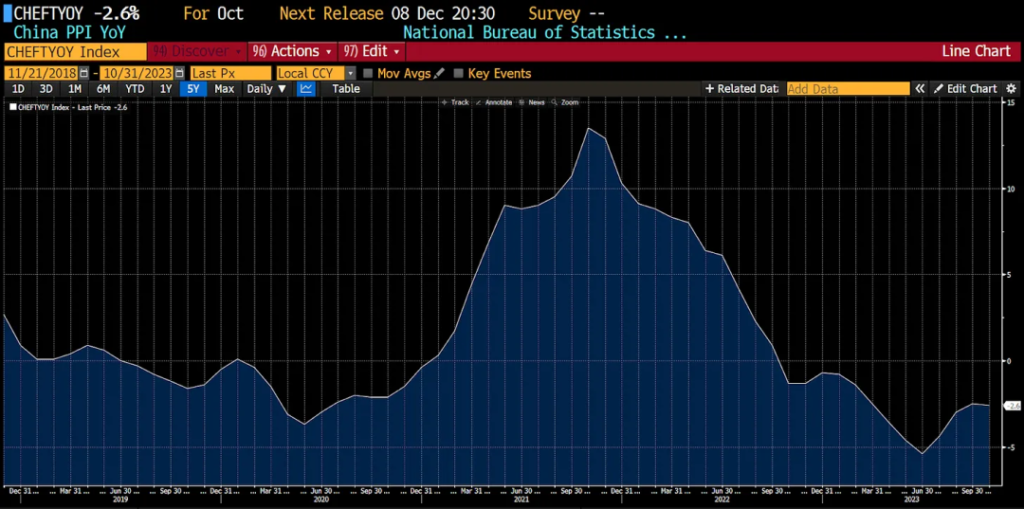
China's economy is built on infrastructure investment and manufacturing rather than consumer purchases, which is called a supply-side or supply-oriented economic structure. Therefore, the most relevant inflation statistic is the Producer Price Index (PPI), not the Consumer Price Index (CPI). PPI is falling, which means the supply side of the economy is unhealthy.
The People's Bank of China has plenty of room to mitigate by increasing credit growth as PPI is in deflationary territory.
As I explained above, China has plenty of room to significantly increase credit. Since PPI is in deflationary territory, credit expansion will not lead to increased inflation. It also won't lead to currency depreciation, triggering capital outflows, because the U.S. is pursuing a weak dollar policy and the yen is strengthening.
Even if all of this happens quickly, how do we crypto traders make money?
Michael Pettis, a former Bear Stearns bond trader and current professor at Peking University, believes that China exhausted its ability to absorb debt in the early 21st century. All the debt that has been added since then has been invested in various projects that have been unable to achieve returns above the interest rates on the debt. The result is that, despite trillions of renminbi being allocated to this project and that, society is getting poorer because it is almost impossible for future economic growth to match interest costs and principal repayments.
As real interest rates fall, those state-owned enterprises that make things will theoretically be able to expand production. Of course, there will be more Chinese gadgets flooding into the U.S. and European markets. However, most of the money will be used to speculate in financial markets because the world doesn't need anything more. That's because, as Pettis argued, China can't profitably absorb more debt, so it's being pushed into financial markets.
Capital, I mean digital fiat currency, is globally fungible. If China is printing yuan, it will enter global markets and support the prices of various risk assets. If a significant portion of tens of billions of dollars' worth of yuan is flowing out of China, then state-owned enterprises and households are speculating in global financial markets because domestic capital has insufficient practical uses.
Capital flows into Bitcoin from China in both micro and macro ways.
microscopic
Hong Kong is China’s window to the global capital market. State-owned enterprises and wealthy Chinese draw money from Hong Kong banks on any international dealings. Hong Kong now has a number of fully licensed crypto exchage and brokers that can buy Bitcoin.
Any wealthy coastal Chinese know about Bitcoin and its promise as a store of value. They have observed this currency from its infancy until now and have been active participants in its success. If there were a legal way to move cash from the mainland to Hong Kong, Bitcoin would be one of the many risky assets to buy.
Further reading: Hong Kong Investment Council Survey: Retail investors’ interest in cryptocurrency investment soars! Nearly 1/4 of young people speculate in coins
macro view
Since the late 2010s, Chinese authorities have been trying to transform China from a supply-led to a demand-led economy. At a basic level, they influence this policy by making credit more expensive onshore. This shifts activity away from capital-intensive heavy industry and toward more consumer goods and services. As a result, many companies, of which real estate developers are some of the most active, have resorted to borrowing dollars offshore. The demand for dollars and the repayments of loans in that dollar pushes up the value of the dollar and makes credit more expensive around the world. As the Chinese banking system becomes more abundant in renminbi credit, demand for U.S. dollar credit and liquidity will weaken.
Given that the U.S. dollar is the world’s largest funding currency, if credit prices fall, all fixed supply assets, such as Bitcoin and gold, will rise in U.S. dollar terms. The great thing about this giant bullish prop is that it doesn’t require Chinese businesses and wealthy individuals to buy any Bitcoin. The fungibility of global fiat credit currencies will determine the marginal flow of fiat dollars to hard currencies like Bitcoin.
2024 and beyond
Nothing forces people to change their minds like an election year. The first priority of any politician is re-election. Democrats will do whatever it takes, and they have shown they are willing to do so by arresting former President Trump to stay on top. Therefore, expect a friendly Biden administration to sweep any minor U.S.-China misunderstandings under the rug. Therefore, I will continue to move money out of Treasuries and into cryptocurrencies because I want to get in before it becomes obvious through the data that China's money printing press is running.