



Author: DeMan
In the current development context of the blockchain world, the trend of project parties developing their own public chains has become increasingly obvious. This not only greatly enriches the use scenarios of their own tokens, but also becomes a key driving force for the upgrade of tokens to Gas Token. . This strategic transformation has fundamentally expanded the scope and influence of the token, making it evolve from a mere value carrier to the core driving force of the entire ecosystem.
This transformation is of great significance, as it marks the diversification and deepening of token functions. Tokens are now not only a medium for circulation in transactions, but also a key element in promoting project development, innovation, and realizing the project vision. These tokens are used as Gas Tokens in the new chain, which not only ensures the operating efficiency of the network, but also brings more autonomy and flexibility to the project.
Today, we are witnessing a critical moment: tokens are no longer just a medium of exchange, they are becoming the key to driving project development, innovation and self-realization. Next, we will explore those projects that are at the forefront of this field and see how they use their tokens to upgrade to Gas Token to enhance their ecosystem and market influence.
Representative of upgrading the token to Gas Token: DYDX, a self-built public chain
When discussing the classic case of token upgrade to Gas Token, we have to mention the strategic change of dYdX. Faced with the high transaction costs of Ethereum, dYdX adopted a radical and far-sighted strategy: cooperating with StarkWare, breaking away from the Ethereum ecosystem and establishing its own chain. Key to this strategy is StarkWare’s technology, which enables dYdX to handle a more diverse range of transactions while remaining scalable and low-cost. This transformation not only allowed dYdX to regain its leading position in the industry, but also achieved true decentralization in the blockchain field.
While building its own chain, dYdX has taken an important step: transforming its token into a Gas Token. This transformation is not just an adjustment to its business model, but a comprehensive reshaping of the role and value of tokens. The role of $DYDX as a Gas Token goes far beyond paying transaction fees. It has become the key to the governance and incentive mechanism of the entire network. This transformation has had a significant impact on the operational efficiency and cost control of the dYdX network, and has greatly enhanced the closed-loop operation capabilities and long-term sustainability of its ecosystem.
By upgrading its token to Gas Token and building its own chain, dYdX has demonstrated practical actions with a deep understanding of decentralization and market needs. dYdX’s actions caused significant reactions in the market. Its DYDX token price peaked on November 15, with an increase of 15.66%.
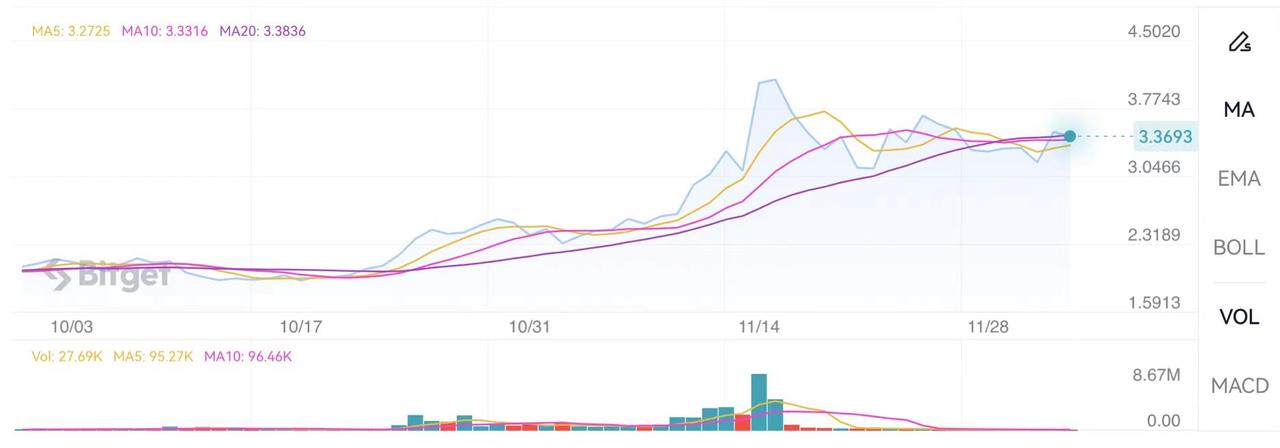
DYDX Token Price Trend
This not only enhances dYdX's position in the highly competitive blockchain field, but also sets a new benchmark for the entire industry in terms of token function expansion and ecosystem construction. This strategy of dYdX is not only an effective response to the current market environment, but also reflects its insight into and leadership of the future development trend of blockchain technology. This strategic shift signals a mature and thoughtful direction of progress in the application of blockchain technology and token economic models.
From Magic to FXS, there are more and more cases of project tokens being upgraded to Gas Token
The recent upgrade of dYdX’s token to Gas Token is just one example of many similar initiatives. In fact, this trend is spreading in the blockchain field, and more and more projects are adopting similar strategies. By transforming tokens into Gas Tokens, these projects not only improve their own operating efficiency, but also enhance their status in the increasingly competitive blockchain market. Below, we’ll explore the specifics of these projects to see how they apply this strategy.
Magic: A decentralized NFT ecosystem based on Arbitrum
TreasureDAO’s trends deserve attention. As a decentralized NFT ecosystem based on Arbitrum, its new action is to launch Magic Token as the Gas Token of its new game public chain. This decision directly promoted the rapid rise of Magic token, with an increase of more than 30% in a week.
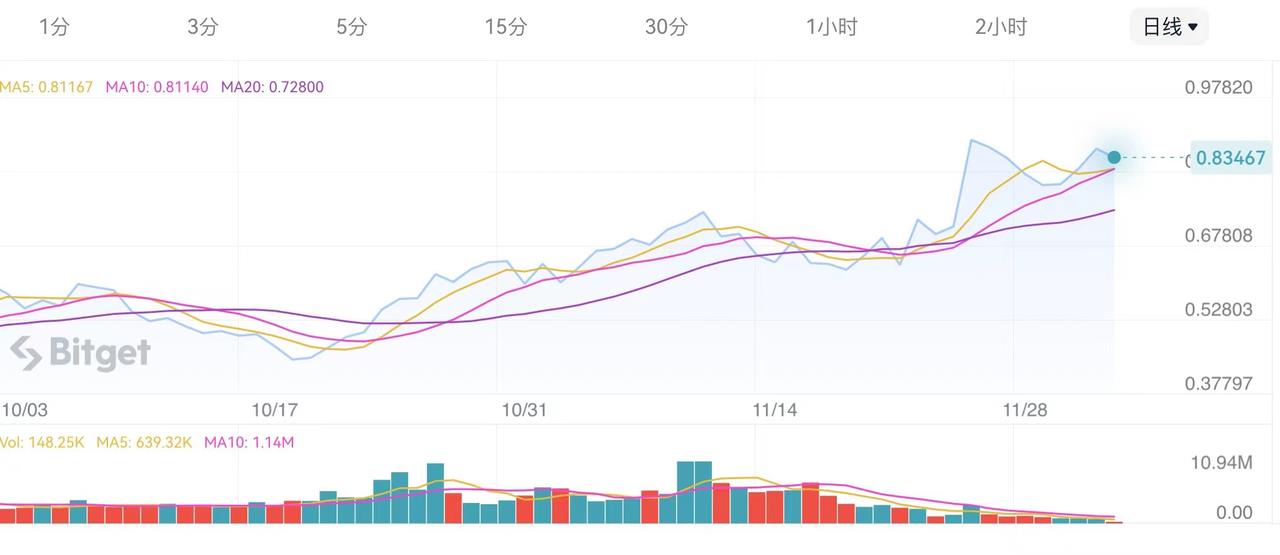
MAGIC asset price trends
As soon as this news came out, the Ouyi OKX market showed that MAGIC rose to 0.8562 USDT in the short term and is now trading at 0.8439 USDT, with a 24H increase of 23.11%.
Hooked Protocol: The new HOOK2.0 proposal attracts attention from the entire network
The HOOK2.0 proposal put forward by Hooked Protocol reveals its keen insight into market trends.

HOOK asset price trend
In the proposal, HOOK was nominated as the Gas Token in the appchain ecosystem. This is not only an enhancement of its functions, but also heralds its strategic upgrade in the on-chain ecosystem.
APE: L2 network built by the co-founders of Optimism
APE, driven by Optimism co-founder Ben Jones, is considering developing its own L2 network ApeChain on Optimism Superchain and using APE or the new AC token as Gas Token. This strategic adjustment not only reflects APE’s response to market trends, but also reveals its ambitions in platform governance and revenue stream innovation.
IOTA: The 2.0 version white paper of the product has been released recently
The IOTA 2.0 Incentives and Token Economics White Paper has been released recently. According to the white paper, IOTA 2.0’s Mana is proposed as a Gas Token, which is a major innovation to the traditional blockchain economic model. This strategy aims to decentralize the verification process while maintaining the stability of the token supply, demonstrating a deep understanding of blockchain economics.
FXS: will be shaped into a universal chain platform where various applications can be deployed
On November 2, Frax Finance founder Sam Kazemian announced on the official Telegram channel that Fraxchain will serve as a general-purpose Rollup platform, rather than a dedicated chain limited to Frax Finance. This means that various applications can be deployed on Fraxchain. Crucially, FXS will serve as Fraxchain’s Gas token, participate in the revenue distribution of the network sorter, and be used to regulate the decentralized mechanism of the sorter in future updates.
Frax Finance’s move to position FXS as Fraxchain’s Gas token reflects its strategic layout in the blockchain network economy. This not only strengthens FXS’s position in the network, but also provides its user base with a new way to participate in the network’s revenue.
The trend of converting project public chain tokens into Gas Token is irreversible, and the Web3 world looks forward to more positive changes
Overall, these cases show how blockchain projects can optimize economic models, improve efficiency, and occupy a favorable position in fierce market competition by upgrading tokens to Gas Token.
As this trend evolves, more projects are expected to join the ranks and jointly promote the economic application and innovation of blockchain technology.






