Written by: Smrti Lab
Compilation: Modular 101
The original English text was published on March 28, 2023. This article is the second half of the content. For the first half of the content, please see: " In-depth Analysis of the RollApp Ecosystem: What are the advantages and disadvantages of each of the four types of application-specific Rollup solutions?" 》
In this part, we mainly introduce the Rollup as a Service (RaaS) solution in the RollApp ecosystem, and compare the advantages and disadvantages of the four solutions: Caldera, AltLayer, Dymension, and Eclipse. In addition, a unified sequencing network scheme is also introduced.
4. Dive deeper into RaaS solutions
Although it may be convenient to use an SDK to build an application-specific rollup from scratch, there are still certain learning curves and barriers. What smart contract developers want is to be able to customize their own RollApp without writing code or understanding the basic knowledge of the actual rollup chain. Therefore, rollup as a service (RaaS) emerged, which makes the development process similar to the dapp experience and is currently very popular.
Each RaaS provider allows developers to easily build and launch their own custom, dedicated rollups with a few clicks. Some RaaS providers may be better suited to specific ecosystems than others (eg Caldera for EVM, Dymension for IBC, Eclipse for SVM, etc.). However, these modular solutions ultimately allow for the addition of different components over time, such as new VMs offering higher throughput, or new DA (data availability) solutions with stronger security guarantees.
Caldera
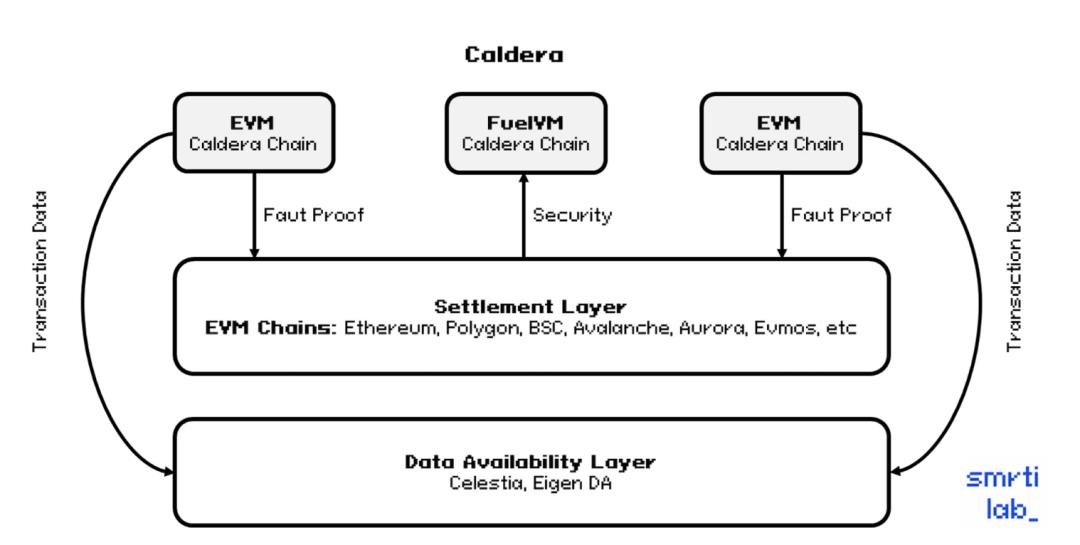
Figure 7. Caldera structure
Caldera (formerly 0xConstellation) is a rollup service provider focused on the EVM ecosystem. The Caldera chain is high-performance (one block per transaction), customizable, and EVM-compatible, meaning teams can leverage existing EVM tools they are familiar with, such as RPC and wallets.
Execution layer
Currently, developers can already use Ethereum VM to deploy their own rollups. However, the team has made it clear that multiple VMs will be added in the future. Some of the VMs they mention in their documentation include SVM and FuelVM.
After selecting the preferred VM, the developer can add his/her own customizations such as tokens for gas, sequencer position, bridging fees, and several other customizations (depending on each solution over time) provided modules).
settlement layer
The Caldera chain can be called a settlement rollup. The Caldera chain can be settled on any EVM-compatible chain. While the most popular choices are Ethereum and Polygon, developers can also choose from other options including BSC, Avalanche, Evmos, Aurora, and more.
As a reminder, this settlement layer is where all proofs are sent, which means that ultimately, every Caldera chain will rely on the security of its underlying EVM-compatible settlement chain.
DA layer
Like other solutions, Caldera is very open when it comes to DA layer choices. Teams can choose to send their transaction data directly to the EVM settlement layer (Ethereum, Polygon, BSC, etc.), or to a DA dedicated solution, currently including Celestia or Eigen DA.
AltLayer

Figure 8. AltLayer structure
Similar to Caldera, AltLayer is a rollup service provider based on settlement rollup, allowing teams to launch their own dedicated execution environments.
Execution layer
Currently, AltLayer allows builders to initiate their own rollups using the EVM. However, they expect to add other options like Wasm over time.
settlement layer
Currently, AltLayer rollup has three settlement options: Ethereum, Polygon or BNB. However, the team has confirmed that other EVM and non-EVM settlement options, such as Solana, will be added in the future.
DA layer
In keeping with its modular philosophy, AltLayer can theoretically connect to any popular DA solution that exists today, but there aren't many details on this at the moment.
AltLayer has two core products, Flash Layers (rollups with set expiration dates) and Pessimistic Chains (chains without expiration dates).
Although few people mention it, disposable chains are very useful for many use cases, mainly in the gaming and NFT fields. Here are some examples:
Mini-games: Such as the Dookey Dash game from Yuga Labs, which shows that some teams can start and benefit from their own short-term, congestion-free rollups.
Indie Games: Traditionally, these types of games are known for only lasting a short time before their popularity eventually wanes and players move on to the next game. This makes indie games suitable for short-term chains.
NFT minting: Popular NFT minting always seems to clog the Ethereum chain, causing increased gas and latency. To avoid this, teams can initiate NFT minting on their own dedicated rollup.
Dymension
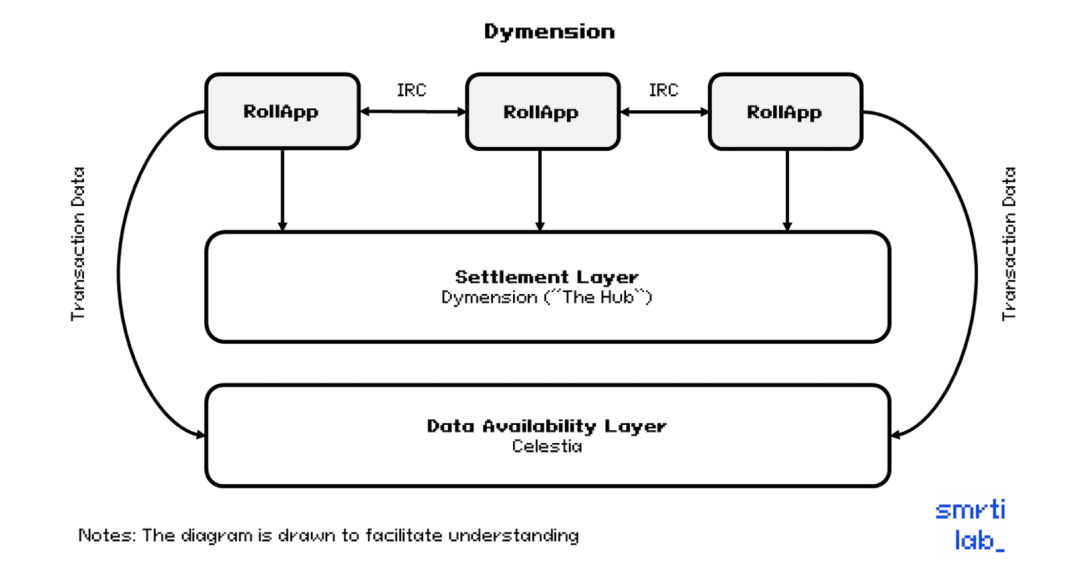
Figure 9. Dymension structure
Dymension is building an embedded rollup ecosystem. More specifically, Dymension is a Tendermint PoS chain built using the Cosmos stack. This PoS chain serves as the settlement center for the entire Dymension ecosystem, providing security, liquidity, and interconnectivity for all connected rollups.
The embedded approach provides rollup with the same trust and security assumptions as the base layer, but is simpler, safer, and more efficient.
Dymension also provides an easy-to-use framework that enables developers to build and deploy their own application-specific rollups. Unlike other solutions we've seen so far, many of which are more focused on the EVM world, Dymension is more focused on "vertically scaling Cosmos" and providing an L2 "dimension" to the ecosystem.
Execution layer
Currently, Dymension provides developers with two VM options - CosmWasm or EVM. Dymension's ability to use EVM through its partnership with Evmos means Solidity developers can deploy dapps using the Ethereum tools they are most familiar with, while still being able to take advantage of IBC connectivity.
settlement layer
As mentioned before, Dymension serves as the settlement hub for the entire ecosystem, unlike previous solutions we have seen, which provide settlement via existing L1 base chains such as Ethereum or Polygon.
DA layer
Currently, Dymension provides the ability to use Celestia as a DA solution. However, just like the other solutions we've seen today, we can expect other DA solutions to be added to the "RollApp" stack in the future, such as Eigen DA, which Dymension's founder mentioned in a previous interview.
Although embedded rollups may lack flexibility and sovereignty, the Dymension hub still has some advantages:
Share security. Dymension hub provides a shared security mechanism. As time goes by, the more RollApps are deployed on Dymension, the stronger the security becomes.
To deploy your own RollApp, you need to bind DYM tokens to network validators. These DYM are staked in the Dymension hub. In order to control the Dymension chain, a malicious actor must hold 2/3 of all staked DYM. Therefore, the more rollups are deployed on Dymension, the more DYM is staked, and the more DYM is staked, the more funds you need to control the network, ultimately increasing security.
interconnection. One of the core components within the Dymension ecosystem is the Inter Rollup Communication protocol (IRC), the ecosystem's own version of IBC. Essentially, it is an IBC customized and fine-tuned specifically for rollup. IRC uses the Dymension hub as a common basis for rollups to achieve seamless rollup<>rollup bridging, and ultimately provides us with a user experience similar to Cosmos. Since the hub itself is IBC enabled, RollApps are able to communicate with the rest of the IBC world, opening the door to interoperability with other IBC enabled App chains (such as Osmosis, Juno, etc.).
Eclipse
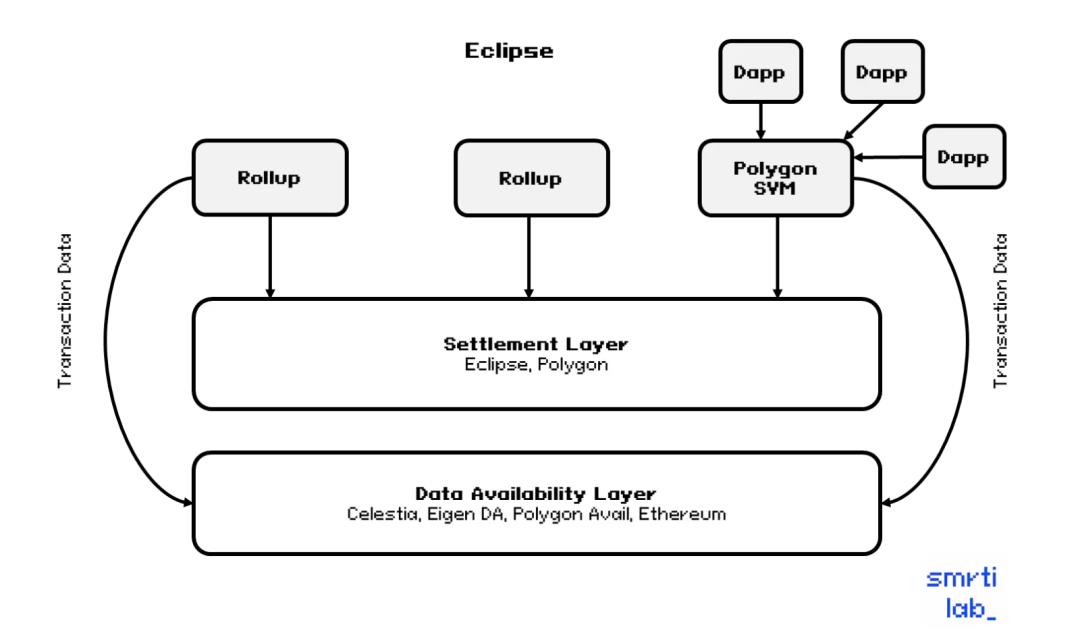
Figure 10. Eclipse structure
Similar to the solutions we saw before, Eclipse provides a Rollup framework as well as a settlement layer. However, what makes it different from other solutions is that it focuses on Solana VM-driven rollup.
More specifically, Eclipse itself is a sovereign rollup built on top of Celestia and built using the Solana VM (Sealevel). One of the Solana developers' favorite SVM features is the use of "parallelism", which is actually how the Solana dapp achieves such high throughput.
Execution layer
Each Rollup deployer can choose their preferred VM, currently, these options include SVM or EVM.
settlement layer
Eclipse itself serves as the universal settlement layer of its ecosystem, which means that every Rollup deployed on Eclipse is settled on this chain. As of today, Eclipse offers optimistic settlement (fraud proof) and is currently working with RISC-Zero to add zk-settlement.
DA layer
As a DA provider, Eclipse allows its Rollup deployers to choose between Celestia, Eigen DA, or Polygon Avail. Additionally, the team has stated in their documentation that they will add Ethereum DA in the future.
Start a new Rollup experience
A user-friendly RaaS should have the following characteristics:
Some degree of chain customization (e.g. whitelist of addresses to interact with the chain, its own gas tokens, etc.).
User-friendly features (e.g. bridge interface, block explorer, etc.).
Well-integrated development tools. (For example, graph indexing tools, oracles, block-level API, etc.)
By design, current RaaS projects provide all three of these aspects. The real question is how well these features are implemented and how stably and quickly they can be deployed.
Altlayer and Caldera currently have their beta projects open for developers to create Rollups. Here's a comparison between the two:
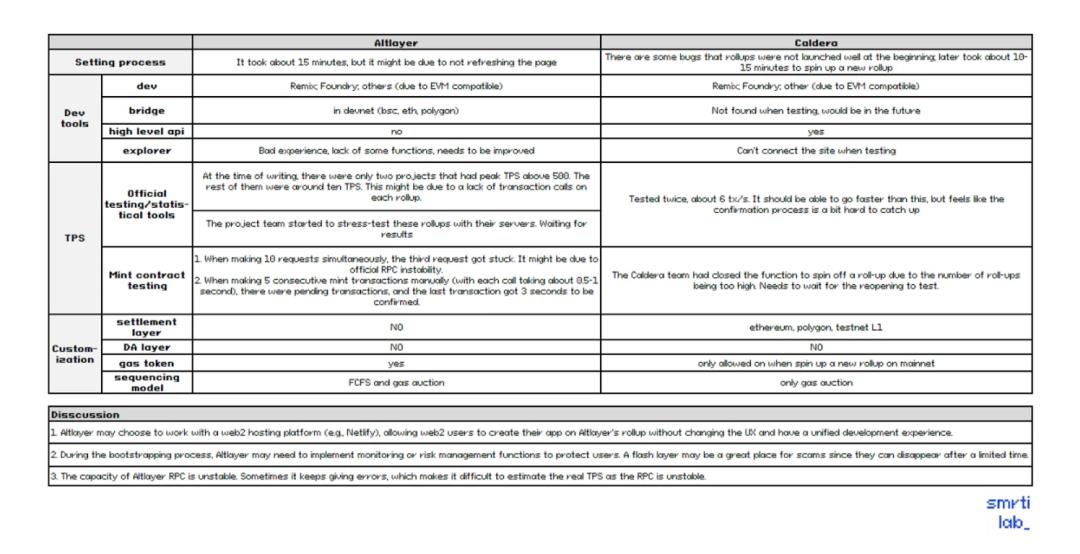
Figure 11. Comparison between Altlayer and Caldera
Currently, developers on Altlayer can customize the transaction ordering mechanism; the name of the Flash Layer; the local currency name, symbol and decimal; and the genesis account and balance. However, Caldera only allows developers to customize their own gas tokens on the mainnet.
Currently, there is not much difference between the development tools provided by Altlayer and Caldera. However, Altlayer currently does not allow switching to another settlement layer, while Caldera offers three options: Ethereum, Polygon, and its own testnet. Although Altlayer only has a sorting model, it provides a FCFS model to reduce the impact of gas wars.
Flash layers can be a breeding ground for scams because they can disappear after a limited time. To better protect users and help build confidence, AltLayer may need to implement monitoring or risk management capabilities during the boot process.
Interestingly, RaaS projects can choose to work with Web2 hosting platforms such as Netlify, which will enable Web2 users to create applications on their Rollup without changing the UX and ultimately have a unified development experience. This could bring more developers and innovation into the crypto world.
5. What is the current status of the unified sorting network?
Currently, most Rollups on Ethereum rely on a centralized orderer to achieve high performance, reduced latency, and instant finality for users who trust the service. However, it is necessary to decentralize the ordering network to reduce the impact of MEV on users and avoid Rollup's single point of failure.
The unified ordering network involves many participants, each aiming to provide its own set of orderers, employing new efficient consensus mechanisms (such as Espresso and Astria). Flashbot's SUAVE aims to provide a marketplace for MEV searchers, performers, and builders/sequencers on different chains. At the same time, Saga aims to leverage its validator set to provide ordering services for Rollup.
Here, we will not delve into the details of each project, but discuss it from the perspective of application chain history.
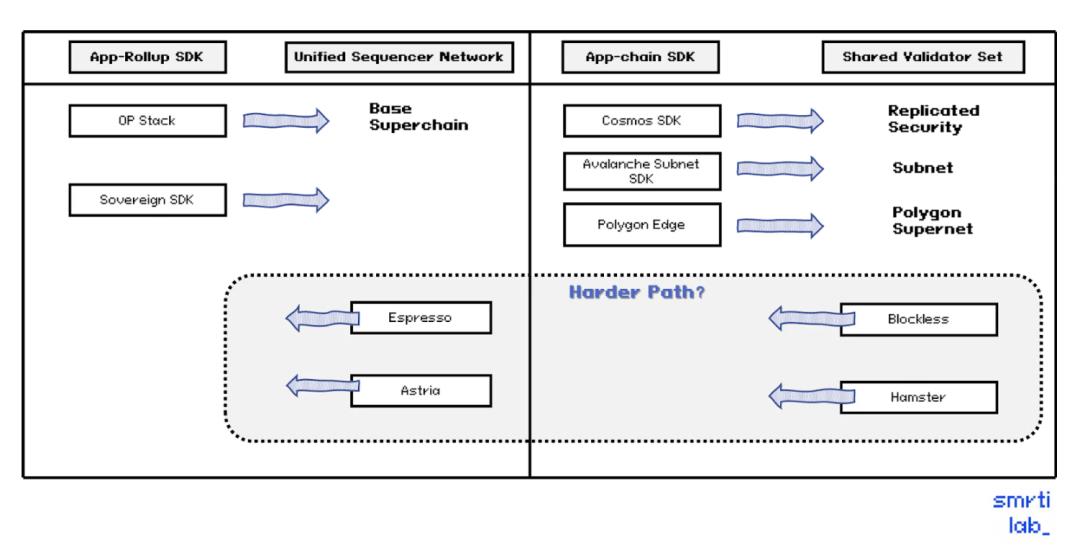
Figure 12. Comparison of application Rollup and application chain
The Application Rollup SDK is similar to the Application Chain SDK, while the Unified Ordering Network is similar to the shared validator set.
It is worth noting that in the app chain world, some projects that provide shared decentralized validator sets, such as Blockless and Hamster, have encountered more difficulties than those projects that initially focused on SDKs.
The main reason for this discrepancy may be that the market does not prioritize blockchain security or decentralization. Instead, it places greater emphasis on the ability to implement business models and the convenience of launching a chain, even if the nodes are not initially decentralized. One example is Optimism, which has not implemented fraud prevention measures and still controls its sequencers.
Will the history of unified ordering networks repeat itself, especially for projects focused on ordering network consensus like Espresso and Astria? let us wait and see.
in conclusion
The RollApp ecosystem is expected to experience significant growth in the coming years . Still, there are many potential issues that need to be addressed, such as centralization, security, bridging, and liquidity fragmentation. Rollups and modular construction are critical to blockchain scalability. As the technology advances, Rollup will simplify the lives of Web3 builders and users by providing customized user interfaces, reducing operating costs, and expanding the design space of native token economies.