Author: Day, vernacular blockchain
Recently, the Bitcoin ecology has gradually become FOMO, which has become popular such as Bitcoin chain game Bitcoin Cats, IDO platform BakerySwap, Bounce, etc. At the same time, BRC20 continues to be popular, and the Bitcoin handling fee continues to soar, reaching a maximum of 600 satoshis/byte. The cost of purchasing a BRC20 is about 80 dollars.
In fact, most meme-based BRC20 and other projects are mostly short-term prosperity, and the popularity may not be sustainable. What can be sustained is the Bitcoin ecological infrastructure it brings, which relatively speaking has long-term value. Today, let’s do it together Let’s take a brief inventory of the infrastructure that has emerged in the current Bitcoin ecosystem.
01Bitcoin Ecology
The main theme of the last bull market was the Ethereum ecology. In this round of bull market, the main theme is the Bitcoin ecology. The voice is getting louder and louder. It can be said that the recent explosion of the Bitcoin ecosystem began with meme Token, but it will not be limited to the meme level. When the sudden wealth effect attracts capital in the circle, the explosion of a large number of projects related to the Bitcoin concept will also become inevitable. Let’s Let’s briefly review some of the more popular Bitcoin-related concepts so far.
Launcher: Bounce Brand
Bounce Brand (formerly Bounce Finance) is a decentralized auction protocol designed to provide users with the ability to create and participate in various types of auctions on multiple blockchain networks. Recently, it has received a lot of attention due to the successive auctions of Bitcoin-related concept projects such as MultiBit (MUBI) and Bitstable (BSSB), and has achieved amazing profits.
On the other hand , in early December, Bounce Brand launched BounceBit, a DeFi solution designed for the Bitcoin ecosystem, and launched the Bitcoin anchor currency BTCB to increase Bitcoin liquidity and make it a Bitcoin ecological project. Because of the popularity of Bitcoin-related concepts and the fact that it is one of the few Bitcoin ecological projects listed on BN, it is very popular. Recently, because of its new project bDID, it was revealed that it has been shipping, and the price has plummeted, even driving auction, mubi, etc. to fall together.
In addition, the function of TurtSat is similar to that of Bounce Brand, but this type of project consumes the resources of the project side. If the project side can continue to launch high-quality projects, it may bring continuous empowerment to the platform.
DeFi Platform: Alex Lab
ALEX Labs is a DeFi protocol built on Stacks, aiming to provide a series of services for Bitcoin applications, including Token issuance, fixed rating and fixed-term lending without liquidation risk, DEX, and interest generation. The goal is to build a broader Bitcoin financial ecosystem to provide more opportunities and choices for Bitcoin holders and DeFi users.
The launch of the cross-chain component ALEX Bridge was announced at the end of November, aiming to achieve a seamless bridge between Bitcoin and other assets (such as BRC20 Token) and provide safe and reliable services. In addition, it recently received strategic investment from LK Venture, a subsidiary of Linekong Interactive, which has added support to its development in the Bitcoin ecosystem.
Cross-chain bridge: MultiBit
MultiBit is a cross-chain bridge protocol designed to connect liquidity between the Bitcoin and Ethereum Virtual Machine (EVM) networks. It allows users to seamlessly transfer tokens between different blockchain networks. Specifically, MultiBit focuses on bridging transfers between BRC20 Tokens and EVM networks such as ETH and BSC.
MultiBit also provides a staking mechanism, that is, users can stake MultiBit's native token MUBI to obtain governance rights and obtain rewards through staking, which may be issued in the form of ERC20 or BRC20 Tokens. For more than 40 days after it was launched, the transaction volume of MultiBit Bridge exceeded 440 million US dollars. In addition, DWF played a driving role behind its development.
Layer 2: MAP Protocol
MAP Protocol is a Bitcoin Layer 2 network for point-to-point cross-chain interoperability. It utilizes the security mechanism of Bitcoin to enable assets and users of other public chains to interact seamlessly with the Bitcoin network, thereby enhancing the security of the network and achieving BRC20 cross-chain capabilities.
Stablecoin: BitStable
BitStable is a decentralized asset protocol built on Bitcoin. It aims to provide a stablecoin solution to the Bitcoin ecosystem, adding liquidity and flexibility, similar to MakerDAO on Ethereum. Through BitStable, users can create, trade and manage synthetic assets that simulate real assets and maintain a fixed value ratio to them. It also introduced the stable currency DAII and the native token BSSB, whose functions are similar to DAI and MKR in MakerDAO, except that the issuing place is changed from Ethereum to Bitcoin. It’s just that the current Bitcoin ecosystem is relatively imperfect, resulting in fewer usage scenarios.
The above are the recent popular Bitcoin ecological projects. Due to space limitations, some smaller projects are not listed. It can be seen that most of them are direct replicas of the Ethereum ecosystem and are currently in the initial stage. Many projects are not so formal. Some projects may have previously worked on other tracks or focused on other chains. Recently, due to the popularity of the Bitcoin ecosystem, they have switched to Bitcoin. This phenomenon cannot be said to be bad. After all, sometimes, one step is the quickest. Step by step, it will become inevitable for more and more projects to start taking into account the Bitcoin ecosystem.
02 NFT
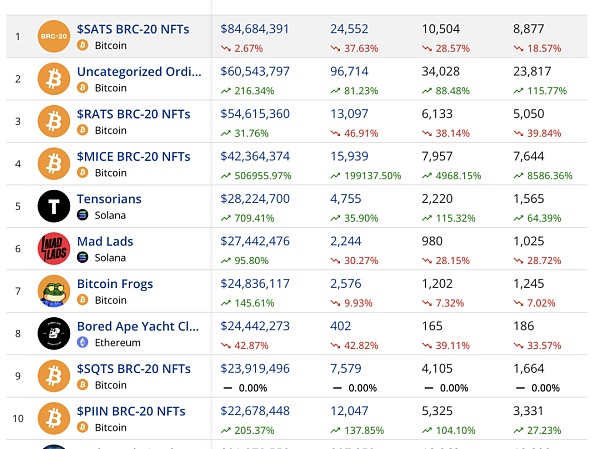
With the development of this period, the Bitcoin ecological NFT has fully blossomed. Cryptoslam data shows that Bitcoin accounted for 57.25% of all NFT transactions last week with a transaction volume of US$265.61 million. Among the top ten NFT transactions in the past 30 days, the Bitcoin ecosystem accounts for 7. Now let’s briefly understand Bitcoin What are the popular NFTs in the ecosystem?
Bitcoin Frogs
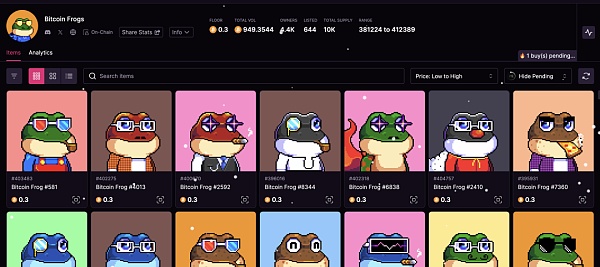
The total number of Bitcoin Frogs is 10,000. Bitcoin Ordinals NFT was launched on March 8, 2023, and is the current NFT leader on the Bitcoin track.
Bitcoin Frogs is a collaboration between Vibegawd of Deezy Labs and anonymous artist Frogtoshi. Projects are minted through Deezy Labs’ launch platform and support lightning payments. Initially, Bitcoin Frogs mint was free with only a small fee required. However, an accident occurred during the mint process, resulting in all Frogs not displaying clothing correctly and becoming known as "Naked Frogs".
To solve this problem, the team used Replace-by-Fee (RBF) to cancel the pending Naked Frogs and recast the correct Frogs. Despite the losses incurred by Deezy Labs due to the engraving incident, the Bitcoin Frogs community continues to grow.
Bitmap
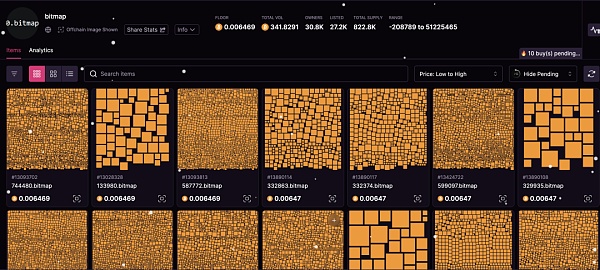
The total number of Bitmap is about 820,000, which is the first Metaverse project in the Bitcoin ecosystem. It is based on Ordinals theory and Bitmap theory, creating a digital landscape by mapping transaction inputs in Bitcoin blocks into land. The size of each parcel depends on the size of the transaction inputs, which make up the blocks or zones. The second phase of the project introduced the concept of zoning, allowing users to independently divide their plots within the neighbourhood.
Goosinals
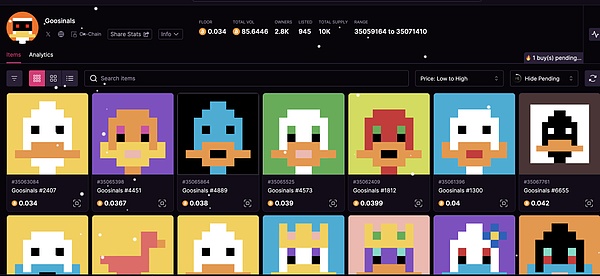 The total number of Goosinals is 10,000, a project inspired by the generative artwork Ringers #879. Ringers is a generative art project released by artist Dmitri Cherniak in 2021. One of the works looks like a goose and is nicknamed the "Big Goose". One of the rare Ringers #879 was purchased by well-known NFT collector @Punk6529 for more than $6.2 million, becoming the second-highest selling generative art work ever.
TOOTHY
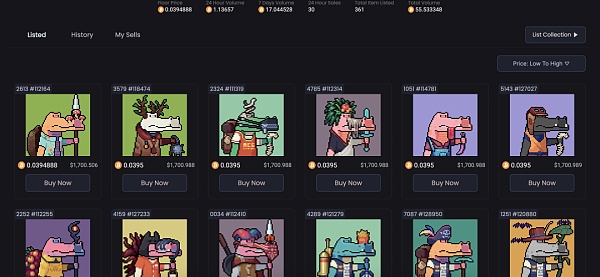 TOOTHY (little crocodile) is one of the first inscription NFT projects to be dmint after the update of Atomics protocol Dmint, with a total of 10,000 pieces. Since the gas fee is not fixed, the highest cost of one NFT is about US$100. The current floor price is $1,700, making it the leading NFT on the Atomics protocol.
03Basic tools
In the past year, with the explosion of Inscription and the gradual improvement of the Bitcoin ecosystem, some basic auxiliary tools have become an indispensable part of investors. Here is a brief introduction to a few tools that are easy to use frequently.
wallet, market
1)Unisat
As the first Inscription plug-in wallet to integrate Ordinals, Unisat supports Ordinals and BRC20, and can help users store, mint and transfer BRC20 Token, including buying and selling BTC, NFT, domain names, etc.
Unisat Marketplace is Unisat's platform that specifically provides trading for BRC20 Token and is used in conjunction with the Unisat wallet.
2) OKX Web3 wallet
OKX Web3 Wallet, as a model of overtaking in this year's trading platform, was the first to support the trading and staking of BRC20 inscriptions and BTC NFT, bringing a large amount of traffic to its wallet. OKX Web3 Wallet has now become the largest BRC20 inscription and BTC NFT trading market in the Ordinals market. As of December 24, the total transactions of OKX Web3 Wallet reached US$870 million. On the other hand, the current experience of the OKX Web3 market in terms of order placement and transaction speed is better than that of the Unisat market.
3) Magic Eden
Magic Eden is the leading NFT market on Solana, providing NFT trading, minting and management. The Bitcoin ecological NFT market launched by Magic Eden in March this year allows users to list, buy and sell Ordinals. Some new Bitcoin NFTs generally choose to list Magic Eden.
On-chain tools
1) Bitcoin browser mempool
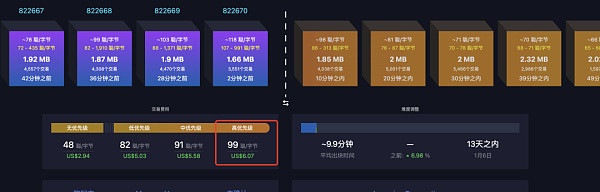
Mempool focuses on mempool and blockchain explorer functions for the Bitcoin community. It provides real-time transaction status and data, allowing users to view the status of currently pending transactions. Because Unisat is embedded with Mempool, it should be the most used one at present. It is mainly used to check the transaction confirmation status and the current real-time gas fee on the chain. Because the BTC chain is very high-volume, when making new updates, it is generally 50-100 higher than the high priority given by it to ensure that the transaction is successful, otherwise it will be in vain. Cheap block producers. Bitcoin generally produces a block every 10 minutes. You can use this to determine the current block production status, whether the block is stuck, and whether the excessive gas is caused by the blocked block or the activity on the chain. This can be used to determine how much gas to give.
2)mct.xyz
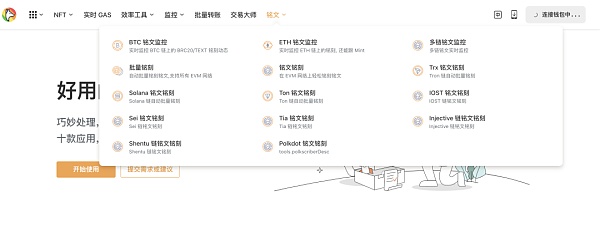
MCT provides a series of blockchain toolboxes that allow users to easily manage wallets, query follow-up information, receive push notifications, etc. What has been used more recently is its inscription casting function, which covers real-time monitoring of inscription projects on more than 20 public chains such as Bitcoin, Ethereum, Solana, Sui, etc., and supports users to batch inscribe. Most of the tools are free, and few Some are paid, but it should be noted that some functions require importing the wallet private key before they can be used. Operations with clear text private keys are extremely risky, so be sure to use them with caution.
 3)GeniiData
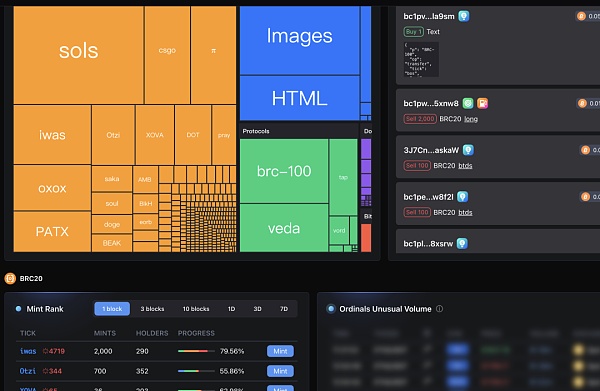
As an Ordinals ecological data analysis platform, GeniiData focuses on providing relevant data services for BRC20 Token and ORC-20 Token, helping users obtain data on Token popularity, rankings, deployment information and transaction records, and supports real-time monitoring and verification of transactions. state. The functions are similar to MCT. MCT has many and complicated functions, but it is not refined enough. GeniiData is more direct in BRC20 monitoring.
The upper part of the picture below shows the current activity on the Bitcoin chain and what transactions everyone is doing. The lower part shows what everyone is doing in a certain period of time recently, the specific times and progress, etc. MCT and GeniiData can be used together.
4)gasnow
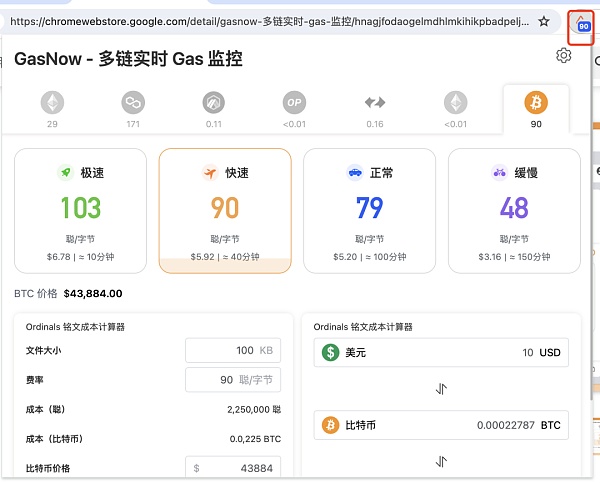
gasnow is a plug-in application that can monitor the gas usage on each chain in real time (marked in red in the upper right corner of the picture below). When gas surges, you can use MCT or GeniiData to check the specific reasons for the surge. Currently, it supports real-time gas information of multiple chains such as Bitcoin and Ethereum.
5) Mining pool acceleration
If the Bitcoin transaction fee is too low, the transaction will not be confirmed, and the wallet may even become unusable, new transactions cannot be issued, and the wallet will be destroyed. The difference between Bitcoin wallet and Ethereum wallet is that you cannot use your own wallet to increase gas for direct acceleration. If gas remains high and you are anxious to use your wallet, you can use the acceleration service of the BN mining pool, enter the hash value, and log in to your BN account for paid acceleration. The cost ranges from tens to more than a hundred dollars.
The above are some of the most commonly used on-chain tools. Although the popularity of BRC20 has decreased recently, I still hope that these tools can help you. You are also welcome to add tools that you use conveniently.
04 Summary
With the development of this period, the Bitcoin ecosystem has undergone earth-shaking changes. From the initial hype of meme concepts such as BRC20 to the continuous improvement of the current infrastructure, the Bitcoin ecosystem will become an important part of the entire industry.
Regarding the next development of the Bitcoin ecosystem, some people believe that as the Bitcoin halving approaches, there will be a wave of major adjustments , and it will be the time to pick up bloody chips. Some people believe that as the halving approaches, the Bitcoin ecosystem will also stagnate. Soon, the hot spot will switch to other tracks such as AI, Ethereum, etc. What do you think? Welcome to share your views in the message area.