Recently, the Ondo Foundation, an organization related to the RWA protocol Ondo Finance, passed a vote to unlock the ONDO token. The ONDO token officially entered the circulation era on January 18. At the same time, Coinbase added Ondo Finance (ONDO) to its assets. On the online roadmap, Binance also launched the ONDO 1-50 times U-based perpetual contract.
According to data from Coingecko, the ONDO token has increased by more than 300% since its inception on the 18th. In less than a week, ONDO has swept the entire encryption community with its impressive increase and has become a hot topic in the X platform encryption community.
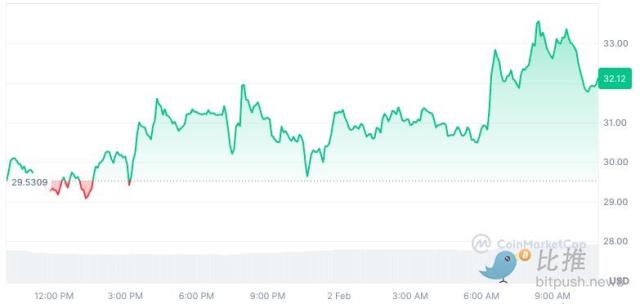
After unlocking the surge, the suspected project side actively selling tokens also began to cause controversy. According to on-chain analyst @ai_9684xtpa, his team is suspected of selling a total of 60 million ONDO tokens since ONDO was listed. Currently, the two addresses are still It holds 106 million tokens, accounting for 7.79% of the total circulation. However, compared with the huge sell-off, ONDO currency price is still relatively stable, maintaining around US$0.25. Behind the stable currency price, it benefits from the attraction of capital to the RWA wave behind ONDO.
Ondo Finance and the traditional financial giants behind it
Long before the token unlock proposal was announced, Ondo Finance announced a community loyalty points program and a partnership with Mantle and Solana to bring USDY to its blockchain. Just after announcing the token unlocking, Ondo Finance once again announced on the 23rd that it would expand its business to the Asia-Pacific region and open its first office in Hong Kong. After that, it also announced the ecosystem catalog on its official website, disclosing information related to liquidity, Custody and other key field partners, among which asset management trust companies include traditional financial giants such as Morgan Stanley, BlackRock, Ankura Trust, Clear Street and NAV Consulting.
Ondo Finance has received support from institutions such as BlackRock and Morgan Stanley since its inception, and has also received investment from top venture capital institutions including Founders Fund, Pantera Capital and Coinbase Ventures.
Crypto analyst McKenna publicly stated on social media that he is more optimistic about Ondo Finance as a "future blue-chip RWA asset" and said that "Ondo Finance has tokenized BlackRock iShares ETFs as short-term U.S. Treasury bond funds and is stable Innovative currency-backed cash equivalents.”
In March last year, BlackRock CEO Larry Fink said in his annual letter to BlackRock shareholders that “BlackRock will continue to explore the digital asset ecosystem, especially in areas most relevant to our clients, such as the Licensed Zone. Blockchain and the tokenization of stocks and bonds”, and BlackRock’s bet on Ondo undoubtedly provides an opportunity for it to enter the RWA field.
Currently, Ondo Finance has tokenized BlackRock’s short-term U.S. Treasury Bond ETF: iShares Short Treasury Bond ETF (Nasdaq: SHV), giving birth to the OUSG (U.S. Treasury Bond) product, which is also Ondo Finance’s TVL's main contribution product, the current price of OUSG is 104.66 USD, and the annualized rate of return is 4.69%. It supports on-chain purchases on Ethereum, Polygon and Solana. As the issuer of ETF, BlackRock will charge an ETF management fee of 0.15%, and OUSG is responsible for charging a fund management fee of 0.15%. This has undoubtedly become a successful case for traditional finance to enter RWA. As BlackRock CEO Larry Fink said, "The next generation of the market, the next generation of securities, will be securities." "Tokenization", currently using OUSG as a breakthrough, BlackRock has taken the first step in asset tokenization.
Financial giants are competing to enter RWA, which may usher in a golden era of blockchain and traditional finance.
Perhaps Ondo will become a "blue chip stock" in RWA in the future. This is not the first time that traditional finance has set foot in the field of real world asset tokenization (RWA). "Tokenize all real assets and create new assets for today's illiquid things." "Liquidity" has always been the top vision for the future among developers in the crypto space.
An argument increasingly shared by both the cryptocurrency and traditional finance sectors is that the tokenization of real-world assets (RWA) will be the backbone of the next bull run and unleash trillions of dollars in the transfer of real-world assets to cryptocurrencies.
Boston Consulting Group has predicted that "the tokenized asset market may surge to $16 trillion by 2030"; while Citigroup stated that "by 2030, there will be $4 trillion to $5 trillion in tokenized digital securities. The volume of trade finance transactions based on distributed ledger technology will also reach US$1 trillion.”
The tokenization of real world assets (RWA) is also developing towards bonds, cars, gold, houses and other fields, which has also successfully attracted the interest and attention of traditional financial giants.
As early as 2021, investment fund giant Franklin Templeton took the lead in launching RWA experiments, launching the Franklin OnChain U.S. Treasury Bond Tokenization Fund on Stellar and expanding to Polygon in 2023. The fund is the first to use public blockchain processing Stellar provides fast, low-cost transactions for U.S.-registered mutual funds that trade and record share ownership and handle asset issuance and exchange in a decentralized manner.
RWA tokenization is ushering in a new golden era of blockchain and traditional finance. Today, RWA has formed a pattern in which many institutions are advancing hand in hand. Currently, traditional financial giants including JPMorgan Chase, Goldman Sachs, BlackRock and Fidelity have embarked on the journey. RWA’s path of exploration.
JPMorgan Chase launched Onyx Digital Assets, a blockchain-based enterprise-level platform in November 2020, aiming to use blockchain to achieve tokenized ownership of money market fund (MMF) shares through the Tokenized Collateral Network (TCN) The transfer of equity allows asset management companies and institutional investors to pledge or transfer MMF shares as collateral. Following this, JPMorgan Chase tokenized USD deposits on the Quorum blockchain via JPM Coin in October 2022.
Qualcomm launched its digital asset platform GS DAP in January last year. It is reported that the platform is developed based on Digital Asset's Daml smart contract language and privacy blockchain Canton. Digital Assets ensures that data is only related to qualified interests through its privacy agreement. shared by all, while supporting the scalability required for globally connected assets.
Fidelity was blocked from opening a Bitcoin account in its 401(k) last year and is still on the sidelines in the RWA field.
Currently, Ondo’s short-term U.S. Treasury Bond Fund (OUSG) has a market capitalization of $111.5 million, second only to Franklin Templeton’s Franklin OnChain U.S. Treasury Bond Fund and Mountain Protocol’s Mountain Protocol USD (USDM), which are $325.5 million and $151.1 million respectively.