Author|Gulu
Source | DeGate
I think the ultimate outcome of the crypto industry in the financial field is to form a large-scale, efficient, and neutral asset platform that serves as an "Internet financial center" for all mankind.
I will divide it into two articles to explain respectively: 1) Why only a sufficiently decentralized blockchain with sufficient throughput can build such an Internet financial center; 2) Why can an Internet financial center based on blockchain be built? It is particularly needed in our time, and what it will probably look like in the future.
The Internet Financial Center is built on the blockchain protocol and is the infrastructure of global finance. It has billions of direct and indirect users and an asset scale of at least tens of trillions of dollars.
A huge variety of assets have been issued on the Internet Financial Center. Because the assets are on the blockchain, they naturally have "programmable" attributes. They are processed efficiently day and night on the blockchain: Transfer, Trade, mortgage, package, split, issue derivatives as underlying assets, etc.
1. Why is blockchain valuable?
Why is blockchain valuable? This is a question that all crypto asset investors have asked at one time or another. The accepted answer in the crypto industry is: because of decentralization. I think this answer is correct, but what exactly are we talking about when we talk about "decentralization"?
I believe that "decentralization" is a means, and the goal is "Trustlessness".
So, what is trustless?
So first let’s talk about what trust is. When you give trust to others, you give them the "power" to hurt you. At the same time, you have positive expectations for the other person and believe that the other person will not hurt you. People first deposited gold into a vault, and the vault gave you a depository receipt, promising that as long as you come with the receipt to withdraw it, the vault will return the gold to you. You have given trust to the treasury, and the treasury can now hurt you and have the ability not to return the gold to you, but you think it should be okay and the treasury should return it to you. Everyone knows what happened later. The treasury found that it was impossible for all depositors to come back to retrieve their gold at the same time, so they lent out part of the gold to earn interest. This eventually developed into the "fractional reserve system", and the treasury became a bank, and then Bank run crises occurred again and again. Again in 1971, the promise of exchange between the U.S. dollar and gold was broken, the "depository receipts" were directly invalidated, and the "U.S. dollar" became an unanchored "U.S. dollar." From then on, legal currency became a wild horse, and we entered the era of wanton issuance of legal currency. The era of credit money.
What is trustless? Trust-free means that you don’t need to give the other party the power to hurt you. Then "trust-free service" means that you can still get services without giving the service provider the power to harm you. Blockchain provides trustless services. In the blockchain world, as long as you hold the private key yourself, no one can take away or freeze your BTC or ETH; as long as you pay the blockchain mining fee, you can definitely send the coins to any address. Yes, no one can hurt you. These trust-free services are achieved through decentralized means and are the core value provided by the blockchain. Trust-free services are particularly suitable for use in the financial field. Services include: issuance of assets (BTC, ETH) according to pre-agreed rules; various disposals of assets, such as transfers, transactions, mortgages, etc.
Today's traditional financial centers, such as New York, London, and Singapore, are all built on a strong legal environment, because under the traditional model, only good legal rules can provide sufficient trust: the money you deposit in the bank, other people If you take it away or freeze it casually, they will be punished by law, so you believe they will not do it. This falls into the category of "Don't be evil", which does not mean that they "can't be evil". Former financial centers can become "financial ruins" because they are capable of evil, just as Hong Kong is experiencing today.
Trust is naturally fragile.
Usually there can be no problems for a long time, but once something goes wrong, the party that gives the trust may suffer huge losses, just like those large savers who had their hair cut during the Cyprus banking crisis in 2013; just like the 1971 financial crisis. People with gold exchange certificates (US dollars); just like people who immigrate and leave Hong Kong now, they cannot get their pensions back, but originally they could get them back under Hong Kong law.
On the contrary, trust-free is naturally anti-fragile and extremely stable, because it does not give the other party the power to harm in the first place.
Blockchain achieves "Can't be evil" through decentralization, which is a step further. It is "I don't know where the cleverness is" compared to them. An Internet financial center was established while "talking and laughing" .
2. Blockchain is 10 times better!
Peter Thiel mentioned in the book "From 0 to 1" that if a new product is more than 10 times better than the old product, then the new product will sweep the market like a storm and users will migrate in large numbers. In terms of creating an Internet financial center, I think blockchain is more than 10 times better than traditional methods:
1) In terms of providing trust, "trust-free" is more than 10 times better than "trust";
2) Creating an address on the blockchain is more than 10 times easier than flying to Switzerland to open a bank account;
3) The global financial platform established on the blockchain will have a huge "network effect" and the processing efficiency is extremely efficient. Both of these are more than 10 times better than traditional financial infrastructure.
Have you ever had the feeling that after using blockchain, you will never go back to using a bank? I will expand on why such an Internet financial center is built based on blockchain, and why it is the call of our times, in the (part two) of this series of articles. This article continues to discuss: Why this blockchain is based on Ethereum.
The blockchain that builds an Internet financial center must be: (A) decentralized enough; (B) able to provide services with sufficient throughput. These two points must be satisfied at the same time, and one is indispensable. In my humble opinion, Ethereum is the only player on this track.
Why must it be sufficiently decentralized? Looking back at our discussion above, the decentralized attribute provides trustless services, and trustless services are the foundation of the Internet Financial Center. Why is trust, or “trustlessness” so important?
Imagine if the Bitcoin blockchain was not decentralized, but ran on a centralized server, then:
· Satoshi Nakamoto needs to open an account on the Bitcoin network for each user. When opening an account, Satoshi Nakamoto needs to review the documents uploaded by each user, such as certificates and proof of home address.
· Satoshi Nakamoto will ask you, where did your BTC come from? Please provide proof of funds!
· Satoshi Nakamoto wants to apply for operating licenses from governments of various countries.
· Satoshi Nakamoto should report various suspicious transactions to governments of various countries.
· Satoshi Nakamoto will provide tax-related information to the governments.
· Satoshi Nakamoto has to accept instructions from various governments to freeze BTC, and sometimes transfer frozen BTC to designated accounts.
· When Satoshi Nakamoto may receive instructions from the US government - please freeze the BTC of the Russian Central Bank. So what should Satoshi do? After all, Satoshi Nakamoto also applied for an operating license in Russia.
· Satoshi Nakamoto received another instruction: Let’s engage in a “quantitative easing” of BTC. Please help us print 700 billion BTC first. Thank you.
Satoshi Nakamoto realized that obviously a server could not run the Bitcoin network. So why is a decentralized network okay? Because decentralization is an "army", it provides the blockchain network with "sovereign independence" similar to a national nature, thereby providing neutral, independent, and predictable security services for the Internet financial center.
Indeed, the blockchain network is very much like a country and provides government-like services in some aspects. It is especially good at protecting property rights, more than 10 times better.
First, let’s talk about why do people need government? What should the government do for people? John Locke, the pioneer of the Enlightenment in the 17th century, explained in "Treatise of Government": "Everyone has inherent natural rights, including the right to life, survival, liberty, property, etc. These natural rights are not given by the government. It is something that people are born with. The reason why people want to transfer some of their rights to society and form a government is to protect these natural rights. If a government deprives people of these innate rights, then it is evil. .”
Are there many evil governments in the world? a lot of! And it has increased in the past few decades, especially in the protection of property rights. This is the background of the times when Bitcoin was born. On the Genesis Block of Bitcoin it is written: "The Times 03/Jan/2009 Chancellor on brink of second bailout for banks", translated into Chinese: "The Times 03/Jan/2009 Chancellor on brink of second bailout for banks". On the brink of a second bailout,” was the headline on the front page of The Times on January 3, 2009.
The independent space built by the blockchain can protect property rights better than the government because decentralization provides trust-free protection. The many decentralized nodes of the blockchain form an "army" to build a long-term independent space that lasts for centuries, where a large-scale "Internet financial center" that is convenient for all mankind will be born. This independent space, as the name suggests, is independent of the government, but it does not destroy the government and the order it establishes, but competes to provide services and products that are 10 times better in some aspects and establish a better order.
The government does not like competition, because no one likes others to compete with themselves. The reason Switzerland was able to remain neutral during World War II was due to its unique geographical advantages and its powerful army. "Independence" was never obtained through begging, but relied on its own strength to stand among the nation-states in the world. Forest. The same is true for blockchain. The blockchain where the Internet financial center is located must have enough decentralization to realize its own sovereignty and protect an economy of tens of trillions of dollars. The military must be powerful enough to prevent potential external attackers (the strongest The big one is that the cost of attacks by governments is too high, so that they are willing to coexist. After all, the Internet financial center only provides competitive services and does not threaten the existence of the government itself, nor does it destroy the order established by the government, just like now offshore financial centers.
It may be okay for the second and third place blockchains to hide under the halo of the first place and spend less on military expenditures on decentralization, but the economic value of the second and third place will be significant. It is lower than the first place because the Internet financial center itself has a network effect, because all applications and all users are willing to collaborate on the same collaboration platform, which is the most efficient for everyone.
When I started my business in Shanghai, I could meet four groups of people a day. If I were not in Shanghai, I would not be able to do this. If China's 1.4 billion people could all live in the same city without being restricted by physical conditions, it would be optimal for everyone from the perspective of efficiency and collaboration, but the physical world does not have enough "scalability", which is why I It is believed that the high throughput (i.e.: scalability) of blockchain is crucial to building an Internet financial center, alongside its decentralized attributes. The gap between the first and second place in blockchain may be the gap between Google and the second place search engine.
As a country-like existence, the blockchain’s network consensus is the country’s constitution. Different from the country, all actions on the blockchain must be subject to "constitutional" review by all consensus nodes in real time. "Unconstitutional" actions will be eliminated from the beginning. From this perspective, the efficiency of justice is also 10 times better above. As a more efficient order construction model, blockchain is expected to build the next generation of human systems in some aspects - a "decentralized system" that does not rely on the government and benefits all mankind.
3. How much decentralization is needed?
If external hostile forces want to attack the blockchain network, the attacker will launch attacks on numerous "decentralized consensus nodes". For example, the government of a major country requires the freezing of BTC on a certain address. To this end, the government wants more than 50% of the consensus nodes of the Bitcoin network to reject all "categorically unreasonable" blocks. If any of these blocks "dare to ” contains any BTC transactions sent from this address. For another example, if a large cross-border remittance company wants to prevent transactions on Ethereum from happening in order to combat potential competition, then more than 1/3 of the Ethereum consensus nodes will refuse to provide services, making it impossible for the Ethereum network to achieve "Finality".
There are several ways to launch these attacks, such as: 1) Send a lawyer's letter to the operator of the consensus node (well, laws can sometimes be made casually); 2) Make the node disconnect from the Internet; 3) Send a lawyer's letter to the operator of the running node. Inject viruses into devices; 4) launch missiles at nodes; 5) shut down the entire Internet; and so on.
How do decentralized consensus nodes as a whole defend themselves? 1) There are a large number of nodes, even if a few are knocked down, it will not affect the overall operation of the blockchain network; 2) The nodes are naturally based on the "pseudonym system", and it is not enough to find the real person behind it and send them a lawyer's letter. So easy; 3) Nodes are in different jurisdictions around the world, and the laws in each region are different; 4) Becoming and exiting consensus nodes are dynamic, and nodes can fight guerrillas.
It can be seen that if there are enough decentralized nodes and the organizational mechanism is good enough, it will not be so easy to defeat this "army". If the attacker's motivation is not strong enough and the attack is difficult enough, then there is no reason to launch an attack. The motivation for the attack has to do with the size of the blockchain economy itself, as well as the detrimental impact the blockchain has on powerful potential attackers. For the former, the larger the scale of the Internet financial center, the more powerful the "army" protection is needed; for the latter, blockchain practitioners do not take the initiative to provoke powerful potential attackers. For example, I think that on the blockchain Anonymization services are unacceptable to governments because they will have a huge impact on the existing national order, so they are likely to attract attacks from governments.
So, how much decentralization is enough? Everyone's judgment is different, and this threshold changes dynamically and is related to the harshness of the external environment.
We know that the current external environment is not friendly. China has long banned all cryptocurrencies. Many people in the US government do not like the encryption industry. For example, the US Securities Regulatory Commission is very reluctant this year after delaying for 10 years. The country was forced to pass the application for BTC spot ETF.
I think that dozens of consensus nodes are definitely not enough to build an Internet financial center; hundreds are not necessarily enough; thousands are starting to make people feel more reassured. In addition to the number of consensus nodes, the degree of decentralization is also very related to the nature of the nodes themselves. For example, if the hardware requirements for the nodes must be data center level, then even if there are thousands of nodes, this "army" is still Vulnerable because the privacy of nodes is almost non-existent and the "soldiers" can no longer fight guerrilla warfare. The Ethereum community believes that it is very important to allow ordinary people's computers to run consensus nodes, and it is an important foundation for Ethereum to maintain decentralization.
Another consideration in terms of how much decentralization is enough is to prevent decentralization from causing evil and corruption. If billions of people entrust their inherent property rights to 21 nodes and let them dominate, how can we ensure that they will not corrupt? How can we ensure that "we are not a mine but a people"? Will 21 Nodes cooperate with certain countries to control "capital outflow"? In fact, it is aimed at your and my hard-earned money. Even if the money goes out, the money will not be allowed to go?
Greed, greed for profit and power, is the "factory setting" of evolution for human beings, from Louis XIV of the Bourbon dynasty as the "Sun King" "I am the country" to Louis XIV, the leader of the Revolutionary Party who overthrew the Bourbon dynasty. Perspier's personal dictatorship, and then Napoleon's realization of personal dictatorship by safeguarding the achievements of the French Revolution, all declare the greed of human nature. The philosophical king in Plato's "Utopia" does not exist in the "Real State". In the "Real State" there are Robespierre and Napoleon. Therefore, we have to sacrifice a certain amount of efficiency and follow the democratic route of power checks and balances. In the blockchain world, this is decentralization, so that such a "decentralized system" can benefit all mankind.
4. Throughput is equally important!
To build a blockchain for an Internet financial center, it must not only be decentralized enough, but also be able to provide services with sufficient throughput. However, before the second-layer technology (Layer2 in English, hereinafter referred to as L2) was proposed, the "Blockchain Trilemma" theory was once popular in the encryption industry. This conclusion holds that it is impossible to achieve scalability, decentralization, and security at the same time. You can only get two of the three. Obviously, security cannot be compromised, so scalability (ie: high throughput) and decentralization must be chosen.
Therefore, many blockchains have made deep compromises in decentralization in order to achieve high performance. For example, the entire blockchain network only relies on 21 high-performance hardware consensus nodes. As discussed earlier, I think such compromises have made them We are out of the race to build an Internet financial center.
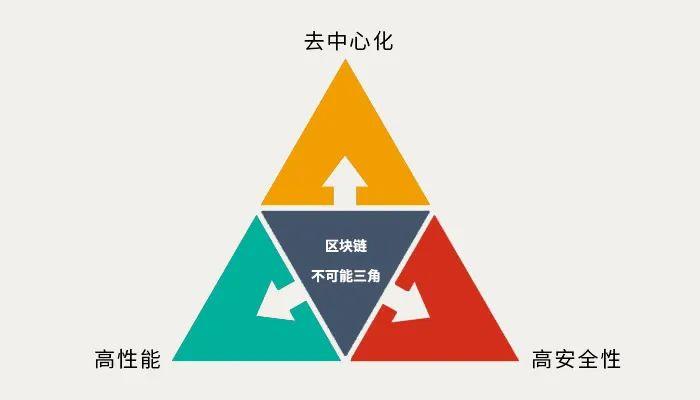
Many years ago, I thought that this "Blockchain Trilemma" conclusion was wrong because it wrongly assumed that every node must verify every transaction in the block, but in fact L2 technology breaks made such an assumption. There are currently several types of L2 technology, and the concept is mixed. Some unscrupulous platforms deliberately change the concept to confuse the public, and even claim that other independent blockchains are Ethereum's L2. In my opinion, the basis for L2 judgment is very simple: whether the L2 system can eventually reach the level of "trust-free" at L1 (Layer1, the underlying blockchain) level in design. L2 is an extension of L1. Together with L1, it forms the overall blockchain internal ecology. If it loses the most important "trust-free" attribute after extension, then such an L2 system is not part of the overall blockchain ecology and cannot To provide an independent space for building an Internet financial center, it cannot be called L2. Otherwise, logically speaking, a centralized exchange can also call itself L2, because you recharge (renamed bridging after changing the concept) to the centralized exchange After the exchange, transfers and transactions can also be carried out.
Putting aside those "pseudo-L2" systems that call themselves L2, among the real L2 technologies, I think the most important branch is Rollup technology. The working principle of Rollup technology is to package and compress a large number of transactions into one Rollup transaction and upload it to the L1 blockchain. There are currently two types of Rollup technologies: Optimistic Rollup and ZK Rollup, both of which break the so-called "Blockchain Trilemma" in their own ways. Optimistic Rollup outsources the verification work that originally needs to be completed by Ethereum nodes. Anyone can challenge the state of the Optimistic Rollup transaction on Ethereum within a specific period of time (typically 7 days), and can challenge the state through the challenge mechanism. An incentive mechanism is designed in the system so that those who succeed in the challenge are rewarded, thereby encouraging active public supervision and challenging any mistakes. In ZK Rollup, through the cryptography of zero-knowledge proof, it is mathematically guaranteed that the state after ZK Rollup must be correct, and the zero-knowledge proof technology can also allow Ethereum nodes to spend only a small amount of computing resources. Ability to quickly verify a large number of transactions packaged together. I think ZK Rollup technology is magical. In addition to its extremely high compression efficiency, it does a clean and neat job of extending the trustless properties of L1 without introducing additional security assumptions that are difficult to evaluate.
5. “L1+L2” is the future
In the long run, I think the future of Ethereum will be a combination of "L1 blockchain + L2 system equivalent to L1 trustless" (hereinafter referred to as "L1+L2"), especially when ZK Rollup solves the problem of universal smart contracts After platform technology. This combination not only provides the current degree of decentralization of Ethereum, but also provides high-throughput services, making it the best choice for an Internet financial center carrying tens of trillions of dollars.
The future is bright, but the road is tortuous. There are many difficulties in the process of reaching the end of "L1+L2", the most significant of which are two major challenges: 1) technical challenges; 2) giving up on the "trust-free" concept .
L2Beat (L2Beat.com 58) is a very useful website. Behind it is a young team that strongly believes in the spirit of decentralization and the concept of "trust-free". This website displays various L2 projects in full detail (including "True L2" and "pseudo-L2"), if you agree with and want to invest in the future of "L1+L2", it is recommended to check out L2Beat frequently, which is very helpful.
Let’s use the information displayed on L2Beat to sort out these two major challenges. The screenshot below shows all 38 L2 projects currently running on L2Beat, sorted from high to low according to the "STAGE" evaluation criteria.
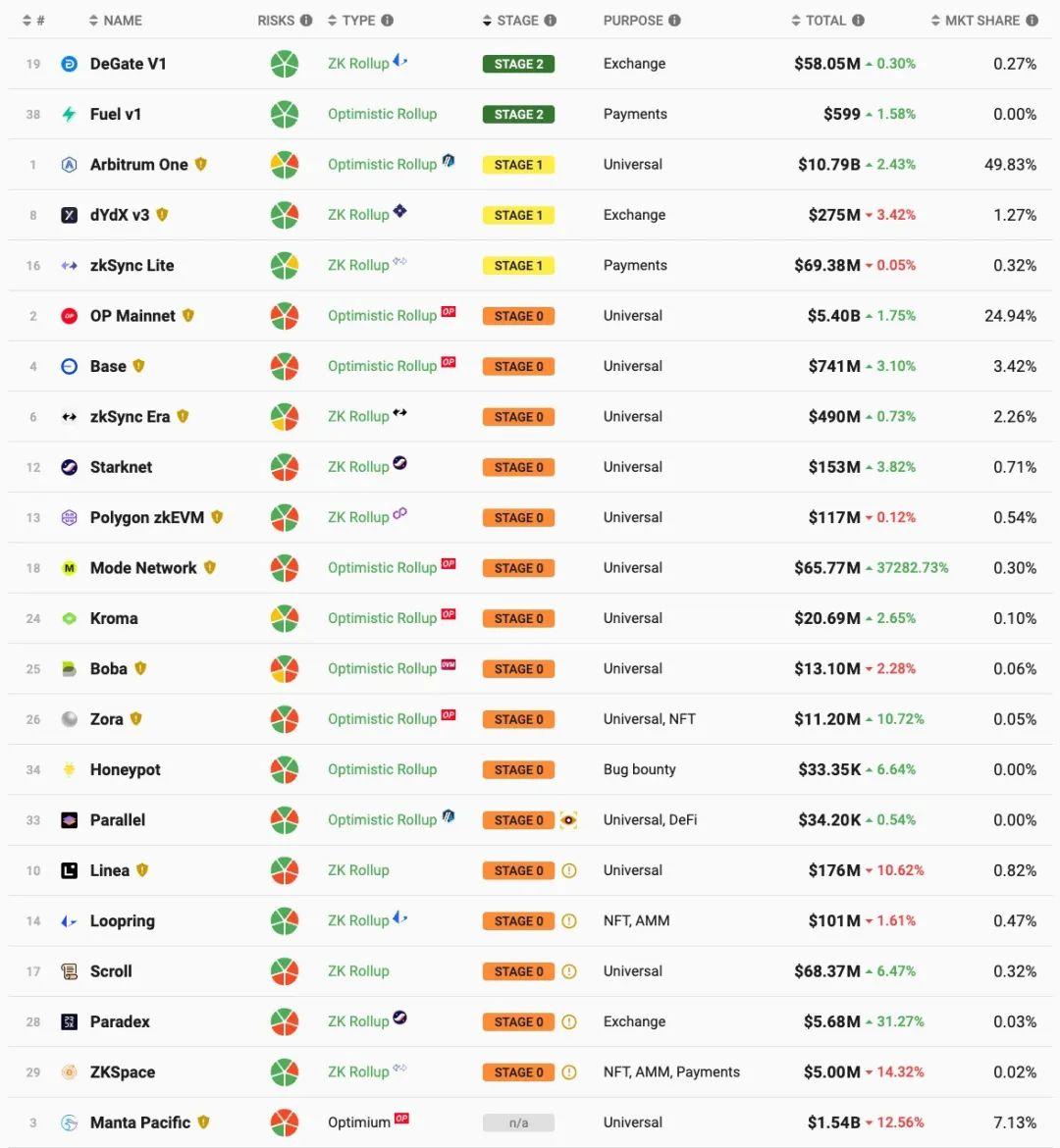
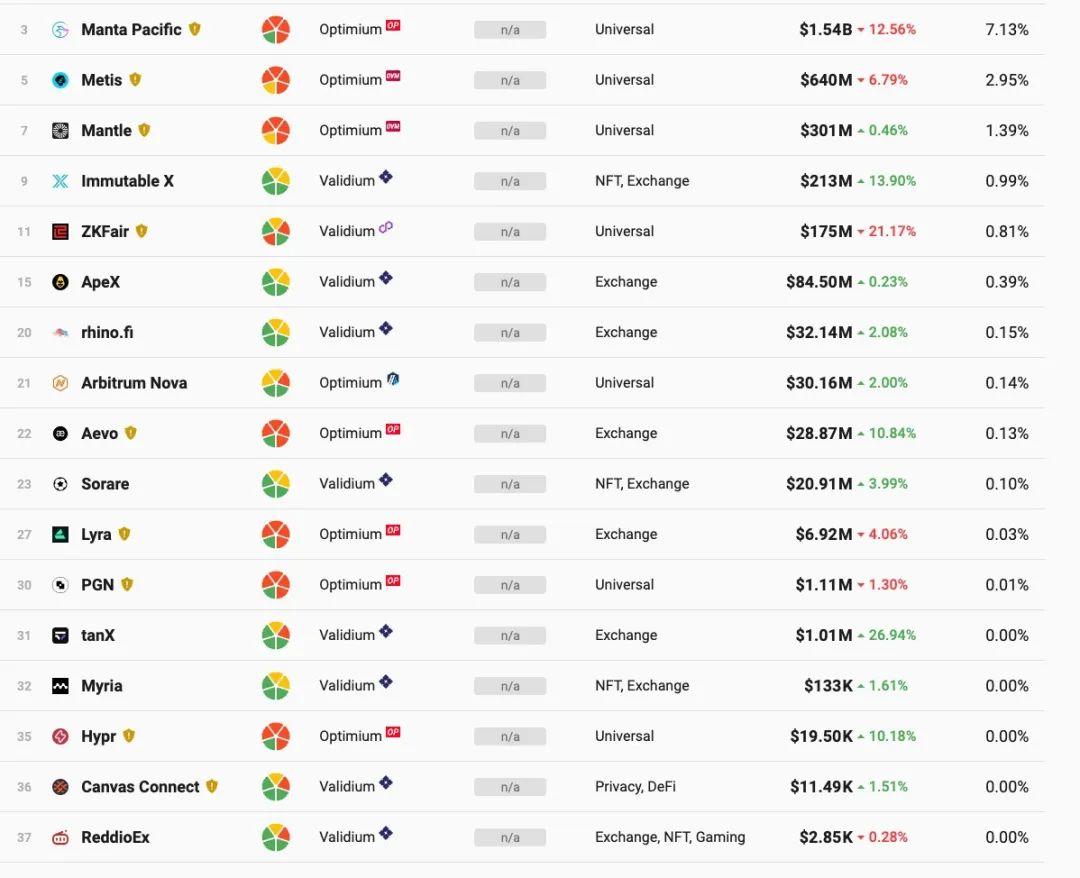
First, let’s introduce L2Beat’s “STAGE” evaluation system. L2Beat judges the completion of "trust-free" based on five risk factors, which L2Beat calls "maturity." These five risk factors are (1) State Validation (state validity check), (2) Sequencer Failure (sequencer failure), (3) Proposer Failure (uplink failure), (4) Exit Window (user Escape window), (5) Data Availability. Take the picture below as an example. Only if all five risk factors are evaluated as green can you get a STAGE 2 rating. Currently, there is only one ZK Rollup project that has received a STAGE 2 rating, which is DeGate shown in the picture.
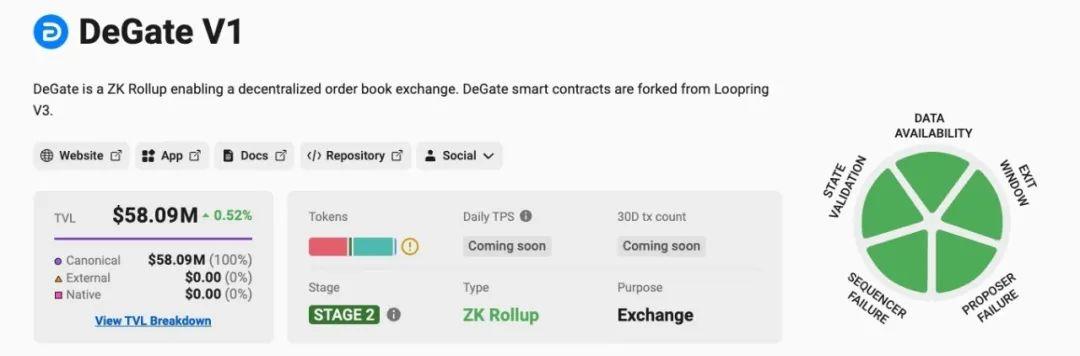
In L2Beat's "STAGE" evaluation system, in order to obtain the STAGE 2 level, the following requirements must be met: Provide users with at least a 30-day escape window period. As long as the user responds within the window period, they can enjoy Ethereum. L1 level “trust-free” security. I think such judgment standards are reasonable and in line with the current stage of L2's overall ecological development. My appreciation for the L2Beat team lies not only in their pursuit of the "trust-free" concept, but also in their insistence on the concept while not being dogmatic or rigid. , for example, they did not set the evaluation criteria for STAGE2 to have an infinite user escape window period, because this is too unrealistic and may have an adverse impact on the development of the overall L2 ecosystem. After all, the L2 ecosystem is currently in a period of rapid development. .
For example, Ethereum will implement EIP4844 in 2024 and will introduce a cheaper data type called Blob Data. After implementing EIP4844, I expect that the cost of Rollup (i.e. Gas cost) can be reduced by at least 80%, but each Rollup system In order to take advantage of the cheaper data services brought by EIP4844, it must be upgradable. Therefore, the user escape period cannot be set to an infinite length. Otherwise, the Blob Data of EIP4844 cannot be used through system upgrades and must be redeployed. Then the old Rollup system will be abandoned, the construction that has been invested in the old Rollup system will also be abandoned, and users will have to migrate all their assets to the new Rollup system. The cost of doing this is too high, it is too demanding, and I think it is detrimental to the overall L2 ecological development. Therefore, L2Beat's current evaluation system is reasonable, adhering to the concept, and consistent with reality without being rigid.
Now, let’s discuss the first of the two major challenges: Why is it technically so difficult to achieve “L1 trustless equivalence” L2? The core reason is that the L2 system is very complex. The more complex the system, the more difficult it is to achieve safe operation, and the longer the construction time required to achieve safe operation. Moreover, both Optimistic Rollup and ZK Rollup are brand-new technologies, especially the zero-knowledge proof used by ZK Rollup, which is very advanced in the cryptography world. In fact, it is the application of ZK Rollup that is rapidly promoting zero-knowledge proof. Development in academia. Among the L2 systems shown on L2Beat, as far as I know, Loopring, the earliest system to implement ZK Rollup, has been going through at least 5 years since the project was established; DeGate, which implemented STAGE 2, took 3 years and made 5 rounds of "security" Audit" and an ongoing "Security Bug Bounty Campaign."
Although there are many technical difficulties, as I said before, I believe the future is bright, because the mature "L1+L2" blockchain system will create an Internet financial center worth tens of trillions of dollars and serve all mankind. . There are currently 5 projects on L2Beat that have reached STAGE 1 or above. They are DeGate, Fuel, Arbitrum, dYdX, and zkSync. Thumbs up for them.
The second biggest challenge is to give up the concept of "trust-free", that is, it is impossible to achieve L1 level "trust-free" in design, which I call "pseudo-L2". I guess the biggest motivation here is to reduce gas costs and provide cheaper services. Cost is important, but it cannot be at the expense of giving up the core value of "trust-free". I think such a compromise has crossed the bottom line. The cost is that these L2 systems cannot become part of the "L1+L2" trust-free system, only " Only "True L2" has the ability to carry tens of trillions of Internet financial centers together with L1. On the other hand, "True L2" can also reduce costs in other ways. The biggest cost of "True L2" is the data cost of uplinking to L1. This part will drop significantly after Ethereum implements EIP4844 this year. I expect it can be reduced by at least 80%.
Recently, there has been a discussion in the blockchain industry about the modular DA (data availability) layer. Some people have proposed moving the DA service away from Ethereum and switching to other cheaper data services. If after the DA service is moved out of Ethereum, the Rollup system can still maintain the L1 level "trust-free" attribute in design, I wholeheartedly support it. In fact, there is indeed such a solution (please see Faust, Geek Web3’s article 11), and there are also excellent teams actively exploring and practicing it. However, recent discussions actually require abandoning the "trust-free" L1 level and downgrading L2 to "pseudo-L2" for lower costs.
I believe that all L2 people who make financial applications aim to be large-scale and eventually become important members of the "L1+L2" system. So whether they should abandon the "trust-free" L1 level from the beginning, it must be Think clearly, because wearing a "gold necklace" around your neck that will rust is not a gold necklace. I think giving up "trust-free" will seriously hinder the scale of "fake L2". Among the 38 L2 projects currently running on L2Beat, the funding scale of "true L2" is more than 10 times that of "fake L2". It can be seen from this , the market cares, and we don’t want to end up becoming a “human mine”.
6. Summary
To summarize, this article discusses:
· Why is blockchain valuable? Because of decentralization.
· Decentralization is the "army" and its purpose is to achieve "trustlessness".
· Only a sufficiently powerful “army” can provide protection for the Internet financial center.
· Explain how much decentralization is enough.
· The blockchain that builds an Internet financial center must simultaneously satisfy (A) sufficient decentralization; (B) provide services with sufficient throughput. Currently, only Ethereum is a player on this track.
·Explains how L2 breaks the "Blockchain Trilemma of blockchain".
· The basis for judging "true L2" and "pseudo L2" is given. Money is smart, and the market chose "True L2".
In the next article, I will discuss why the blockchain-based Internet financial center is particularly needed in our era and is very marketable, and what it will probably look like in the future.
Thanks for reading.