
An event that happens every four years! What is Bitcoin’s “halving”?
Bitcoin (BTC) soared past a record high of US$73,000 (approximately NT$2.19 million) in March this year. It is expected that the upcoming “Bitcoin halving” event in April this year will have an even greater impact on Bitcoin. It will have a profound impact on the value of cryptocurrencies, the profits of miners, and the entire cryptocurrency market.
"Bitcoin Halving" is a special event that occurs every four years. When Bitcoin was originally designed, in order to ensure that the "total supply" of Bitcoin was quantitatively limited and to effectively control the speed of releasing new coins, Bitcoin would regularly increase the difficulty of mining so that the rewards obtained from mining " Halving" to maintain the value and scarcity of Bitcoin.
Since "halving" will reduce the amount of Bitcoin flowing into the market, thereby increasing the value of Bitcoins that have not yet been mined, the price of Bitcoin will increase significantly from 6 months to 18 months after each Bitcoin halving. Bringing a bull run to the cryptocurrency market.
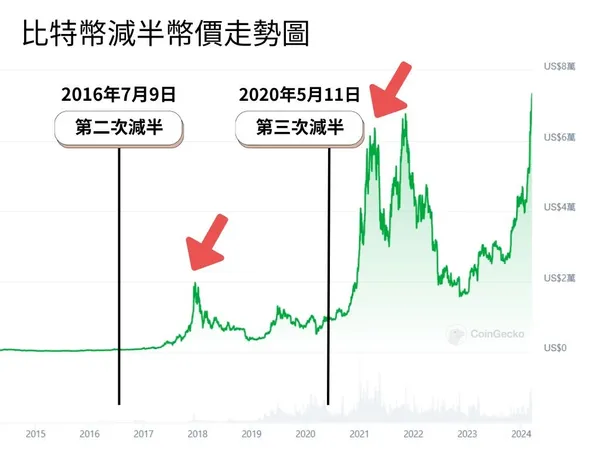
Therefore, not only miners will be affected, but investors are also paying close attention to the follow-up to the Bitcoin halving.
What impact will the Bitcoin halving have on miners?
Since the birth of Bitcoin in 2009, there have been three halvings, occurring in 2012, 2016 and 2020 respectively. Coupled with the fourth halving that took place in April this year, the mining reward of Bitcoin has dropped from the initial 50 Bitcoins to only 3.125 Bitcoins.
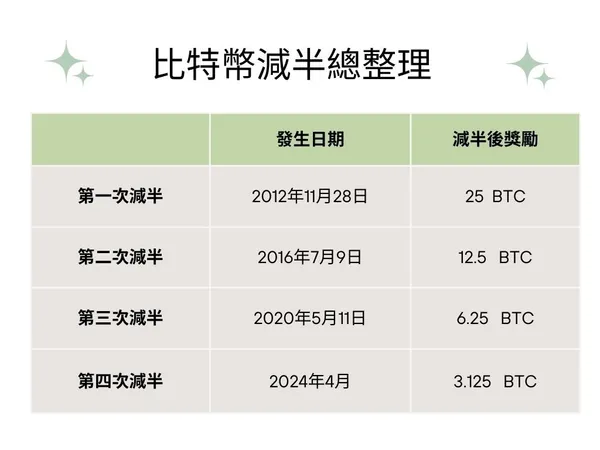
Impact 1: Mining is not profitable? Two major directions for the survival of miners in the future
Bitcoin researcher Chen Bowei pointed out that the halving of rewards is actually a big blow to miners. There were also related papers in 2013 that argued that the economic model of Bitcoin cannot actually support its continued operation in the future, because the rewards obtained for digging out blocks are simply not enough to cover the costs paid by miners, and the number of miners mining will increase in the future. few.
Under such circumstances, there will be two possibilities for the future development of Bitcoin.
In the first case, since Bitcoin transaction fees are an important source of income for miners, if the popularity of Bitcoin accelerates and more and more people invest in using Bitcoin, transaction fees will also increase. No matter how difficult mining becomes, Miners can also continue to survive.
The second situation is that the price of Bitcoin rises sharply due to scarcity. Assuming that after the halving, the price of Bitcoin soars, and the value of one Bitcoin becomes twice or more than its past value, then mining will still have a chance for miners to make back their money.
Impact 2: Applications are moved to Layer 2 to welcome a healthy blockchain environment
However, as more and more people enter the world of the Bitcoin blockchain, transaction fees will rise and the speed will slow down due to too many people.
The emergence of Layer2 (expanding the existing problems of existing blockchains) can effectively improve user experience. Therefore, Chen Bowei believes that the final appearance of the Bitcoin blockchain in the future will move towards a stable balance. Bitcoin investment If performed on Layer1, the application will remove Layer2.

When the Bitcoin Layer 2 ecosystem flourished and a large number of users poured in, the transaction fees of the Layer 1 network increased significantly. By then, only transaction fees will be able to feed miners stably, and then a truly healthy blockchain environment will be formed, and the halving event will no longer be a problem.
How much more will the currency price rise after this halving?
For investors, the past three halving events have indeed driven Bitcoin to rise or enter a bull market. But this time, it's a little different from the past.
The biggest change is that the United States officially approved Bitcoin spot ETFs in early January this year. People can directly buy funds that track Bitcoin spot prices on the stock exchange without opening a separate wallet in the Web3 world.
In the past, the crypto always said that "the bull market begins after the halving." Judging from past historical data, the bull market stage lasts approximately 14 to 18 months, and it is currently in the early stages of the bull market. Since the U.S. Bitcoin Spot ETF has attracted more investors to enter this time, it is more difficult to predict the highest point or end point of this bull market.

Yang Yaoyang, co-founder of Red Mansion Capital, said that while Bitcoin ETFs will establish the legal status of Bitcoin, they will also bring in more “institutional money.” A major feature of this type of funds is that their response speed is relatively slow.
Yang Yaoyang gave an example. Suppose a big event suddenly occurs today. Compared with investors in the crypto, the investment habits of ETF investors are less likely to buy or sell immediately. Therefore, extreme situations such as a sudden rise of 50% in a week and a sudden drop of 50% in a week are likely to occur less often in the future, because the market is supported by ETFs acting as basic funds.
Metrics to watch: How much money will a “Bitcoin ETF” bring?
How much money the "Bitcoin ETF" will bring will be the key observation indicator for this halving.
During the bear market, Lin Hongyu, a cryptocurrency lawyer who insisted on buying Bitcoin at a regular daily quota, said, "I am very optimistic that this market cycle will see a price jump like the previous three halvings in the past."

Bitcoin believers often regard Bitcoin as a challenge to central institutions and the traditional financial system, and have a certain degree of confidence, rather than just pursuing short-term interests; but ordinary investors may pay more attention to the return on investment in Bitcoin.
That being the case, there’s room for the old saying to come in handy: You can make money or lose money when investing, depending on your personal risk tolerance.
Review editors: Gao Jingyuan, Chen Junyi