TL;DR
1. After a round of bear market reshuffle, the mental outlook of those “Ethereum killers” in the past is not as good as before, but the potential energy retained is different.
2. As the only public chain in the time control group whose market value has not declined but increased, Solana has accumulated a lot in the trough and completed a "rebirth from the ashes."
3. Star public chains may never set the goal of becoming the second in Ethereum. They only want to be the first in their own track.
Table of contents:
1. The birth of Ethereum (ETH)
2. Attracting a killer, what is Ethereum’s crime?
3. The “Ethereum Killers” who are generally optimistic in 2021
4. In a bear market, the market value does not fall but increases. What is Solana’s “ trump card ”?
5. Briefly review the ups and downs of other “Ethereum killers”
6. Ending
From the bear market in 2022 to the beginning of the bull market in 2024, the crypto world has ushered in several upward trends, large and small.
In addition to the most conspicuous protagonist "Bitcoin", the price broke a new high and reached $73,750. In the last round, Solana's native token "SOL", known as the "Ethereum Killer", also took one year and three months to rise from the bottom of 9 dollars. It quietly reached 208 knives, becoming the fastest growing kid on the market capitalization list.
The boomerang of the "Ethereum Killer" hits the crypto world in the head again.
This also makes me wonder, there were so many chains in the past that claimed to subvert Ethereum, what are they doing now?
1. The birth of Ethereum (ETH)
Let’s start with the central object being sniped.
The idea of the Ethereum network can be traced back to the end of 2013.
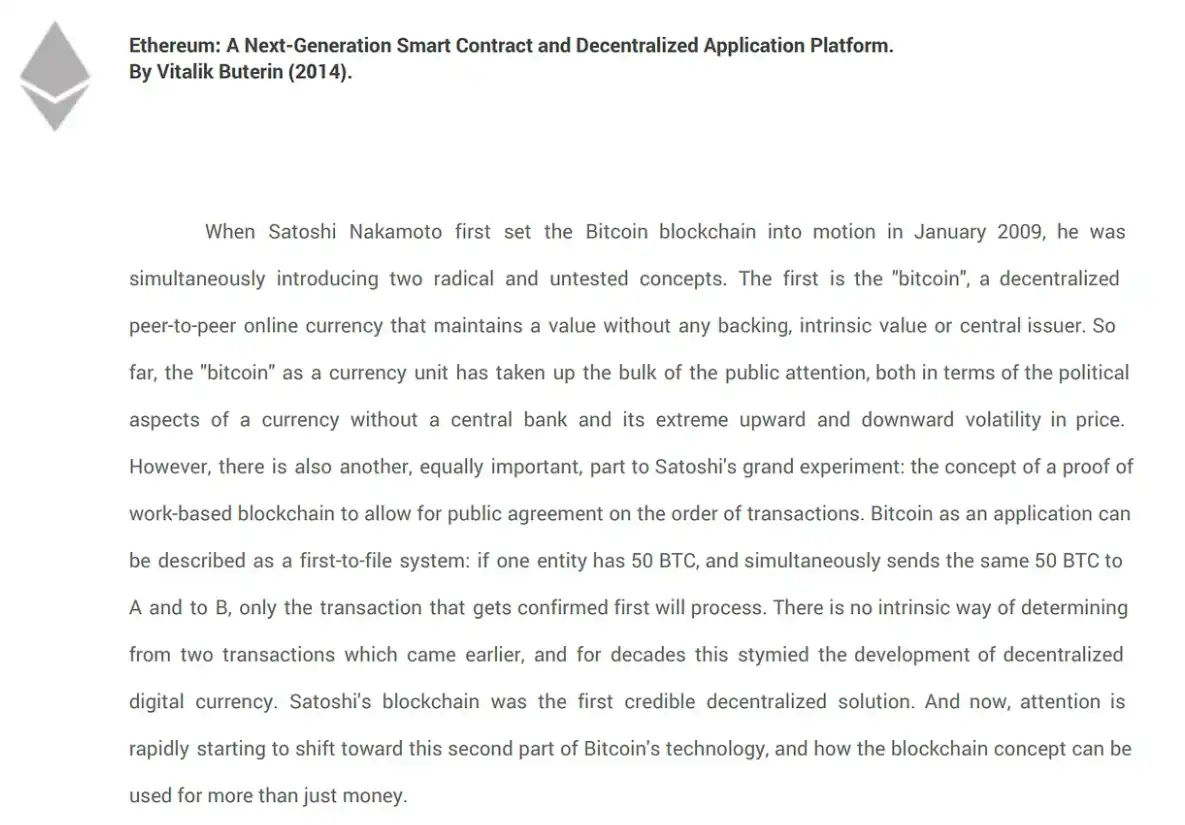
Founder Vitalik Buterin proposed in the white paper such an "open source, blockchain technology-based decentralized platform that allows developers to create and deploy smart contracts and decentralized applications (DApps) on it."
In July 2014, Buterin and his team began pre-sales for Ethereum (ETH), the native cryptocurrency based on the Ethereum network. The sale period lasted 42 days and raised approximately US$18 million for the development and maintenance of the network.
In August 2015, the Ethereum mainnet was launched, mainly for developers to develop and test smart contracts. At that time, the opening price of ETH was approximately US$0.3. Soon after, it gradually climbed to the second position in market capitalization and remains firmly there today.
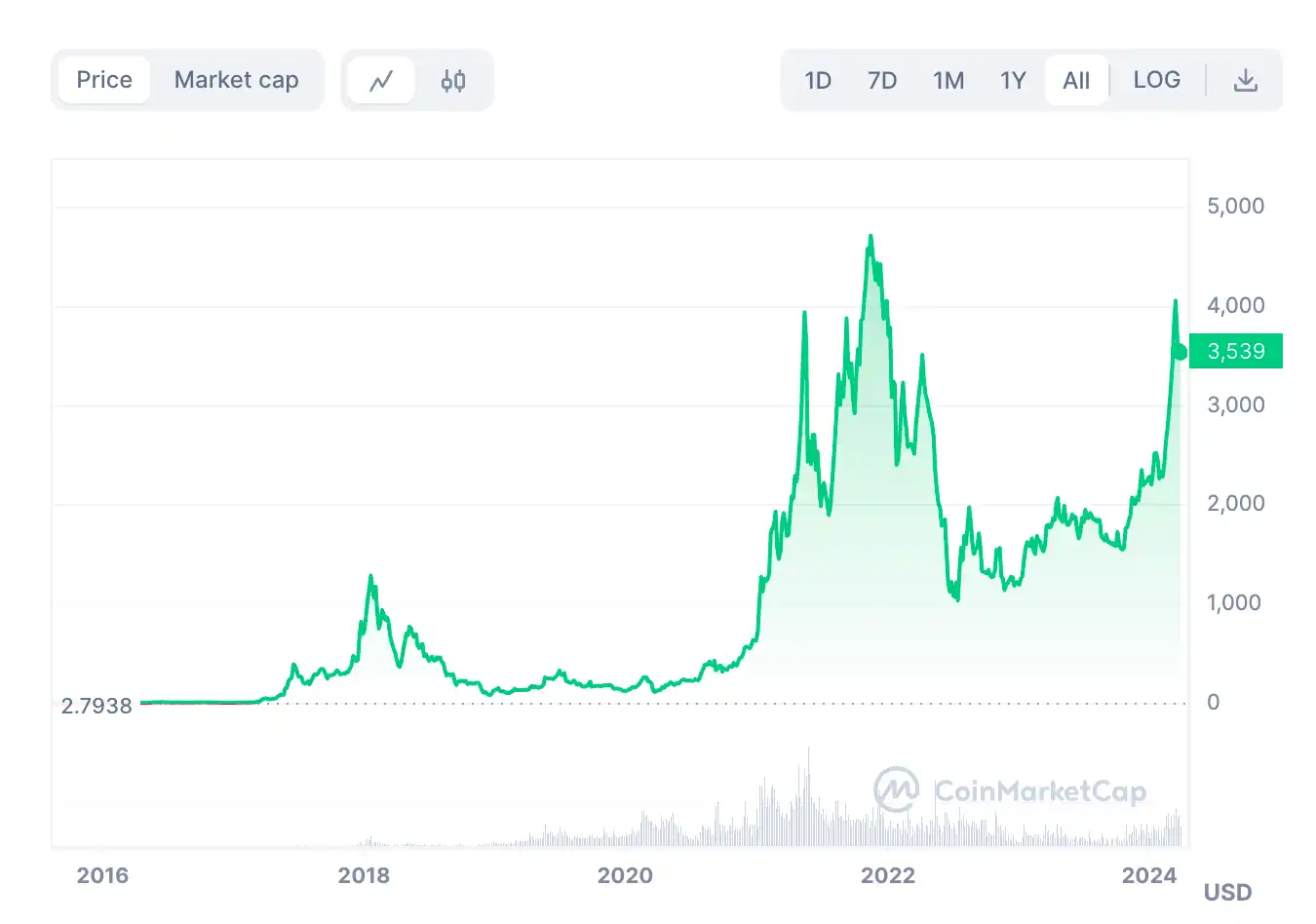
Come 2017, ICO (Initial Coin Offering) has become a popular way for many blockchain projects and start-ups to raise funds.
Many projects choose to conduct ICOs on the Ethereum platform, and the market value of Ethereum has also reached a new high.
The choice of the Ethereum network as the ICO platform can be mainly attributed to its following differentiated features:
1. Smart contract function & ERC-20 standard:
a. One of the core features of the Ethereum network is its support for smart contracts. Smart contracts are self-executing agreements based on preset conditions, which allow developers to create complex applications on Ethereum with fast transaction confirmation times and low transaction fees (compared to Bitcoin). Such as on-chain financial transaction (DeFi) platform, on-chain games (GameFi), voting, etc.
b. Among them, the innovative "ERC-20" is another smart contract standard that provides unified rules for token creation and issuance.
Tokens that follow the ERC-20 standard can be integrated with Ethereum wallets and exchanges without additional development operations, allowing project parties to easily issue their own tokens on Ethereum, and also provide them with important tools to raise funds in ICOs. Conveniences.
2. Mature ecosystem & active community:
a. At that time, the Ethereum network had developed a relatively mature ecosystem to bridge the entry of more developers, such as the smart contract programming language Solidity, the MetaMask wallet that provides convenient entrances, etc. These provide the necessary infrastructure and services for the deployment and issuance of new project tokens, greatly reducing the entry threshold for project parties.
b. Ethereum has an active community, especially its developers and technical experts, who have spontaneously solved technical problems and provided innovative ideas for many projects, promoting project development.
Being able to rely on a high-quality community and practical developer technical support plays a crucial role in the success of new projects.
3. Market recognition & liquidity:
a. As the cryptocurrency with the second highest market value at the time, Ethereum has gained market recognition, making it easier for ICO projects on Ethereum to attract the attention and trust of investors.
b.ETH, as the native token of the Ethereum network, has a large demand for it both from project developer deployment and user transactions. High liquidity allows investors to easily enter and exit the market, and also provides good liquidity for ICO projects.
In summary, the frenzy of ICOs on the Ethereum platform has also brought a large number of project parties and investors to purchase the ETH currency itself. The price of the ETH currency has risen accordingly, reaching a high of US$1,400 at the end of 2017.
2. Attracting a killer, what is Ethereum’s crime?
Along the way, it seems that Ethereum has become the chosen one earning enough attention in the crypto world since its birth.
It continues to innovate and improve the blockchain world, and the introduction of smart contract protocols has opened up unlimited imagination for the cryptocurrency industry, and set the stage for subsequent benchmark events-"2020 DeFi Summer" and "2021 The popularity and prosperity of "NFT Explosion" has cultivated fertile ground, promoted the practical application and development of blockchain technology, and also attracted more and more investors and developers from all over the world to the encryption world.
"Therefore, if the trees are beautiful in the forest, the wind will destroy them."
When too much expectation and approval is cast on something, there must also be voices of opposition.
Ethereum does have the following problems that are mainly criticized by users.
In order to facilitate understanding, we can use "obstacles that may be encountered when swimming in the pool" as an analogy to "problems that may be encountered when trading on the Ethereum network":
Just like the capacity of a swimming pool is limited, as more and more people pour in, the pool will become overcrowded and people will not be able to swim in it smoothly and quickly.
1. Scalability issues:
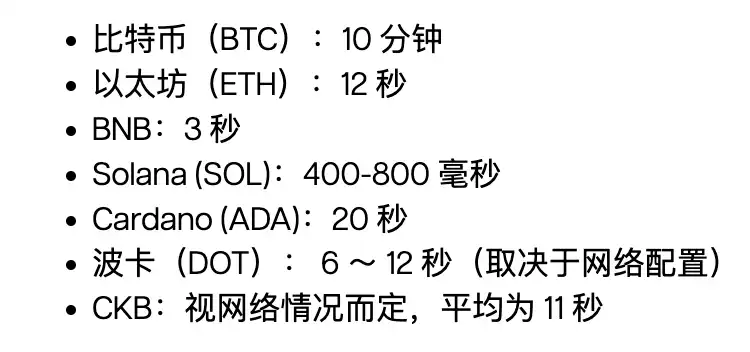
As the number of users and applications increases, the network becomes congested, resulting in longer block times and slow transaction speeds. When the demand for high transaction volume cannot be met, it will have a negative impact on many projects, especially in areas that require timeliness such as games (GameFi), on-chain financial transactions (DeFi) and NFT transactions.
When the summer peak season arrives, this swimming pool will host a larger user base than ever before. If you want to swim out of your own lane calmly in the "dumplings" situation, you need to use your "money power" to summon the staff and deploy some low-priced admission users who used the "early bird price" or "discount coupons" to join first Wait in line, wait for the "money player" in front to finish swimming ashore, then return to the pool and move forward quickly.
2. Network congestion and high Gas charges:
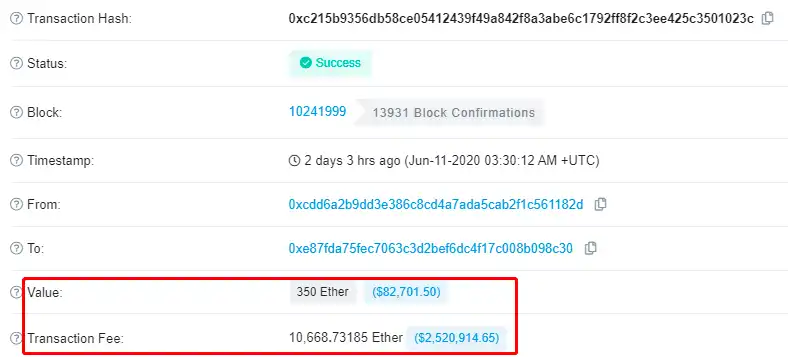
In some specific periods (such as the rush to create new mint NFTs, rapid transactions of airdropped tokens, etc.), it will cause serious congestion on the Ethereum network, and transactions may be delayed or even unsuccessful, which greatly affects the operating experience.
If users want to quickly resolve network congestion in a short period of time, they need to pay higher transaction fees (Gas fees).
The swimming pool has locked storage cabinets for you to store your personal belongings. Although most of the time there is no problem if you open and take them out, if the storage is not complete, there will be a bad luck and you will find that all the valuable items in the cabinet have been stolen.
Or maybe you have carefully placed your belongings on the shore within sight of you and packed them with clothes. Only when you get to the shore do you realize that the clothes are still there, but the belongings have been turned into worthless items by civet cats.
You go to the swimming pool for help and check the surveillance, only to see the thief go out with the stolen goods, turn right, open any door in Doraemon, and go to a different world without a trace;
There is nothing you can do to complain to the swimming pool, because you have signed a contract when you enter and you are fully responsible for your belongings.
3. Security issues:
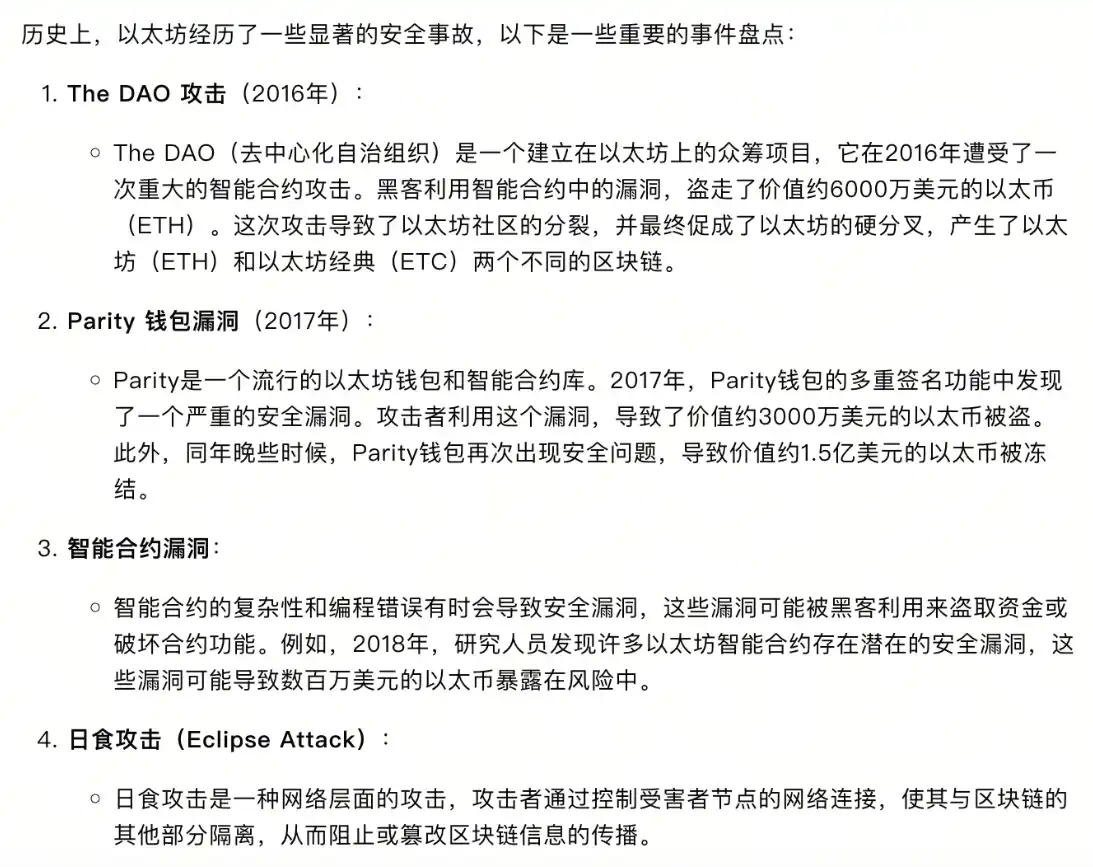
Security can be said to be the red line in the blockchain world. With the development of blockchain technology, endless hacking techniques have also been iteratively transformed and unpredictable. The Ethereum network has also suffered several major disasters in its history. Security attacks.
For example, in The DAO crowdfunding project in 2016, attackers exploited a recursive call vulnerability in the smart contract and stole approximately 3.5 million ETH (worth approximately $60 million at the time) from the fund pool. This attack directly led to the split in the Ethereum community, and ultimately led to the hard fork of Ethereum (divided into two different chains, ETH and ETC). This exposes potential security risks to smart contracts and the entire network, hiding unknown security vulnerabilities.
Of course, the probability of encountering the problems in the example when swimming in a pool is extremely low;
The above transaction problems can occur on the Ethereum network, and they are indeed more frequent.
In summary, it has become uneconomical for users to conduct small transactions on the Ethereum network, which also hinders the large-scale and widespread adoption of Ethereum, especially for application scenarios that require frequent operations and real-time transactions.
Because of this, many project parties have discovered new opportunities in these poor user experiences, waiting for opportunities to polish their own targeted magic weapons and alternatives, and launch their own public chains to carve up this part of the market that Ethereum cannot eat. flow.
3. The “Ethereum Killers” who are generally optimistic in 2021
In order to create a splash in the cryptocurrency world, where the cost of attention is particularly expensive, many media outlets will label many celebrity public chains as "Ethereum killers" to attract attention when writing promotional releases.
I turned here to an article on "forkast" at the end of 2021, called "The top 5 "Ethereum killers" of 2021", which lists the following 5 "Ethereum killers":
Cardano (ADA), Avalanche (AVAX), BNB Chain (BNB), Solana (SOL), Polkadot (DOT).
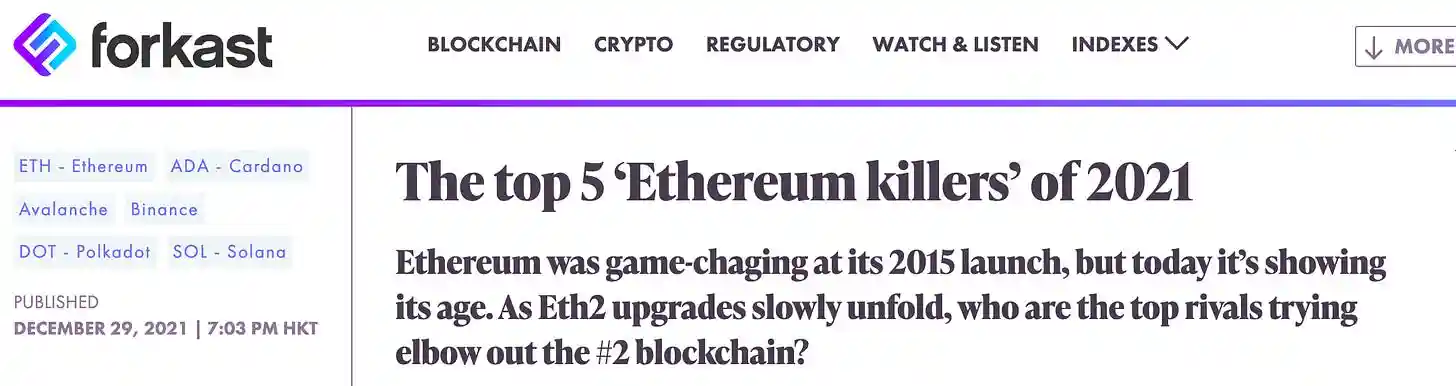
The author is LACHLAN KELLER, an Australian journalist who focuses on the encryption industry. Although one person's opinion cannot represent everyone's views, it can reflect that it was late 2021, when some people were generally optimistic about potential targets other than ETH.
Just by observing the five phenomenal "Ethereum killer" public chains mentioned in this article, let's take a look at their B&A changes in the past two years. (The following rankings are in no particular order)
Price trend is the best explanation of an underlying fundamentals
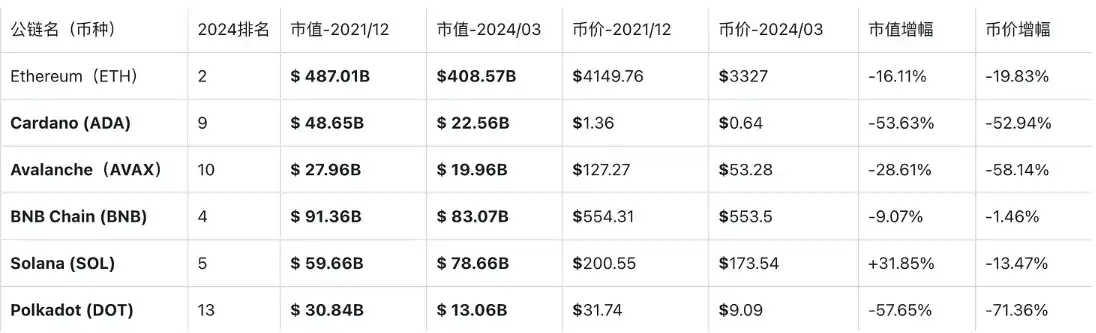
As can be seen from the table, after a round of bear market, the prices of all currencies have declined.
Among them, BNB has the smallest decline. After the recent bull market correction, it has basically reached the same price as the currency at that time. The gap from the ATH (All-Time High historical high) of $690 in 2021 is gradually shortening.
Next is SOL.
Although the currency price recorded today has dropped slightly from that time, in the middle of this month, the Solana chain ushered in a wave of pre-sales of multiple 10,000-fold meme disks, which also raised the currency price to a maximum of $208, which is higher than the record at the end of 2021. The data has climbed slightly.
What is even more noteworthy is that among these five "Ethereum killers", SOL is the only currency with an increase in market value, with an increase of +31.85%. Some time ago, the market value even surpassed BNB and ranked fourth.
The prices of the remaining three currencies (ADA, AVAX, and DOT) all experienced sharp corrections of more than 50%, among which the native token of Polkadot, DOT, fell by more than 71%.
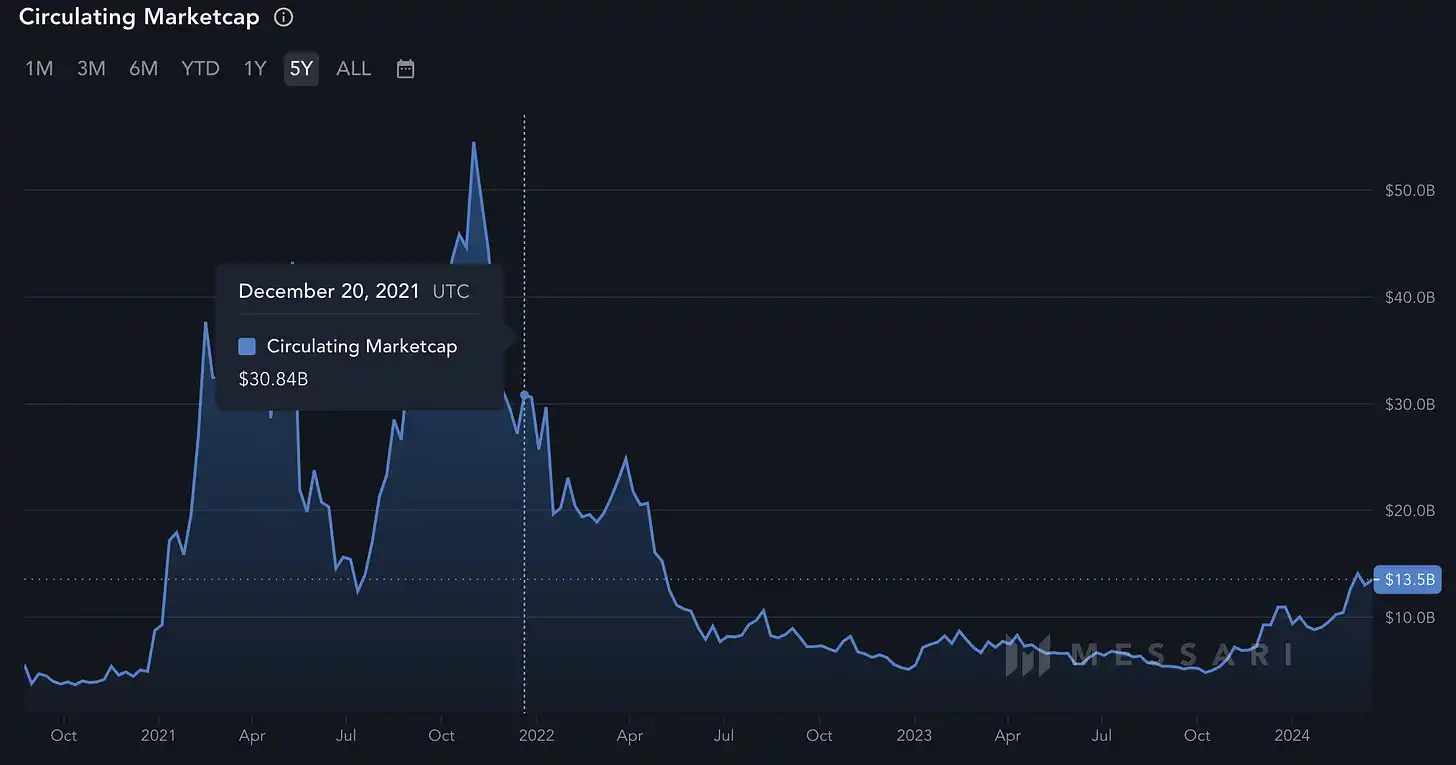
At that time, 2021, when Lachlan wrote the article, was a year of great harvest for the cryptocurrency market, and the future seemed to be unlimited:
The price of Bitcoin reached a then-new high of $69,000, Coinbase was listed on Nasdaq, the U.S. Securities and Exchange Commission (SEC) approved the first Bitcoin futures ETF, the rapid popularity of NFT and the Metaverse concept brought unlimited increases...
However, with the cyclical fluctuations in the industry, as well as the global epidemic, U.S. interest rate hikes, and the Luna black swan incident, a large amount of capital has accelerated its departure from the Crypto industry. As a result, the crypto world has also ushered in a bear market, and the targets that were generally optimistic at the time have also welcomed A full and deep correction is coming.
In such a market full of randomness and volatility, ups and downs are normal.
But how can we travel through the ups and downs of bulls and bears in the sea of time, and still be able to land neatly ashore and rush to the next sea area after going back and forth, instead of being washed away by the sea water and leaving little of the body?
Perhaps we can get a glimpse of it from the performance of these "killers".

4. In a bear market, the market value does not fall but increases. What is Solana’s “ trump card ”?
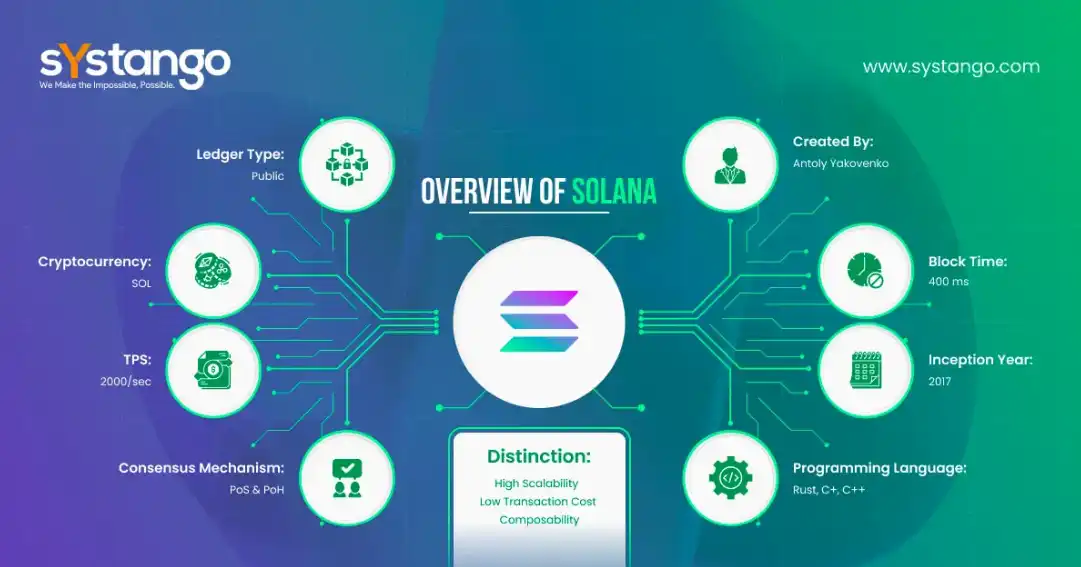
First, let’s briefly introduce various information about Solana——
· Founder’s background:
The founder, Anatoly Yakovenko, previously worked as a core engineer at Qualcomm in the United States and has extensive experience in performance optimization.
· Background of the project:
Initially, I wanted to create an order book trading platform on the blockchain, but found that Ethereum was unable to host large-scale on-chain transactions. In early 2018, Anatoly decided to build a smart contract platform with Raj Gokal.
· Financing and cooperation project parties:
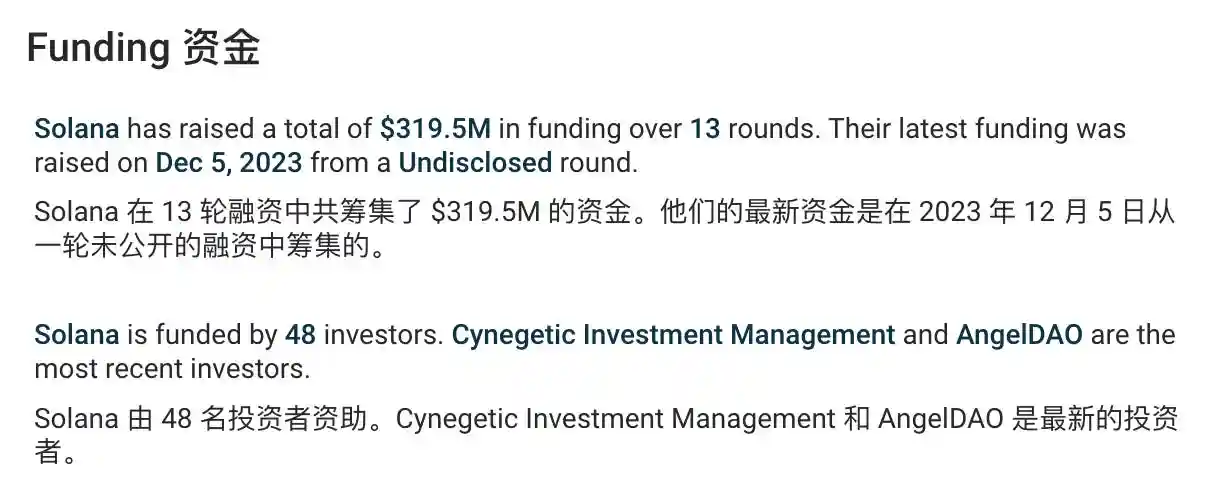
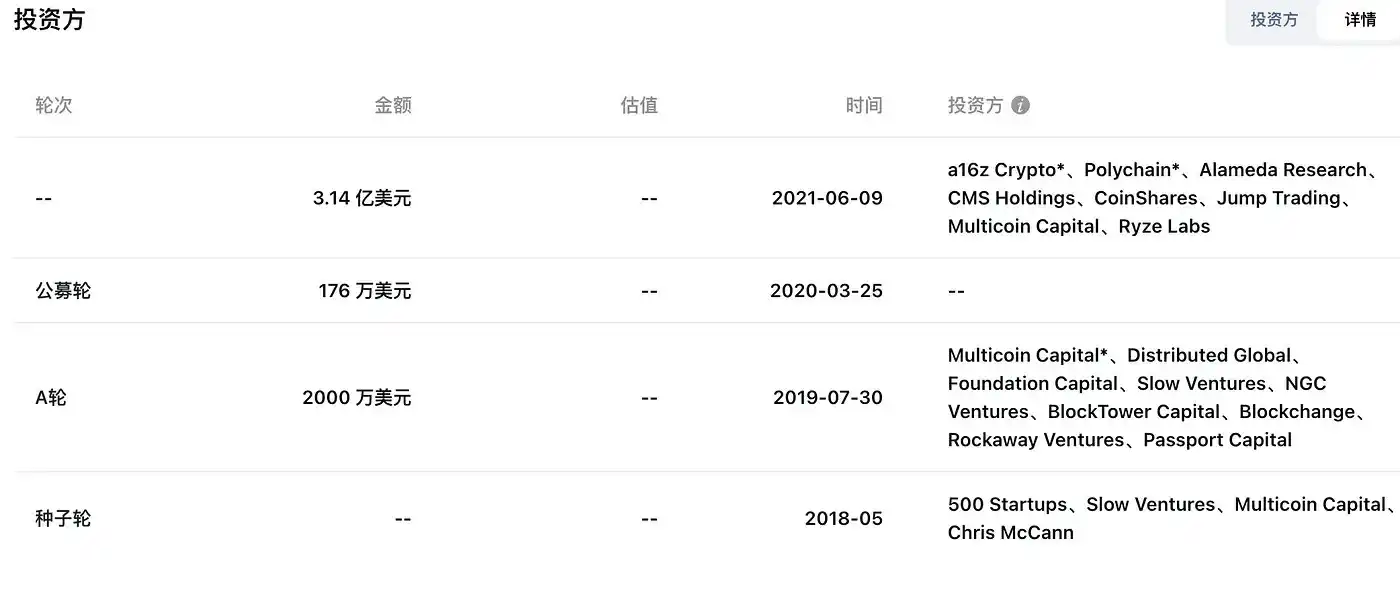
According to Crunchbase statistics, Solana has conducted 13 rounds of financing so far, raising a total of approximately US$320 million. The largest single financing was US$314 million in June 2021, led by Andreessen Horowitz (a16z).
In the remaining rounds of financing, Multicoin Capital (which has been with the founding team since the seed round that no one cared about), Jump Crypto, and Alameda Research also provided considerable support.
· Differentiating features:
The performance label that a public chain is most proud of is often written on the official website page.
There is a striking sentence on the homepage - "Powerful for developers. Fast for everyone."
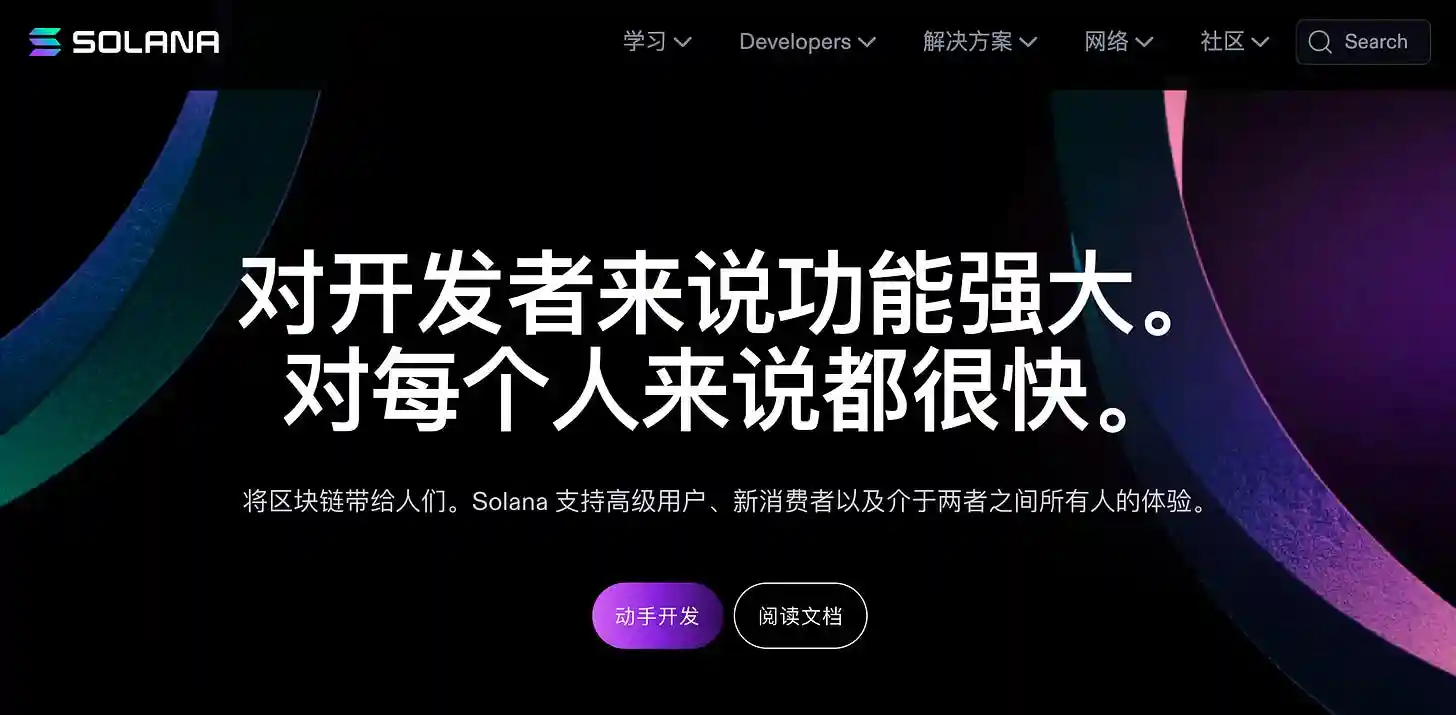
It can be clearly read from this official slogan that Solana is very confident in the underlying technology of its public chain, and its vision is relatively simple and pure.
Mainly for two groups -
1 Developers “can use innovative capabilities on the chain to develop functions to the extreme”
2Every user "transacts on the chain fast, really fast."
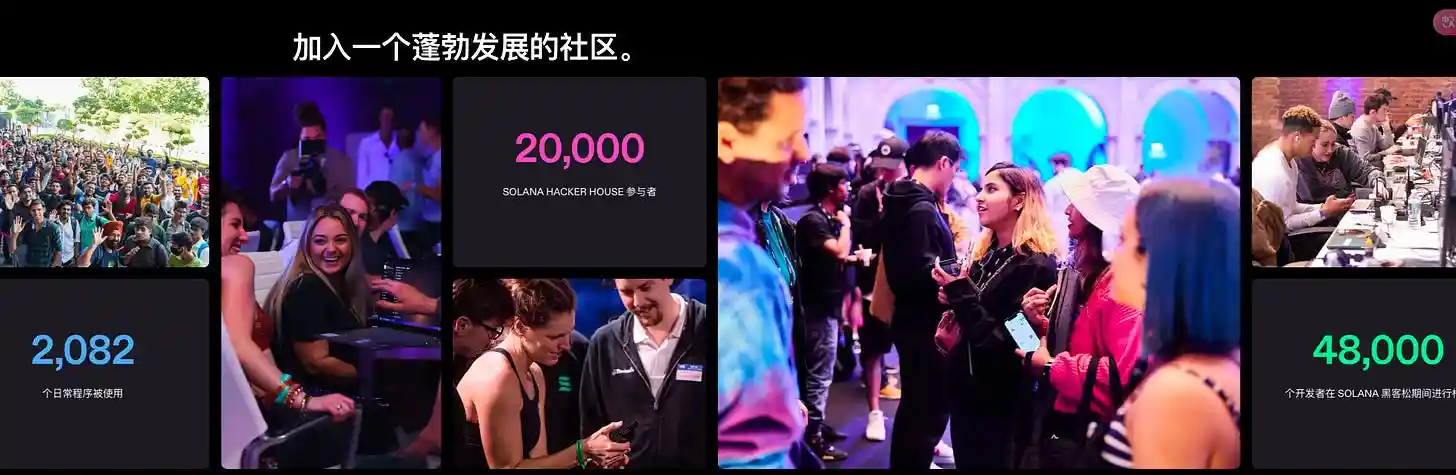
Keyword 1: Communities of Millions
-More than 20 million active addresses
-Over 200 million NFTs have been minted on the chain
- Solana Hacker House has 20,000 participants
-4.8W developers participated in projects during the hackathon
Keyword 2: Mass Adoption
-The average cost of each transaction in "Economy" is 0.00064 (in contrast to the gas fee on the Ethereum chain, which can often reach tens/hundreds of dollars)
-The "fast" block generation time is 4s, and can process approximately 3170 transactions per second (Ethereum block generation time is approximately 15s, and can process 25 transactions per second)
- "Decentralization" is verified by 1717 independently operating nodes, ensuring that your data remains secure and censorship-resistant. (There are currently 8188 nodes on the Ethereum chain)
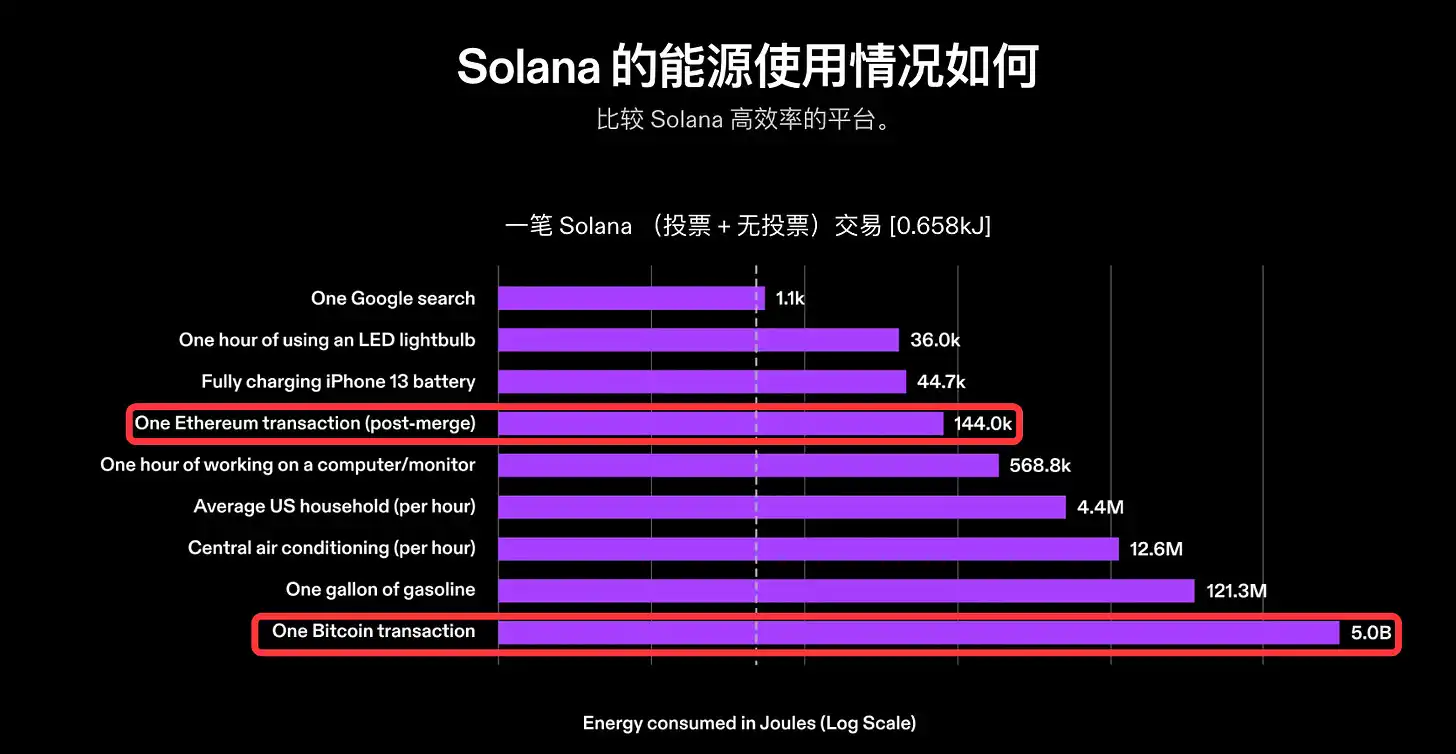
- "Energy Saving and Net Carbon" creates an innovative combination of PoS (Prove of Stake) and PoH (Prove of History), which is a new timing method for distributed systems. This mechanism allows the network to operate without the need for traditional Consensus can be reached within a meaningful block time interval, thereby increasing transaction speed and greatly saving energy. (A single PoS consensus mechanism is implemented on the Ethereum chain)
Keyword 3: Growth (Growth in All Aspects)
- "Payment" The Solana Pay protocol is connected to physical merchants such as Visa and Shopify, allowing users to use SOL or any other Solana-supported token (such as the stable currency USDC) for real-time payment, with extremely low handling fees and no need to involve banks or Third parties such as payment processors.
- "Game" uses solid technology to ensure the normal operation of multiplayer online game projects on the chain, achieving fast response and low latency, such as Star Atlas, Aurory, etc.
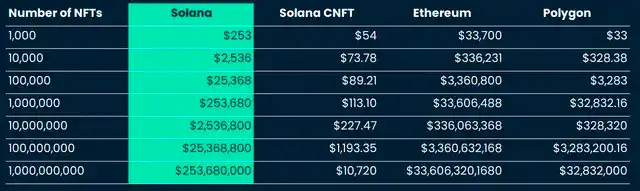
- "NFT" uses state compression technology to reduce the cost of NFT casting to $0.00011, helping projects to issue collections on the chain at a large scale and at low cost. That is, it only costs a few hundred dollars to mint thousands or even millions of NFTs.
-The total value locked (TVL) on the "DeFi" Solana chain has exceeded US$11 billion, and the average 24-hour transaction volume has exceeded 400 million. It is its solid infrastructure that allows the chain to undertake a variety of super-fast, simple and cost-effective transactions. DeFi applications.
summary:
As the number one in the reserve echelon of "Ethereum Killer", Solana's trump card is "I have what you have, and I have what you don't have."
Like Ethereum, Solana understands that strong infrastructure technology is the cornerstone for the prosperity and development of a public chain.
Therefore, it attaches great importance to creating an active developer ecosystem, holds hackathons to attract outstanding developers, and actively attracts investors to inject capital support into various high-quality young entrepreneurial teams on its chain.
For example, it has given birth to Phantom Wallet (a smooth and easy-to-use browser wallet), top DeFi applications such as Raydium (DEX), Magic Eden (NFT trading platform), StepN (M2E fitness game) and so on.
In order to maximize performance, a consensus mechanism combining PoS and PoH was created to improve scalability and sustain high throughput, thereby reducing transaction delay time and transaction fees, thus optimizing user experience.
Of course everything has two sides.
There have also been many security incidents such as large-scale downtime and theft on the Solana chain.
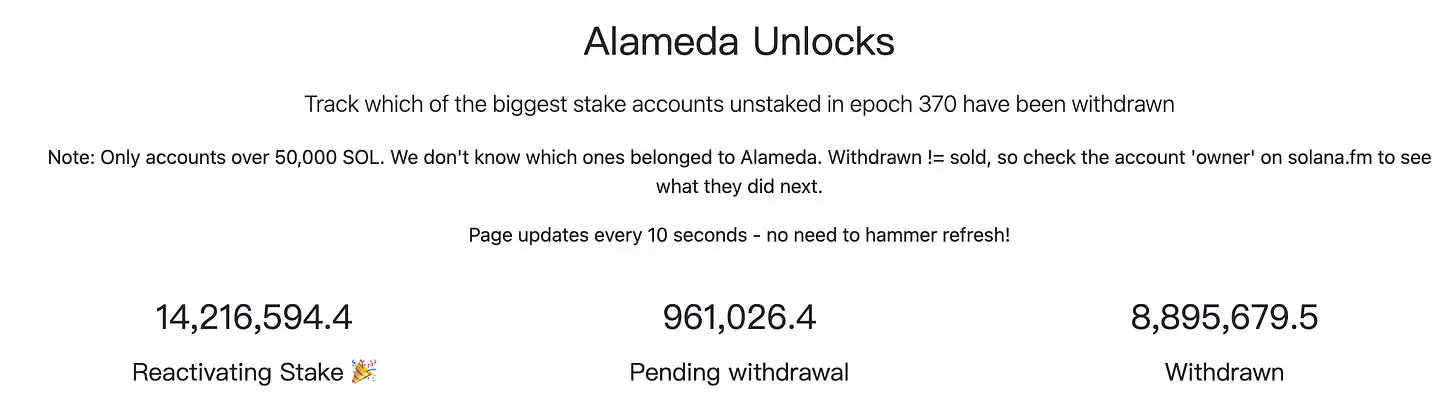
In particular, the bankruptcy of FTX in 2022 and the disgrace of founder SBF (an early supporter and active investor of Solana) also affected the price of Solana's currency to plummet to single digits. And FTX/Alameda Research still holds a large amount of SOL tokens to be unlocked. This part of the assets is gradually being liquidated. It remains to be seen whether it will have a certain impact on the market.
But what is worthy of recognition is that after leaving the halo and protection of various big bosses before, Solana did not become depressed and forgotten during the trough of the bear market. Instead, it firmly blazed its own path.
Lily Liu, chairman of the Solana Foundation, has actively opened up the development territory of other countries. Developers have not given up on continuing to develop and work on the ecosystem, but have become increasingly active in innovating.
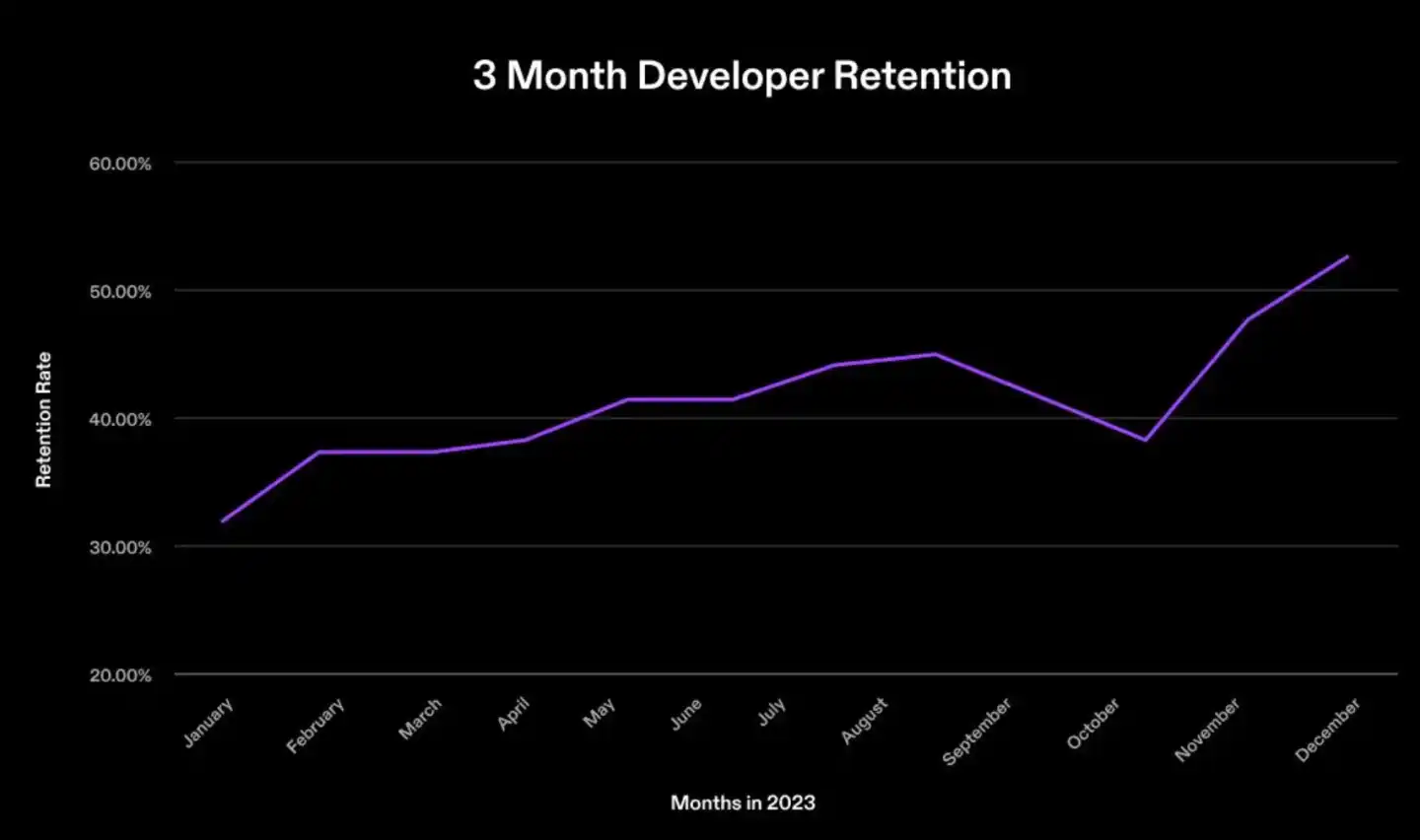
During this period, the state compression technology that is beneficial to the issuance of NFT projects was launched, the SAGA hardware mobile phone was launched, the Solana Pay payment scenario was expanded to Visa and physical merchants, the cross-chain bridging performance of Wormhole and other chains was continuously optimized, and the DePIN field was The preferred chain has brought more DePin projects (such as Helium Mobile’s token MOBILE, which has increased tenfold in a week) to users, and various meme crazes have broken out on the chain...
It is this kind of evidence that constantly "refreshes the sense of existence" that allows investors to see that there are still unlimited opportunities on the Solana chain. The currency price in the single and tens of digits is a value depression. The general optimism also allows Solana to rise. People have completed a "rebirth from the ashes" without shame and will return to the battlefield in 2024.
Excellent players such as Solana have returned to the user's field of vision. Why did the other players in the "killer" pool join the queue? How are they doing now?
5. Briefly review the ups and downs of other “Ethereum killers”
BNB Chain (BNB, the initial total supply is 200 million, and there will be multiple destructions)
Pros
1. As the first exchange in the universe, its rapid growth in transaction volume and user base has given investors hope, and Binance has also launched Binance Smart Chain (BSC) that is compatible with Ethereum smart contracts, providing a low-fee, The highly efficient decentralized application development environment has attracted a large number of projects and developers.
2. Unlike Ethereum, which has unlimited issuance, Binance adopts a unique token destruction mechanism, which uses part of the profits to repurchase and destroy BNB every quarter. This mechanism reduces the circulating supply, thereby increasing the value of BNB. .
3. BNB is not only a trading medium, it can also be used to participate in liquidity mining and IEO (initial exchange token issuance), and is also called the "golden shovel" by many users. For example, PancakeSwap on the BSC chain launched IFO (Initial Farm Offerings), allowing users to participate in the issuance of new tokens by pledging BNB in exchange for CAKE tokens.
Cons
1. In October 2022, BNB Chain was hacked, involving a total amount of more than $566 million at the time. It was also one of the largest security incidents in the cryptocurrency field to date.
2. In November 2022, the bankruptcy of the FTX exchange had a huge impact on the entire cryptocurrency market, triggering market panic and a crisis of trust. Although Binance and FTX are different entities, market panic also spread to other exchanges and their tokens.
3. Competition in the exchange market is becoming increasingly fierce. For example, last year when Inscription became popular, OKX took the lead and launched a Web3 wallet and attracted a large wave of users and funds. This also indirectly affected Binance's market share and BNB's performance.
4. As the exchange with the largest cryptocurrency trading volume in the world and a Chinese origin, Binance has faced increased regulatory pressure in the past bear market. Facing criminal charges from the SEC, it ended with the payment of a $4.3 billion fine and the resignation of founder CZ as CEO.
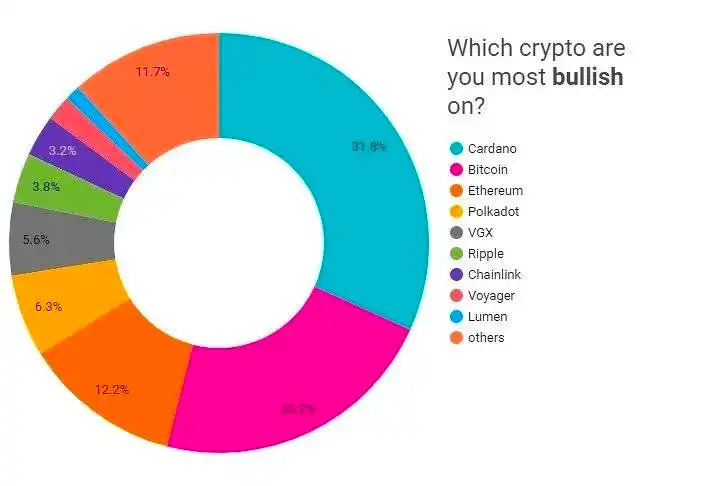
Cardano (ADA, maximum total supply 45 billion)
Pros
1.Cardano uses a new algorithm called Ouroboros, which is essentially a proof-of-stake mechanism (PoS) designed to provide high energy efficiency, security, and scalability. And it uses a two-layer system operation, the settlement layer (CSL) is used to process transactions, balances, smart contracts, etc.; the computing layer (CCL) is used to handle data storage for future applications. Each layer can be upgraded independently without slowing down transactions on the other layer, also to provide higher transaction processing speeds (TPS) and lower transaction fees.
2. For interoperability and fork issues, Cardano/ADA solves them through side chain and smart contract technologies respectively, allowing different mainnet coins to be safely converted and avoiding fork incidents, while providing an example for industry development.
3. A large amount of funds were raised in the ICO as early as 2017. It was one of the second largest ICOs at the time and has accumulated the loyalty and recognition of many old users. And Cardano is jointly promoted and developed by three teams, with a detailed and clear division of labor:
●IOHK (Input Output Hong Kong): A Hong Kong company composed of hundreds of elites led by founder Charles Hoskinson, responsible for technology development.
●EMURGO: A Japanese company responsible for Cardano's project ecological layout, supporting and incubating other project teams in the ecosystem, and solving funding problems (most of the early financing came from Japanese public investors, so Cardano is also nicknamed "Japanese Ethereum" ).
●Foundation: The Foundation is responsible for the financial supervision of Cardano, formulating ecological regulations and standards and community construction, popularizing and promoting the Cardano protocol, and is responsible for communication and supervision with the government.
Cons
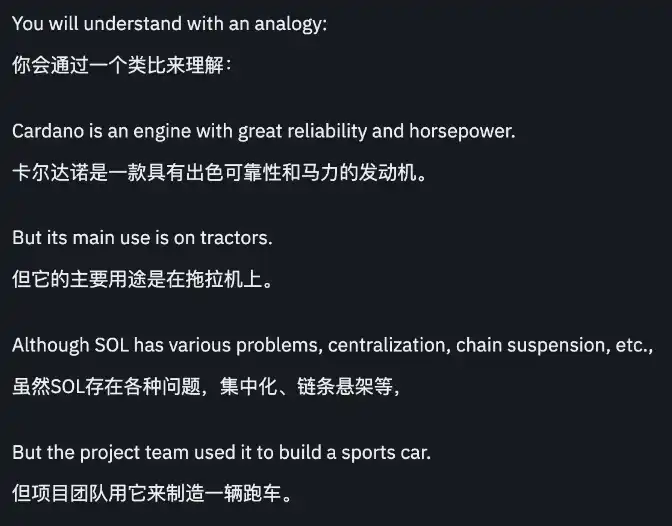
1. The development progress is slow. There has been no "killer application" for several years, and the operation team's promotional words are not grounded enough. Users say that engineering is too obscure and difficult to understand.
2.Cardano as the basis of the network is built on the Haskell language, and the smart contract programming languages on it are Plutus, Marlowe and Aiken. Compared with other projects, the Solidity/Rust/Move language is still relatively niche, requires higher-level software engineers, and has high development entry barriers.
Avalanche (AVAX, maximum supply 720 million)

Pros
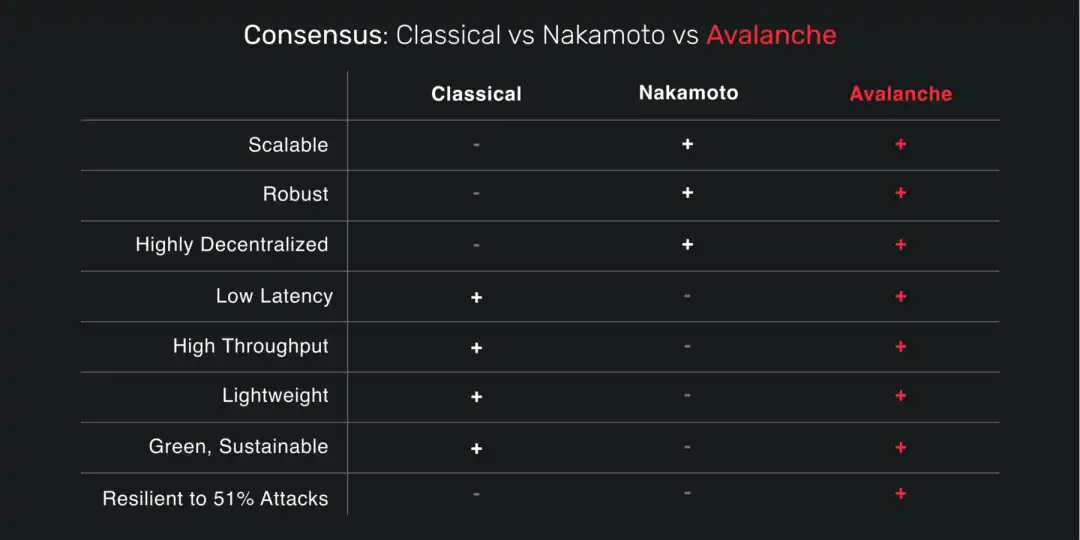
1. Avalanche is a blockchain on Layer 0 under construction. The protocol consensus mechanism is a brand-new consensus algorithm that combines the advantages of classic Byzantine Fault Tolerance (CBC) and Satoshi Nakamoto Consensus (PoW), through random sub-sampling. (random subsampling) to achieve scale, security and high speed. (For detailed explanation, please refer to this article compiled by BlockBeats: https://www.theblockbeats.info/news/28137 )
2. Avalanche chain consists of 3 subnets, namely: transaction chain (X chain), contract chain (C chain) and platform chain (P chain). This brand-new mechanism improves the overall transaction speed on the chain. Officials claim that the throughput of each subnet is as high as 4,500 TPS.
3. The foundation launched Avalanche Rush, a $180 million liquidity mining reward program, aiming to attract more DeFi projects and users to join the ecosystem. This plan has significantly increased DeFi activity on Avalanche and increased on-chain TVL.
4. Not only supports sub-second confirmation, but also supports access to a variety of virtual machines, such as EVM and WASM, making it an Ethereum-compatible blockchain. Through the cross-chain bridge, assets can be easily transferred to Avalanche for trading, providing more choices for DeFi users.
5. In the gaming field, because subnet technology allows each game to build a customized chain according to its own specific requirements, this means that game developers have great flexibility to optimize the performance parameters of the blockchain. Game developers can even provide Gas-free transactions to lower the threshold for players to participate in the game.
6. Actively seek other opportunities for growth. For example, the foundation launched the "Avalanche Vista" plan to support the value of tokenization of off-chain assets; realize interoperability between Uniswap and Avalanche through LayerZero; JPMorgan Chase and Evergreen Subnets collaborated to build a proof-of-concept demonstration area The potential of blockchain technology, smart contracts, and tokenization in automated portfolio management; AvaCloud joins forces with Citibank to test the feasibility of leveraging blockchain infrastructure for foreign exchange trading; helps Amazon provide computing power and storage, and more.
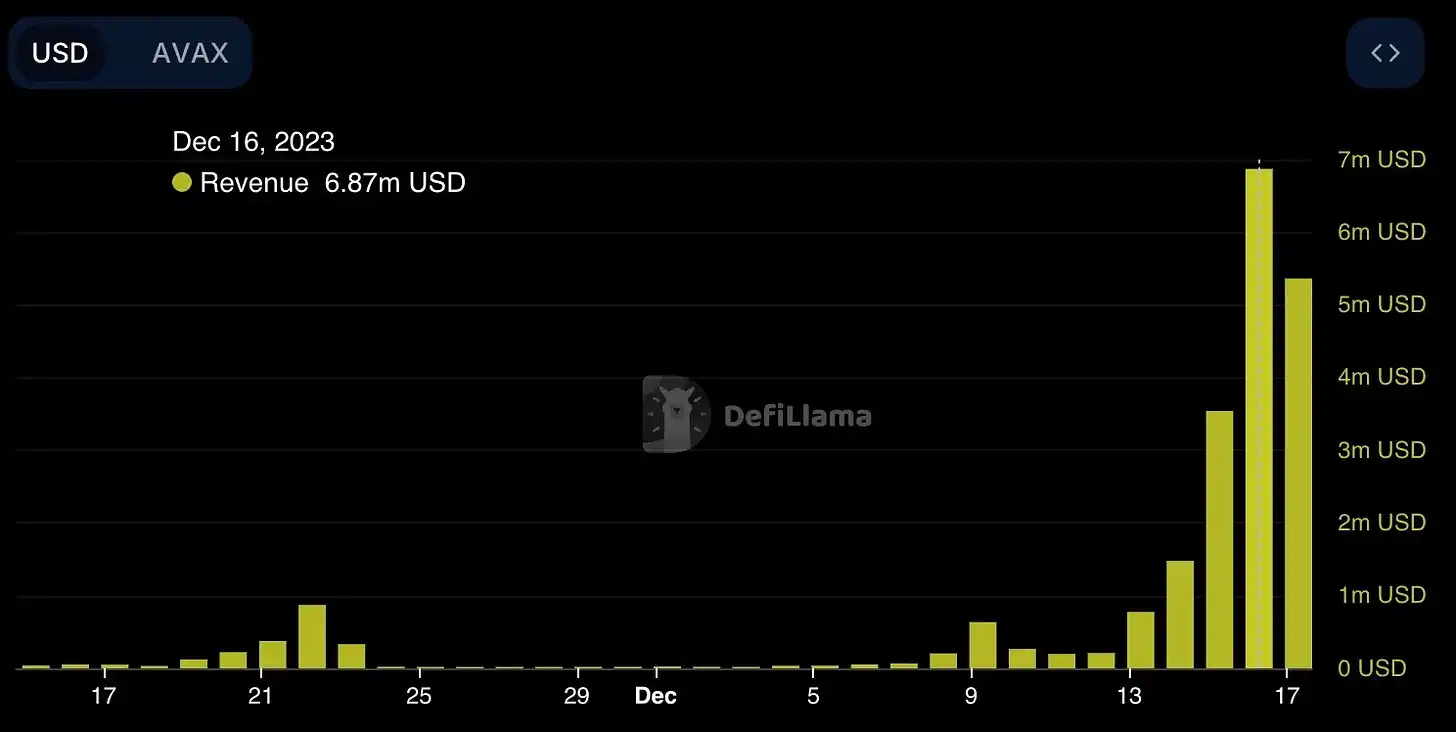
7. At the end of last year, it actively embraced the popularity of inscriptions. Within a week, the transaction volume of inscription casting and trading on the chain exceeded 10 million US dollars.
Cons
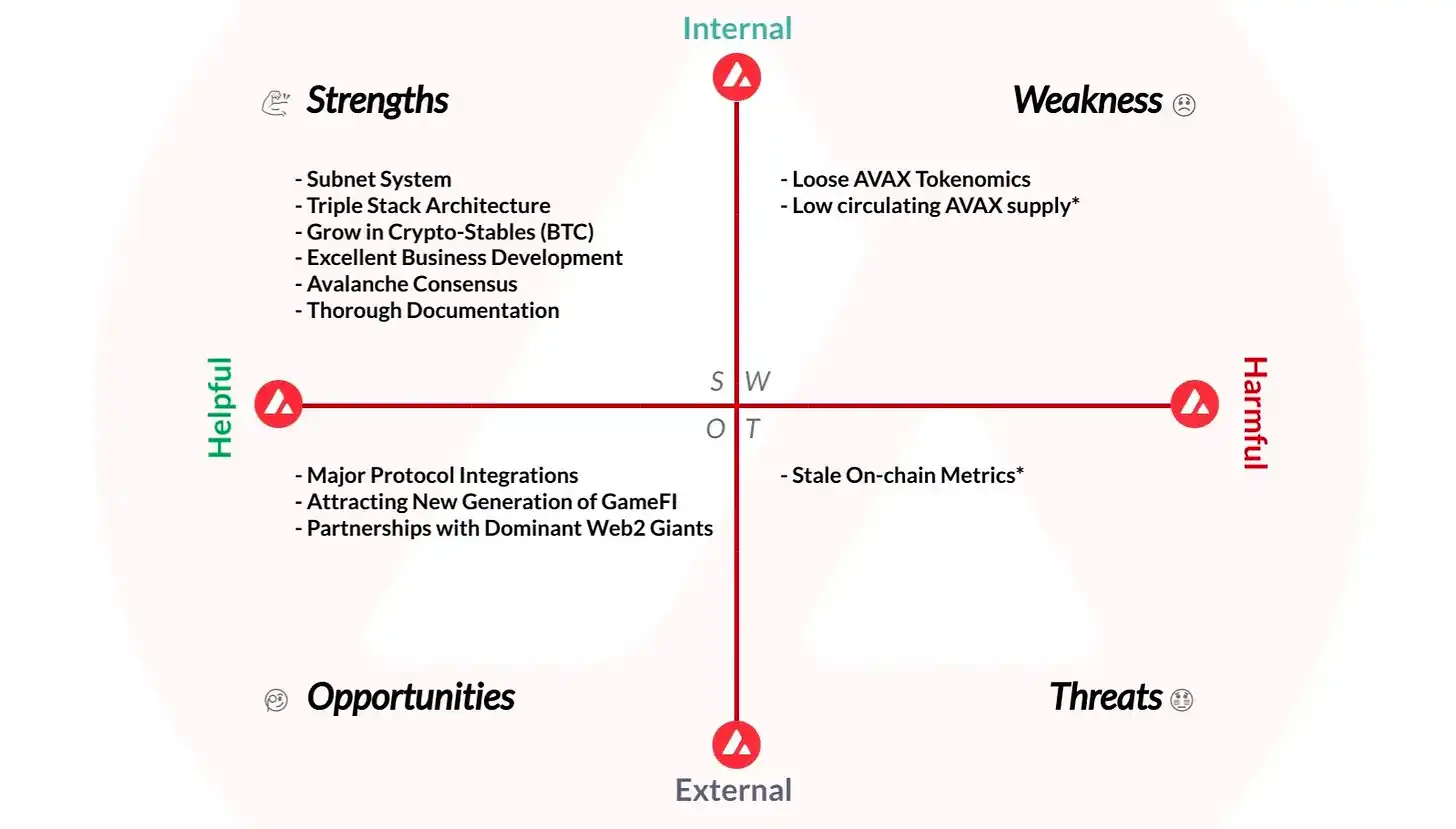
1. AVAX has a low circulating supply (~48%), leading to potentially undesirable price suppression and excessive volatility.
2. Avalanche’s ecosystem and tokens are not closely linked, and the current token economic model does not require subnets to pay for their activities in AVAX.
Polkadot (DOT, unlimited inflation token)
Pros
1. Polkadot is a project built on Layer 0 of the Web3 Foundation and was founded by Gavin Wood, one of the co-founders of Ethereum.
2. Polkadot uses the Nominated Proof of Stake (NPoS) mechanism to elect validators, and the GRANDPA mechanism to finalize the consensus algorithm of the block. This dual governance model ensures the decentralization and strong security of network decision-making. .
3. Polkadot is called a "multi-chain network" and aims to seamlessly integrate various blockchains, allowing communication and data transfer between chains. Parachains are a unique structure in the Polkadot network. They are connected to the Polkadot mainnet through Polkadot’s Relay Chain, aiming to achieve parallel interoperability between multiple blockchains. flexibility and scalability, while maintaining their independence and security, and also improving network throughput.
4. Invented the Parachain Auction narrative. That is, in order to connect to the relay chain, the parachain needs to obtain a slot through auction. The auction process is decentralized, with DOT tokens locked to bid for slots.
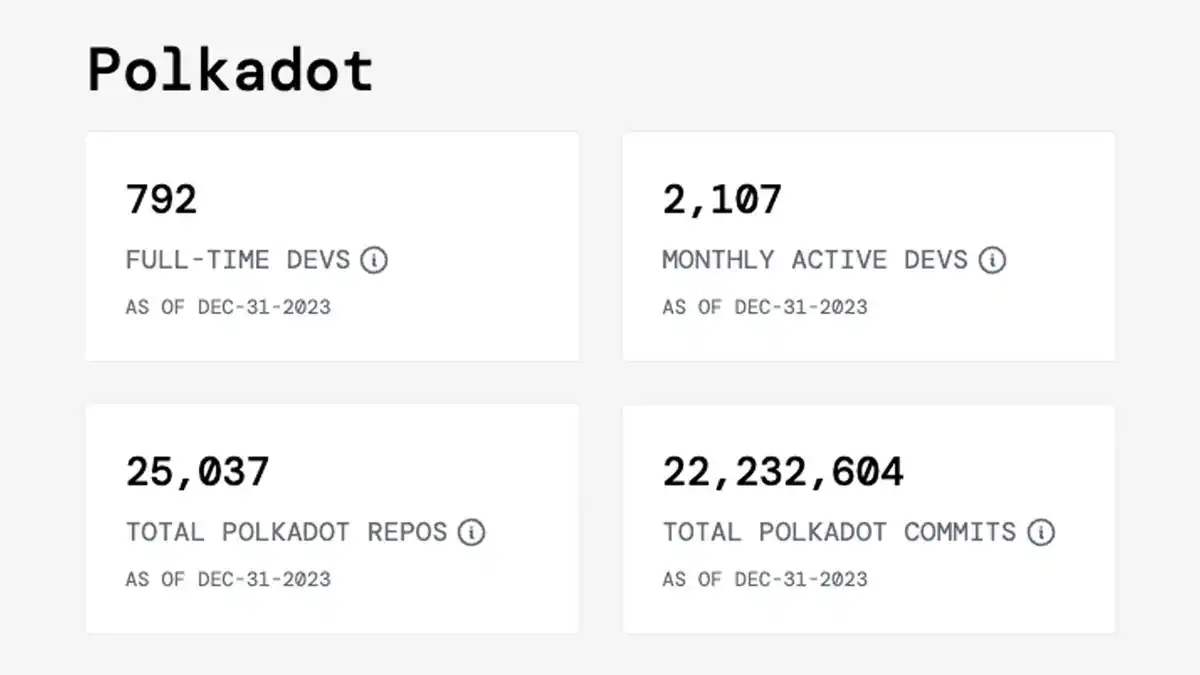
5. The developer ecosystem is active. According to the 2023 developer report released by Electric Capital, Polkadot network developers submitted a total of 22,232,604 pieces of original code throughout 2023. Developer contributions accounted for 10.5% of all code submissions in the Web3 field, and it has the second largest number of full-time developers. The number, second only to Ethereum, reaches 792.
Cons
1. The Polkadot ecosystem is relatively complex, and its working principles and technical details are difficult for ordinary users to understand, which increases learning costs and participation thresholds.
2. Although the cutting-edge decentralized governance model OpenGov has been launched, few voters actually actively participate in voting and proposals, making the final decision-making process centralized and lacking community participation.
3. The activity declined after the first round of slot auction, and new stories are needed to reactivate users. Moreover, the number of parallel chains that can be supported is limited, and the auction system is not friendly to start-ups and small innovators with small amounts of capital.
4. There is a gap in information transmission and feedback between Polkadot officials and users. The latest developments cannot be synchronized to the community in a timely manner, and the communication skills are not plain and easy to understand.
5. In terms of economic models, the inflation rate is high and the use scenarios of DOT tokens are relatively limited, causing some users and investors to have doubts about the actual use and long-term value of the tokens.
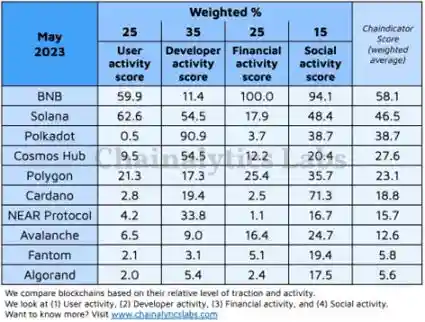
According to Chainalytics Labs’ mainstream public chain activity statistics in May 2023, from the four aspects of “user activity”, “developer activity”, “financial status”, and “social activity”, Polkadot in addition to development User participation ranking is relatively leading, and other scores are very different from BNB and Solana. The user activity index ranking is even the lowest, and the overall ranking ranks third.
summary:
After searching for these famous public chains according to the timeline and pictures, looking back, I just feel a little confused.
The crypto boom in 2021 has made these star public chains unparalleled, but now more than two years later, they are basically still recovering from the severe losses of the last bear market. Looking back, the reporter who wrote the article on forkast at the time also wrote about it as early as early last year. I stopped writing and stopped working, and the X account homepage no longer paid attention to or updated any content about the encryption industry.
There are too many stories about high-performance public chains. From the beginning, everyone’s eyes lit up, but later the actual delivery results were unsatisfactory, making people no longer easily buy into such narratives.
5-1
Almost every chain uses "high throughput" and "low transaction fees" as the ticket to the "killer round", but they also have their own differentiating highlights——
BNB Chain (BNB): As the first chain in the universe, the large number of users that its own CEX attribute can bring naturally gilts the token. BNB has also been given the leverage to participate in liquidity mining and IEO. When the currency becomes a golden shovel that can leverage more benefits, the long-term demand for it by investors and users is naturally self-evident.
Cardano (ADA): Unique and detailed team division of labor, it has accumulated a large number of audience support and investor attention in the early stage. Subsequent development progress was slow, there was no "killer application" for several years, and it was far away from community members. Some users quietly left during this period.
Avalanche (AVAX): The groundbreaking protocol consensus mechanism and the three subnets each performing their own duties have greatly optimized its transaction speed. Low latency and low fees have made Avalanche Chain's achievements in the gaming field even more dazzling. It has cooperated with South Korea and other "MapleStory" games to launch a Web3 version called "MapleStory Universe". And it also actively pursues various marketing rules, embraces hot narratives, such as inscriptions, cooperates with Web2 companies, and strives to become the preferred platform for traditional companies to issue encrypted assets on the chain, etc.
Polkadot (DOT): Its multi-chain structure and extremely active developer ecosystem are its strongest bargaining chips. But it may also be because it develops engineering-oriented technologies too one-sidedly and neglects mental education and external marketing within the community. When the value of tokens is cut in half in the bear market, it is difficult for Polkadot Chain to retain users who have little knowledge of technology and insufficient faith.
5-2
During the process of data collection, what impressed me most was actually a 30,000-word long article from the "Polkadot Ecological Research Institute" on the Polkadot chain: "10,000-word strategic report: How Polkadot can get rid of growth difficulties and the way out for the future Where exactly is it?". (I strongly recommend that everyone click on it and read it. You will really be moved by this sincerity and intention.)
This organization has focused on researching Polkadot and the development opportunities and prospects in the Polkadot ecosystem for five years. It has received support from the Polkadot treasury six times in a row and is the OG team in the community.
In the article, the researcher team not only sincerely acknowledged the prevalence of negative emotions among users in the community, but also analyzed in detail the current situation of Polkadot Chain, the technical achievements achieved, and even problems in the operation of social media accounts, as well as the obvious advantages and disadvantages of the public chain. etc.
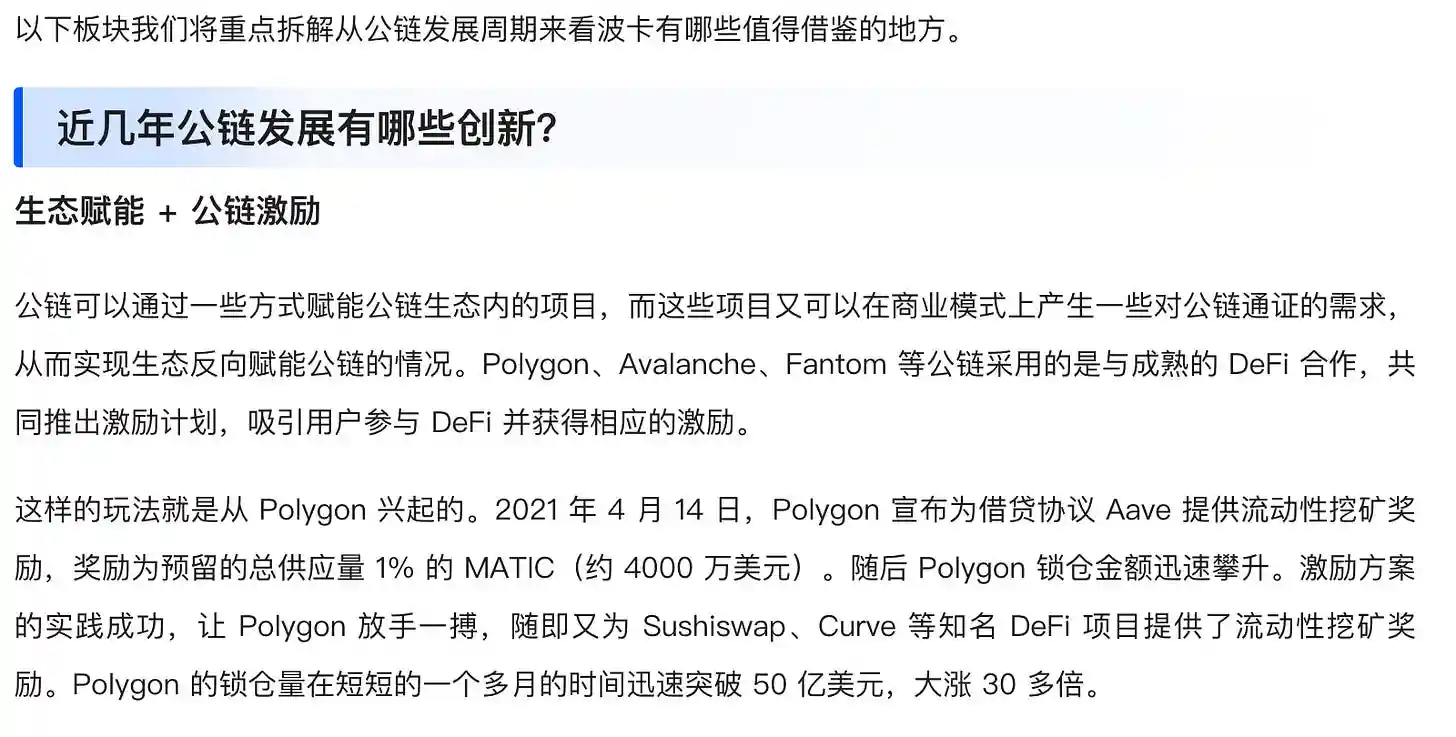
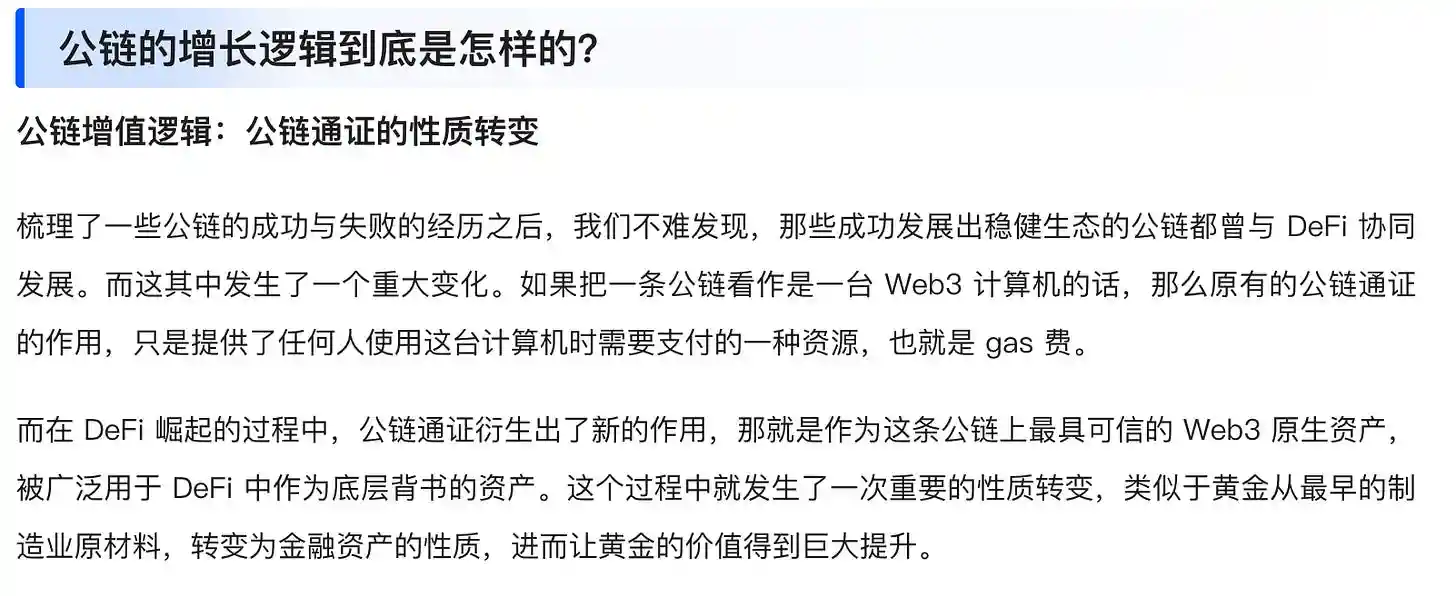
In addition, the team also thoughtfully shared some derivative thinking content, such as "What innovations have been introduced in the development of public chains in recent years?" "What is the growth logic of public chains?".
In addition to paying attention to the Polkadot chain itself, researchers also find shining points and improvement points from other public chains that perform well or poorly in the market, and use these points to feed back and think about how Polkadot chain can break through.
5-3
Combining the opinions in the report and my feelings after swimming in the sea of information, the following opinions can be output:
5-3-1
The most unavoidable word in the Crypto world: "Follow the trend"
In a bear market where development is generally sluggish, funds have become conservative and have withdrawn, and user enthusiasm for participation has also faded.
The price trend is unstable or even declining, and the team's development progress or actual application does not meet expectations. These all bring uncertainty to investors, developers, and users.
If the project team fails to come up with an innovative narrative that grabs attention and launches a phenomenon-level application at this time, or spends most of the budget on a single financial incentive, it will not be effective, because users are more inclined to abandon the market in a precarious environment. Compared with the bull market, it is more obvious to "get twice the result with half the effort".
When the flywheel of the positive feedback mechanism cannot rotate, it will directly lead to a decrease in activity and sluggish ecological development. External investors will become increasingly hesitant to enter, causing the project to fall into a death spiral.
There is a high probability that many project parties will feel that they have encountered a bearish market at a stage when they should develop most vigorously.
The industry itself is known for its definite "cyclicality", and it is precisely because of the cycle that it leaves room for you to "arbitrage".
"Profit" for ordinary users may mean buying low and selling high, but for project developers, it means using less valuable time in a bear market to build a ladder that can jump to the bull market with less effort.
If there are cycles, there will be ups and downs, and if there are fluctuations, there will be rhythm.
If you clearly focus on adapting to the trend in the right cycle, and even make plans for the next cycle, you may have small bumps along the way, but you won't be staggering and unable to move.
5-3-2
In a market with many people and few people, the rise of a public chain is inseparable from the development of DeFi on it.
When DeFi flourishes, the tokens on that chain are often used as native token assets.
When there are more and more DeFi gameplays that can be played, it also means that the scenarios in which token tokens can be applied become richer. This playability and positive feedback mechanism make users more willing to hold tokens for a long time, thus attracting more people to join. in.
Often how many tokens can be locked in a DeFi application also reflects the liquidity, activity and user participation of the chain's ecology.
As mentioned by the Polkadot researcher above, it is precisely because of the slow development of Polkadot chain technology and the late launch of DeFi applications that all the dividends at the end of the bull market have caused more than half of the market value to evaporate in the bear market.
“DeFi can empower other projects on the chain in the same way as traditional financial empowering entities. It can not only bring more composability and higher asset utilization to the assets of other projects, but also provide benefits to the entire public. The chain leverages out more funds.
DeFi is to public chains what banks and other financial institutions are to cities. It is an important financial infrastructure. Therefore, under the premise of limited resources and limited time, giving priority to the development of DeFi is the primary goal of the public chain. "
5-3-3
The investors who pay the most are those project parties with the strongest ability to deploy "people".
We must admit that every round of prosperity must be accompanied by bubbles.
When a cyclical retracement occurs, these bubbles will be the first to burst and dissipate.
Only by retaining real users and constantly attracting new people can the top of a glass of beer be filled with beautiful foam and attract the attention of investors.
When the goal in a bear market is more focused on "people",
It will make the project party cherish the existing developers and users more, share every step of the plan, and make the collective feel more involved;
It will force the project team to be more innovative and come up with new narratives that can attract more people;
This will make the project team more sensitive to "peopled scenes". If web3 is empty, go to web2 to find an increase.
…
You can say, "Specialize in the new, not in the old" is the golden rule in Crypto.
But "old" ones like Solana, with their silent hard work and strong marketing capabilities, continue to come up with new tricks to keep people here, and can even create many new incremental entrances, such as DePIN, RWA, AI+Crypto , actively building merchant payment rails in the web2 world, and more.
It is like a good student who is not partial to subjects. Not only does he have a correct attitude, but he also has some tricks up his sleeve;
It is also like a Doraemon with a treasure bag, making people always curious and looking forward to what kind of surprises it will give people.
6. Ending:
There is no doubt that even if more powerful rivals appear and this bull market is slightly weaker, Ethereum still holds some unique and irreplaceable advantages.
It is the first blockchain platform to implement Turing-complete smart contracts;
The Ethereum Foundation has nearly the most mature blockchain ecosystem in the crypto world, the most active developer community, continuous technology development iteration capabilities, and strong management capabilities;
The chain carries thousands of decentralized applications (DApps), and has opened a Pandora's box of explosive growth such as DeFi Summer and NFT craze for the crypto world.
This vast ecosystem has provided developers with a wealth of tools and resources over the past few years, and has also attracted a large number of users and developer communities.
As the future Ethereum ETF application is expected to be implemented gradually, technology continues to upgrade, and Layer 2 capabilities become more powerful, it will also bring more benefits that are currently unpredictable to the market. These often need to be observed and evaluated over several years. get conclusion.

And I increasingly feel that the public’s belief that some celebrity public chains “covet” Ethereum is just a imaginary gimmick.
Perhaps from the beginning, these project teams did not regard Ethereum as an insurmountable mountain.
I remember what Zhang Xiaoyu said,
"Choose your competitors carefully because you may end up looking a lot like you."
These public chains, which are known as "Ethereum killers", each have their own winning formula and unique narrative. Discover the chronic disease that is limited to Ethereum. I have the corresponding antidote, and I can also learn the advantages and strengths of Ethereum, let alone think that I will be Ethereum 2.0.
They don't bother to be such-and-such killers. They will eventually open up a new track and completely go their own way.
I still hope that they and other high-quality public chains standing in this bull market can jump higher on their own ladders in the upward cycle and bring more surprises to the entire encryption market.
When the original intention of all project teams is to use blockchain technology to better achieve decentralization and ensure financial sovereignty with supreme freedom, no matter how rugged the road is, they will eventually achieve the goal of recasting the consensus in everyone's hearts. Tower of Babel.
I still believe it.