



Written by: Xiao Sa Team
In the article a few days ago, Sister Sa's team has introduced to you the causes and consequences of the 25-year sentence of Sam Bankman-Fried (referred to as SBF), the actual prosecutor of the FTX case (interested partners can check " Xiao Sa's Team" by themselves) | Breaking! The first criminal in the FTX case was sentenced to 25 years in prison, the end of an era "). With the "first criminal" being convicted and punished, the case has come to an end temporarily. For the vast majority of ordinary passers-by, investors, and creditors, SBF's severe judgment is more about "relieving hatred" and "eating melons", etc., but the most important thing that concerns their own interests is what will happen to the FTX bankruptcy liquidation case. This determines whether our claims can be effectively paid off.
In addition, the FTX case is the largest bankruptcy liquidation case in the world today and the largest global bankruptcy liquidation case for crypto assets in history. Every move in this case will attract the attention of investors from all over the world. At the same time, its handling of the bankruptcy case of a giant multinational crypto asset company The act will also become a benchmark precedent with important reference value for the world and influence judicial practice for a long time to come.
After the FTX case, the Sajie team has continuously received relevant rights protection consultations from my country's creditors. From 2022 to now, the case has also experienced multiple claims declarations. However, due to the large disputes in the actual implementation of the liquidation plan, FTX Due to reasons such as failure to complete liquidation of bankrupt assets within a short period of time, creditors have a long and distant road to repayment. Nowadays, FTX liquidation entities and claim portals have been established and opened, and the repayment of creditors is about to begin. Today, the Sajie team has specially produced the "FTX Claims Declaration Guide" for everyone, adding a new dimension to the road of rights protection for all partners. Grip.
FTX case background and liquidation team introduction
For those who are not familiar with the FTX case, Sister Sa's team will first give a brief introduction to the FTX case.
Before its bankruptcy and collapse, FTX, founded in 2019, was a world-class cryptocurrency exchange that could compete with the famous Binance. It is headquartered in the Commonwealth of The Bahamas, the backyard of the United States, and its main business is concentrated. In the U.S. FTX is huge, with hundreds of large affiliated companies and millions of customers all over the world. After FTX completed Series C financing in 2022 (led by Sequoia, Temasek, SoftBank, Tiger, etc.), its valuation has reached an astonishing US$32 billion.
The collapse of FTX was rapid and irreversible, fully embodying the theorem of "a day in the crypto, a year in the world". Initially, Coindesk, a well-known media in the crypto, published a report at the end of 2022, which revealed that up to 70% of the assets of Alameda Research controlled by SBF were actually FTT, a token with poor market liquidity issued by FTX itself. Subsequently, Binance publicly announced the liquidation of a large number of FTT tokens it held. This move triggered market panic in the current slump in the encryption industry. With everyone selling FTT, FTX was unsustainable and entered death. spiral.
After FTX collapsed and entered bankruptcy proceedings, its headquarters legal entity FTX Digital was registered in the Bahamas, but its main business was carried out in the United States through its subsidiary FTX Trading Ltd., but FTX maintained operations in both jurisdictions. Certain bankrupt assets. Therefore, on November 14, 2022, the Supreme Court of the Bahamas appointed two heads of PwC’s Bahamas office and Hong Kong as provisional liquidators to initiate the liquidation process of FTX Digital in the Bahamas. Subsequently, the U.S. Court of Delaware placed FTX Trading Limited and its related debtor entities (collectively, the "Debtors") into bankruptcy proceedings in accordance with Chapter 11 of the U.S. Bankruptcy Code, and on February 15, 2023, the company was subject to judicial proceedings. The provisional liquidation of the Bahamas is recognized.
At the end of 2023, the Supreme Court of the Bahamas appointed the joint provisional liquidator JPL as the joint official liquidator of FTX Digital and its affiliated companies (The Joint Official Liquidators ("JOL")), using the legal entity "FTX Digital Markets Ltd" specifically for the liquidation of FTX. The assets are liquidated and creditors are compensated (the liquidation process shall be carried out in accordance with the provisions of the domestic law of the Bahamas on the liquidation of international business companies).
Currently, JOL has established a special FTX claims declaration website. Customer claims, non-customer claims, and transferee claims are all submitted to the website for declaration. The declaration work needs to be completed before May 15, 2024.
FTX Debt Declaration Guide
1. Enter the FTX debt declaration and claims portal and register your own claim account
First, creditors need to enter the FTX claim declaration and claims portal: https://digitalmarketsclaim.pwc.com/
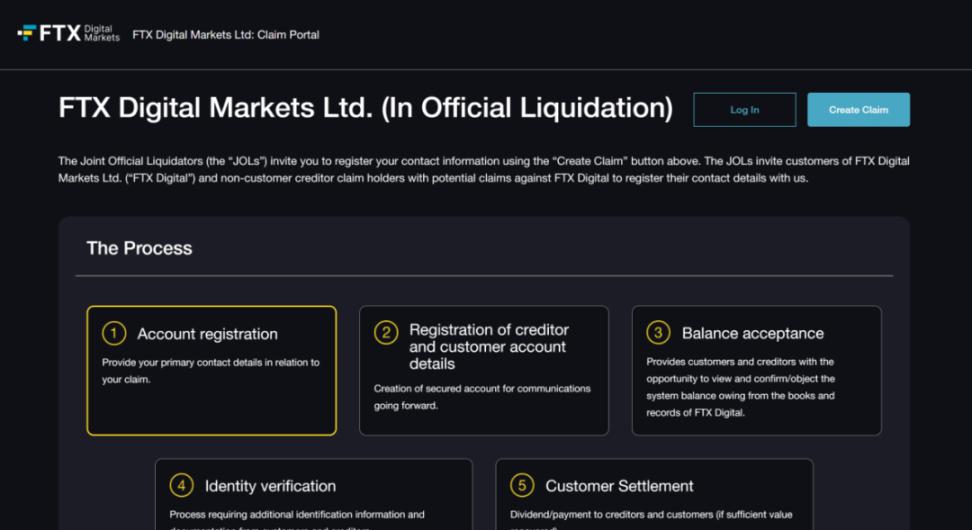
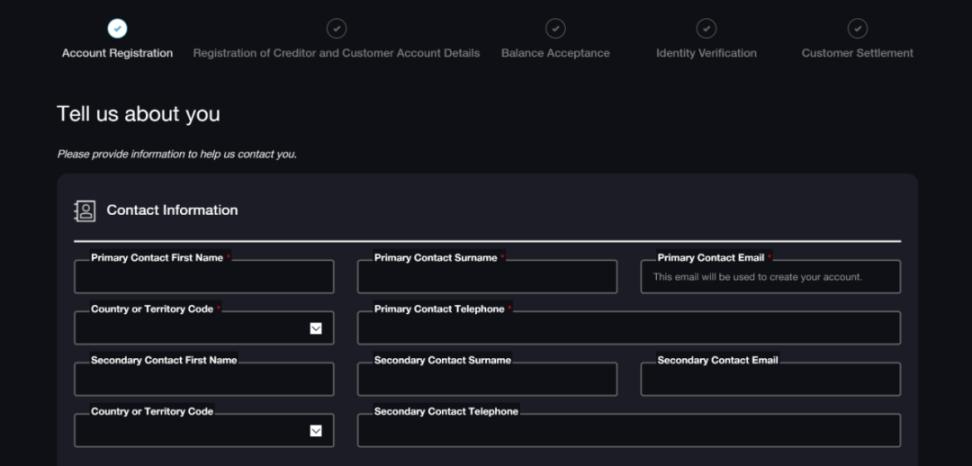
Partners who enter for the first time need to click on the blue box in the upper right corner to register a claim account. You mainly need to fill in your name, email, country and region, contact information and other information. You need to pay attention to using a reliable email to register, because every subsequent login requires a verification code to be sent to the registered email. If there is a problem with the email, it may This will result in the inability to log in normally.
In addition, partners need to pay attention to correctly selecting the claimant type. The three options are "Individual customer", "Institutional customer" and "Non-customer creditor". If you are a user of the FTX exchange and register in your own name and use the FTX platform to trade crypto assets, select an individual client; if you use an FTX account registered with a legal entity, such as a company, select an institutional client; if you are not an FTX user The customer has not used the FTX platform, but has a creditor-debt relationship with FTX or its affiliates for other reasons (such as employees employed by FTX, suppliers that provide products to FTX, etc.) and chooses non-customer creditors.
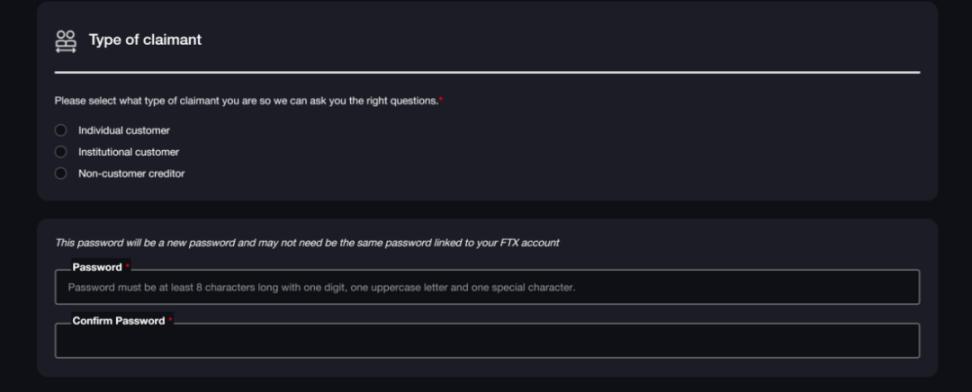
The website is relatively lenient in registration. Even if it chooses institutional clients or non-client creditors, it does not require the registrant to provide relevant documents such as the identity certificate of the authorized representative during the registration process.
2. Registration of creditor and customer account details
In this section, you need to pay attention to what kind of creditor's rights you have. If it is an individual customer or a legal person customer mentioned before, then we directly submit our account registration information on FTX on the application page of the website (taking a natural person as an example, You need to fill in your name, date of birth, phone number, address, country or region of residence, occupation, nationality, ID number, etc.), you can associate your claim account with your FTX account, and you can also check your account status after association.
After completing the account association, the website will jump to the credit balance confirmation page. Partners need to pay attention to this part. You must carefully check and check whether the balance and assets displayed on this page are consistent with the assets in your FTX account. If the confirmation is consistent, you can click the blue button to confirm, and this part of the assets will become our declared claims and enter the claim process.
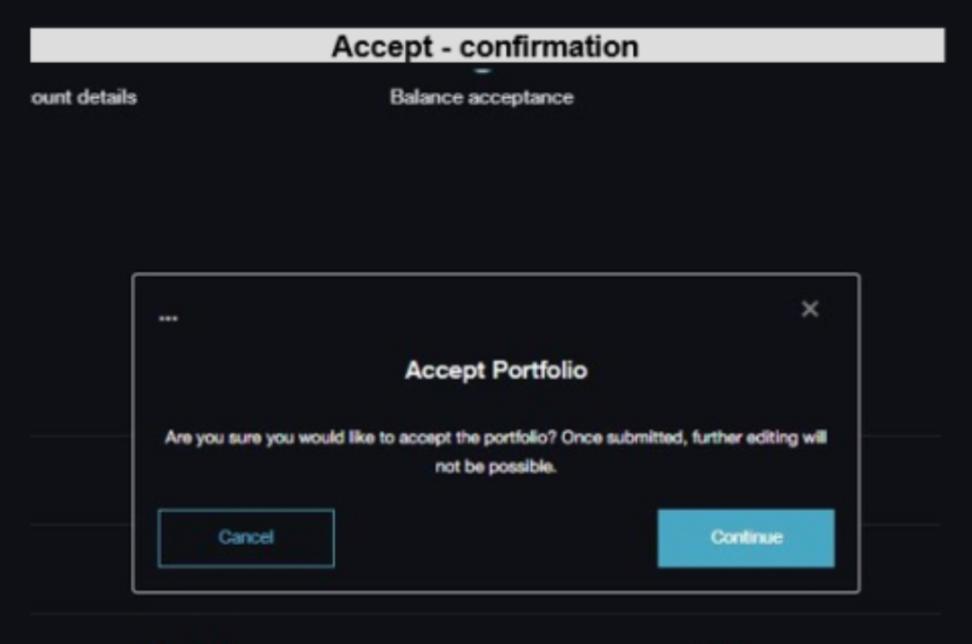
If you have any objection to the assets in the account linked to your FTX, you need to go through the Dispute Portfolio objection procedure and further provide JOL with materials about your claims for declaration. In this part of the procedure, the Sajie team recommends consulting professionals to prepare application materials that meet the requirements for objection declaration. Especially for non-customer creditor entities, it is necessary to submit qualified claims basis and credit certificates for declaration. This part The work is relatively professional and requires judgment by professionals who are familiar with the relevant bankruptcy laws in China, the United States, and the Bahamas.
In addition, for the transferred FTX bankruptcy claims, a complete proof of transfer is required before filing. For example, if the members of Sister Sa's team purchased someone else's FTX bankruptcy claims on Xclaim, they need to specifically submit the rights to transfer the relevant claims. Vouchers are used to declare claims. If there is still a guarantee for the claims declared by friends, the relevant vouchers for the guarantee need to be submitted together with the materials for claiming the claims to prevent the guarantee from becoming invalid due to failure to declare in time.
Finally, after completing the submission of the above materials, a normal KYC procedure (an identity verification procedure based on anti-money laundering compliance requirements) is carried out, and the friends' claims declaration is completed.
If you have already declared bankruptcy claims on KROLL, do you need to declare it again?
As mentioned before, the bankruptcy case of FTX Trading Ltd. in the United States has been accepted by the Delaware court, and KROLL, a well-known bankruptcy management company, is responsible for registering bankruptcy claims. Since the United States acted relatively quickly, many investors who suffered losses in the FTX case have already declared their claims on KROLL in advance. So, do those who have already declared their claims need to make a second declaration in the Bahamas?
First of all, we need to understand the legal consequences of filing on the two platforms: If you have already filed a claim on KROLL, and file again on the FTX bankruptcy claims portal designated by The Bahamas, there will automatically be two legal consequences:
(1) It shall be deemed that the creditor’s claims and claims filed against FTX Trading Ltd., its affiliates, subsidiary debtors, etc. based on the U.S. bankruptcy law are withdrawn;
(2) Bankruptcy claims are transferred to the Bahamas court, which will govern, check, evaluate, reconcile, adjudicate, resolve and pay off the creditors' claims and claims in accordance with the relevant laws of The Bahamas.

Secondly, we need to understand that in the FTX bankruptcy case, the United States and the Bahamas have reached a preliminary consensus on the liquidation of the bankruptcy property: after the liquidation is completed, the property will be distributed as a whole. Therefore, the declaration of claims based on the FTX Digital entity released by the Bahamas actually gives creditors a free choice of jurisdiction and use of law, but it will not cause creditors liquidated in the Bahamas or the United States to be repaid. Substantial unfairness occurs in the process.
This choice will not lead to an increase or decrease in the liquidation property. However, the application of such laws and the choice of judicial authorities will have a greater impact on whether the bankruptcy claims of FTX-related creditors can be recognized, the size of the recognition ratio, the raising of objections and Rulings, etc. are also related to the vital interests of creditors. Therefore, the Sajie team recommends that partners consult a professional legal team before making a choice.






