Author: Chandan, web3 Research, Translation: Plain Blockchain
This was a brief introduction to AVS and node operators, as well as the various LRT protocols, and recent developments in the field.
To become an Ethereum validator, you need two resources: 32 ETH and the hardware required to run the node software. If you lack the required 32 ETH, you can escrow your funds to a liquid staking solution. These platforms will replenish your ETH and operate a node on your behalf, sharing the rewards earned with you.
Currently, in the Liquid Restaking solutions market, Lido holds a 30% market share, followed by Coinbase with 14%, Binance with 3.88%, and other providers.
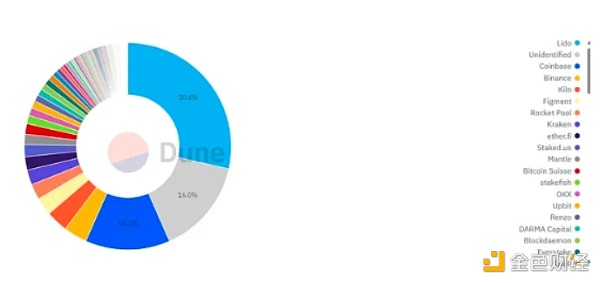
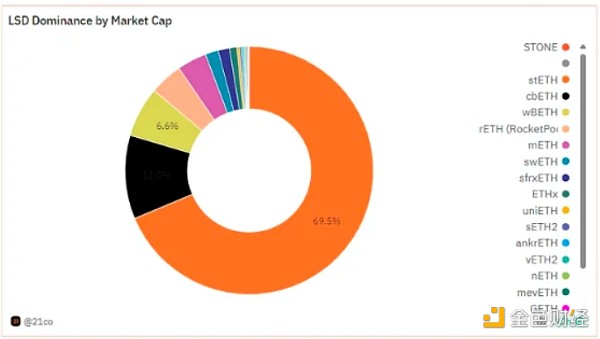
Liquid staking solutions such as Lido, Coinbase, and Rocket Pool offer derivative tokens that represent users’ staked ETH. Lido offers STETH, Coinbase offers cbETH, and Rocket Pool offers RETH. These liquid staking derivative tokens function in the DeFi ecosystem similarly to other ERC20 tokens, enabling users to provide liquidity on decentralized exchanges (DEXs), participate in lending protocols, and engage in various other DeFi activities.
1. EigenLayer
EigenLayer is a restaking protocol that advances liquid staking protocols. While liquid staking allows users to use their staked tokens in other DeFi protocols, EigenLayer makes it possible to restake ETH in other protocols that require security. Protocols that use EigenLayer's re-staking of ETH for security are called Active Validation Services (AVS).
Active Verification Service (AVS) uses the EigenLayer protocol to integrate with Ethereum’s security mechanisms, enhancing verification for blockchain applications that do not have their own consensus mechanisms.
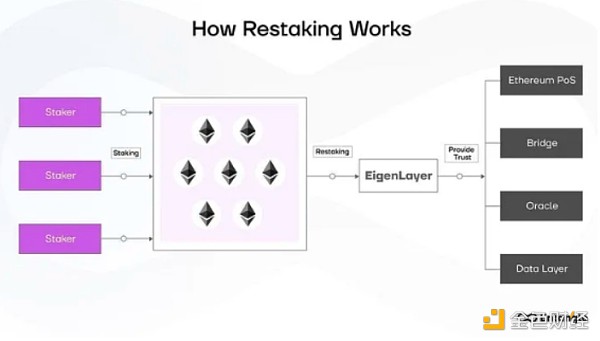
ETH is staked on both the Ethereum network and the Active Validation Service (AVS) . Well-known projects such as AltLayer, Celo, Espresso, EigenDA, Hyperlane, Mantle, and Polyhedra plan to participate in EigenLayer as early AVS. Staked ETH can earn rewards from both staking types, although it is subject to different penalty conditions.
How can ETH be staked on both the Ethereum network and other AVS protocols simultaneously ?
Ethereum validators can set withdrawal vouchers to allow ETH withdrawals, including EigenLayer's smart contract. This allows Ethereum validators to participate in AVS validation through EigenLayer's re-staking, run the required client, and set the withdrawal voucher to EigenLayer's smart contract. If the validator meets the AVS penalty conditions, EigenLayer has the right to punish ETH, making the re-staking ETH subject to both penalty conditions at the same time.
2. Node operators in EigenLayer
Node operators secure AVS transactions by re-staking their ETH on EigenLayer and receive additional validation rewards from AVS operations on top of Ethereum rewards. This provides an ecosystem with economic incentives for validators to support the AVS network.
1) What is the Liquid Restaking Token protocol?
The Liquid Re-collateralized Token (LRT) protocol aims to release the liquidity of ETH re-collateralized on EigenLayer, similar to how Liquid Staking Tokens release ETH staked on Ethereum. From an end-user perspective, the Liquid Re-collateralized Token protocol solves several inconveniences encountered when interacting directly with EigenLayer.
2) Inconveniences when using EigenLayer directly
Node Operator Selection: End users find it challenging to select a node operator on EigenLayer due to the complexity of risks and rewards that need to be considered.
Interest Compounding: Users must manually compound rewards in EigenLayer to benefit from compound interest, which incurs expensive gas fees.
Insufficient liquidity: ETH re-staked on EigenLayer lacks liquidity and cannot be easily used elsewhere.
The LRT protocol solves these problems by re-stacking deposited ETH to various operators in EigenLayer, thus standardizing the reward and risk configuration. In addition, it provides users with a tokenized representation of their re-staked ETH and rewards, enabling them to leverage these tokens in other DeFi protocols for additional benefits.
3. Different types of LRT protocols:
1) Native Liquid Staking:
The native Liquid Restaking protocol takes all the functionality of the traditional Liquid Staking protocol and adds an extra layer to create EigenPods for restaking with different EigenLayer node operators.
Ether.fi:
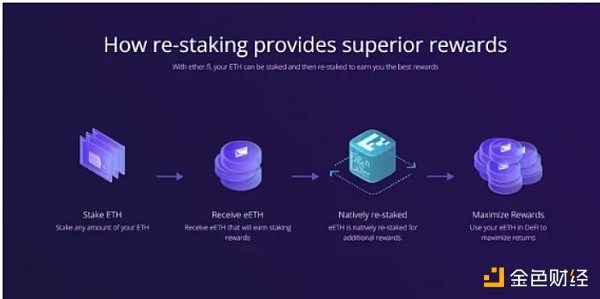
The protocol enables users to mint eETH, the first native liquid re-staking token on Ethereum, by staking their ETH. By minting eETH, users can benefit from rewards generated by staking and re-staking activities conducted through Ether.fi.
Ether.fi is the only protocol that gives stakers control of their keys, reducing counterparty risk for both node operators and the protocol.
Ether.fi runs Operation Solo Staker, which further decentralizes Ethereum by launching nodes in different geographical regions.
Puffer
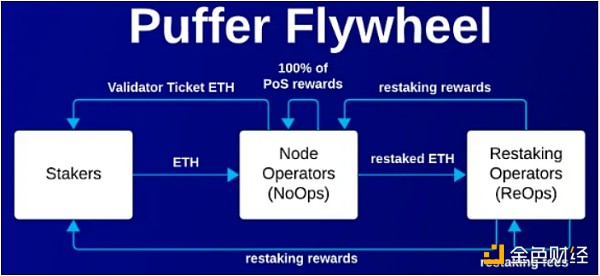
Puffer is a decentralized native liquid staking protocol (nLRP) built on EigenLayer that makes native re-staking on EigenLayer easier. It allows anyone to run a proof-of-stake (PoS) validator on Ethereum and increase their rewards at the same time.
Capital efficiency: Less than 2 ETH required to run a validator. Slashing protection: First anti-slashing hardware support. MEV autonomy: Node operators can choose their own MEV strategy.
Swell allows users to earn passes by staking or re-staking ETH, while receiving blockchain rewards and re-staking AVS rewards. In return, users will receive a yield-generating liquid token (LST or LRT) that can be held or participated in the broader DeFi ecosystem to earn additional income.
2) Basket-based LRTs:
Allows users to stake various tokens and obtain a single voucher token representing a basket of Restaking Liquid Staking Tokens (LSTs). Due to exposure to different tokens, users are exposed to multiple counterparty risks.
Renzo
Eigenlayer's strategy manager guides users in re-staking strategies.
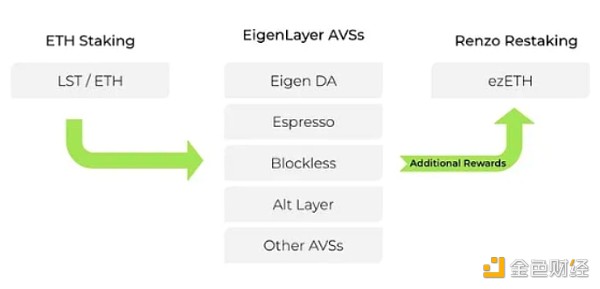
Key product: ezETH, a liquid token representing the user’s restaking position.
Function: Users can deposit liquid staking tokens (stETH, rETH, cbETH) in exchange for ezETH. For every LST or ETH deposited on Renzo, it will mint an equal amount of ezETH.
Kelp DAO
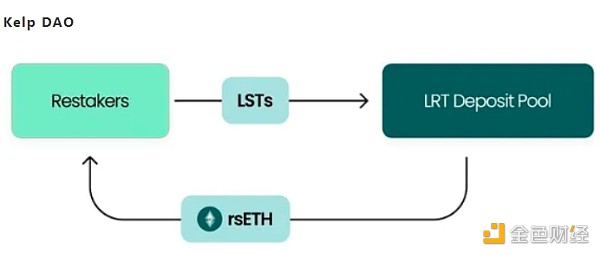
rsETH is a single liquid re-staking token for all accepted ETH LSTs. Kelp’s rsETH is a liquid re-staking token (LRT) that provides liquidity for illiquid assets deposited into re-staking platforms such as EigenLayer.
3) Isolated LRTs
It involves exchanging a specific type of Liquid Staking Token (LST) for a corresponding specific type of Liquid Restaked Token (LRT). By isolating the relationship between LSTs and LRTs, counterparty risk is minimized.
Astrid Finance
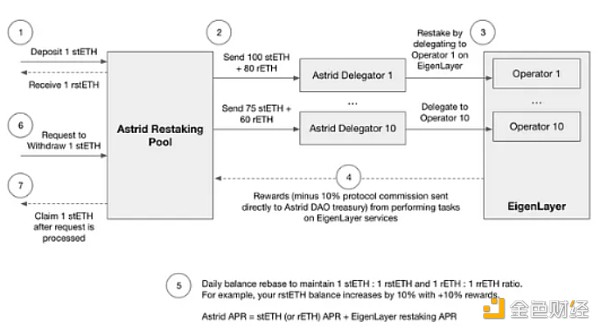
Users deposit LSTs (stETH, rETH or cbETH) into the re-staking pool and receive the corresponding Astrid Liquid Re-staking Tokens or LRTs (rstETH, rrETH, rcbETH). The pooled LSTs will be re-staked on EigenLayer and delegated through multiple operators voted by Astrid DAO. The rewards obtained are compounded and distributed through balance rebase, automatically adjusting the user's balance.
These protocols cater to different user preferences and risk profiles, providing flexibility in managing staked assets while taking into account factors such as counterparty risk and reward structure.
4. Latest progress in LRT protocol and EigenLayer
1) Expansion of AVS providers
The number of AVS projects listed on the EigenLayer website has reached approximately 76, with new ones being launched every day.
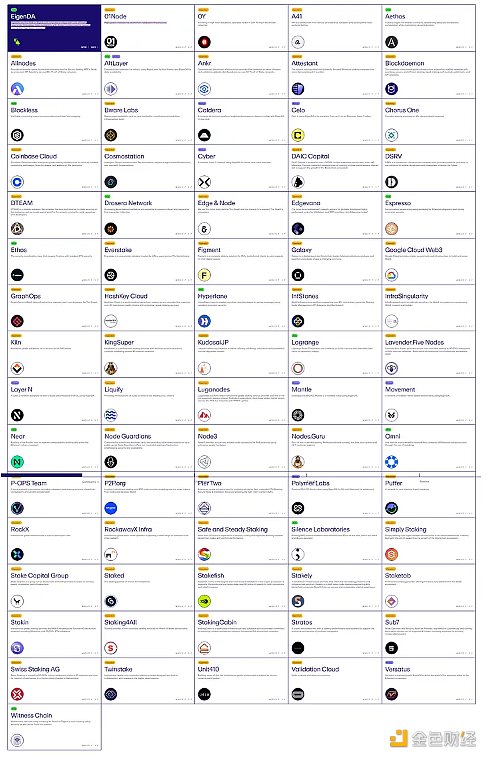
2) Growth of Liquid Restaking Protocol
The Liquid Restaking Protocol has seen widespread popularity and adoption among projects such as Ether.fi, Puffer, and Swell, attracting over $5 billion in total locked value (TVL).
3) EigenLayer’s TVL growth
EigenLayer’s total locked value (TVL) has increased fivefold from $2 billion in January to $11 billion.
4) Innovative Token Model
Various types of LRT protocols have emerged, including local liquidity re-pledge (such as Ether.fi), basket-based LRTs (such as Kelp DAO), and segregated LRTs for specific Liquid Staking Tokens (LSTs). These diverse models provide users with multiple options for re-pledge assets while managing counterparty risk and maximizing returns.
5 Conclusion
Similar to how we saw Liquid Restaking Token become the most used token in decentralized exchanges and lending protocols, we can expect the same to happen with LRTToken. Many projects have created different types of liquid restaking tokens, with different pros and cons.
While this does introduce additional leverage, the core added risk comes from the new reduction conditions leading to unlocking. This risk is not as complex or dangerous as the community may think. If the LRT protocol becomes more active, it can still generate huge value despite Ethereum's huge market cap, and we can expect the Ethereum DeFi ecosystem to become more active.