UncommonGoods is about to become the Genesis Rune on Rune Protocol. As the founder of Ordinals, Casey launched a homogeneous token for the first time, which attracted widespread attention from the market. Due to its unique issuance method, many potential investors and users are curious about how to participate, and are full of doubts about its future performance and value.
This article aims to explore the following key topics:
UncommonGoods launch date;
Is there a cap on the supply of UncommonGoods?
UncommonGoods’ valuation;
UncommonGoods’ coin price prediction;
How to Participate in UncommonGoods: Profitable Strategies for Minting and Trading.
time
UncommonGoods will be minted at the BTC halving block (block height: 840,000, expected to be April 20, 2024 UTC) 9:10 ) Officially launched, no pre-mining, fair launch, everyone can participate.
Total
The total amount of UncommonGoods that can be minted is set to have no upper limit in the code, and the time limit is between two BTC halving blocks, which is about 4 years. Due to the characteristics of the Bitcoin blockchain, its total supply can be estimated. Each UncommonGoods is a token, and BTC has a block every 10 minutes, each block contains 2,000-5,000 transactions (txns), and most of the time it is around 3,000 txns. Only a portion of these txns are minted UncommonGoods, so it can be inferred that:
If 500 txns in a block are mint UncommonGoods,
Daily supply: 500 * 6 * 24 = 72,000
Weekly supply: 500 * 6 * 24 * 7 = 504,000
Monthly supply: 500 * 6 * 24 * 30 = 2,160,000
Annual supply: 500 * 6 * 24 * 365 = 26,280,000
Total supply: 500 * 6 * 24 * 365 * 4 = 105,120,000
If 1,000 txns in a block are minted UncommonGoods, the total supply is 210.24M — this is almost the maximum value under extreme conditions. Over a period of four years, an average of 10–20% of transactions (500 txns) per block are minted UncommonGoods, which is a relatively reasonable estimate. Under this estimate, the total amount of UncommonGoods is about 100 million.
Valuation
As a star project, the valuation of UncommonGoods can be compared with Runestone, Ordi, and Sats. Runestone is a BTC NFT project. Its founder is also the founder of Ord.io. Due to its free & fair concept and its promise to airdrop Runes tokens to NFT holders after the launch, the price has soared, and the current market value has reached 800 million US dollars. Ordi and Sats are the top two tokens in Ordinals BRC20, with market values of 1.58 billion US dollars and 1 billion US dollars respectively.
As the Genesis Rune of Rune Protocol and the first issued token of Casey , Uncommon Goods has an industry influence that is not weaker than the above three. Its long-term market value can be simply estimated to be 10-20 Billions of US dollars .
Price prediction
If the long-term market value of UncommonGoods is estimated to be 1 billion US dollars and the 4-year supply limit is 100 million, then the token price is estimated to be 10 US dollars.
In the early days of the launch, the circulating supply is very low. Under rational mint conditions, the weekly supply is 504,000 and the monthly supply is 2,160,000. However, there may be fomo sentiment in the early market, which will lead to an increase in mint and a short-term increase in the circulating supply of 200%-300% (1,000-1,500 mint/block). That is, the circulating supply in the first week of the launch has reached 1M-1.5M. If the market value reaches 50M, the price range in the first week will be 33U-50U; if the market value reaches 100M, the price range will be 66U-100U.
If one month later, the market cap reaches 150–300M, the supply of UncommonGoods will be double or triple the 2,160,000, that is, 4M-6M, and the price range will be 25U-75U.
According to the above estimates, the price of UncommonGoods in the first month will fluctuate in a wide range of 25–100U; the narrow range will fluctuate in a range of 35–60U. The price range for a longer period is about 10–20U .
The above estimate is a simple estimate based on the circulating supply and the circulating market value of the token. The actual currency price performance may be lower or higher than this range. We will need to wait until it goes online to know.
Profitable strategies for minting and trading
Whether you can make a profit depends on two conditions: cost and price.
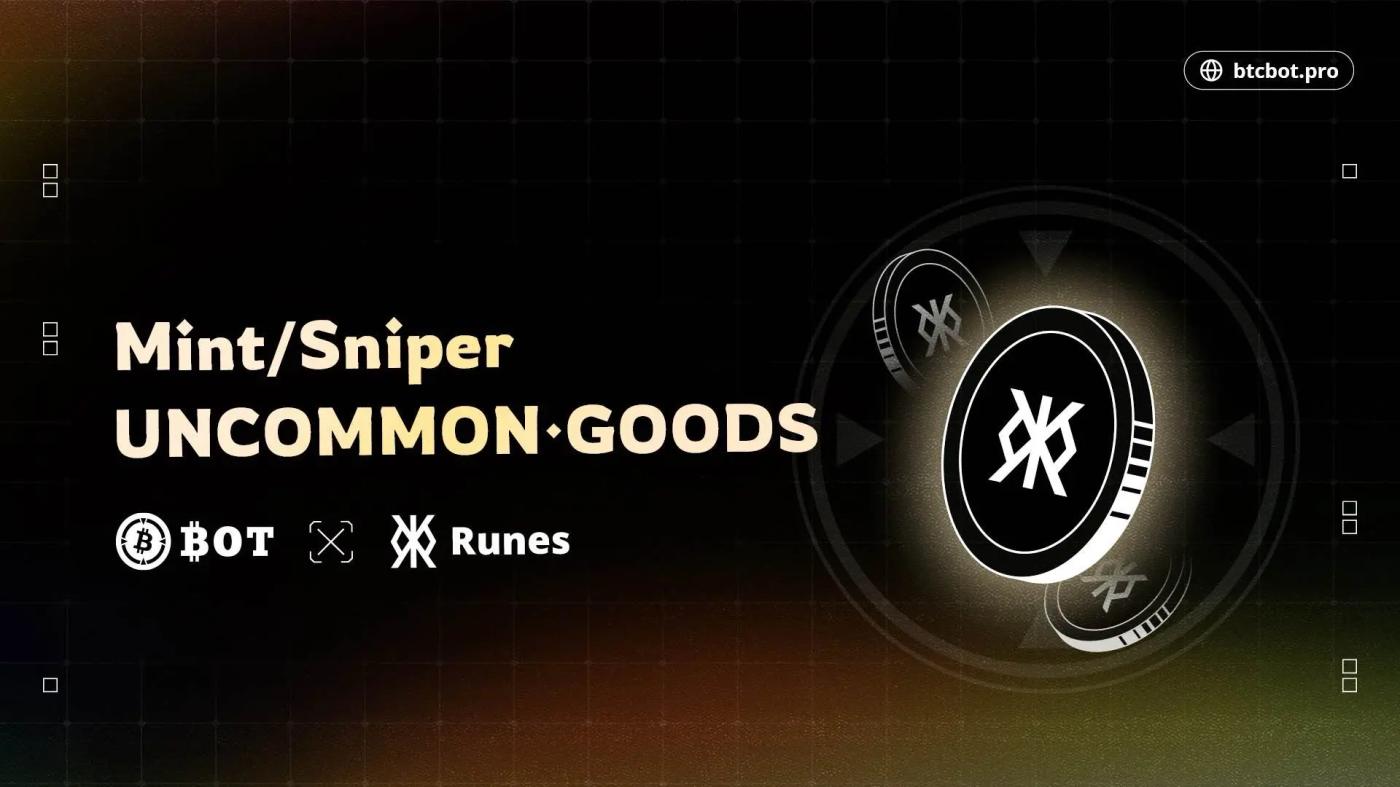
Through BTCBot's Auto Sniper function, the mint cost can be precisely controlled.
If the casting cost is lower than the expected price, the probability of profit can be increased, which requires fine control of the gas price. In BTCBot.pro, users can set the maximum gas price and the number of mints. As long as the blockchain network is lower than this gas price, minting will start until all mints are completed. For example, in BTCBot Auto Sniper, the maximum gas price is set to 35sat/vB, the token is UncommonGoods, and the number of mints is 50: when the network gas price drops to 35sat/vB, minting will automatically start until the task is completed.
Through BTCBot’s limit buy order function, you can precisely control the purchase cost.
At the same time, BTCBot has a limit buy order function, which allows you to set the buy price and quantity, as well as "slippage". Here, the gas fee will affect the overall purchase cost. In BTCBot, the impact of the gas fee is called "slippage". For example, if the limit buy order condition is set to: 10U/token, buy 100, and set the maximum slippage to 5%. When there is a sell order in the market for 100 tokens at a price of 10U/token, and a 3U gas fee is required, then the slippage is 3÷1000=0.3%, and the limit buy order will be triggered and executed; if there is a sell order in the market for 1 token at a price of 9U, the transaction will cost 3U gas fee, then the slippage is 3÷9=33.3%, which is higher than the set maximum slippage of 5%, and the transaction will not be triggered.
As long as UncommonGoods can control costs through tools, there will be profit opportunities whether it is mint or trade.
In summary, this article explains the launch time, total volume estimation, valuation, coin price prediction, and profit strategies for engraving and trading of UncommonGoods. I hope it will be helpful to Rune Protocol and UncommonGoods enthusiasts. In the future, BTCBot will launch more practical arbitrage tools, so stay tuned.