Author: @Web3Mario
Data link:
EtherFi participates in address analysis Thegraph: https://api.thegraph.com/subgraphs/name/web3mario/etherfi_airdrop_analyze
All accounts will receive airdrop results: https://cf-ipfs.com/ipfs/QmP2tgnrAyUGwRs1o6B8YGzHmnecyZrVhY5QiFCESxUsBv
Introduction: In the previous article, the author discussed the Web3 oligarchs' exploitation of users through Loyalty Point . In this article, we choose an actual case to further demonstrate this point of view;
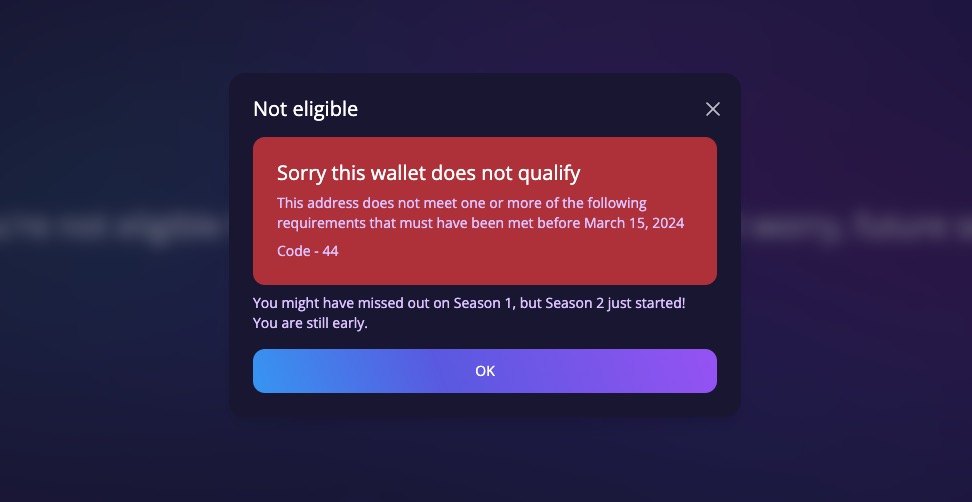
On March 18, 2024, Ether.Fi, the leader in the Restaking track, took the lead in TGE and conducted the first round of airdrops of its ETHFI tokens, which brought considerable wealth effects. As of the time of writing, $ETHFI’s The price has reached $5.54, and the fully diluted market value has reached $5.5 billion. This valuation is very impressive for an early-stage project whose core business has not yet been launched. It also reflects investors’ recognition of the project’s vision.
However, many users have criticized the results of this round of airdrops, because for a long time in the past, EtherFi’s promotion focus and incentive mechanism have been around EtherFi Loyalty Points. Naturally, users would receive airdrops and accumulate Points in the past. However, after the airdrop results were announced, many users found that there seemed to be no necessary relationship between the two. Many loyal users who had accumulated a lot of Points had similar rewards to some "lightly involved" users, and many giant whales were also discovered. With its financial advantage, it quickly occupied a large amount of airdrop allocation.
Therefore, the author spent some time analyzing the design ideas of the project side in this round of EtherFi airdrop activities in detail from the data side, and positioned the biggest beneficiaries of this round of airdrops. I hope it can help readers optimize their subsequent participation in similar airdrop competition strategies, and in Finally, we look forward to the possible design direction of EtherFi’s airdrop rules for the second quarter and estimate the potential benefits.
Review of EtherFi Season 1 Airdrop
First, let us review the officially disclosed rules of EtherFi’s first season airdrop:
EAP: You participated in the Early Adopter Program
ether.fan:You are the holder of ether.fan NFT
Solo Staker: You are ether.fi Solo Staker
eETH / weETH: You hold eETH or weETH
DeFi rewards: You participate in eETH or weETH DeFi pool or vault
Badges: You have unlocked one or more ether.fi badges
Referrals: You have invited one or more new users to participate in ether.fi
It does not directly point out the description related to Loyalty Point, and the specific calculation algorithm is not very clear. However, after our analysis of the full amount of data, we can still find certain patterns.
Obtain through TheGraph the addresses of all participating users from July 10, 2023, when EtherFi deployed the Liquidity Pool smart contract to March 18, 2024 ( TheGraph Query Link ). After that, we used a Python crawler to crawl these addresses to obtain airdrops. The results have been uploaded to IPFS , and interested friends can analyze them by themselves. The analysis results are as follows:
A total of 82,102 addresses participated, of which a total of 71,380 addresses received airdrops;
Among all users who received airdrops, each user has an average of 536,444 Loyalty Points, and each user received an average of 702 ETHFI airdrops;
On average, each user needs to accumulate 755 LoyaltyPoints to obtain 1 $ETHFI, that is, the $ETHFI conversion rate is 755 Loyalty Points / ETHFI.
The Matthew effect of the project is extremely obvious. Among all users who have received airdrops:
The top 20% of Loyalty Point users received Loyalty Points accounting for 94% of the total Loyalty Points, and the airdrops received accounted for 77.5% of the total airdrops;
The top 10% of Loyalty Point users received Loyalty Points accounting for 87.8% of the total Loyalty Points, and the airdrops received accounted for 72.2% of the total airdrops;
The top 5% of Loyalty Point users received Loyalty Points accounting for 79.2% of the total Loyalty Points, and the airdrops they received accounted for 65.6% of the total airdrops;
The airdrop distribution mechanism of projects is more conducive to "lightly involved" users and "heavy loyal" users (usually whale users).
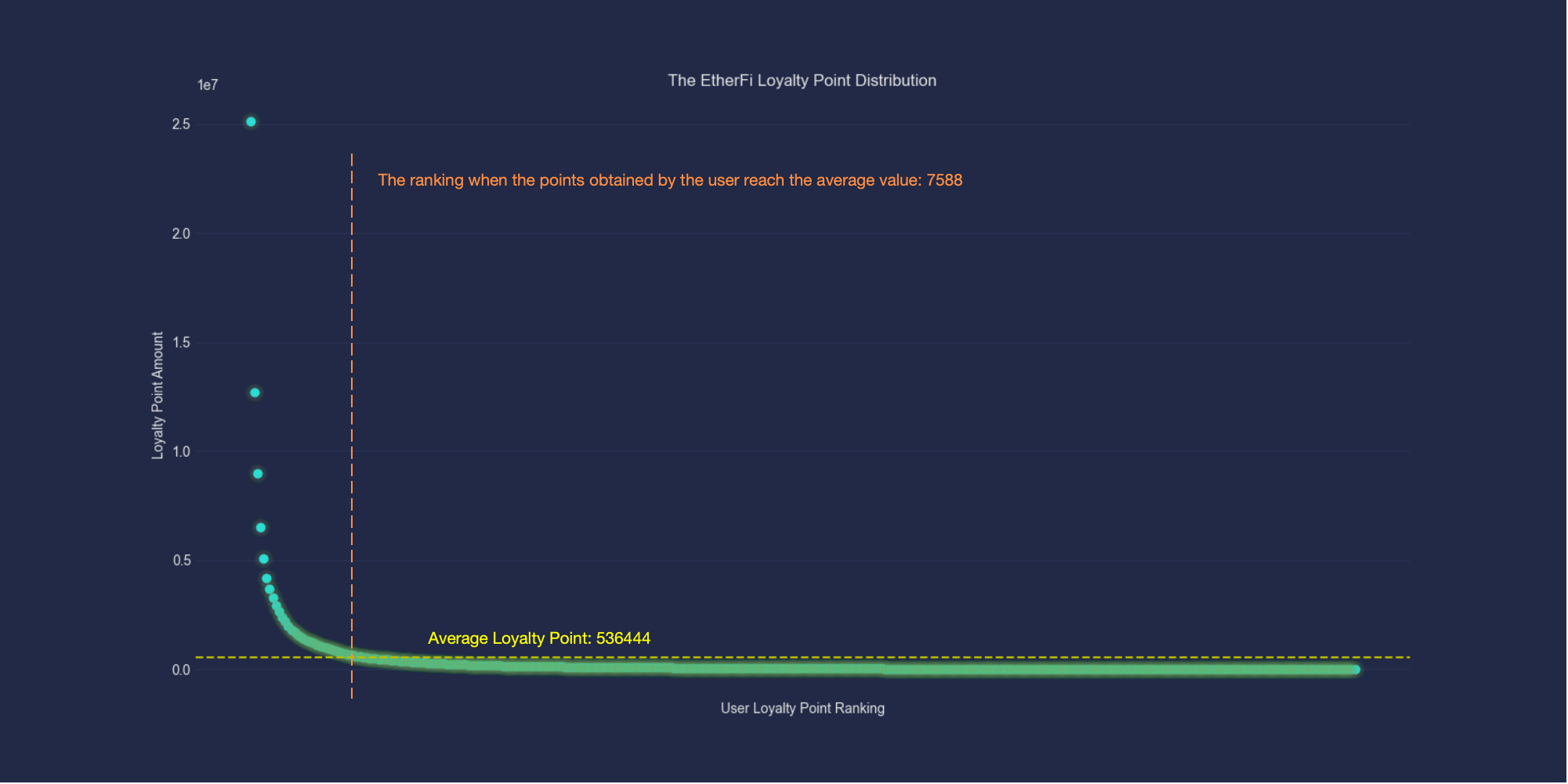
First, let’s look at the distribution of Loyalty Points obtained by users, as shown in Figure 1. The horizontal axis is the user’s Loyalty Point ranking, and the vertical axis is the amount of Loyalty Points held by the user. We can see the average Loyalty Points obtained by each user. The amount is 536444, but at this time only the top 7588 users can reach such a standard. Compared with 82102 participants, this is a relatively small range, which means that giant whales hold a large number of Loyalty Points.
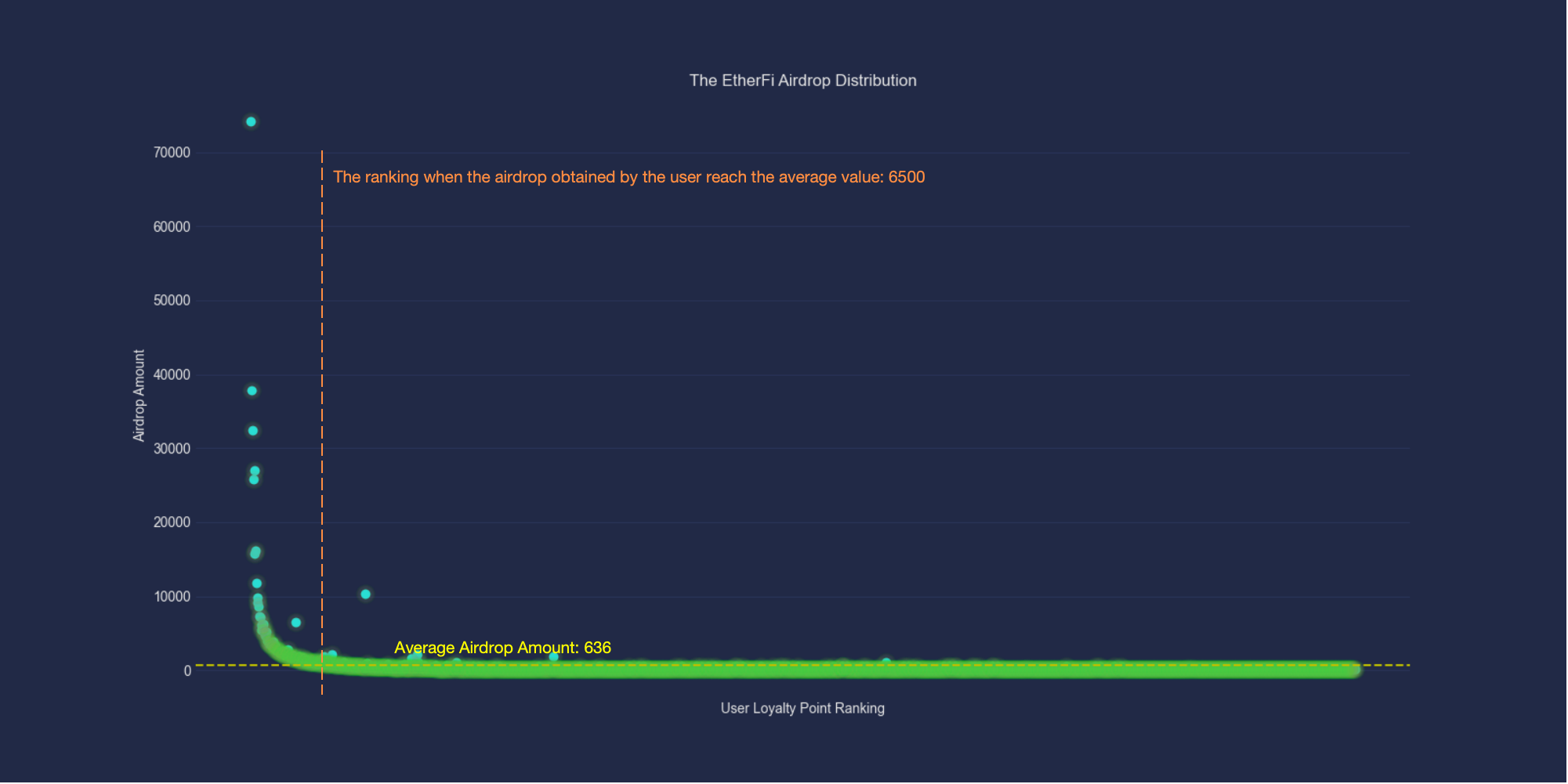
Next, let’s take a look at the distribution of the number of airdrops received by users. As shown in Figure 2, the horizontal axis is the user's Loyalty Point ranking, and the vertical axis is the $ETHFI airdrop amount received by the user. We can see that the average airdrop amount received by each user is 636. At this time, the top 6500 users can To achieve this standard, compared to the distribution of Loyalty Point, the distribution of airdrop numbers is more concentrated among top-ranked users.
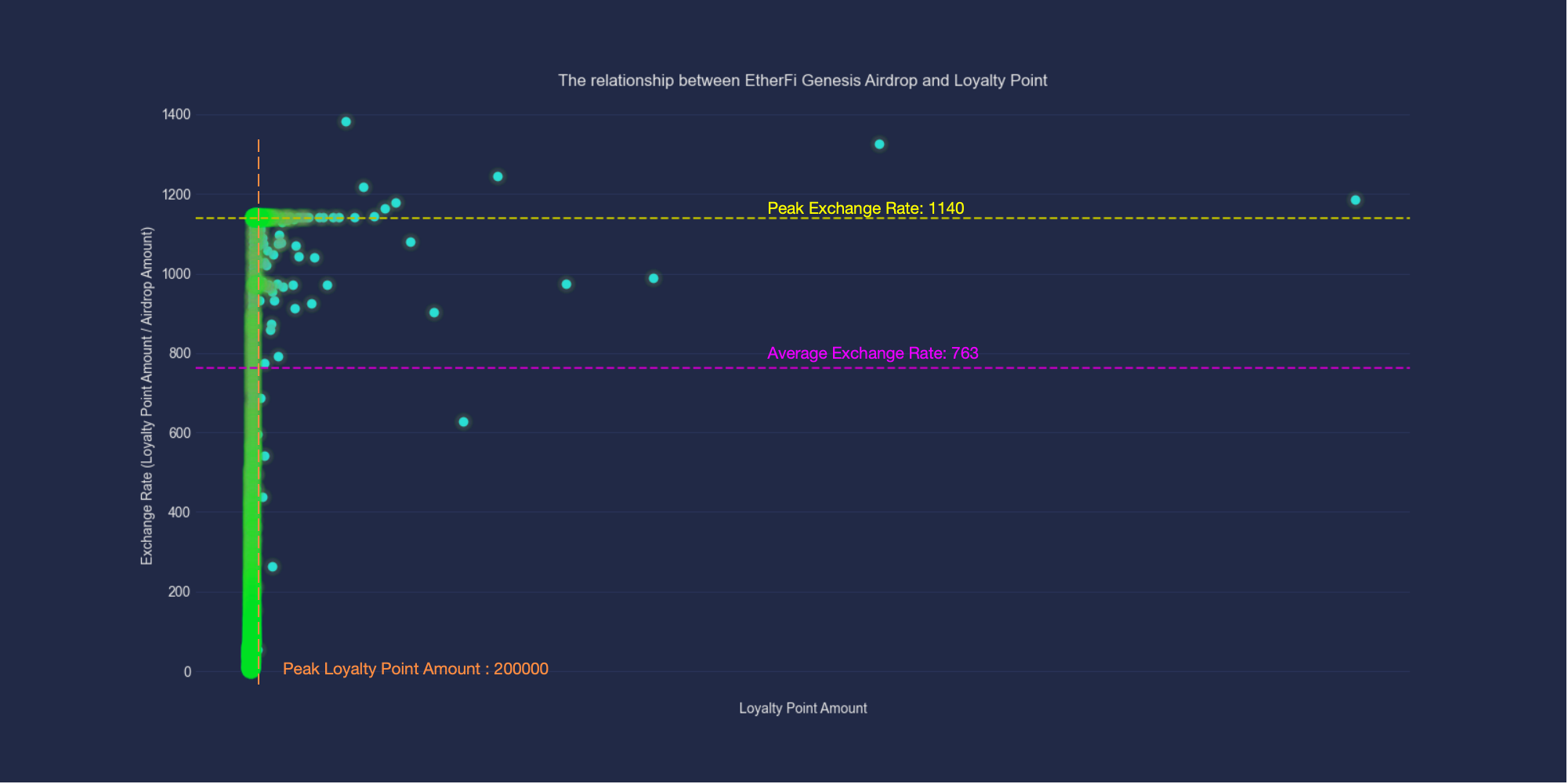
Finally, let’s explore the scatter plot of the user’s Loyalty Points and the number of airdrops, as shown in Figure 3. The horizontal axis represents the user’s Loyalty Points, and the vertical axis represents the user’s $ETHFI airdrop conversion rate, that is, every $ETHFI obtained How many Loyalty Points need to be held for airdrops. We can find that Loyalty Point and airdrop conversion rate present an approximate rule of piecewise function. In the first piecewise function, the user’s airdrop acquisition rate is roughly proportional to Loyalty Point. The more Loyalty Points held, the corresponding The greater the airdrop conversion rate, this means that the Loyalty Points required to obtain a unit of $ETHFI airdrop will become higher and it will become more difficult to obtain them. When the Loyalty Points held by the user exceed approximately 200,000, the entire segmentation function enters the second part. This period reaches the peak, when the user's airdrop conversion rate is approximately 1140, which means that at this stage, the more Loyalty Points you hold will not further increase the difficulty of obtaining airdrops, which is more friendly to giant whales.
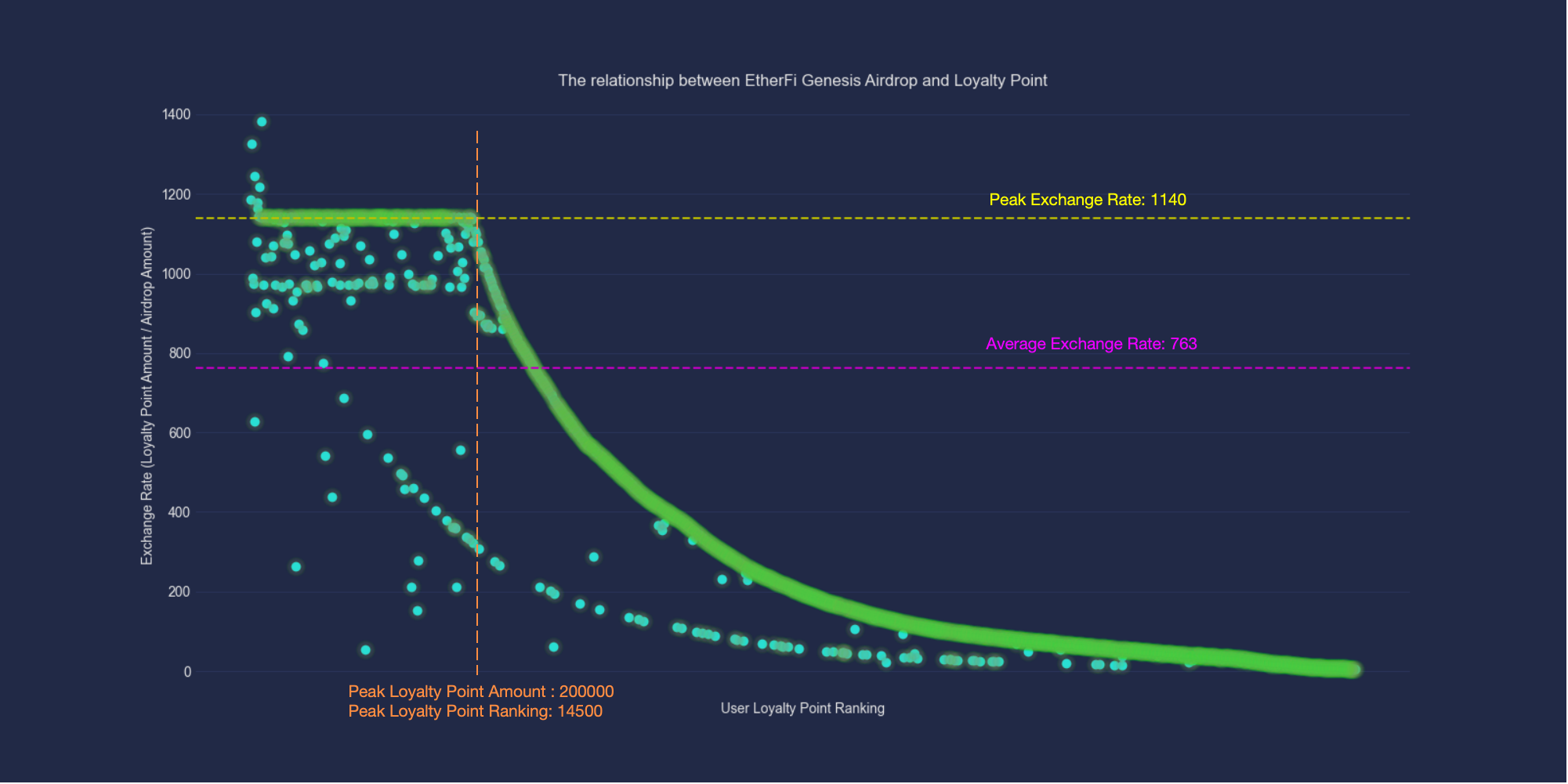
In order to better reflect this relationship, as shown in Figure 4, we transform the horizontal axis into the user's Loyalty Point ranking. From left to right, the higher the user's ranking, the fewer Loyalty Points they hold. The vertical axis is the user's Loyalty Point ranking. The $ETHFI airdrop conversion rate, the relationship is more obvious at this time. When the user's Loyalty Point ranking is around 14,500, the piecewise function is at a critical point.
Looking ahead to EtherFi’s second quarter airdrop
Next, let’s look forward to EtherFi’s second season airdrop, which has disclosed the relevant details of Season 2: StakeRank :
StakeRank is a ranking system with 8 levels or "tiers"
Users staking ETH on ether.fi will increase by 1 level every 100 hours
Each level has progressively higher loyalty point rate increases
Your staking balance needs to be higher than 0.1 eETH to continue to improve the rankings
Users participating in the first season start from Rank II
Ranking improvement range is 1x - 2x (subject to change)
Ether.Fan NFT holders automatically upgrade to Rank III
Valid only once per NFT holder
In the transition to Season 2, the agreement is designed to recognize Season 1 participants without disproportionately allocating Season 2 airdrops to them. To achieve this goal, everyone's loyalty points accumulation rate will increase by 10 times. While this will dilute old points, they are still valid, subject to the following conditions.
All eETH and weETH, whether held or DeFi positions, including Liquid, will be treated equally by StakeRank.
If by the end of Season 2 your points total means 70% of it comes from the points you accumulated in S1, then you are not eligible. However, the base rate of loyalty points will increase 10x in S2. Staking in S2 means your new points balance should be significantly greater than the amount collected in S1. That said, Season 1 Pledgers were recognized in Season 1. Season 2 will recognize stakers who were active in Season 2.
The overall plan is designed around the ranking of Loyalty Points, with different layers and different boosting effects set for each level. At the same time, the most important thing is the guidance on the final redemption method of the second season airdrop. The impact of Points obtained in the past on the final airdrop is diluted, which means that users who have accumulated a lot of Points will have a sharply reduced advantage in Season 2 airdrops, and loyal users will have to start over. And more importantly, EtherFi still chose to use a vague description to express the relationship between the final airdrop volume and Loyalty Point. This also introduces considerable uncertainty. Considering that in the design of the first season airdrop, the team seems to favor shallow participating users and whale users, which seems to have a certain guiding effect for users to participate in the second season airdrop activity. But don’t forget that the airdrop in the first quarter has already distributed ETHFI, which accounted for 6% of the total issuance. In the second quarter, only 5% of the total airdrop is left.