On April 20, 2024, when the Bitcoin block height reached 840,000, the mining reward was halved for the fourth time, from 6.25 BTC to 3.125 BTC. Although this event did not cause much ripples in the Bitcoin price trend that day, we may have different findings if we look at this reduction in production from a higher dimension. Especially compared with the previous three reductions, this reduction event has quietly planted a seed full of imagination and infinite possibilities for the future development of the Bitcoin ecosystem and even the development of the crypto industry.
Is Bitcoin just a payment tool?
In October 2008, Satoshi Nakamoto published the Bitcoin Genesis Paper, which clearly defined it as [a peer-to-peer cash payment system] in the title. In the following decade, both in people's cognition and in actual application, Bitcoin has been basically imprisoned in such a cage - an innovative and unregulated payment system, and it is not very easy to use. Although entrepreneurs have continued to work hard to improve transaction efficiency and the scalability of the Bitcoin network, there has been no breakthrough progress. It has become a strong evidence for Bitcoin opponents. The 99bitcoins website has an interesting statistic that records the number of times the mainstream media has "declared the death of Bitcoin" since 2010.
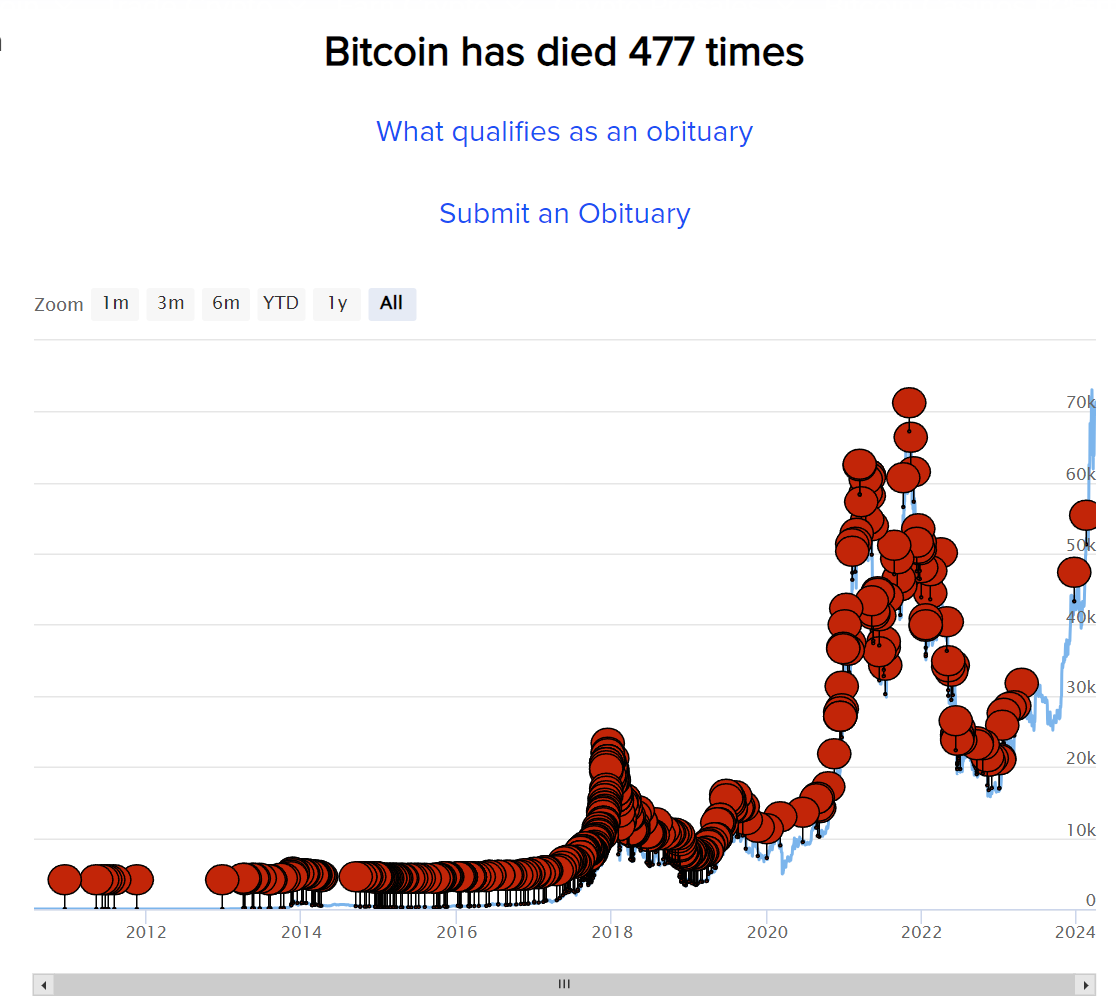
Figure: Number of Bitcoin obituaries from 2010 to 2024, source: 99bitcoins
But what is obvious to all is that, along with these 477 "death notices", Bitcoin has continued to grow amid doubts, and has now become an emerging financial entity with a market value of more than 1.2 trillion US dollars, ranking tenth in the global asset rankings. So, what is the force that has driven Bitcoin to achieve such a dazzling achievement in just 15 years? Here we might as well take the time points of Bitcoin's previous production cuts as the axis to review.
The first Bitcoin production reduction occurred in November 2012, when the mining reward was reduced from 50 BTC to 25 BTC. Subsequently, the price of Bitcoin reached the highest point of the first bull market in November 2013, exceeding $1,180.
The second Bitcoin production reduction occurred in July 2016, when the mining reward was reduced from 25 BTC to 12.5 BTC. Subsequently, the price of Bitcoin reached the highest point of the second bull market in November 2017 - $19,000.
The third Bitcoin production cut occurred in May 2020, when the mining reward was reduced from 12.5 BTC to 6.25 BTC. Subsequently, the price of Bitcoin reached the peak of the third bull market - US$69,000 in November 2021.
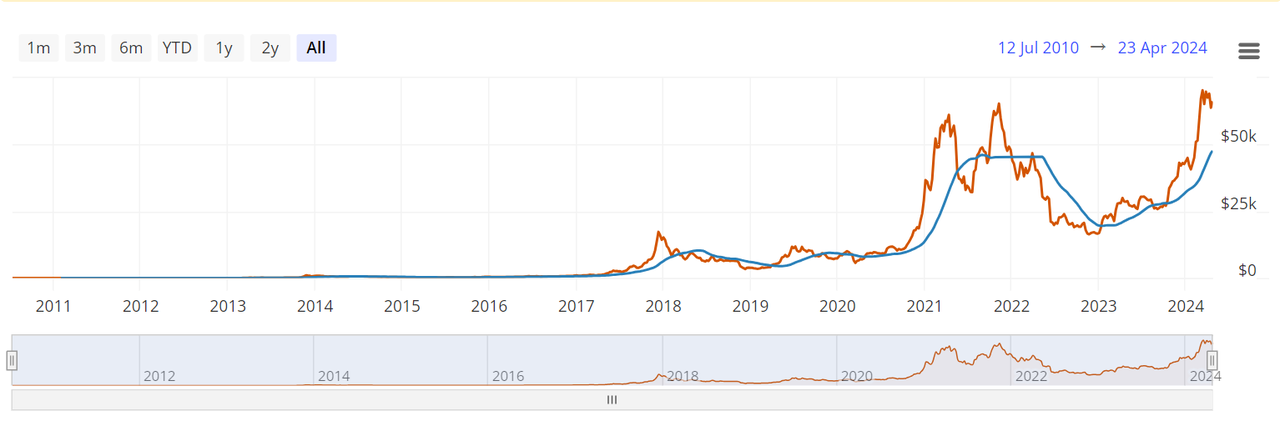
Figure: Bitcoin price trend from 2010 to 2024, source: bitcoinvisuals
When Bitcoin’s production was cut for the first time, it was still in a very small circle. Based on the highest price in November 2013 and the total mining volume at that time, the total market value was less than 20 billion US dollars. But even so, Bitcoin still quickly attracted the attention of Wall Street capital in the following years, and then a number of Bitcoin futures ETFs were successfully listed in 2017, and attracted Bitcoin trusts represented by Grayscale to continue buying Bitcoin, which contributed greatly to pushing the price of Bitcoin to new highs in 2017 and 2021.
So, what different expectations will the continued influx of Wall Street capital and this Bitcoin production cut bring to the market for future developments? Simply put, it is a bigger narrative chapter.
Inscriptions may just be a dessert in the Bitcoin ecosystem
Ecosystem - This word seems a bit strange and distant to the Bitcoin network. Since security was put first in Satoshi Nakamoto's original design, a considerable amount of efficiency and scalability were sacrificed.
However, with the rise of the inscription craze represented by the Ordinals protocol, we are excited to find that NFTs similar to those in the Ethereum network can also be perfectly replicated in the Bitcoin network. Ordinals does not require side chains or tokens other than Bitcoin, and can be used without changing the Bitcoin network. The inscriptions have the same permanence, immutability, security, and decentralization as Bitcoin.
Tracing back to the origin, although the Ordinals protocol was proposed by developer Casey Rodarmor on January 21, 2023, his proposal to assign a unique serial number to each sat and allow users to track each sat on the blockchain through this unique serial number was proposed as early as October 2012 by a BitcoinTalk forum user with the ID @jl2012. He had published an almost identical plan, but it was limited by the objective conditions at the time and did not attract much attention from the community.
With the rich ecosystem based on Ethereum as a reference, it is actually easier for us to understand and accept the new thing of inscriptions. For example, we know that inscriptions do not have to represent non-fungible marks, and users can also create Bitcoin-based security tokens and other assets. Since Ordinals inscriptions are completely on-chain and stored in taproot transaction scripts. This means that the Ordinals protocol revives the huge potential of tokenized assets on the highly secure and decentralized Bitcoin blockchain. Not only that, it is also a means of permanently storing digital content directly on the chain-a rare phenomenon in the NFT field.
For this reason, Ordinals is actually receiving more and more attention, including many veteran NFT players on Ethereum and other public chains. Although the price of the Ordinals protocol token, ORDI, has risen since its release, we believe that the real impact of Ordinals has not yet been fully revealed. The prospects of the Bitcoin ecosystem have only revealed the tip of the iceberg, and there is still a broader market that developers need to explore and develop.
The Ethereum ecosystem cannot do without L2, but what about the Bitcoin ecosystem?
Today, the prosperity of the Ethereum ecosystem is obvious to all. It has not only become the largest ICO platform, but also brought together DeFi, GameFi, SocialFi, etc., which focus on different segments. However, it is inevitable to face the Blockchain Trilemma problem. The Ethereum network has made great improvements in scalability. In the process of vigorous development of ecological construction, how to improve efficiency has become an unavoidable topic. After all, every ecological participant is unwilling to bear gas fees of hundreds of dollars or even higher.
As a result, we saw the presence of L2 developers. Whether it is the error proof used by Optimistic Rollups or the validity proof scheme used by zk-rollup, the core is to execute smart contract state changes off-chain and verify them on-chain, so as to improve the throughput of the blockchain and reduce costs.
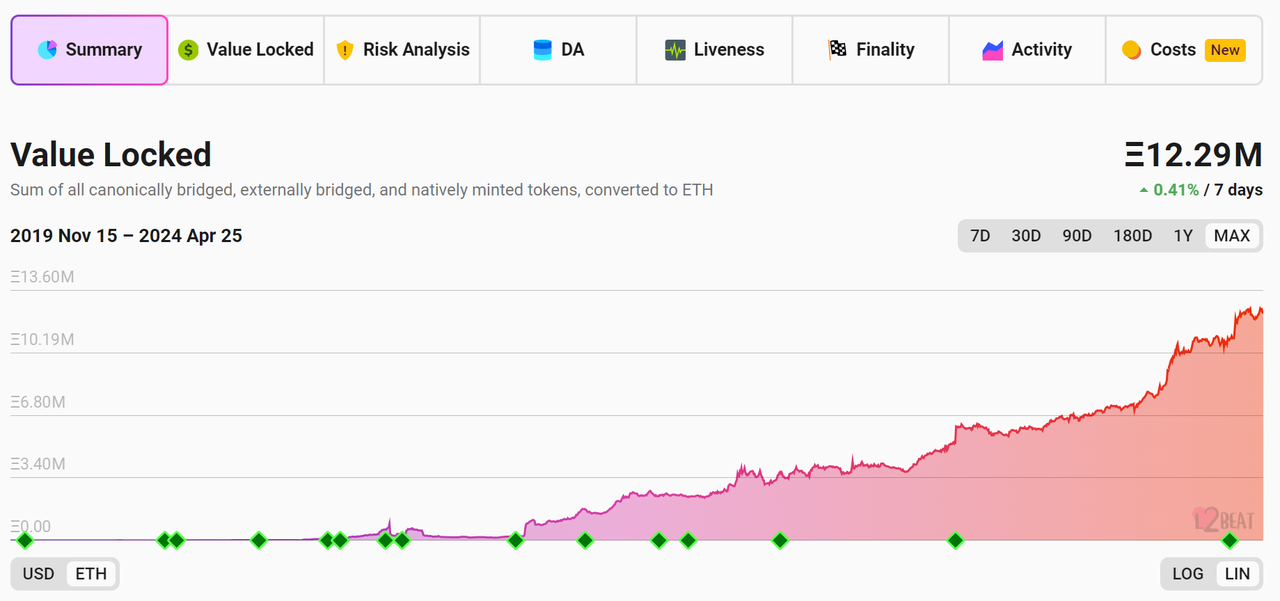
Figure: Changes in assets locked in Ethereum L2, source: l2beat.com
According to statistics from l2beat.com, since September 2021, the assets locked in Ethereum L2 have shown a rapid growth trend. Currently, more than 12 million ETH have been locked, with a value of more than US$38.7 billion, accounting for more than 10% of ETH's circulating market value.
Another point to note is that the TPS of the Ethereum network is about 27, while that of the Bitcoin network is only about 5, which is more than 5 times that of the latter. According to the Twitter account @bitrabbit.btc, after BRC20 began trading on April 24, 2023, by the end of November of that year, the UTXO of the Bitcoin network soared to 140 million in about 7 months. In contrast, Bitcoin has only accumulated 87 million UTXOs in the past 14 years, and among the more than 50 million newly added UTXOs, 40 million are extremely small transactions of 100-1000 Satoshis. If these transactions are calculated according to the current TPS, they may never be packaged and processed in the next few decades or even forever, and objectively constitute junk transactions similar to DDOS attacks on Bitcoin. From another perspective, if the Bitcoin ecosystem continues to develop, the requirements for efficiency will inevitably be higher than that of Ethereum, and innovative Bitcoin L2 solutions will be needed to face this realistic and serious problem.
Zulu Network, building a bridge between Bitcoin and Ethereum
Speaking of Bitcoin L2, in addition to the well-known old projects such as Stacks, RSK, Liquid, etc., new solutions such as Zulu Network, Merlin, BitVM, BEVM, etc. also provide new ideas. However, today we will first introduce Zulu's solution to expand the functions of the Bitcoin network by introducing a two-layer architecture. This is the first entrepreneurial project to propose this solution in the Bitcoin L2 track.
How to understand Zulu's proposal of "introducing a two-layer architecture"? Simply put, it is divided into two steps - ZuluPrime (L2) takes BitFi (Bitcoin DeFi) to a new level through EVM, while ZuluNexus (L3) expands Bitcoin's native functionality through UTXO innovation. ZuluPrime operates as the second layer of Bitcoin, emphasizing EVM compatibility and providing stable and mature decentralized finance (DeFi) applications and financial services for the Bitcoin network, while making it possible to use BTC and BRC20 tokens on different dApps without switching to other ecosystems. On the other hand, ZuluNexus is positioned as the second layer of ZuluPrime, essentially acting as the third layer of Bitcoin. It adopts a hybrid virtual machine (VM) design that, although not compatible with EVM, supports UTXO and account types. This solution carefully and creatively combines the stability needs of the overall architecture with the efficiency needs of ecological construction.
Furthermore, the challenges of relying solely on EVM compatibility include limitations on ecosystem innovation and application scenarios. On the other hand, fully retaining the UTXO characteristics carries inherent risk issues. In order to solve these problems and promote the rapid deployment of DeFi protocols on the Bitcoin network, Zulu cleverly proposed a two-layer architecture design concept.
In addition, according to Jinse Finance, in April 2024, Zulu Network announced the completion of a US$3 million Pre-Seed round of financing. Investors included Cryptogram Venture (CGV), D11 Labs, Web3.com Ventures, Satoshi Labs and other well-known investment institutions in the industry.
Conclusion
In the survival rule of the crypto industry, it is never the big fish that eat the small fish, but the fast fish that eat the slow fish. The "fast fish" here not only refers to strong action, but more importantly, the ability to have a keen perception and judgment of the development trend of the industry and put it into action. This has been verified more than once in the competition of various tracks. In the face of the Bitcoin ecosystem on the eve of the outbreak, only by seizing the opportunity to join it can there be a chance to gain a foothold. If we roughly estimate it based on the TVL scale of Ethereum L2 mentioned above, when the Bitcoin ecosystem develops to the same prosperous stage, the cake of Bitcoin L2 will reach hundreds of billions or even trillions of dollars. It can be said that it is a vast blue ocean. Zulu Network and many Bitcoin L2 developers have great potential in the future.