avatar
Cindy胖迪🥰
84,059 Twitter followers
Follow
#Bitcoin|币圈从业者 | Youtuber https://t.co/MoUY8tD1H7| @AlphaMoonDao Space主持人|#Alpha 玩家 |商务:https://t.co/DgnY4Wv3zk
Posts
avatar
Cindy胖迪🥰
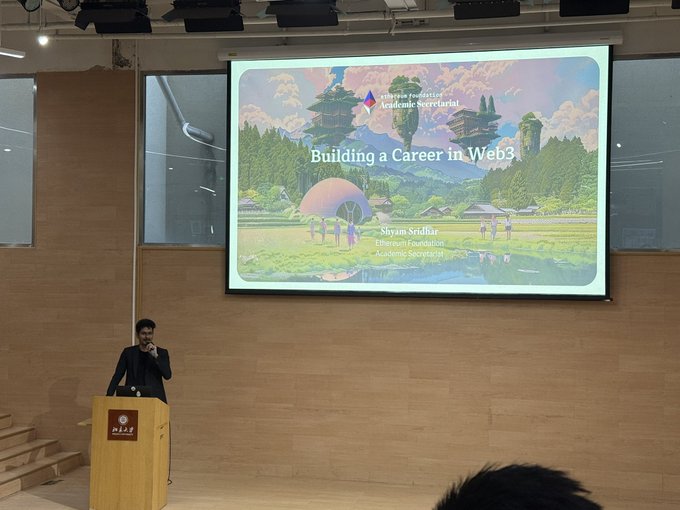
It's been a while since Dizi mentioned the #Aztec @aztecnetwork project in Beijing. Back then, it was a CCA auction, raising 19,476 ETH. Truly impressive! Moreover, over 50% of the subscription funds came from community members, demonstrating the community's strong support for this project. This might be the allure of the privacy-focused field that Vitalik Buterin mentioned in the meeting, and it also owes much to the strong support from Aztec, as I discussed in the previous post. 👇 Previously, privacy was always associated with "outer encryption," an optional "shell." Now, privacy is no longer an "add-on feature" of blockchain, but is becoming a core requirement of the infrastructure. A leading privacy-first Layer 2 platform in the Ethereum ecosystem, Aztec Ignition Chain is designed for developers to build applications that truly protect user privacy. Aztec has launched Ignition Chain on the Ethereum mainnet and it continues to produce blocks, becoming the first truly decentralized Layer 2 network. The team, comprised of world-class cryptographers, secured $100 million in Series B funding led by a16z. They invented and defined a trustless client-side proof standard, fundamentally enabling privacy applications in public blockchain environments. Today, while scrolling through Twitter, Dizi saw an update on the project's Official Twitter. The website shows that the release date is still 01:01:35. This indicates that the project is fully prepared, and "the privacy infrastructure is in place." By this time next year, every smart contract will be private. Another point is that the Aztec team almost single-handedly built the complete technology stack for modern privacy computing. Today, almost all teams working on privacy are using the tools they developed. This is enough to demonstrate that technology pioneers are the leaders. JPMorgan Chase included Aztec in its Quorum team evaluation as early as 2019 to conduct privacy experiments for regulated financial scenarios. Taurus's confidential token standard is built directly on Aztec technology and has been adopted by leading institutional-grade infrastructure service providers. These cases demonstrate that Aztec is already a production-ready privacy infrastructure platform. In an industry where "speed" and "new narratives" often struggle to translate into long-term success, Aztec has broken into the mainstream thanks to its continuous technological accumulation, real institutional adoption, and the network surrounding its privacy cryptography ecosystem. As a16z has repeatedly emphasized, privacy is not a functional race, but a fundamental technology and a key component underpinning long-term financial infrastructure. Real-world applications are gradually being prepared for launch on the Aztec network. Programmable privacy represents a significant advancement in technology adoption and could potentially trigger a new wave of on-chain privacy applications, such as Perp privacy, which helps prevent targeted attacks and malicious attacks. With TGE on the horizon and the execution layer set to launch in Q1 2026, Aztec is already a leader in the privacy space. If you believe privacy will be the next standard infrastructure feature of blockchain, then Aztec is worth keeping an eye on. #Aztec #Privacy #Ethereum #Layer2 twitter.com/CindyCreation/stat...
AZTEC
25.78%
avatar
Cindy胖迪🥰
02-08
Thread
The Simple Logic Behind Several Buy The Dips| _2024111120230_ Last May I said that I would never be able to buy Ethereum at 1500 again, and I almost got slapped in the face! As a mature investor, not being greedy is basic logic. I sold all my positions at 4300, and still have a dozen or so left. We're currently approaching the level I buy the dips last time, so I've resolutely decided to continue buy the dips. Overthinking often cloudes one's judgment. I currently only have three reasons for buy the dips: 📗Core Reason: We only need to observe which protocol institutions choose to integrate when formulating their cryptocurrency strategies: 1️⃣ Coinbase has chosen Ethereum as its Layer 2 network, Base. 2️⃣ Robinhood's second layer has also recently been built on top of Ethereum. 📕Reason 2: Is it possible that it has no rivals at all in terms of the fundamental logic of blockchain finance: "decentralization"? Ethereum will eventually become an institutional-grade protocol. Although transaction costs are higher and speeds are slower, its greater decentralization makes it more secure, allowing many institutions to confidently entrust billions of dollars in assets to it. Other chains cannot do this yet. 📙Reason 3: Application level: This is the AI ​​+ blockchain mentioned by Vitalik. AI-powered agent-based interactive payments all rely on smart contracts. Future payment processes will be automated through smart contracts. The 8004 protocol is the authentication layer, providing the AI ​​with an identity; the X402 protocol is the payment layer—the two are perfectly matched because AI requires authentication. The most explosive applications may emerge on Ethereum. Large institutions have been closely watching the explosive growth of stablecoins, and most stablecoin activity is taking place on Ethereum. This is a market worth trillions. Finally, let's consider what everyone thinks is the biggest potential pitfall right now: #Bitmine These institutions are essentially stable exposures to the ETH ETF. They help traditional investment institutions avoid taxes and intermediary fees. Bitmine provides a solution where, despite a premium, the utility of an Ethereum vault is greater than that of a Bitcoin vault, for example, in staking, while ETFs currently cannot be staked for ETH. However, an increase in ETF staking may occur this June. Its existence is necessary and justified; Bitmine will not collapse. Yes 🙌
Cindy胖迪
@CindyCreation
02-04
回看这个视频,$ETH 核心的投资逻辑无非两个 1.通缩 (质押率、销毁..) 2.能滚雪球❄️(质押ETF资金来源、应用之王) 加之最近的主网升级,预计今年6月质押ETF纷纷落实,等雪球滚起来了,也就没你啥事儿了。 投资有时候大道至简…. 虽然我高位跑了…但接下来几个月慢慢买 so buy the fu**ing dip x.com/cindycreation/…
ETH
1.25%
avatar
Cindy胖迪🥰
02-04
Clearly, Vitalik's point is that L2 utilizes L1, but it hasn't adequately provided value or ecosystem feedback. Now that L1 can scale independently without relying on L2, L2 must either maintain consistency with L1 (native rollup) or become L1 itself. Let's break down Vitalik's meaning more simply: 1. L2 utilizes L1, but the value/ecosystem feedback isn't adequate: Vitalik didn't explicitly say "utilize," but he implied that L2 borrowed L1's security, consensus, and asset anchoring (e.g., ETH on L1), but didn't fully give back to the ecosystem. For example, some L2s fragmented liquidity (user funds scattered across different L2s, making cross-chain transactions difficult), leading to a deterioration in the overall Ethereum user experience and failing to contribute to the overall growth of L1. Many interpret this as L2 "profiting"—using L1's security to attract users and TVL (Total Value Locked), but not fully returning the token economy or liquidity to ETH or L1. Vitalik said this is the price of an open ecosystem; he wasn't angry, but transparency is crucial: if L2 contains centralized elements (like regulatory backdoors), it shouldn't claim to be "expanding Ethereum." Some say this is "detoxifying" the L2 narrative, preventing L2 from relying on L1's security for free. 2. Now L1 can scale itself, without depending on L2: This is the source of Vitalik's confidence. He repeatedly emphasizes that L1's optimized fees are extremely low (currently just a few cents), and the gas limit will increase significantly in 2026 (doubling throughput), enabling it to handle most scaling needs. Previously, L2 was the "savior," but now L1 says, "I can manage on my own; I no longer need you as the sole scaling tool." However, this doesn't mean completely abandoning L2—L1 will still help L2 build tools (such as native rollup pre-compilation, which is an L1 built-in validator that makes it easier for L2 to securely connect to L1, achieving seamless interoperability). 3. L2 must either maintain consistency with L1 (native rollup) or become L1: Vitalik encourages L2 to "maintain consistency"—using tools like native rollup pre-compilation to closely align with L1, achieving full inheritance security (stage 1 or 2), and focusing on complementary innovations (such as privacy, high speed, and low-latency apps). However, if L2 doesn't want to play this way (slow progress or clients want centralization), then it should "go independent"—don't call it L2 anymore, just become an independent chain (equivalent to another L1, such as a sidechain or a new public chain). It's not about "becoming L1" (because L1 specifically refers to the Ethereum main chain), but about "becoming its own L1-level chain," building its own consensus, security, etc. But he cautions: after going independent, it must have a unique selling point; otherwise, why wouldn't users just use the increasingly powerful Ethereum L1? What does this mean? It's bad news for general-purpose L2, but good news for L2 application chains, as we've consistently stated before. L2 application chains can be used in many creative ways, providing value back to the ecosystem. In conclusion: Vitalik's message is "the old dream is over, the new path begins"—L2 should stop relying on L1's halo and receive genuine feedback (through innovation and interoperability); L1 has gained confidence and will focus on the underlying infrastructure, but still welcomes L2 as partners. This isn't anger, but rather a push for evolution to make the entire Ethereum ecosystem healthier.
vitalik.eth
@VitalikButerin
02-03
There have recently been some discussions on the ongoing role of L2s in the Ethereum ecosystem, especially in the face of two facts: * L2s' progress to stage 2 (and, secondarily, on interop) has been far slower and more difficult than originally expected * L1 itself is scaling,
ETH
1.25%
loading indicator
Loading..