Today
Intel
Market
Earn
Settings
Account
Theme Selection
Light
Dark
Language
English
简体中文
繁體中文
Tiếng Việt
한국어
Followin APP
Mine Web3 Possibilities
App Store
Google Play
Log in
茶哥:币安Web3.0
30,749 Twitter followers
Follow
https://www.binance.com/zh-CN/activity/referral-entry?fromActivityPage=true&ref=LIMIT_RL25JH4C1 趋势交易员.16年的韭菜花
Posts
茶哥:币安Web3.0
05-03
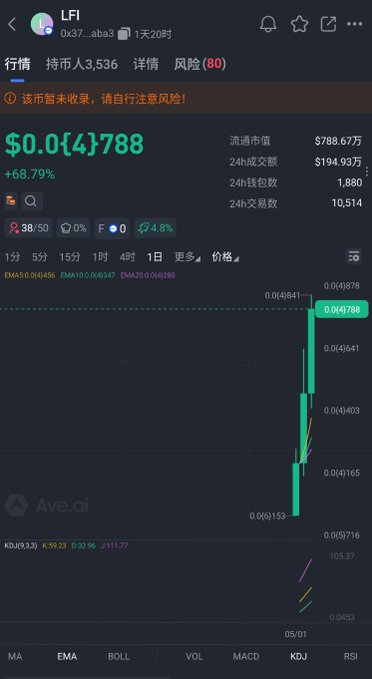
$LFI is still surging. Saw Sister Yueya post it and followed along with some. twitter.com/R5Z5G/status/20509...
LFI
0%
茶哥:币安Web3.0
04-06
Thread
#Thread#
A recent change in the community is quite real: more and more people aren't just joining for the airdrops, but genuinely starting to "play the game." I'm doing the same now; the first thing I do every morning is open .RealGo, clear my energy, and catch a few pets—I'm already a bit addicted. The early game is actually quite friendly. Catching pets, fighting monsters, opening treasure chests, doing daily quests—the resource cycle runs smoothly. The differences between A/B/S-tier pets are significant, and different tools have varying efficiency levels. As you play, you start figuring out how to save resources. But the real difference lies in the mid-to-late game. Once the Arena opens, the pace completely changes. It's no longer just about grinding resources; it's about team composition, skill, and judgment. Which pets to bring, how to combine them, who to attack and who not to attack—every step directly impacts win rate and rewards. Pets are no longer "collectibles," but real productivity. Strength isn't determined by rarity, but by the ability to consistently win. This is crucial. Because once wins and losses are tied to rewards, players will actively optimize their teams, invest resources, and participate in trading. The whole cycle is now running. My current feeling is simple: retain players early, widen the gap in the mid-game through PvP, and then it depends on whether the content can be sustained. After all, in this market, no amount of talk is as convincing as a real battle. Download the app 👉 realgo.game/download @RealGoOfficial #GameFi #Meme
MEME
0%
茶哥:币安Web3.0
03-12
Thread
#Thread#
The Myth of Getting Rich Quick, Part 14: Li Lin Li Lin, founder of Crypto: The ups and downs of the industry and current dynamics. Li Lin is the co-founder and former CEO of Huobi (now HTX), and one of the key figures in the early development of cryptocurrency. His latest activities in 2026 focus on clarifying rumors and institutionalization. 🔍 Core Experience and Key Milestones Born in 1985, he holds a master's degree in automation from Tsinghua University. In May 2013, he founded Huobi.com, which quickly rose to prominence with its zero-fee strategy. Within four years, it became the number one crypto exchage in Asia and one of the top three in the world, with its daily trading volume once accounting for 20% of the global total. After domestic regulations tightened in 2017, he led Huobi to expand overseas to markets such as Singapore, Japan, and South Korea, completing its global compliance transformation. He stepped down as CEO in 2021, retaining only the position of chairman; in 2022, he sold a majority stake in Huobi Global (for approximately US$3 billion) and withdrew from core management. Currently based in Hong Kong, the company has established a family office, Avenir Capital, focusing on compliant asset management and stablecoin business. Its subsidiary, Sinohope Technology, manages over US$30 billion in assets, and its OneKey hardware wallet has a 40% global market share. 📣 In February 2026, in response to market rumors (related to institutions such as LD and Garrett Gin, and the reduction of BTC/ETH holdings), Li Lin clarified one by one in his WeChat Moments, explicitly denying participation in related fund operations, emphasizing that he has not reduced his BTC/ETH holdings and maintains a long-term holding position. According to SEC holdings data for Q3 2025, Avenir Group held $1.189 billion worth of IBIT (Bitcoin ETF), maintaining its position as the largest institutional holder of Bitcoin ETFs in Asia for five consecutive quarters, and continuing to increase its investment in the compliance sector. ⚠️ Dispute and Risk Warning In October 2025, the UK's FCA sued HTX for promoting crypto services in the UK without a license. The lawsuit also covers the early actual controller, and Li Lin still faces related legal risks. With increasingly stringent regulations in the cryptocurrency industry, both past business operations and current strategies need to be continuously adjusted within a global compliance framework. Investors and participants in related fields should be wary of policy and market volatility risks.
BTC
0.91%
茶哥:币安Web3.0
03-10
Thread
#Thread#
Myth of Getting Rich Quick 9 Xue Manzi (real name Xue Biqun, Charles Xue) Born in 1953, he is an American of Chinese descent, a well-known angel investor, and one of the founders of UTStarcom. Core identity and experience: Master of History of Sino-Foreign Relations from the Chinese Academy of Social Sciences, and Master of Arts from the University of California, Berkeley. Entrepreneurship and Investment He co-founded UTStarcom in 1991, received investment from SoftBank's Masayoshi Son, and went public on NASDAQ in 2000, with extremely high early-stage investment returns. He previously served as chairman of 8848 and China Learning Network, and invested in Autohome, Xueqiu, Huayi Baichuang, and others. He is known as the number one angel investor in China. Public and Controversy In 2011, she launched a campaign against child trafficking on Weibo, becoming a KOL with millions of followers; in the same year, she revealed that she had rectal cancer and was actively fighting the disease. In recent years, he has been active in Cambodian investment, Web3/cryptocurrency, and homestay industries. II. Recent Developments (as of March 2026) In February 2025, he denied rumors of his death, stating that he was living a normal life in Taiwan. Focus on real estate and resource investment in Sihanoukville, Cambodia, and expand overseas assets. Participate in Web3 and SocialFi related discussions and projects. Do you want me to compile a list of his classic investment cases and returns to help you quickly understand his investment style?
UT
0%
茶哥:币安Web3.0
01-13
Thread
#Thread#
Many AI projects immediately focus on models, parameters, and computing power, but @openmind_agi feels different. It doesn't focus on "what cool things AI can do," but rather a more fundamental and challenging question: when AI truly begins to act autonomously, how do we understand it, constrain it, and coexist with it? The era of multi-agent systems isn't a future vision, but a reality already unfolding. Agents will collaborate, conflict, and influence real-world assets and decisions. If there are only "results" without a process, the risks will be amplified infinitely. OpenMind invests heavily in behavioral structures, decision-making paths, and collaborative mechanisms. These are things that are difficult to hype in the short term, but are indispensable parts of systems engineering. I actually appreciate this approach more: not rushing to create narratives, not eager to prove "I'm the strongest," but first laying a solid foundation so that developers can truly use it and dare to use it. Perhaps it won't be the first to go mainstream, but if AI is to operate in the real world long-term, OpenMind's approach is likely a necessary layer. @KaitoAI @Punk9277 @MaraCakeHotSale @lowadka
茶哥:币安Web3.0
01-09
Thread
#Thread#
I truly started paying attention to Inference Labs when I noticed many people around me repeatedly tweaking the same agent. It wasn't a "try and play" approach, but rather continuous modification and iteration. @inference_labs Later, I saw data showing that the agent had been tweaked over 800,000 times since its launch. This number is quite telling—it's hard to keep up with such long-term effort on something that doesn't work well. Many AI projects compare model parameters and computing power, but Inference Labs focuses on something else: whether you dare use it for long-term decision-making. TruthTensor directly exposes the inference process, not just providing the answer, but telling you "why this is the answer." This makes a huge difference in practical use; you'll be more willing to entrust it with complex tasks rather than treating it as a one-off tool. I think they've grasped a key point: the trustworthiness of AI ultimately doesn't depend on how intelligent it is, but on whether it can be understood and traced. @KaitoAI @Punk9277 @MaraCakeHotSale @lowadka
Loading..