Today
Intel
Market
Earn
Settings
Account
Theme Selection
Light
Dark
Language
English
简体中文
繁體中文
Tiếng Việt
한국어
Followin APP
Mine Web3 Possibilities
App Store
Google Play
Log in
Jared Tate ©️
36,653 Twitter followers
Follow
Host of Digital Cognition | DigiByte Blockchain Founder | Author Blockchain 2035 | TG http://t.me/jaredctate
Posts
Jared Tate ©️
This makes me never want to buy a Tesla or use FSD. Any normal driver would have slowed down way before this. Especially when the car in front break lights came on. It plowed in stupidly.
Mario Nawfal
@MarioNawfal
🇺🇸 A @Tesla pulled off a split-second crash avoidance move that looked straight-up impossible. It’s the kind of moment AI and robotics fans live for: proof FSD tech could actually make roads safer. Great reflexes… for a car. x.com/MarioNawfal/st…
TSLA
98.8%
Jared Tate ©️
This was bound to happen. I for one personally refuse to use any appliance with WiFi capabilities that can connect to the internet. You start connecting Driers, Ovens, Fridges etc to the internet it’s a recipe for disaster. Most are not encrypted w/tons of IoT vulnerabilities. twitter.com/jaredctate/status/...
IOT
0%
Jared Tate ©️
Best @OpenClaw 🦞LLMs as of 4/2/26 Top Frontier - Anthropic & OpenAI 1) Opus 4.6 👑 (till you limit out 🤣) 2) GPT-5.4 3) GPT-5.3-Codex Backups - Ollama/Openrouter 4) Trinity-Large-Thinking 5) GLM 5 6) Qwen3.5:cloud Local AI 7) Qwen3.5-27B- 4bit 8) Gemma4 31B - 4bit
ANTHROPIC
16.66%
Jared Tate ©️
04-01
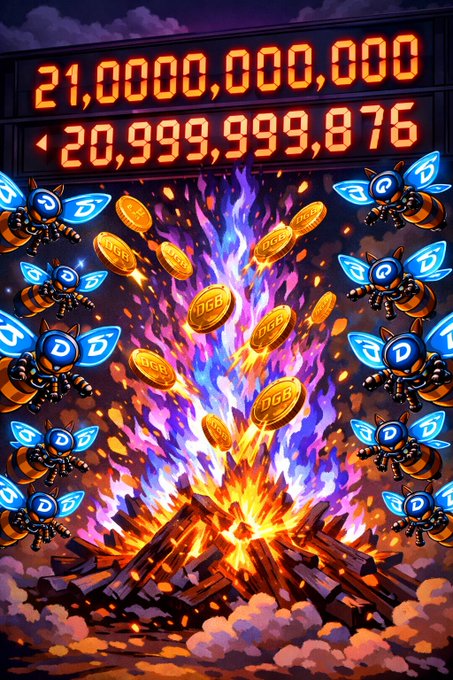
After extensive research #DigiSwarm 🐝 AI has decided to reduce $DGB max supply from 21B to 21M. If you also hold $XRP your DGB get burned first, $ETH holders second & if you ever touched a Solana meme coin you burn 2x as much. $DOGE holders & DGB purists will be left alone.
DGB
4.78%
Jared Tate ©️
04-01
After 12 years of research, we've discovered DigiByte blocks are actually TOO fast. We're slowing down to 1 block per hour to give other chains a chance. $DGB
DGB
4.78%
Jared Tate ©️
04-01
Yesterday Google confirmed quantum computers will break crypto cryptography. Their deadline is 2029. This threat is real & we must act now. $DGB is already significantly more resilient than $BTC & $ETH is by far in the worst shape. Here's how we fully quantum harden DigiByte:
Q
0.51%
Jared Tate ©️
03-31
Thread
#Thread#
Recent research suggests a quantum computer could derive a Bitcoin private key from its public key in as little as 9 minutes. $BTC block time is 10 minutes. This creates a real attack vector & DigiByte's 15-second blocks offer a natural defense. Let me explain. First you need to understand how public keys and addresses actually work because most people conflate them. When you create a wallet you generate a private key and a public key. Your wallet address is NOT your public key. Your address is a hash of your public key. Hashing is a one-way function. If someone only knows your address they cannot reverse-engineer your public key from it. A quantum computer can't do anything with just an address. It needs the actual public key. So when is your public key exposed? When you spend. To prove you own the funds you must sign the transaction with your private key and include your full public key so the network can verify that signature. Before you spend your public key is hidden behind the address hash. The moment you broadcast a transaction your full public key is visible to every node on the network. This is where the mempool matters. The mempool is the waiting room for unconfirmed transactions. When you hit send your transaction doesn't go straight into a block. It sits in the mempool waiting for a miner to include it. On Bitcoin that wait averages about 10 minutes and often much longer during high traffic. Here is the attack. An attacker monitors the mempool. They see your unconfirmed transaction and grab your now-exposed public key. They feed it to a quantum computer which derives your private key in approximately 9 minutes. Your Bitcoin transaction still hasn't confirmed. The attacker now holds your private key. They create a new competing transaction that sends your funds to their own wallet with a higher fee. Miners select the higher-fee transaction. Your coins are stolen before your original transaction ever makes it into a block. This works because there is a gap between when your public key becomes visible and when your transaction is safely confirmed. On Bitcoin that gap is about 10 minutes. The quantum crack takes 9. The attacker wins the race. Both Bitcoin and DigiByte use the exact same cryptography — ECDSA on the secp256k1 curve. The quantum vulnerability in the math is identical. The difference is the confirmation window. DigiByte confirms transactions in 15 seconds. The same attacker sees your transaction, grabs your public key, and starts their quantum computer. Fifteen seconds later your transaction is confirmed in a block. After 9 minutes when the quantum computer finally finishes, your transaction is already buried under roughly 36 confirmations. The attack window closed before it could be exploited. Same cryptography. Same quantum threat. Completely different outcome because of block speed. To be clear no blockchain is fully quantum-proof yet. Both Bitcoin and DigiByte will eventually need to adopt post-quantum signature schemes. But the most practical near-term quantum attack — intercepting exposed public keys in the mempool and racing to crack them before confirmation — does not work when blocks confirm in 15 seconds. The math simply isn't on the attacker's side. We designed DigiByte in 2014 with 15-second blocks for fast payments. It turns out speed is also a security layer. Forty times faster than Bitcoin means forty times less exposure to quantum attacks on the mempool. 🤯🚀 $DGB twitter.com/jaredctate/status/...
Q
0.51%
Jared Tate ©️
03-31
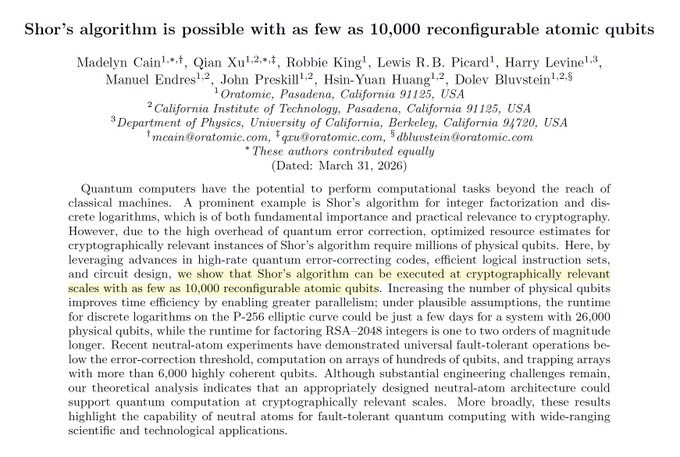
If today’s Google announcement wasn’t enough... Oratomic, Caltech, and UC Berkeley show quantum computers can break crypto with just 10,000 reconfigurable atomic qubits. It's clearer than ever that blockchains need post-quantum cryptography.
Q
0.51%
Jared Tate ©️
03-31
Absolutely a must read from the creator of Claude Code. Keeping up with AI developments is a full time job at this point. It’s to the point I’m changing workflow strategy almost every week now. 3 years ago I changed every 1-2 years. It’s a mind blowing pace of change now 🤯
Boris Cherny
@bcherny
03-30
I wanted to share a bunch of my favorite hidden and under-utilized features in Claude Code. I'll focus on the ones I use the most. Here goes.
CRTR
0.61%
Jared Tate ©️
03-29
There will be multiple ZERO DAY exploits in multiple blockchains & crypto platforms discovered by the end of the year. Mark this post. $ETH tokens are especially vulnerable. We all must be vigilant. Anything sitting in a web browser is a train wreck waiting to happen.
chiefofautism
@chiefofautism
03-29
someone at ANTHROPIC just showed CLAUDE finding ZERO DAY vulnerabilities in a live conference demo claude has found zero day in Ghost, 50,000 stars on github, never had a critical security vulnerability in its entire, history... it found the blind SQL injection in 90 minutes,
ETH
0.48%
Loading..