I typically use four EMAs to identify short-term opportunities and assess trend strength. They essentially represent the cost and defense lines of capital at different timeframes.
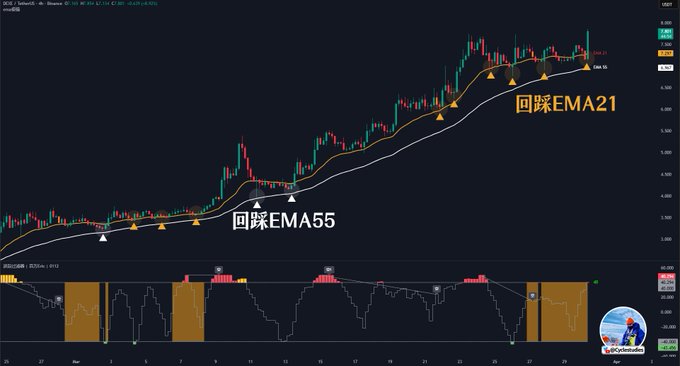
The 20 EMA is a watershed between trend strength and weakness. In a strong market, a pullback to the 20 EMA is often a good entry point; once the price breaks below it and fails to recover, it often indicates that upward momentum is starting to weaken.
The 50 and 100 EMAs act as a buffer zone between bulls and bears. Prices tend to linger here, often oscillating and choosing a direction, making them suitable for observing the strength of a structural breakout.
The 200 EMA is the final lifeline of the trend. Whether it holds largely determines the validity of the long-term structure. A sustained breach often means the original trend logic may be over.
Finally, moving averages are indeed based on price calculations and inherently have a "lagging" effect. However, this does not prevent them from being the most intuitive and objective benchmark for novice traders to understand the market.
To put it simply, it's like contour lines on your trading map, not a crystal ball predicting where the peaks and valleys are.