Today
Intel
Market
Earn
Settings
Account
Theme Selection
Light
Dark
Language
English
简体中文
繁體中文
Tiếng Việt
한국어
Followin APP
Mine Web3 Possibilities
App Store
Google Play
Log in
TraderS
2,093 Twitter followers
Follow
FlameQuant Investment Founder/ Magical Trader / 前某著名大所非著名资深老油条 / 灵魂画线师 / 肥猪流操盘手 / 基金流水线制造者 / 家办批发商 / 出海老船长 / 拉盘委员会副会长 / 金融游猎民族
Posts
TraderS
Thread
#Thread#
Just closed out the short position on Bitcoin and opened a long position on gold.
TraderS | 缺德道人
@Trader_S18
Oil prices break through 100, how much longer can gold, silver, and Bitcoin keep pretending to be hot shit on their own after their collapse? Keep shorting.
BTC
0.55%
TraderS
04-27
Thread
#Thread#
Looks like my skills still aren't up to par; I need more practice. To think they didn't even block me—such a letdown 😭 twitter.com/Trader_S18/status/...
TraderS
04-26
Thread
#Thread#
For now, Iran is temporarily safe. Trump has no intention of linking the shooting incident to Iran. But Vance might be in trouble—what does it mean when the leader hasn't left yet and you're already bolting? 🤡🐶🌚
TraderS | 缺德道人
@Trader_S18
04-26
If word gets out that the assassination of Trump was carried out by someone sympathizing with the Iranian side or opposing Israel, wouldn't that just give them another excuse to start a war? x.com/trader_s18/sta…
VANCE
0%
TraderS
04-21
Thread
#Thread#
Yesterday, I spent half the day watching the old man's passionate speech at the event, wondering how he could be so energetic. Today, while flipping through my photo album, I discovered it was the legendary "empowering love" program. I'm getting better too; I can actually stand alongside wealthy men and women! Unfortunately, my understanding is too limited; I really don't understand it.
TraderS
04-20
Thread
#Thread#
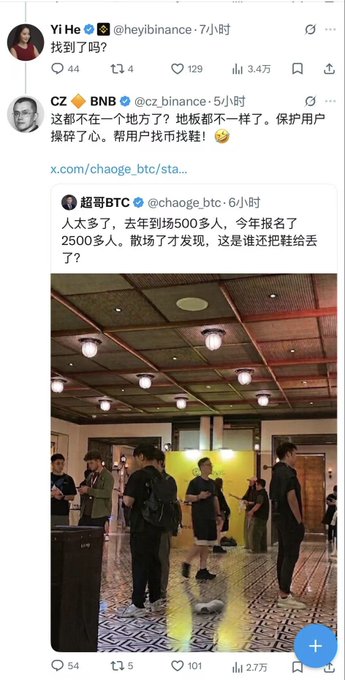
I saw everyone talking about this topic this morning but didn't pay much attention. But when I opened the picture, wait a minute, the person in the middle is me! Okay, I'll stop pretending. I picked up the shoes, and searched for ages but couldn't find the owner. Then @PhyrexNi pulled me to take a photo with @sisibinance and the masked guy, so I left the shoes where they were. Hopefully, the owner will find them. @heyibinance @cz_binance twitter.com/Trader_S18/status/...
TraderS
04-18
Thread
#Thread#
I arrived in Hong Kong a day early and was strolling around downstairs with Fengmi (@KuiGas) when we suddenly spotted an F1 race car. We initially thought it was a Red Bull event. Then, upon closer inspection, we realized Red Bull is sponsored by Gate. And then, upon even closer inspection, it turned out to be a Gate event! Gate events are so low-key; we hadn't heard anything about them beforehand, but we bumped into them on the street! 😂 @Gate_zh @Gate @Gate_luqingxiao
TraderS
04-18
Thread
#Thread#
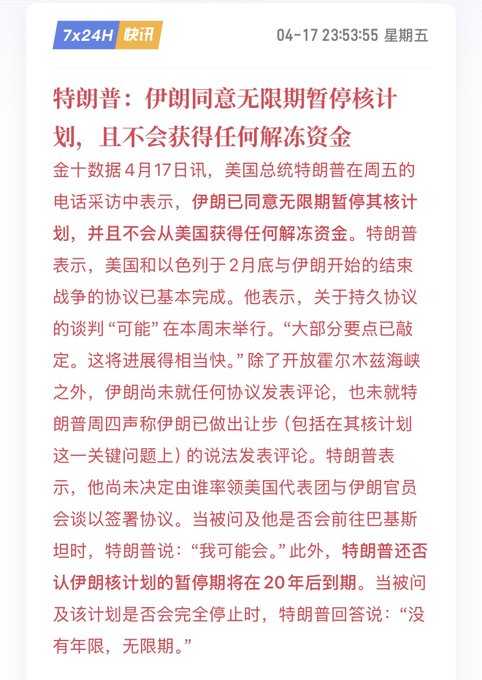
Tonight's peace came too suddenly, and the more Trump speaks, the more fake it seems. It's purely one-sided rhetoric and propaganda. Many points are clearly unrealistic and incomplete. Let's wait for Iran's response. The opening of the Strait is conditional; it only applies to the remaining time of the ceasefire agreement and requires reporting to the Revolutionary Guard according to fixed shipping routes. It's not a full opening. twitter.com/Trader_S18/status/...
TraderS
04-16
Thread
#Thread#
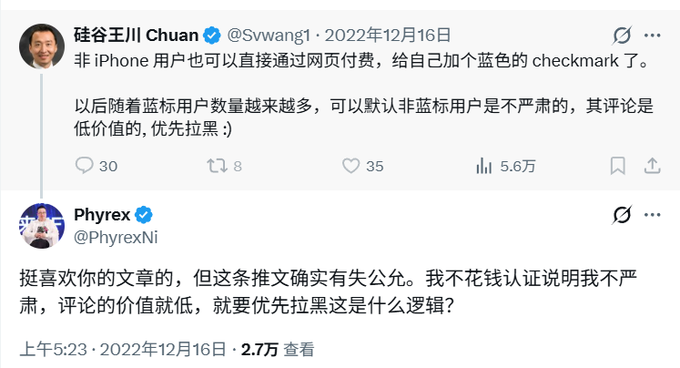
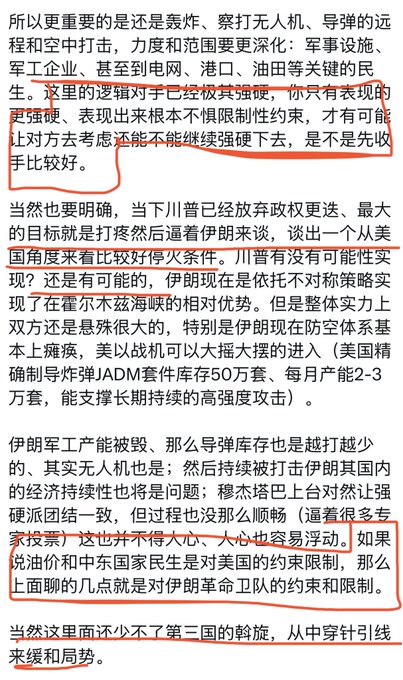
The article "Covering My Chest" is an overview of recent articles, offering valuable guidance for both the stock and cryptocurrency markets. However, this series is quite lengthy, so I've used AI to distill the "Covering My Chest Skill" for those interested. It comprises 4 core analytical skills + 3 investment decision-making skills, presented concisely and clearly: 1. Core Analytical Skill (Geopolitical Game Theory Judgment) 1.) Objectivity + Comprehensiveness All publicly available information must be collected to understand the true demands of all parties. Personal emotions/preferences must be resolutely eliminated (disliking Trump or abhorring Iran will lead to bias). 2.) Strictly Avoid Linear Extrapolation Do not make simple inferences based on "A is strong → will win quickly" or "B has a local asymmetric advantage → is invincible." Each time, specific differences must be compared (political system, constraints, cards, etc.) to avoid applying past experience (such as the Taco trade war) to new scenarios. 3.) Dynamic Perspective from Game Theory Focus on changes in the mentality and goals of both sides, rather than static comparisons of strength. Example: One side shifts from "desiring complete regime change" to "only seeking a dignified withdrawal"; the other side shifts from "remaining tough to the end" to "wanting living space." Neither side wants a protracted stalemate, which is often the basis for "conditional peace." 4.) Continuously track the dynamic evolution of strength and mentality. Pay attention to constraints (economic sustainability, regime stability, infrastructure damage, etc.). Infrastructure, industrial facilities, financial warfare, and information warfare have become the main battlefields of modern games, rather than simply seizing territory. 2. Investment Decision-Making Skills (Translating Geopolitical Judgments into Position Actions) 1.) Fundamentals are always paramount; macro/geopolitical factors are secondary. When stock prices enter a high-value range, positions can be gradually built without waiting for the macro/geopolitical situation to become fully clear. 2.) When the market has priced in the worst-case scenario, that's the opportunity. Once the situation reverses and the worst-case scenario is quickly eliminated, sentiment will quickly recover → forming a reversal trend. 3.) Identify changes in driving logic and avoid grand narratives. Markets typically have multiple driving themes, with different dominant logics at different stages (for example, during earnings season, the shortage of AI computing power might suddenly become a new driving force). Grand narratives are often linear extrapolations. In practice, the most important factors are pragmatism, understanding the transmission logic, and awareness of market psychology changes. In short, the blogger's core skill is: Analyze geopolitics using an objective, dynamic, and game-theoretic framework, avoiding emotional and linear thinking; then map the analysis results to fundamental-priority investment decisions, acting decisively when the most pessimistic expectations have been digested by the market. twitter.com/Trader_S18/status/...
TraderS
04-12
Thread
#Thread#
If Trump's threat to seize ships is actually implemented, it would be equivalent to imposing a double "security tax," "seigniorage," and "energy tax" on oil tankers that have finally managed to get through after paying Iran. In other words, challenging the dignity of American hegemony will incur a price, a kind of "passage fee." (It's even possible that Trump could actually have the US Navy collect this fee 🤣, but that's a story for another time.) The Revolutionary Guard previously established a five-tiered "friendliness" ranking system for nationalities, with lower fees for more friendly countries. China, which purchases 80% of Iran's oil, already settles accounts in RMB. Pakistan received special treatment due to its mediating role. Iran allowed 20 Pakistani ships to pass through the strait, and Pakistan even began contacting international commodity traders to inquire if they would be willing to temporarily fly under the Pakistani flag. This has become a quota-selling business. If Trump were to intercept all ships that have paid Iranian passage fees on the high seas, the Gulf oil-producing countries (Saudi Arabia, UAE, Kuwait, Qatar) would be most affected. Next would be China, India, Japan, South Korea, and Southeast Asia. Even if construction on the pipeline started immediately, it would still take at least two years. Therefore, the response to this policy is either for the country of the passing ships to step in and, instead of paying a toll, secretly transfer funds to Iran under the guise of national reconstruction aid or some other pretext to secure security and circumvent Trump's policy; or for both sides to pay simultaneously, which would be more costly; or for Iran to back down; or for Trump to TACO; or for everyone to unite and eliminate either Iran or the United States. So the most likely outcome is that all parties reach a "face-saving agreement": the Strait is declared open, the toll is renamed a "security coordination service fee" or "navigation maintenance fund," the US turns a blind eye and doesn't intercept ships in international waters, Iran receives the money but doesn't call it a "toll," and Trump posts that he has won. One victory, everyone's happy.
TraderS | 缺德道人
@Trader_S18
04-12
From Trump's posts, several pieces of information can be gleaned: previously, someone did indeed pay Iran, and Iran did lay mines. Before, paying Iran was like paying a strait passage toll, and the U.S. wouldn't interfere with the subsequent journey, allowing ships to reach their x.com/Trader_S18/sta…
Loading..